 Jens Holscher did a little video interview on economic crises with students from the Faculty of Media and Communication, which can be watched here:
Economic.mp4
/ Full archive
RKEO Calendar survey – last day
 It’s been four months since the 2017-18 RKEO calendar landed on your desk. The calendar contains all of the events that RKEO arrange, major funder call closing dates, information on various research schemes, and other activities that will be of interest to academics.
The Research & Knowledge Exchange Office would like your feedback on the calendar before deciding on whether to create next year’s.
Tell us what you think by completing our short survey . All entrants names will be entered into a draw and one lucky person will receive an RKEO goodie bag. The deadline date is TODAY – Friday, 26 January.
Research Staff Association coffee morning 31/01/18 – theme research ideas and funding
The next BU Research Staff Association coffee morning will take place on the 31st January, 10-11am in S107, Studland House, Lansdowne Campus. The focus is on developing your research ideas and where to look for funding. These coffee morning are open to all staff at BU, and we particularly welcome those on research specific contracts including PGRs.
We are delighted to welcome guest speaker Ehren Milner, Research Facilitator from the BU Research and Knowledge Exchange Office to share his knowledge and experience in this area.
We look forward to seeing you there.
BU Research Staff Association
Brexit Impact – Creative industries, tourism and digital single market
The House of Commons Digital, Culture , Media and Sport Committee has published a report on the potential impact of Brexit on the creative industries, tourism, and the digital single market – click here for the full report.
Here are excerpts from the Conclusions and Recommendations
The UK creative, tech and tourism industries need sufficient access to talent to continue as world leaders. That is self evidently in the nature of being a global centre of excellence in these areas. The then Secretary of State, Rt Hon Karen Bradley MP, said that Brexit is an opportunity to think about “how we can upskill our native workforce”, but this alone will not address the challenges that businesses face today particularly in an increasingly globalised and international sector. Brexit will place a greater urgency on developing the skills of the domestic workforce, but we cannot allow a skills gap to occur which could create shortages of essential workers for businesses in the UK as a result of our departure from the EU. (Paragraph 32)
The then Secretary of State’s assertion that analysis of the workforce must be completed on a sector–by–sector basis is a sensible approach. However, the lack of detail regarding precise numbers is problematic. There is a lack of clarity about reliance on EU workers. For instance, figures cited to us for the number of people working in tourism ranged from 3 million to 4.5 million. (Paragraph 33) It is imperative that any analysis examines regional demand for staff and the operational requirements of businesses and organisations, ranging from very small start-ups to international corporations.
Irrespective of Brexit, the Government should overhaul the existing visa system for non-EU nationals, who also make a valuable contribution to the UK economy, including our creative, technology and tourism industries. These industries rely on EU workers, and their commercial success is built on having a diverse workforce. The Government must heed warnings that SMEs across creative industries and tourism will not have the capacity to manage a new system that foists additional bureaucracy upon them. (Paragraph 52) We believe that salary levels are a crude proxy for value and fail to recognise the central role that workers from the EU and beyond play in making British businesses successful. We recommend that the Government explores ways in which commercial value, and value to specific sectors of the economy, can be factored into the UK’s post-Brexit immigration system. (Paragraph 53)
Simplicity should be a key feature of the future migration arrangements that the UK will agree with the EU. In particular, the creative industries and performing arts need a system which complements the spontaneity that defines live performance. (Paragraph 54)
The ability to utilise Creative Europe to secure additional sources of funding, combined with the freedom it gives to British organisations to lead projects with partners from across the EU (and outside the EU), means that there are clear incentives to maintain our participation. (Paragraph 67.) If the UK were to depart Creative Europe, this would represent a significant blow to the performing arts, museums, galleries, publishing and many other sectors in the creative industries. The limitations of participation experienced by other non-EU members illustrates that reaching agreement may not be straightforward but, equally, neither the UK nor EU member states will benefit from the UK’s departure. (Paragraph 68)
The Government should publish a map of all EU funding streams that support tourism and creative projects, whether dedicated to this specific purpose or not. This mapping exercise should:
– spell out where previous EU funding has, directly or indirectly, benefitted these sectors;
– indicate those streams that will need to be replaced;
– provide an overview of the total sum of funding that the UK government will provide to cover these costs; and
– clarify the role of the devolved administrations in the present arrangements and their proposed role in the future in the eyes of the UK Government.
In addition, the Treasury and DDCMS should illustrate how ‘value for money’ will be measured in any assessment of those EU funds that will be honoured by the Government’s guarantee. (Paragraph 79)
Some businesses, in the fashion and textiles sector, for instance, do see opportunities to improve trade links beyond the EU post-Brexit, and to develop strategies to support more UK-based production.(Paragraph 88)
The success of the UK’s digital economy is underpinned by ongoing data transfer across the globe and particularly within the EU. In order to preserve the UK’s policing and security arrangements, and to maintain commercial confidence, the Government must aim to deliver certainty from March 2019 onwards. (Paragraph 117) It is important to recognise that Brexit creates a potential risk that the UK’s ability to transfer data across borders will be limited.
The conclusions of the House of Lords Committee expose two key concerns.
Firstly, leaving the EU may not give the UK the flexibility to develop data protection law in the manner called for by witnesses such as Dell EMC.
Secondly, once we leave the EU, our influence over the development of the legal framework that will guide UK law will be reduced, undermining our ability to agree structures and exemptions for the UK, and diminishing our role as a world leader in data protection law. (Paragraph 119)
Brexit puts at risk the UK’s position as a world leader in developing and implementing the regulatory system for data protection. To address this concern, the Government should lay before Parliament an action plan which describes how, post-Brexit, the UK will be able to develop policy on data protection to support businesses and protect consumers, in order to keep pace with the demands of fast moving and developing technologies. (Paragraph 120)
It is very encouraging that the tourism and aviation sectors believe that existing aviation arrangements will be replicated once the UK has left the EU. Unfortunately, the then Secretary of State could provide very little detail as to the nature of the discussions, potential stumbling blocks and, crucially, the timing associated with reaching an agreement. The Government should recognise that it needs to provide certainty to an industry that is already marketing holidays for summer 2019, and for the consumers who will purchase them. (Paragraph 132) We believe reaching an early agreement in relation to aviation is a key priority for the Government. Nevertheless, the Government must provide an assurance that contingency plans are being made in the event of no deal being agreed and provide more information as to what any contingency arrangements would mean for businesses and travellers. (Paragraph 133) The development of a new system of entry to the UK for EEA visitors will be a key aspect of the UK’s relationship with the EU after Brexit. In its consideration of the implications of altering the principle of free movement, the Government must be aware of the detrimental impact this could have for the UK as a tourist destination. Businesses and organisations within the tourist industry are understandably concerned and we believe that the Government should be cautious about taking any steps which could harm the ‘welcome’ the UK provides to tourists. (Paragraph 138) Given the potential benefits to the British tourist industry, while the Government is grappling with the challenges posed by Brexit, it would be wise to design a new system also to encourage more tourism from non-EU markets. We recommend that the Government publishes an analysis of how the visa system could be developed to boost inbound tourism by visitors from beyond the EU. (Paragraph 139)
Preserving a strong, robust Intellectual Property framework is crucial for the continued success of the creative industries after Brexit. As such, the Government should clarify its position on whether EU Intellectual Property transposed into UK law (via secondary legislation or otherwise) will continue to apply after Brexit, and if not, what contingency plans the Government has in place to ensure that the current level of Intellectual Property protection remains following the UK’s departure from the EU. At the very least, the Government should commit to ensuring that the current level of Intellectual Property protections offered by EU and UK law, including those that are vital to the success of the Creative industries, will remain unchanged. (Paragraph 158.) Equally, the Government should clarify how it intends Intellectual Property enforcement to operate after the UK has left the EU. The Government should lay out its plan for cooperation with EU states after Brexit on Intellectual Enforcement Property matters, and outline what improvements, if any, it intends to make to the current enforcement framework. (Paragraph 159)
If Country of Origin rules cease to apply after Brexit then we must expect this will have an impact on the broadcasting industry within the UK. The Government must set out the steps it is taking to avoid that outcome, explaining its negotiating objectives and the timescale for such negotiation. The Government should provide an update to the Committee on progress made in securing a deal by the end of May 2018. (Paragraph 184.) The Government should also confirm as soon as possible that it intends for the United Kingdom to remain members of the European Single Market and under the terms of the current Country of Origin rules, for a transitional period after Brexit, until the end of 2020. (Paragraph 185)
The concerns of audio-visual sector, including broadcasters, producer and rights holders, over terms of the Draft Digital Single Market Directive which would affect territorial licensing are just one example as why it is crucially important that the UK needs to preserve its influence while Brexit proceeds. The Government should clearly spell out its strategy for doing so and how it proposes to embed its future participation in the widening of the digital single market in any Withdrawal Agreement. (Paragraph 191)
Opportunity to preview Her story: Tales of Poole Women Past and Present
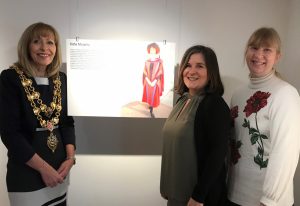
As a result of their long standing research partnership with Poole Museum, Dr Holly Crossen-White and Dr Anglea Turner-Wilson were invited to preview a new exhibition last Friday attended by the Mayor of Poole, Councillor Lindsay Wilson and Councillor Mohan Iyengar Cabinet Member for Economy, Culture and Learning and Community Engagement. The exhibition, Her story: Tales of Poole Women Past and Present was inspired by International Women’s Day and features two women associated with Bournemouth University. Firstly, Jean Tocher who served as a WREN in the Royal Naval Intelligence Section at Bletchley Park during World War II and in later life worked at Bournemouth University as a Careers Advisor. Dr Kate Murphy from the Faculty of Media and Communications is the other women to feature in the exhibition. The exhibition highlights the great achievements of women who have a local connection. Visitors to the exhibition are being asked to leave their own reflections about a woman they feel has had a significant influence upon their life.

Essential IT maintenance – Research blog unavailable from 12pm on 30th Jan
The research blog will be temporarily unavailable on Tuesday 30th January from 12pm until further notice.
This is due to an update on the server.
If you have any concerns, please contact the IT Service Desk on 01202 9(65515).
BU Briefing – Inattention, working memory and goal neglect regarding ADHD
 Our BU briefing papers are designed to make our research outputs accessible and easily digestible so that our research findings can quickly be applied – whether to society, culture, public policy, services, the environment or to improve quality of life. They have been created to highlight research findings and their potential impact within their field.
For many years Attention Deficit Hyperactivity Disorder (ADHD) was thought to be a disorder exclusive to childhood, and has only recently been recognised as existing in adults. Around 6% of adults have the classic ADHD symptom of inattention and have difficulty concentrating, remembering things and organisation.
This paper examines whether inattention may be linked with problems in the brain system which co-ordinate Working Memory (WM). WM allows you to hold information in your mind while either manipulating the information, or doing something else at the same time. It is essential to build a stable mental ‘task model’ to complete tasks at home, work or study.
Using the Conners Adult ADHD rating scale, adults aged 18–35 were assessed for ADHD symptoms and completed tasks designed to tap verbal and spatial aspects of WM.
Click here to read the briefing paper.
For more information about the research, contact Dr Emili Balaguer-Ballester at eb-ballester@bournemouth.ac.uk or Dr Ben Parris at bparris@bournemouth.ac.uk.
To find out how your research output could be turned into a BU Briefing, contact research@bournemouth.ac.uk.
Research Impact – parliament and policy
The parliamentary outreach service are running an event aimed at academic researchers who would like to engage with parliament for their research to inform policy making.
Here are the details:
Want to have an impact in the UK Parliament? Discover how your research could broaden debate and better inform our democracy
Book a place at Research, Impact and the UK Parliament at Plymouth Marjon University on Wednesday 21 March 2018 at 1.30pm.
At our 3 hour training event, you will learn:
- How to contact MPs and Members of the House of Lords from Parliament’s Outreach & Engagement Service
- How to work with Select Committees from a clerk of a House of Commons Select Committee
- How Parliament has been cited in REF 2014 impact case studies from the Parliamentary Office of Science and Technology
“This event was excellent – well organised, highly relevant, focused, all speakers strong, content highly practical” – RIUKP Attendee
Tickets cost £40 and include afternoon tea. If this fee is a barrier to your attendance, please contact us; we may make exceptions in some circumstances.
Book your place at Research, Impact and the UK Parliament now.
Cafe Scientifique – Are we spending conservation resources wisely?

Date: Tuesday 6th February
Location: Café Boscanova, 650 Christchurch Rd, Bournemouth BH1 4BP
We are ready and rearing to go for the first Café Scientifique of 2018!
We will be joined by Dr. Phillipa Gillingham, who will be discussing whether managing protected areas is a wise way of spending conservation resources.
Recent climate change has caused many species to change their distributions to try and track suitable conditions. However, borders of the areas that we are managing and protecting do not move, potentially being a waste of time and money.
What’s your opinion? Come on down to Café Boscanova on Tuesday 6th February to join the discussion. Find out more on our website.
Dr. Gillingham is currently working on the likely impacts of climate change on protected areas in the UK.
SRA academic applications – closing date this Friday
A reminder that the deadline for academic applications is Friday 26th January 2018.
Academics are invited to submit applications for this years’ SRA programme. Application deadline is 26th January 2018.
The programme is funded by the Fusion Investment Fund and the scheme continues to focus on supporting departments reach co-creation targets whilst supporting students to undertake research under the guidance of an experienced academic that is directly related to their career path and/or academic discipline. Each department has its own allocation of funding and we encourage collaboration between departments for this scheme.
The academic applications will be assessed against the following criteria which you will need to demonstrate within the application form:
- Student-centred
- Co-creation and co-production
- Fusion
- External engagement
- Impact
- Cross-Faculty
This scheme is for successful students to work for 30 hours a week for a total of four weeks in June/July 2018.
The SRA programme is coordinated via RKEO.
Academics will apply for the funding via an application form. A Faculty based panel will review all staff applications and decide which applications to continue to the student recruitment stage of the scheme. The application deadline for this round is 26th January 2018.
Approved academic applications will be advertised as SRA positions to students with student applications being received, processed and managed centrally within RKEO and distributed to the relevant academics after the closing date. Academics will be responsible for shortlisting, interviewing and providing interview feedback to their own candidates. Successful students will need to complete monthly timesheets, signed by their supervisor for payment.
These SRA vacancies will be available to taught BU students only, where SRA applicants must be able to work in the UK, be enrolled during the time of their assistantship and also hold an average grade of over 70%. Staff are permitted to have multiple SRAs.
If you have any queries, please contact Rachel Clarke, KE Adviser – sra@bournemouth.ac.uk
Placement Development Advisor Vianna Renaud selected as judge for the 2018 National Undergraduate Employability Awards
 Serving as the selected ASET Trustee representative on the judging panel of the National Undergraduate Employability Awards was a great honour and amazing experience. As ASET, the UK Work Based and Placement Learning Association, has been a long time award sponsor, it was wonderful to be involved with the Awards in this way.
I was greatly impressed by the quality of the submissions. All of the shortlisted candidates showed clear initiative, innovation and dedication to undergraduate student employability. Judged on the categories of showcasing excellence, innovation and impact, and making invaluable contributions to business and industry, clear examples of creative and innovative Best Practice amongst the sector were demonstrated.
The Student Awards include: Best Placement Student, Best Intern, Best Contribution to a Small to Medium-sized Enterprise, and New Best Brand Manager.
The University Awards include: Best University Placement Service (Both Under and Over 100 Placements), Best University Careers / Employability Service, Most Improved Commitment to Employability, Outstanding Contribution to Work Experience, and Best Collaboration between a University and Employer.
The Employer Awards include: Top Undergraduate Employer, Top Medium-sized Undergraduate Scheme, Best Small to Medium-sized Employer, Best Diversity Initiative in Work Experience, Best Short-term Insight Scheme, Best Recruitment Marketing Campaign, and Best Collaboration between a University and Employer.
A true celebration of student employability, I would highly recommend everyone interested in this area to attend.
For more information on the awards, to view the Finalists and to book tickets: http://nueawards.co.uk/
For more information on ASET, the UK Work Based and Placement Learning Association: http://www.asetonline.org/
There’s no such thing as a bad metric.
 Lizzie Gadd warns against jumping on ‘bad metrics’ bandwagons without really engaging with the more complex responsible metrics agenda beneath.
An undoubted legacy of the Metric Tide report has been an increased focus on the responsible use of metrics and along with this a notion of ‘bad metrics’. Indeed, the report itself even recommended awarding an annual ‘Bad Metrics Prize’. This has never been awarded as far as I’m aware, but nominations are still open on their web pages. There has been a lot of focus on responsible metrics recently. The Forum for Responsible Metrics have done a survey of UK institutions and is reporting the findings on 8 February in London. DORA has upped its game and appointed a champion to promote their work and they seem to be regularly retweeting messages that remind us all of their take on what it means to do metrics responsibly. There are also frequent twitter conversations about the impact of metrics in the up-coming REF. In all of this I see an increasing amount of ‘bad metrics’ bandwagon-hopping. The anti-Journal Impact Factor (JIF) wagon is now full and its big sister, the “metrics are ruining science” wagon, is taking on supporters at a heady pace.
It looks to me like we have moved from a state of ignorance about metrics, to a little knowledge. Which, I hear, is a dangerous thing.
It’s not a bad thing, this increased awareness of responsible metrics; all these conversations. I’m responsible metrics’ biggest supporter and a regular slide in my slide-deck shouts ‘metrics can kill people!’. So why am I writing a blog post that claims that there is no such thing as a bad metric? Surely these things can kill people? Well, yes, but guns can also kill people, they just can’t do so unless they’re in the hands of a human. Similarly, metrics aren’t bad in and of themselves, it’s what we do with them that can make them dangerous.
In Yves Gingras’ book, “Bibliometrics and Research Evaluation” he defines the characteristics of a good indicator as follows:
- Adequacy of the indicator for the object that it measures
- Sensitivity to the intrinsic inertia of the object being measured
- Homogeneity of the dimensions of the indicator.
So, you might have an indicator such as ‘shoe size’, where folks with feet of a certain length get assigned a certain shoe size indicator. No problem there – it’s adequate (length of foot consistently maps on to shoe size); it’s sensitive to the thing it measures (foot grows, shoe size increases accordingly), and it’s homogenous (one characteristic – length, leads to one indicator – shoe size). However, in research evaluation we struggle on all of these counts. Because the thing we really want to measure, this elusive, multi-faceted “research quality” thing, doesn’t have any adequate, sensitive and homogeneous indicators. We need to measure the immeasurable. So we end up making false assumptions about the meanings of our indicators, and then make bad decisions based on those false assumptions. In all of this, it is not the metric that’s at fault, it’s us.
In my view, the JIF is the biggest scapegoat of the Responsible Metrics agenda. The JIF is just the average number of cites per paper for a journal over two years. That’s it. A simple calculation. And as an indicator of the communication effectiveness of a journal for collection development purposes (the reason it was introduced) it served us well. It’s just been misused as an indicator of the quality of individual academics and individual papers. It wasn’t designed for that. This is misuse of a metric, not a bad metric. (Although recent work has suggested that it’s not that bad an indicator for the latter anyway, but that’s not my purpose here). If the JIF is a bad metric, so is Elsevier’s CiteScore which is based on EXACTLY the same principle but uses a three-year time window not two, a slightly different set of document types and journals, and makes itself freely available.
If we’re not careful, I fear that in a hugely ironic turn, DORA and the Leiden Manifesto might themselves become bad (misused) metrics: an unreliable indicator of a commitment to the responsible use of metrics that may or may not be there in practice.
I understand why DORA trumpets the misuse of JIFs; it is rife and there are less imperfect tools for the job. But there are also other metrics that DORA doesn’t get in a flap about – like the individual h-index – which are subject to the same amount of misuse, but are actually more damaging. The individual h-index disadvantages certain demographics more than others (women, early-career researchers, anyone with non-standard career lengths); at least the JIF mis-serves everyone equally. And whilst we’re at it peer review can be an equally inadequate research evaluation tool (which, ironically, metrics have proven). So if we’re to be really fair we should be campaigning for responsible peer review with as much vigour as our calls for responsible metrics.

It looks to me like we have moved from a state of ignorance about metrics, to a little knowledge. Which, I hear, is a dangerous thing. A little knowledge can lead to a bumper sticker culture ( “I HEART DORA” anyone? “Ban the JIF”?) which could move us away from, rather than towards, the responsible use of metrics. These concepts are easy to grasp hold of, but they mask a far more complex and challenging set of research evaluation problems that lie beneath. The responsible use of metrics is about more than the avoidance of certain indicators, or signing DORA, or even developing your own bespoke Responsible Metrics policy (as I’ve said before this is certainly easier said than done).
The responsible use of metrics requires responsible scientometricians. People who understand that there is really no such thing as a bad metric, but it is very possible to misuse them. People with a deeper level of understanding about what we are trying to measure, what the systemic effects of this might be, what indicators are available, what their limitations are, where they are appropriate, how they can best triangulate them with peer review. We have good guidance on this in the form of the Leiden Manifesto, the Metric Tide and DORA. However, these are the starting points of often painful responsible metric journeys, not easy-ride bandwagons to be jumped on. If we’re not careful, I fear that in a hugely ironic turn, DORA and the Leiden Manifesto might themselves become bad (misused) metrics: an unreliable indicator of a commitment to the responsible use of metrics that may or may not be there in practice.
Let’s get off the ‘metric-shaming’ bandwagons, deepen our understanding and press on with the hard work of responsible research evaluation.

Elizabeth Gadd is the Research Policy Manager (Publications) at Loughborough University. She has a background in Libraries and Scholarly Communication research. She is the co-founder of the Lis-Bibliometrics Forum and is the ARMA Metrics Special Interest Group Champion
 Original content posted on The Bibliomagician reposted here with permission. Content is licensed under a Creative Commons Attribution 4.0 International License.
Looking for a different way to disseminate your PhD research?

Do you want to showcase your PhD? Raise the profile of your research? Be in with the chance of winning over £500 worth in prizes?
If the answer is yes to any of the above then the 3MT® might be the opportunity for you.
The 3MT® competition cultivates students’ academic, presentation, and research communication skills.
Presenting in a 3MT® competition increases capacity to effectively explain research in three minutes, in a language appropriate to a non-specialist audience.
Eligibility: Active PhD and Professional Doctorate candidates who have successfully passed their transfer milestone (including candidates whose thesis is under submission) by the date of their first presentation are eligible to participate. If your Viva Voce will take place before the date of the University final (7 June 2018) you are not eligible to enter the competition.
Eligible applicants should submit a fully completed application form, to the Research Skills and Development Officers at PGRskillsdevelopment@bournemouth.ac.uk by midnight on Monday 5 February 2018.
We look forward to receiving your application.
ERASMUS 2017: Promoting autonomy for people with dementia using ICT applications
The end of 2017 brought about the start of the second successful ERASMUS funded project for Dr Ben Hicks (psychology lecturer and member of ADRC) and Professor Wen Tang (Head of Creative Technology Department). Working alongside European partners from Slovenia (Alzheimer’s Slovenia), Greece (Aristotle University of Thessaloniki), Spain (Alzheimer’s Castellon and the University of Valencia) and Turkey (Alzheimer’s Turkey), the two year project aims to develop an e-platform that raises awareness and promotes the use of Information and Communication Technology (ICT) to enhance the autonomy of people with dementia and their care partners.
The first meeting was held in Castellon, Spain, at the Universitat Jaume 1 on the 18-19th December 2017 and was attended by Ben and Natalia Adamczewska (ADRC). Over the course of two days, the proposed research plan and outcomes of the project were discussed in more detail and tasks were assigned to each of the European partners. This included establishing an Advisory Group of people with dementia, care partners and practitioners to inform the development of the project as well as conducting a review of best practice within this field.
Although it is only early days, there was a real buzz around the meeting, as the partners discussed the project and the potential beneficial impact it could have for people living with dementia across Europe. The second meeting for the project team is planned for April/May 2018.
If you would like further information on the research please contact Ben on bhicks@bournemouth.ac.uk

REMINDER: ADRC presents NIHR Clinical Research Network (CRN) Wessex Seminar this Wednesday
You are cordially invited to this lunchtime seminar which is open to all BU staff.
Please feel free to bring your lunch.
Wednesday 24th January 2018
1 – 2 pm
B407, Bournemouth House, Lansdown Campus
The NIHR is the UK’s major funder of applied health research. The NIHR develops and supports the people who conduct and contribute to health research and equally supports the training of the next generation of health researchers. The NIHR CRN Study Support Service helps researchers set up and deliver high quality research to time and target in the NHS in England.
We are fortunate to have two Research Delivery Managers from the NIHR CRN Wessex, David Higenbottam and Alex Jones coming to BU who will be presenting a seminar about the network, funding opportunities and forthcoming strategic plan for 2018, followed by Q & A session.
Please email Michelle O’Brien (mobrien@bournemouth.ac.uk) if you are planning to attend. See you there!
Biographies
David Higenbottam
Has worked in research since 2012.
2012 – 2014 South Coast DeNDRoN Network Manager.
2014 – to date Research Delivery Manager for Divisions 2 and 4 (Division 4 includes dementia as one of its specialities).
Alex Jones
Worked for Hampshire & Isle of Wight CLRN from July 2013 – April 2014.
Division 5 Assistant Portfolio Manager then Portfolio Manager April 2014 – December 2017 (Division 5 includes ageing as one of its specialities).
Currently Acting Research Delivery Manager for Division 5.
Wessex CRN
The Wessex CRN was formed in April 2014, its geographic footprint is Hampshire & Isle of Wight, Dorset and South Wiltshire. It comprises 12 partner NHS organisations and 10 clinical commissioning groups. Research specialities are spread across 6 Divisions.
SPSS Training in early 2018 – Book now to secure your place

At the core of all quantitative research at BU are skills with mathematics and statistics.
In these introductory two-day workshops, we will learn the fundamental concepts of statistics and quantitative analysis with the help of SPSS. This is a hands-on programme with statistical analysis designed to help you make the most of the SPSS application to aid your own research and facilitate support of student researchers. You will not need any previous experience with SPSS or statistics.
The RKEO ‘Statistical Analysis with SPSS’ two-day programmes are aimed at faculty staff who would like to learn more about quantitative statistical analysis for their own research purposes or are supervising students undertaking a quantitative research project.
The introductory 2-day programme is designed to assist faculty staff who have no prior knowledge of quantitative statistics and do not have experience with a statistical application like SPSS, or who do not routinely work with this type of data.
Depending on attendees prior experience, planned content includes the following:
- Introduction to SPSS and statistical analysis.
- Managing and manipulating data in SPSS.
- Introducing null hypothesis significance testing and p-values.
- Normality testing.
- T-test analysis.
- ANOVAs
- Correlation and Regression (time allowing)
The course comprises two sessions:
- A two day beginner session – 12th and 13th February 2018
- A two day intermediate session – 23rd and 24th April 2018
Please book onto the session which is most appropriate for your needs or both. If you are unsure of which route is best for you, please contact the session facilitator, whose details are given on the internal booking information page.
Each session is limited to 20 attendees but there will be a reserve list maintained so that demand for future sessions can be demonstrated.
These sessions are for BU academics and researchers only.
Students who are studying for a PhD/MRes should not use these workshops, but rather book places on the dedicated PhD quantitative analysis and SPSS workshops via the Doctoral College Researcher Development Programme.
HE policy update for the w/e 19th January 2018
A quieter week policy-wise following the cabinet reshuffle.
New minister – new set of priorities?
Our new minister has been fairly quiet as he settles in and thinks about the many priorities – we expect that the PM wants him to focus on the “major review” – and despite pressure he has refused to get drawn into a discussion of details. He gave a formal response to a parliamentary question earlier this week:
Q – Wes Streeting (Labour): To ask the Secretary of State for Education, if he will publish the (a) scope, (b) timetable and (c) membership the review panel for the review of university funding and student financing announced by the Prime Minister in her speech to the Conservative Party Conference in October 2017.
A – Sam Gyimah (Conservative, new Universities Minister):
As stated in the Industrial Strategy white paper published on 27 November 2017, the government is committed to conducting a major review of funding across tertiary education to ensure a joined-up system that works for everyone.
As current and significant reforms move into implementation, this review will look at how we can ensure that the education system for those aged 18 years and over is:
- accessible to all;
- supported by a funding system that provides value for money and works for both students and taxpayers;
- incentivises choice and competition across the sector;
- and encourages the development of the skills that we need as a country.
The government will set out further details on the review in due course.
And the minister spoke at Queen Mary University of London this week in a date agreed while he was still at the Ministry of Justice – clearly the subject matter had moved on given his new appointment. The discussion was covered by Wonkhe – it seems to have been a balanced and reasonable set of responses from someone who is thinking carefully before leaping into the fray.
Of course there has been plenty of advice for the new minister – from calls for him to get stuck into Brexit discussions to defend research funding, mobility etc. (he did vote remain, after all), to questions about the freedom of speech agenda and BME students at Oxbridge (he was one).
UKRI
John Kingman has been named as the permanent chair of UK Research and Innovation, officially taking the role in April. He has been acting as the interim chair to date to support the shadow running and new set up of the organisation. The Commons Science and Technology Committee are required to ratify his appointment. Also reported in Times Higher.
Freedom of speech
The debate over free speech continued in the Parliamentary Joint Human Rights Committee this week. NUS VP Doku has called for the number of events with freedom of speech issues to be published to quantify if the ‘issue’ is government rhetoric or genuinely needs tackling. Wes Streeting (MP Ilford North and former NUS President) claims the challenges are “overstated” and that Prevent has had the greatest impact on freedom of speech. He continued that no platforming, under NUS policy, was only used to prevent racism and fascism.
International Students
The Home Affairs Committee published Immigration policy: basis for building consensus calling on the Government to make it a clear and stated objective of public policy to build greater consensus and trust on immigration as part of major overhaul of immigration policy making. Read the short summary. The report does not consider specific policy options for EU migration. The Committee will examine these once the Government publishes its forthcoming White Paper on immigration.
Chair of the Home Affairs Committee, Rt Hon Yvette Cooper MP commented:
- “The Government has a responsibility to build consensus and confidence on immigration rather than allowing this to be a divisive debate. But that requires a transformation in the way that immigration policy is made as too often the current approach has undermined trust in the system.
- The net migration target isn’t working to build confidence and it treats all migration as the same. That’s why it should be replaced by a different framework of targets and controls. And frankly the system needs to work effectively. As long as there are so many errors and so many problems with enforcement, people won’t have confidence that the system is either fair or robust.”
The Report recommends:
- An Annual Migration Report setting out a three-year, rolling plan for migration.
- Clearer and simpler immigration rules, underpinned by principles and values – including the contributory principle, supporting family life and safeguarding security
- Replacing the net migration target with an evidence-based framework for different types of immigration that takes into account the UK’s needs. There should be no national target to restrict the numbers of students coming to the UK, and at a minimum the Government should immediately remove students from the current net migration target.
- An immigration system which treats different skills differently. There is clear public support for the continued arrival of high-skilled (not just highly paid) workers who are needed in the economy. Immigration rules should allow UK businesses and organisations easily to attract top talent, with restrictions and controls focused more on low-skilled migration.
- Immigration plans should be linked with training plans to increase domestic skills in sectors and regions where there are skills gaps that need to be filled through migration.
- A national integration strategy and local authority led local integration strategies
The report also notes:
- “In calling for more international students to come and study in the UK, universities must be mindful of local impacts of large numbers of students and work with local authorities to help manage pressures on housing and public services. Universities should be expected to consult local authorities on future student numbers in their area.”
Mayoral pressure
The Financial Times ran an article noting how seven cross-party metro mayors have united to press the Prime Minster to provide a ”more open and welcoming message” to overseas students. The mayors have also written to the Migration Advisory Committee. The FT quotes the letter:
- “As the UK prepares to leave the EU, it is important that any future immigration system acknowledges the vital contribution international students make to regional jobs and growth. This includes projecting a more open and welcoming message for international students.”
The letter combines last week’s HEPI report showing the huge net financial benefits international students bring with HESA data illustrating a downturn in international student numbers. The FT critiques the letter which uses 2016/17 data stating most students would have applied for their courses before the Brexit result was not known. What the FT fails to consider is that a lower conversion rate between application and enrolment does support the premise that Brexit has caused a fall in student numbers.
The Migration Advisory Committee is due to report to Government in September 2018, however, think tank HEPI is campaigning for an earlier response.
Widening Participation
Grammar Schools- A Financial Times article More grammar schools and lower tuition fees are not the answer covers the cabinet reshuffle (the widely reported demise of Justine Greening for blocking the PM’s school agenda) and draws on Education Policy Institute research:
- On grammar schools, EPI analysis is very clear — more selective schools might deliver a small exam grade benefit to those who gain entry, but at a cost to those (poorer) children who do not pass the entry test. More grammar schools are therefore likely to worsen the country’s social mobility problem.
Meanwhile A Guardian article aiming to criticise Damian Hinds suggests that Theresa May is still determined to push grammar schools through
BME withdrawal – The Guardian considers the influence of social cultural and structural factors in Why do black students quit university more often than their white peers? The article quotes the Runnymede Trust (think tank) 2015 report: “University institutions have proved remarkably resilient to change in terms of curriculum, culture and staffing, remaining for the most part ‘ivory towers’ − with the emphasis on ‘ivory’.”
Admissions – In Robin hood and the America dream a Dorset born educator and careers advisor compares the HE admissions differences between Finland, America and the UK, and contemplates their social mobility implications.
STEM
A National Audit Office report: Delivering STEM skills for the economy has been published this week. It suggests Government initiative to improve the quality of STEM provision and take up of these subjects and rectifying the skills mismatch has met with some success. However, it pushes for Government departments to create a joined up vision sharing their aims, and a co-ordinated cross departmental plan, the delivery of which can then be examined for value for money. The report notes that the STEM gender gap continues.
Technical education
The House of Lords Economic Affairs Committee continued its examination of the economics of higher, further and technical education across two sessions. The first session considered the differences between UK education provision and comparable economically advanced countries (e.g. Germany). The panel discussed how FE could be enhanced, which countries integrated FE and HE effectively, and methods of encouraging lifelong learning. The narrowing of subjects after GCSE was also criticised. The following session address whether HE was currently prioritised over technical education, and whether this produces individuals with the necessary skills. Apprenticeships and T-levels were discussed in detail.
Enterprise and Entrepreneurship
The QAA has published Enterprise and Entrepreneurship Education: Guidance for UK HE Providers. The guidance says
- “all students should have an opportunity to engage with Enterprise and Entrepreneurship, and to align it with their subject(s) of choice. This will enable them to identify and seek out new opportunities; have higher aspirations in their careers; be resilient; and better adapt to change”.
- “Learning about and experiencing Enterprise and Entrepreneurship while at university can have several benefits. It gives students alternative perspectives on their career options and ultimately, the confidence to set up their own business or social enterprise.”
The guidance aims to inform, enhance and promote the development of Enterprise and Entrepreneurship Education and includes description of good practice.
Consultations
Click here to view the updated consultation tracker. Email us on policy@bournemouth.ac.uk if you’d like to contribute to any of the current consultations.
Other news
Full on: In the brave new world of accelerated degrees and intensified courses a Wonkhe blogger talks about working and studying (MSc) full time. She says universities can make studying more accessible to employees and employers by:
- Teach modules in intensive blocks, e.g. 3 days, rather than spreading across a whole term
- Provide assignment information well in advance of deadlines, ensuring no deadline clashes between other modules on the same programme
- Sharing reading lists, presentations and essay topics well in advance of a module beginning – so the employed student can start reading and have an overall understanding of the subject area before attending lectures.
- Careful structuring of the courses are important, as is the option to switch to part time study
- Access to robust pastoral care and academic check ins
On the employer side the blogger notes that planning a balanced workload with her managers and knowing when key work deadlines fall within her academic calendar. She also recommends employers take a personalised approach to their employees study/work balance. For some this could me changing their hours or work pattern for all or part of their course.
- “Studying is challenging. Working is challenging. Doing both at the same time certainly isn’t a walk in the park. However, employers and universities can help employed students to make it work.”
The Smart Machine Age: A Financial Times article describes the changes associated with the smart machines age and the skills graduates will need to develop.
- Smart technology is already moving beyond manufacturing into the service industries and the professions, such as medicine, finance, accounting, management consulting and law. Businesses will reduce their headcount, because humans will only be needed for jobs that technology will not be able to do well: involving higher order critical, creative, and innovative thinking and/or emotional and social intelligence.
- When they graduate, a student’s multidisciplinary skills should contain at least the following: scientific method; root cause analysis; unpacking assumptions; critical thinking purposes and questions; insight processes; design thinking; premortems; and after-action reviews .They ought to have emotional and social intelligence; the ability to collaborate and to know how to learn and develop their cognitive and emotional capabilities.
Graduate Recruitment: High Fliers have published The Graduate Market in 2018 noting a 4.9% decrease in the number of jobs available for 2017 graduates. They state this is the first drop in 5 years. The decrease was sharpest in the financial and banking sectors. Part of the blame was, of course, attributed to Brexit effects. Press coverage: The Times, The Guardian and The Telegraph (who note supermarket Aldi is now offering graduate salaries comparable with law and investment banking starter salaries).
Political inventions: It cannot be disputed how often HE has featured in the news in the last year. A Times Higher article reports on a (PA Consulting) Vice-Chancellor survey which reality checks the press, suggesting that some of the furore was politically motivated and often without genuine substance.
Woodgates, PA’s head of education, sums up that university leaders felt under siege.
- “Before the [2017 general] election, universities were still seen as one of the jewels in the crown of UK plc, and suddenly we seem to have moved to a world where nothing is different but the political narrative is that universities are a bit of a problem: they don’t provide value for money, their teaching quality is not very good, and vice-chancellors are overpaid.
- Most of our respondents felt that this is fundamentally politically driven by the fact that Labour did well courting the youth vote and the Tories have responded to that, but there was also a feeling that the sector hasn’t done a very good job of responding to that and needs to be more proactive.
- The sector has got locked into a position of responding to a political narrative rather than asserting their own narrative about the value they add: in relation to research, but also in relation in education, [and] the fact that they are very important players in social and economic development.”
What students want: The Guardian ask students what they would like the Office for Students to focus upon
Antisemitism on campus: Communities Secretary Sajid Javid announces £144,261 of funding for a new programme to support universities in tackling antisemitism on campus. The programme will be delivered by the Holocaust Educational Trust and the Union of Jewish Students and will involve 200 students and university leaders from across the country visiting the former Nazi concentration camps at Auschwitz-Birkenau. It is expected that the 200 university student leaders who visit Auschwitz-Birkenau will then go on to deliver activity that engages a further 7,500 university students.
Communities Secretary Sajid Javid said:
- “We all have a duty to speak out in the memory of those who were murdered during the Holocaust and all those, today, who are the subject of hatred and antisemitism. Holocaust education remains one of the most powerful tools we have to fight bigotry. The Holocaust Educational Trust has been hugely successful in teaching school children about where hatred, intolerance and misinformation can lead. That’s why I am proud that the government will fund this new programme to tackle antisemitism, prejudice and intolerance on university campuses.”
Josh Holt, President of the Union of Jewish Students (UJS) said:
- “ UJS are very grateful that our partnership with HET is being recognised and supported by the Ministry of Housing, Communities and Local Government. The resources committed today will enable a substantial expansion of student and university leaders receiving the education and training needed to combat antisemitism and prejudice on campus. Sadly we have seen a distressing increase in swastika graffiti, Holocaust denial literature and politicisation of the Holocaust on some UK campuses. We are determined to combat this and welcome this significant contribution to our longstanding work bringing students of all faiths and backgrounds together to create cohesive campus communities.”
The new programme will be jointly funded by the Ministry for Housing, Communities and Local Government and the Department for Education, building on the Holocaust Educational Trust’s highly successful ‘Lessons from Auschwitz’ programme for school students.
Subscribe!
To subscribe to the weekly policy update simply email policy@bournemouth.ac.uk
JANE FORSTER | SARAH CARTER
Policy Advisor Policy & Public Affairs Officer
Follow: @PolicyBU on Twitter | policy@bournemouth.ac.uk
RKEO Calendar survey reminder
 It’s been four months since the 2017-18 RKEO calendar landed on your desk. The calendar contains all of the events that RKEO arrange, major funder call closing dates, information on various research schemes, and other activities that will be of interest to academics.
The Research & Knowledge Exchange Office would like your feedback on the calendar before deciding on whether to create next year’s.
Tell us what you think by completing our short survey . All entrants names will be entered into a draw and one lucky person will receive an RKEO goodie bag. The deadline date is Friday 26 January.
BU staff can login below:
Other services







Recent posts
BU research Funding opportunities EU
 International Open Access Week: open access and the REF
- International Open Access Week: BU support for open access
 Food Price Research Shortlisted for Civil Service Prize
- It’s International Open Access week
 3C Event: Research Culture, Community & Connections – Wednesday 11 November 3-4pm
 ECR Opportunities: New Development Programme, Researcher Grants & Upcoming Events
 Horizon Europe Cluster 3 (Civil Security for Society) 2026 Calls Now Open
 MSCA Doctoral Networks 2026 Call Information Webinar
 ESRC Festival of Social Science 2026: Application Deadline Extended to Thursday 25 June 2026
- Apply now to take part in the 2026 ESRC Festival of Social Science
 Reminder: Register for the ESRC Festival of Social Science 2026 Information Session
 ECR Funding Open Call: Research Culture & Community Grant – Apply now
- MSCA Postdoctoral Fellowships 2025 Call
 ERC Advanced Grant 2025 Webinar
- European Migration Research and Impact – Invitation to a Roundtable Discussion
- MSCA Postdoctoral Fellowships 2025
 Update on UKRO services
 European research project exploring use of ‘virtual twins’ to better manage metabolic associated fatty liver disease
 Research Information Network
- Physical Sciences Case studies: information use and discovery
- Information handling in collaborative research: an exploration of five case studies
- Information literacy monitoring and evaluation
- Data centres: their use, value and impact
- Heading for the open road: costs and benefits of transitions in scholarly communications