/ Full archive

Retaining Special Constables…Myth v Reality!

Hard at Work...Analysing Interview Data!

Hard at Work…Mapping Interview Data!

Dr Lois Farquharson is working on an exciting research project for Dorset Police and Devon & Cornwall Police which focuses on the lived experience of Special Constables and its impact on retention.  This research is being undertaken jointly with Dr Iain Britton and Dr Matt Callender from The Institute for Public Safety, Crime and Justice (IPSCJ) at University of Northampton.  We are also delighted to have a BU MBA student, Steven Kueberuwa, involved in the project.

Key areas which the project delves into in detail are:

  • Motivations and expectations when joining the force
  • Recruitment and training
  • Knowledge translation, development and pathways to independence
  • Worklife balance and impacts on ‘being’ a Special Constable
  • Relationships, support and morale
  • Organisational culture and environment
  • Job satisfaction and future intentions

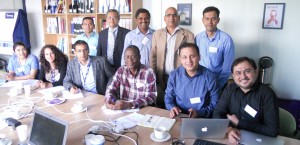
Individual in-depth interviews have taken place with Special Constables across both constabularies from May through July.  Today was our first workshop focusing on mapping the data – intense, but very enjoyable – watch this space for more info on findings and outputs in due course.

The Graduate School visits Liverpool

On the2016-07-04-PHOTO-00000001 4th and 5th of July, three members of the Graduate School attended the annual UK Council for Graduate Education (UKCGE)  Conference in Liverpool. Dr Julia Taylor presented a co-authored paper on the ‘Development of a New Model for Doctoral Supervisory Training at Bournemouth University’. The Conference attracted delegates from more than 75 Higher Education Institutes from across the UK. The presentation was delivered in the prestigious Council Chamber of Liverpool Town Hall and generated an interesting discussion around BU’s innovative approach to supervisory training and how other higher education institutes can implement similar methods.


Non-Invasive Prenatal Testing: The Challenges for Public Health, Law & Ethics

A one-day Workshop on 20 July 2016, hosted by the Centre for Conflict, Rule of Law and Society at Bournemouth University and exploring recent developments in prenatal screening and the resulting challenges for public health, the law and ethics.

Aims of the Workshop:
The UK already operates a fairly comprehensive prenatal screening programme. The discovery of cell-free fetal DNA in maternal blood has made it possible to undertake additional, accurate and reliable tests that present minimal risk to mother and the developing fetus. The UK RAPID evaluation study1 has recently reported on the contingent use of non-invasive prenatal testing (NIPT) for Down’s syndrome and the UK National Screening Committee (UKNSC) will shortly have to make a decision about the public provision of these tests within the NHS.
This event will draw upon contributions from speakers from a wide range of disciplines and will explore a variety of medical, social, ethical and legal perspectives. The aim of the day will be to identify benefits, challenges and possible outcomes for this new technology.
We are pleased to announce that the workshop will be chaired by Professor Roger Brownsword of Kings College London & Bournemouth University. Contributors will include speakers from UKNSC and the Nuffield Council on Bioethics.

Date : 20th of July 2016

Location: Bournemouth University, Executive Business Centre (7th Floor, EB708), 89 Holdenhurst Road, Bournemouth, BH8 8EB

More information can be found here. 

Lunchtime Seminar: CBT for MS Fatigue – from individual to technology-based interventions – 29th July 2016

bucru identity


Dr Kirsten Van Kessel a clinical psychologist from the Auckland University of Technology, New Zealand is visiting Bournemouth University Clinical Research Unit as part of study leave

You are cordially invited to a lunchtime research seminar she is presenting which is open to all students and staff. (Please feel free to bring your lunch).

“Cognitive Behaviour Therapy for Multiple Sclerosis Fatigue: from individual to technology-based interventions”

by Dr Kirsten van Kessel

Friday 29 July 2016

13.00 – 13.50pm

Create Lecture Theatre, Fusion Building, Talbot Campus

Abstract:

There have been promising findings of cognitive behavioural therapy (CBT) approaches delivered by health professionals for the management of Multiple Sclerosis fatigue, including one-on-one and group based delivered CBT. However, such health professional delivered interventions for fatigue management can be impractical due to a shortage of trained therapists, limited access to rehabilitation and funding constraints. As such, exploring and evaluating alternative delivery mechanisms for CBT is an important area in clinical intervention research. This presentation will focus on how evidence based individual and group delivered CBT protocols have been used to develop technology based interventions for Multiple Sclerosis fatigue.

Presenter:

Dr Kirsten van Kessel is a Clinical Psychologist and Senior Lecturer in the Department of Psychology at the Auckland University of Technology in New Zealand.  She has particular interest and expertise in CBT and its application to mental and physical health problems. Her doctoral thesis was a randomised controlled trial assessing the efficacy of CBT for people with multiple sclerosis fatigue. Current research interests include evaluating CBT for psychological and/or physical health issues, as well as the development and evaluation of eHealth interventions.

Seminar: Blog Writing to Build Bigger Audiences with Kip Jones

WED 20 JULY 11 am – 12:30 pm venue TBA

Please mark your diaries and do let Kip know via email if you are planning to attend and to receive details about what to bring with you. Staff and students welcome!

A recent two-day workshop, ‘Creative Writing for Academics’ was a big success. The Blog Seminar will be based on some of that material.

Much of what is becoming routine in many fields, including academia, is now web-based, magazine style publications.

Jones said, “Blog writing is an important place for those academics with ‘writers block’ to start to get some experience with writing for publication. I like to talk about how blog publications can sometimes develop into full academic articles.  I think there is a particular reluctance by some to start right off by perhaps being rejected by academic journals. Writing for the web offers an opportunity for a bit of success first before going in to the deeper waters”.

Inspiration: http://blogs.bournemouth.ac.uk/research/2013/08/21/the-blogosphere-creative-solutions-to-reaching-bigger-audiences/

BOOK TODAY! Email Kip Jones at kipworld@gmail.com

Best Paper Award, Academy of Marketing Conference 2016

The Best Paper Award for the Marketing of Higher Education Track was presented to Helen O’Sullivan, Elvira Bolat and Chindu Sreedharan, for their work entitled Radicalising the Marketing of Higher Education: Learning from students-generated social media data.
Helen O’Sullivan presented their paper at The Academy of Marketing Conference 2016 in Newcastle last week.

Jo Johnson to be quizzed on Brexit

House of Lords1The House of Commons’ Science and Technology Select Committee will today (13/7/16) hold an evidence session on the implications of Brexit for science and research. Jo Johnson will be appearing before the committee alongside Professor Philip Nelson of RCUK and several senior officials from BIS. Johnson has signalled his commitment to make Brexit work for universities, and has stated that ongoing projects such as Horizon 2020 should be carrying on as normal.

You can watch the evidence session here from 9.30am onwards.

British Academy launches interdisciplinarity report

BA IDR ReportThe British Academy has today published a report examining the opportunities and barriers to interdisciplinarity, from the point of view of all research career stages and institutional levels.

Crossing paths: interdisciplinary institutions, careers, education and applications considers support for interdisciplinary research (IDR) across the UK’s research and higher education sector, with a focus on university structures, funding, and evaluation. Case studies on interdisciplinarity at the undergraduate level and on how interdisciplinary research can influence public policy are also provided.

Finding broad and deep support for IDR, Crossing paths makes recommendations to allow researchers, including those early in their career, to pursue high quality IDR alongside, or as part of, cultivating an academic home, a secure base from which to carry out IDR.

The report is based on a call for evidence as well as roundtable discussions and visits to interdisciplinary research centres at UK universities.

Professor Roger Kain FBA, VP for Higher Education and Research at the British Academy, said:

“This report tackles an important topic at a turbulent time for the UK’s higher education sector, which is being encouraged to place an even greater emphasis on IDR. The opportunities for IDR are enormous, enabling researchers to unpick some of society’s most complex challenges and bringing greater rigour to our understanding of our own disciplines. Adopting the recommendations in this report would mitigate some of the risks that currently exist to pursuing it.”

The full report is available to download at www.britishacademy.ac.uk/interdisciplinarity

Brexit and the implications for Open Access

Whilst it’s relatively early to predict what Brexit will mean for Open Access in the UK, JISC recently released a blog post outlining the main issues that will arise from the UK’s decision to leave the EU.

The blog post raises issues around the future of EU OA policy and also funding.

At the present time, it appears the main effect of Brexit will be to create greater reliance on Green OA (usually accepted, peer-reviewed versions of outputs) rather than gold paid open access owing to fluctuating financial markets and uncertainty surrounding future European funding.

Library and Learning Support have recently created a OA support video, looking at the benefits of OA and how you can make your research OA through engaging with BRIAN and BURO.

Please contact the BURO team with any queries you may have and we will be happy to help.

Don’t forget our guide Open Access and Depositing your research

£5 million boost for next generation robotics technologies

robot_in_tomorrows_world

Science Minister Jo Johnson has announced a £5 million challenge, to encourage UK companies and academics to develop robotic innovations.

The challenge will encourage UK businesses and academic institutions to work together to develop new and novel uses for robotics and autonomous systems across different industry sectors. The competition has been devised by the UK’s innovation agency, Innovate UK and the Engineering and Physical Sciences Research Council (EPSRC).

Read the news from Innovate UK here.

This competition is not yet live but is due to be launched  around the week commencing 18th July and more details on it will be available then.

Why not bookmark the Live Competition list by clicking on the link below:

https://www.gov.uk/government/collections/innovation-grants-for-business-apply-for-funding


Aerospace research and development projects – funding announced


Aircraft engines

£365m funding announced for new UK aerospace research and development projects and major partnership with Boeing to create 2,000 jobs in the UK.

Read the story in full.

To ensure the UK’s continued position at the forefront of global aerospace, a further £365m worth of aerospace R&D projects have been approved. These are jointly funded by industry and government. These are part of the work of the Aerospace Growth Partnership which will publish a new strategy at Farnborough setting out plans to maintain the UK aerospace sector’s leading position. This includes a new supply chain competitiveness charter signed by 11 major companies across the aerospace sector.

For more on the Aerospace Strategy click here.

For more information on innovation grants for business click here.

Digital Families project video

cemp_big_021c-BU ORANGE

CEMP’s project for Samsung is the subject of this video.

The Digital Families project aims to connect families with technology, enhancing digital capability in disadvantaged communities. In this video, we hear from the researchers, teachers, sponsors and families involved with this work, which is the subject of an impact case study for UoA25 at BU.

Introduction to the Research and Knowledge Exchange Development Framework

We are delighted to announce that the Research and Knowledge Exchange (RKE) development framework will launch in October 2016! launching soon pic

The RKE development framework will offer a new range of opportunities for BU academics  to develop their skills, knowledge and capabilities in relation to research and knowledge exchange.

Consultation with academic colleagues has been key to its development, to ensure that the opportunities to be made available match their needs and wishes. We have created an agile and flexible Framework which we trust will appeal to colleagues undertaking research and knowledge exchange activities across the University.

Look out for more information coming each week on the research blog.

ERC Deadlines

ercThe deadlines for the European Research Council calls are quickly approaching.

Please contact Emily Cieciura, RKEO’s Research Facilitator: EU and International if you intent to apply for:

Why not sign up for ERC email alerts so that you keep up to date with ERC news and events?


Call for Gender Experts for Horizon 2020

We have received the following  invitation to join the Database of Gender Experts for European Research and Innovation.

Dr. Ineke Klinge, Chair H2020 Advisory Group on Gender, invites GenPORT members (free to register) to join the H2020 database as gender experts.

Horizon 2020 considers gender as a cross-cutting issue and it shall be adequately integrated in research and innovation content at the level of Work Programmes and projects. Applicants to Horizon 2020 calls are encouraged to include the gender dimension in their proposals. The European Commission is continuously looking for experts with gender expertise in all areas of Horizon 2020 calls to evaluate submitted research proposals.

To find experts with relevant expertise who are willing to evaluate research proposals, the Commission uses an online database. You can register your expertise for gender, and other areas in which you wish to be considered as an expert, in this database on the Participant Portal.

It is very important that you indicate your gender expertise next to your original / main area of training and this has now become much easier than in the past. The Commission therefore encourages you to signal your gender expertise, whether you register for the first time or would like to update your expertise. In the following links you will find:

1) Criteria for gender expertise, as established by the Horizon 2020 Advisory Group on Gender, and

2) Guidance on how to signal your gender expertise in the database prepared by the Gender Sector of DG Research and Innovation.

The European Commission will greatly appreciate your cooperation in increasing the number of experts with gender expertise in its expert database.

If you are keen to know more about gender in funding and participate in this group, please register on GenPORT.

Research and Knowledge Exchange Development Framework : Pre-Award at BU

research_strategyWe have previously posted about the Research and Knowledge Exchange (RKE) Development Framework. Here, we introduce another of the pathways: that focusing on the Pre-Award process when applying for funding. Please see the previous blog posts on the Development Framework for information on the separate  pathways.

The ‘Pre-Award at BU’ pathway will provide details about the information and tools that will aid BU academics applying for funding.  Sessions will include details about ‘Searching for research funding’, ‘Getting started on applying for research funding’, understanding ‘Pre-award finances’  and ‘Intellectual property at pre-award’.  Training will also be provided as part of this pathway for those conducting Quality and Financial approvals.  More events will be added to this pathway in 2017-18 and beyond, with a focus on emerging priorties for BU.

We’ll be populating the the OD website with more information and the booking link over the coming weeks. We’ll also be providing a timetable of all events as soon as possible. In the meantime, updates will be posted on the BU research blog and the Faculty blogs.

RCUK GCRF Call for Evidence

RCUKlogoThe Government Spending Review on 25th November 2015 announced “a new £1.5 billion Global Challenges Research Fund, to ensure UK science takes the lead in addressing the problems faced by developing countries, whilst developing our ability to deliver cutting-edge research”. The Global Challenges Research Fund is a BIS initiative which operates across a number of delivery partners, including the Research Councils, National Academies and HEFCE.

The RCUK Global Challenges Research Fund (GCRF) represents the largest portion of this Fund. They have launched a call for evidence to gather your views on the high-level challenges that will form the basis of the funding calls from the GCRF Collective Fund, the information gathered will also be shared with the other delivery partners so that it may inform their own strategies. They would also like your views on the most effective ways of delivering GCRF.

They are seeking inputs from individuals and institutions across all academic disciplines, non-governmental organisation and industrial sectors both in and outside of the UK.

The results from the survey will be reviewed alongside feedback from the Town Meetings. They will share a short summary of evidence they have collected and outline how that has informed their strategy in the autumn.

This call for evidence forms part of a broader programme of strategic engagement activities taking place under the GCRF programme. They will be running focus groups later this year and opening a Call for Ideas early next year to generate priority themes within each challenge.

You can complete the survey by clicking the link below. The survey closes at 16.00 on 22 August:

http://www.smartsurvey.co.uk/s/6LOJI/

Respondents are encouraged to familiarise themselves with the following background information whilst completing the survey: