/ Full archive

Who to contact in RKEO?

RKEO has had a lot of changes over the past six months and this guide aims to explain who to contact in the new structure.

You can read more about the roles about all staff in RKEO and access a structure chart here: http://blogs.bournemouth.ac.uk/research/contact/

Support with writing your bid and identify a funder/scheme/call:

– For support with developing your ideas, horizon scanning for possible funding, building networks or advice on structure and content, you should speak with your Research Facilitator:

  • Faculty of Management – Alexandra Pekalski
  • Faculty of Media & Communication – Alexandra Pekalski
  • Faculty of Science and Technology – Jennifer Roddis
  • Faculty of Health and Social Sciences – Jennifer Roddis

– For support with EU and/or international research bids you should speak with one of our EU/international funding specialist Research Facilitators:

  • Any Faculty – Emily Cieciura and Paul Lynch


Support with submitting a bid:

– For support with costings, internal approvals, submitting your bid, recording it on RED, using Research Professional, etc. you should contact your Funding Development Officer:

  • Faculty of Management – Ehren Milner
  • Faculty of Media & Communication – Dianne Goodman
  • Faculty of Science and Technology – Kerri Jones and Alice Brown
  • Faculty of Health and Social Sciences – Jason Edwards


Support with managing your research project(s):

– For support with financial and project management of your research grant, legal and audit queries, reporting, etc. you should contact your Project Officer:

  • Faculty of Management – Philip Leahy-Harland
  • Faculty of Media & Communication – Dean Eatherton
  • Faculty of Science and Technology – Laura Zisa-Swann (Laura is due to go on maternity leave soon and will be replaced by Giles Ashton)
  • Faculty of Health and Social Sciences – Cristina Lujan Barroso

– For specialist support you should contact:

  • Outputs, publishing, open access – Pengpeng Hatch
  • Complex financial queries, budgeting, forecasting – Gary Cowen
  • Ethics, governance and research data management – Eva Papadopoulou
  • Fusion investment fund administration – Sue Townrow


Support with knowledge exchange:

For specislist support with KE activities, you should speak with:

  • Public engagement, including the Festival of Learning – Naomi Kay or Harry Gibson
  • HEIF projects and business development – Jayne Codling
  • KTPs – Rachel Clarke
  • Research communications, PR, research website – Rachel Bowen
  • Student engagement with research – Sam Squelch

“A Breath of Fresh AiR”

The Bournemouth University ARTS in Research Collaborative (AiR) held a two-day workshop in late summer to experiment with interviewing, narrative and ephemera, and arts-based representations of such approaches (reported here previously). An article available online from today in The Qualitative Report by Kip Jones entitled, “A Report on an Arts-led, Emotive Experiment in Interviewing and Storytelling” details the thinking behind this effort and the mechanisms put in place that contributed to the workshop’s success.

The paper reports on the two-day experimental workshop in arts‐led interviewing technique using ephemera to elicit life stories and then reporting narrative accounts back using creative means of presentation.

 Academics and students from across Departments at Bournemouth University told each other stories from their pasts based in objects that they presented to each other as gifts. Each partner then reported the shared story to the group using arts‐led presentation methods.

Narrative research and the qualitative interview are discussed. The conclusion is drawn that academics yearn to express the more emotive connections generated by listening to the stories of strangers.

The procedures followed for the two‐day workshop are outlined in order that other academics may also organize their own experiments in eliciting story using personal objects and retelling stories creatively.

Because the group wanted to take the impact of this experience further, AiR applied and was accepted to present the concept at the Social Research Association’s workshop ‘Creative Research Methods’ on 8 May at the British Library in London. The Collaborative is about to meet up to brainstorm ways in which to translate their experiences of the workshop into a more presentational one.

Anyone from across Departments, whether lecturer, researcher, student or faculty, is welcome to join the ARTS in Research Collaborative. Please contact Kip Jones if you are interested in joining or just want to know more about the Collaborative.

 This just in from Creative Quarter!

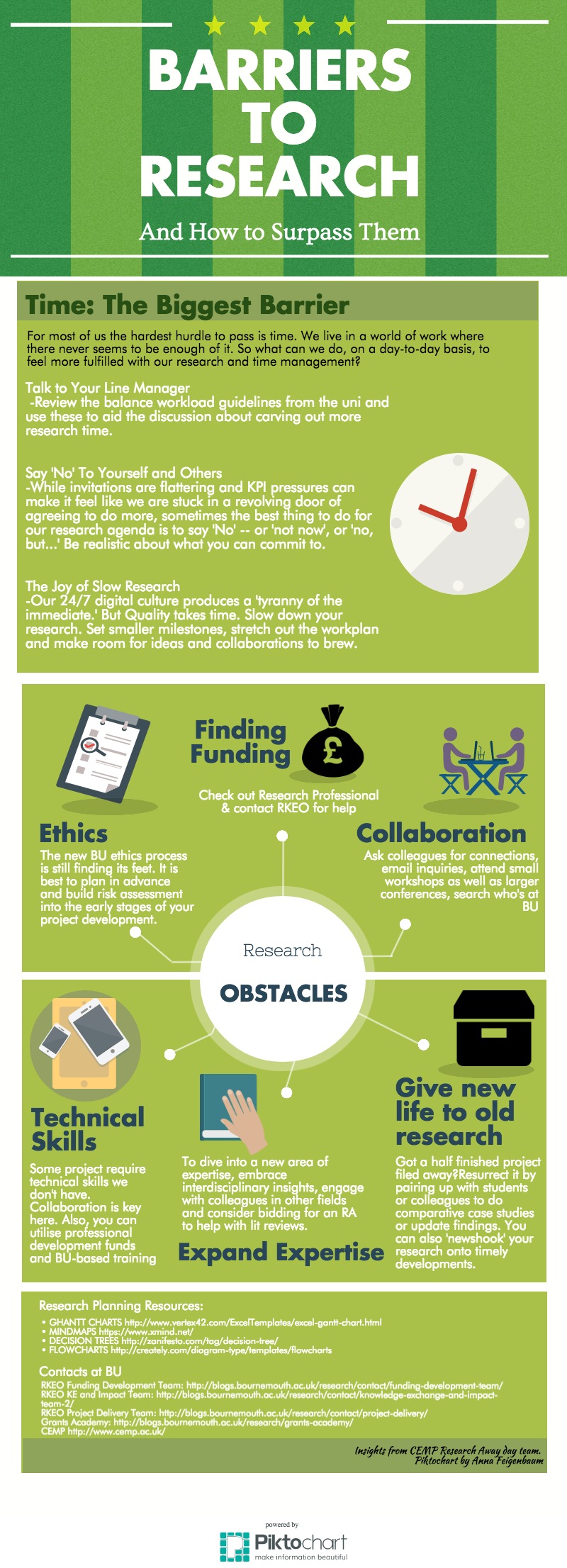
Ten ‘rules’ for being creative in producing research

£500,000 funding – Better interactions between people and machines

Investment up to £500,000 in feasibility studies in the area of user experience (UX). The aim is to encourage new and improved ways for machines, their computing systems and people to interact.

Innovate UK is to invest up to £500,000 in feasibility studies in the area of user experience (UX). The aim is to encourage new and improved ways for machines, their computing systems and people to interact. Proposals may address technologies that contribute to these new approaches, such as sensing information about the user, or they may address technologies that help with specific types of experience, such as mobile or wearable devices. Projects must be collaborative and business-led. The competition is open only to micro, small and medium-sized enterprises, with the option to collaborate with one additional SME or research organisation/academic partner. 

Small businesses could receive up to 70% of their eligible project costs and medium-sized businesses up to 60%. 

Projects are expected to last between 3 and 12 months and to have total project costs of up to £50,000. 

The feasibility studies are part of a £1.5m Innovate UK programme to stimulate innovations in user experience (UX). This competition runs in parallel with a £1m Knowledge Transfer Partnership competition. For details, visit the competition page.

 This competition opens on 16 February 2015 and the deadline for registration is noon on 25 March 2015. The deadline for applications is noon on 1 April 2015. A briefing day (with webinar option) for potential applicants will be held in London on 18 February 2015.

SW businesses can benefit from £5k of funding from Creative England

Creative England is offering creative digital businesses in the South West the chance to apply for a third round of Business Strategy and Innovation Vouchers.

The scheme provides companies with £1,000 – £5,000 to subsidise much of the cost of procuring expert third party services in order to aid growth.

Funded by the Creative Industries iNet programme through the European Regional Development Fund (ERDF) and the Regional Growth Fund (RGF), the initiative focuses strongly on digital innovation and business strategy.

The Creative England Innovation Programme helps creative companies build and sell innovative products and services more successfully. This work is delivered through structured projects – which include seed investment, mentoring, marketing, and business support, planning and strategy. These projects help companies jump over business barriers to grow more quickly and profitably.

In order to apply to this round, businesses must be based in Bristol, Bath, Dorset, Devon, Wiltshire, Somerset or Gloucestershire, and be able to provide a total equalling 30% of the requested amount in match funding.

The voucher scheme is part of a wider £314k programme of support through the Creative England Innovation Programme.

Applications for the Voucher Scheme close on February 27th, 2015. For more information please read the guidelines below. Companies can apply directly here.


Searching for innovative salt replacement and shelf life extension technologies

Strategic Allies are looking  for new solutions for food products in two specific areas:

 Salt substitution using a non-sodium ingredient.

Full (100%) salt substitution using a new innovative ingredient or process in order to achieve the same flavour and sensorial properties, without sodium (e.g. MSG would not be of interest).

Shelf life extension – improvement and maintenance of the “freshly roasted” texture and flavour.

Any process or technology innovation that maintains the texture and flavour experienced after cooking, for a period of 12 months. ​

The  client is a European manufacturer of snacks and bite-sized foods who is interested in new technologies and solutions to improve the nutritional profile and presentation of their products. The majority of the company’s products are based on roasted, fried and baked snacks.

 You can find further information regarding this search here.


North Wales Brain Injury Service – Independence in cooking tasks

This competition aims to promote independence in cooking tasks , to identify and develop innovative solutions that maximise the benefits for brain injury service users’ and benefits for public services.

On Thursday 26th February 2015 the competition will launch to seek and develop innovative solutions that will promote independence in cooking activities for North Wales Brain Injury Service users rather than current practice which involves direct one to one prompting from therapists and support workers. 

Organisations will be invited to compete for a share of a total £160,000 fund for the further development and commercialisation of innovative technologies, processes and business models.

The competition will open on 26th February 2015 and close on 20 April 2015. There will  be a formal launch event on Monday 23rd March 2015 in Wrexham.   

Once the competition is open, interested parties will be able to get further information, register their interest and book a place at the briefing event on 23rd March 2015 via the following email address;  

SBRI.NWBIS@wales.nhs.uk

 For further details click here.

Grants Academy small grants scheme launched!

RKEO are delighted to launch the Grants Academy small grants scheme! This scheme, only available to members of the Grants Academy, offers funding of up to £2000 for small or pilot studies which will lead to a submission to an external funder. It is anticipated that it will allow the collection of pilot data, but other activities will be considered. All current grants academy members are encouraged to submit an application; it is anticipated that 5 awards will be made. All projects must be completed by 31st July 2015.

The deadline for proposals is 4th March 2015. Any queries should be directed to Jennifer Roddis – jroddis@bournemouth.ac.uk . The application form and guidance can be found at I:\R&KEO\Public\GA pilot funding 2014-15. We look forward to receiving your applications…

Cloud and Weather Simulation for computer graphics

We would like to invite you to the next research seminar of the Creative Technology Research Centre.


Speaker: Leigh McLoughlin

Title: Cloud and Weather Simulation for Computer Graphics

Time: 2:00PM-3:00PM

Date: Wednesday 18th February 2015

Room: P335, Poole House, Talbot Campus


Abstract:

In this talk I will discuss my work on cloud simulation for computer graphics. This work was designed to provide a means of simulating clouds and weather features, such as rain, using desktop graphics hardware. This involves elements of meteorology, numerical weather simulation and computational fluid dynamics, taken from the sciences and adapted to meet the more artistic requirements of computer graphics in which an element of control is required and the laws of physics may be wilfully disobeyed. The result is a lightweight physically-inspired cloud simulation scheme, capable of emulating the dynamic properties of cloud formation and weather effects.

We hope to see you there.

The editor is a *!@#*!

Editors of academic journals are regularly cursed by academics worldwide.  At universities across the globe we can regularly hear expression such as “Who does the editor think he is rejecting my paper?” or “Why does it have to take six months (or more) to find out my paper is rejected?” or “Why does the editor not understand how good/novel/innovative/… our paper is?  These kinds of expression of dismay may or may not be accompanied by an expletive.  Being both busy editors and well published authors we thought timely to put pen to paper and explain the work (role and limitations) of the typical editor of an international academic journal.

First, being an editor is not all bad, and is actually a privilege. It is an opportunity to nurture new authors, be at the forefront of your discipline and it is part of being a ‘serious’ scholar. However, we have been at the receiving end of the wrath of authors dissatisfied with something we did or didn’t do as an editor AND we have been disappointed as authors with what we perceived to be, poor editorial decisions!

We wrote a short outline of the proposed paper and send it to the editor of Women and Birth.  The idea was readily accepted and resulted in a paper published this week in the scientific journal.

The paper includes little snippets of insight and advice to authors.  For example, a reminder that the average editor of an academic journalist an unpaid volunteer, usually a full-time lecturer and/or researcher with a busy day job, who does most of her editorial work on Sunday morning when the kids are still in bed or Tuesday night after the second-year marking has been completed. We hope that knowledge of the editors’ role will help authors (a) understand the submission process better; and (b) be a little bit more patience with the editors.  And, last but not least, we hope our article helps the development of editors of the future.


Jenny Hall, Vanora Hundley & Edwin van Teijlingen

CMMPH

Reference:

Hall, J., Hundley, V., van Teijlingen, E. (2015) The Journal editor: friend or foe? Women & Birth (accepted). http://www.sciencedirect.com/science/article/pii/S1871519215000104

Open Access research: BURO and benchmarking

BURO, our institutional repository, shares its content with IRUS-UK, a national aggregation service, which contains details of all content downloaded from UK participating Institutional Repositories. The aim is to provide consistent and comprehensive statistics, presenting opportunities for benchmarking at a national level. This also allows us to see where BURO sits amongst our participating peers in Jisc Band 5b.

The table below is for September 2014-January 2015 downloads for all item types in participating Jisc Band 5b institutions

The table below is for January 2015 downloads for articles in participating Jisc Band 5b institutions

The table below is for January 2015 downloads for all item types in BURO

The most downloaded peer reviewed article in January 2015 was:

Hough, B. and Spowart-Taylor, A., 2001. The Doctrine of Consideration: Dead or Alive in English Employment Contracts? Journal of Contract Law, 17 (3), pp. 193-211. = 346 downloads

Most downloaded thesis in January 2015

Franklin, I., 2009. Folkways and airwaves: oral history, community and vernacular radio. Doctorate Thesis (Doctorate). Bournemouth University. = 522 downloads

Ensuring your research is open access

Please do keep adding your full-text research outputs to BURO via BRIAN, both green and gold. To be eligible for submission to the next REF exercise all journal papers and conference proceedings will have to be made freely available in an institutional or subject repository (such as BURO) upon acceptance (subject to publisher’s embargo periods). See the blog post here on how to add outputs to BRIAN.

Any queries please contact the BURO team: BURO@bournemouth.ac.uk

Thinking about monographs in a world of open access – blog post by Professor Geoffrey Crossick

Original article is published on 22 January 2015 via – http://blog.hefce.ac.uk/2015/01/22/thinking-about-monographs-in-a-world-of-open-access/

Distinguished Professor of the Humanities, School of Advanced Study, University of London

In this post, Professor Geoffrey Crossick introduces his report on monographs and open access, outlining the key messages of the report and giving his personal take on the issues and the wider contexts. Professor Crossick is Distinguished Professor of the Humanities, School of Advanced Study, University of London and led the HEFCE Monographs and Open Access Project.
Open access to research publications has in recent years emerged as a major issue for academics, publishers and funders. Discussion and policy have, however, overwhelmingly focused on articles in journals. That is where funders, including HEFCE and RCUK, have announced mandates which require open access, and with most academic journals now published in digital format it is easier to think about making them open access.

There has been only limited discussion of how open access might apply to books, even though these are an important way in which academics in the arts, humanities and social sciences communicate their research. This classically means a monograph, but research books also include works such as scholarly editions, books of research essays by different authors, and scholarly exhibition catalogues.

I say only limited discussion, but underneath the surface there has been a great deal of paddling going on. This has meant debates about how monographs (I’ll use the term from now on to refer to all research books) might be made available on an open access basis, and a variety of initiatives to find financially and organisationally viable ways of doing so.

The Finch Report on open access focused above all on journal articles, and acknowledged that more work was needed to understand the issues with respect to monographs. HEFCE explicitly recognised this when it announced that it would not require them to be open access for the next REF.

And that is where I came in. Late in 2012 HEFCE invited me to lead some work on the implications of open access for monographs. The aim was not to come up with Finch-style policy recommendations, because the development of open access for books is at too early a stage for that. What was needed was some consultation, collecting of information and thinking with a view to producing a report that would be helpful to those interested in developing policy though not in itself setting out what policy might be.

I readily accepted the invitation. Book-centred disciplines have been part of my life as an academic (I’m a historian) and in my roles in higher education and research management. The arts, humanities, and social sciences matter to me, and I appreciate the importance of securing the future of the research book in a changing world of scholarly communication.

I put together an Expert Reference Group drawn from academics, librarians, publishers, funders and others to support me in this work. Together we set about a project that from the outset was not about open access alone, but about the whole position of the monograph today. If we didn’t understand the role of the monograph in research activity and communication, if we didn’t understand its function in the cultures of disciplines and departments, if we didn’t know what was happening to the monograph today, then we really couldn’t begin to understand what open access might mean for it.

My report to HEFCE (and to the AHRC and ESRC who supported the project) was published on 22 January. It covers a lot of ground in exploring the key issues that need to be understood by anyone wanting to think about policy in this area. It needs some 70 pages plus annexes to engage with the reality of what books mean, as well as the potential and the challenges of their moving to open access. The report, therefore, has much to say about the world of research and publication in universities.

As a humanities scholar I’m used to reporting complexity where complexity exists, as it does here. Some things are nonetheless clear. Talk of the monograph in crisis is hard to sustain – they’re being published in ever-increasing numbers, academics are writing and reading them, and libraries and individuals are buying them. That doesn’t mean that all is rosy, but it is important to see open access as an opportunity rather than as a response to a crisis.

It is essential that any future for open access monographs sustains their fundamental importance in most arts, humanities and social science disciplines. That means better technology to enable many of the material qualities of the book that go beyond words alone (the format, images, layout, references and much else) to be retained in a digital future. Though few academics told us that they enjoyed reading a whole research monograph on a screen – if they like it they buy or borrow a print edition. Printed books will not disappear.

It also means being flexible about the kind of licences required for books on open access, it means overcoming the potential high charges that owners of third-party rights (to images, texts, bars of music or dance notation) might impose, and it means finding the business models that will make it work. On this last issue there are many experiments underway and it seems to me improbable that any one of them will become dominant – the future will be one with a diversity of business models.

There is much more in the report and I really look forward to its discussion, and to see how HEFCE and others will take the issues forward. Open access carries with it great potential for larger readership and easier access, and also for new ways of engaging with and using the results of research. I was struck by the constructive approach that I found in responses from academics to the question of open access for monographs.

There were, of course, anxieties and policy needs to take these into account, but there was also real recognition of the potential. My advice to HEFCE and other policy makers is that there is much to be gained by working with the grain of academic opinion, and much to be lost by not doing so. I look forward to the debate!