
We will soon be upgrading BRIAN to bring you more enhancements and improvements to the interface and usability of the system. More details will follow soon so watch this space!
Latest research and knowledge exchange news at Bournemouth University
We will soon be upgrading BRIAN to bring you more enhancements and improvements to the interface and usability of the system. More details will follow soon so watch this space!

11-00: Coffee
11-15: Introductions and introduction to the series.
11.30 : David W Jones (University of East London): Overview of the significance of ‘the media’ and the story of ASPD
12.15 Candida Yates:(Bournemouth University) ‘I know just how he feels’ Taxi Driver, Disordered Masculinities and Popular Culture
1-00: Lunch
2.00: Alison Cronin (Bournemouth University): ASPD and the media reporting of crime.
2-45: Stefania Ciocia (Canterbury Christ): ‘Only Underdogs and psychos in this world’
3-30 – Tea
3-45: Bradley Hillier, ( South West London Forensic Service) “Breaking Bad: How dark is Walter White?”
4-30 Discussion
5-6pm Wine and canapes
VENUE: Room EB702, Bournemouth University Executive Business Centre, 89 Holdenhurst Road
Bournemouth
BH8 8EB
*If you would like to attend this event, please contact Prof. Candida Yates: cyates@bournemouth.ac.uk

03/12/2015
The Research Councils today announce that they have become members of the Jisc UK ORCID Consortium and their grants system will be ready to start capturing ORCID identifiers (ORCID iDs) in early 2016.
This news is the culmination of several years of engagement between the Research Councils and Jisc to understand how they can improve the flow of information across the higher education sector. In a joint Research Councils UK (RCUK) and JISC report published earlier this year, ORCID iD was identified as the leading standard for a researcher identifier.
By becoming a member of ORCID through the Jisc UK ORCID Consortium, the Research Councils have benefited from reduced membership as well as access to enhanced technical resource. The Consortium should accelerate adoption and provide a smoother path to ORCID integration for UK universities. By becoming a member of ORCID universities can integrate the ORCID iDs of their researchers into their own research information system which in the longer term will make the flow of information to RCUK and other funders quick and easy.
The ORCID iD gives researchers a unique digital identity which can be kept throughout their career. This allows them to keep an on-going record of their scholarly activities even if they change research organisation or leave academia. In the short-term, an ORCID iD should ensure correct assignment of research outputs by allowing them to be unambiguously linked to their creators. It also increases the chances that a researcher’s work is discoverable. In the longer term, it should bring about efficiency improvements by saving time and duplication in grant applications and enhanced reporting of research outputs to funders as well as improved analysis of outcomes.
Further information about the benefits of using ORCID are outlined in the RCUK blog. The announcement on the Jisc website can be found here.
BU has also recently joined the Jisc UK ORCID Consortium and RKEO will be looking at integrating ORCID IDs with existing systems early next year.
For information on how to obtain an ORCID ID, please see this link – http://blogs.bournemouth.ac.uk/research/2015/05/18/orcid-have-you-got-one/
Last night I received an email from an academic based in South Africa who asked me if I could facilitate a two-day writing workshop in an other sub-Saharan African country later this month. He had found a copy of our paper ‘Writing an academic paper for publication’ on the web.[1] This is, of course, a good advert for Open Access Publishing. I had the pleasure of being able to tell my African colleague that most of our published papers on various aspects of academic writing are Open Access.[1-10] Hence most are freely available to scholars like him in low-income countries. 
Unfortunately, this particular request was for a workshop later this month, which is far too short notice. Especially since my co-author and BU Visiting Faculty Prof. Padam Simkhada (Liverpool John Moores University) and I will be running a one-day writing workshop in Liverpool the day before the proposed dates of the African workshop.
Professor Edwin van Teijlingen
CMMPH
References
BURO, BU’s open access repository for research, is currently experiencing some intermittent Distributed Denial of Service (DDoS) attacks, which means that occasionally it has been temporarily unavailable to our BURO Editorial Team and external users of open access content. Please note, this does not seem to have affected the uploading files to BURO from BRIAN or the links to open access works embedded in your Staff Profile Pages. The company that host BURO have been contacted and we hope all will be resolved shortly.
If you have any concerns please report to IT Services.
The guide Open Access and Depositing your Research will help answer some of your questions about open access.
If you have any further questions about depositing your research open access please contact buro@bournemouth.ac.uk
 An item in this week’s Piirus weekly update caught my eye – Digital Identity Health-check for Academics. The short video introduces their longer guide and gives helpful hints and tips on how to increase your profile online.
Although not explicitly mentioned in this guide, do also make sure that you add all relevant publications to BURO (BU’s Institutional Repository) via BRIAN. You can find out how to do this in this blog post.
What can Piirus do for you? Piirus helps you to connect with other researchers – it’s as simple as that. Check out the guide to what they do and how you can get involved. Lets make sure that when other organisations are looking for potential partners, BU academics are there and make use of Piirus to locate your potential partners.
 As it is Open Access Week I would like to clarify one of the Open Access publishing myths. One of the common replies I receive from academics colleagues when raising Open Access publishing is that it is (too) expensive. This is, of course, true for many academic journals, but not all are expensive. Some don’t even charge a processing fee at all. Infamously, The Lancet Global Health charges an article processing fee of US $4750 upon acceptance of submitted research articles. More moderately priced scientific journals still charge anything up to about £1,500 per article.
Academic publishing has been big business for decades, and Open Access has rapidly become part of that business. While traditional book and magazine publishers struggle to stay afloat, research publishing houses have typical profit margins of nearly 40%, according CBCNEWS who quote Vincent Larivière from the University of Montreal’s School of Library & Information Science.
At the same time we see a sharp increase in so-called Predatory Publishers who have set up business for the sole reason to make money from Open Access publishing. They have not established or taken over academic journal for the greater good of the discipline or the dissemination of research findings to the widest possible audience. Unscrupulous publishers jump on the Open-Access bandwagon BU librarian Jean Harris recently shared an interesting article about Predatory Publishers (click here to read this!).
 However, there are other format of Open Access. One of our more recent papers on research ethics was published in the Nepal Journal of Epidemiology which is an online Open Access journal that does not charge authors for publishing! Also the Journal of Asian Midwives, where FHSS PhD student Preeti Mahato recently had her article accepted, is hosted in Pakistan by Aga Khan University through its institutional repository eCommons. Publishing in this Open Access online journal is also free of charge. In other words, Open Access publishing does not have to be expensive!
Prof. Edwin van Teijlingen
CMMPH
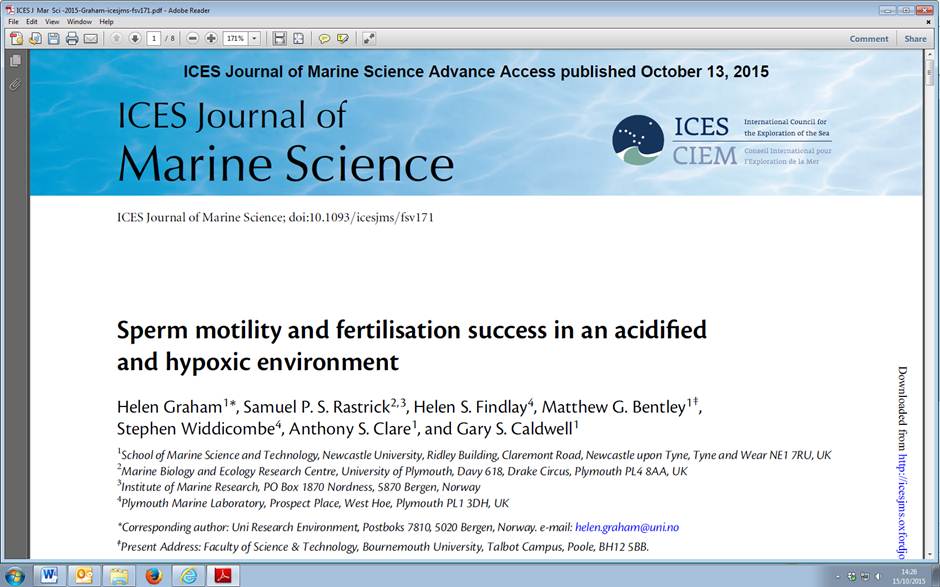
Matt Bentley’s first paper with a Bournemouth University Address was published in ICES Journal of Marine Science on 13 October 2015
To support academic colleagues in depositing their research open access the BURO Team in Library and Learning Support have produced a brand new guide – Open Access and Depositing your Research. Colleagues will find this guide particularly useful if you are…
Guidance is provided in the following key areas: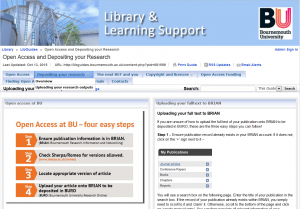
Please note: this guide is in development and more sections will soon be added. The guide will shortly appear on the deposit page in BRIAN. The BURO Team welcome any feedback.
Please note: during this short period around the Mock REF/internal review exercise increased levels of deposit mean the BURO Editorial Team may take a little longer than usual to make your research open access and respond to any queries about your outputs. In recognition of this the online nomination form provides an option to indicate that you have submitted the your full text to BURO via BRIAN even if you are unable to provide a BURO web link for each of your outputs at the time of form completion.
The first internal Research Excellence Framework (REF) preparation exercise invites academic colleagues to submit one to four outputs (published since 1 January 2014), which will be reviewed by a panel of internal expert reviewers. You can find the Individual Outputs Nomination Form here.
Where possible all nominated outputs (specifically journal articles and conference contribution with ISSN) should be made available Open Access, by uploading them to the institutional repository Bournemouth University Research Online (BURO) via BRIAN. The SHERPA RoMEO website will help you to upload the correct open access version of your work. You will need to provide the BURO web link (e.g. http://eprints.bournemouth.ac.uk/xxxxx) for each output in the nomination form.
Please note: during this short period of increased levels of deposit the BURO Editorial Team may take a little longer than usual to make your research open access and respond to any queries about your outputs. In recognition of this the online nomination form provides an option to indicate that you have submitted the your full text to BURO via BRIAN even if you are unable to provide a BURO web link for each of your outputs at the time of form completion.
Looking ahead you should aim to make your research outputs open access as an integral part of you publication process and deposit your full text within 3 months of acceptance.
For more guidance about the mock REF:
The first internal Research Excellence Framework (REF) preparation exercise is now taking place. Academic staff are invited to submit from one to four outputs (published since 1 January 2014) and these will be reviewed by a panel of internal expert reviewers.
The review exercise is open to all academic staff and if you wish to be considered for the review and have not yet nominated your outputs, please do so through this link as soon as possible:
https://bournemouth.onlinesurveys.ac.uk/mock-ref-light-touch-internal-review-individual-outputs
The nomination form will close on 19th October 2015.
Refer to this blog post for more info:

Emma Crowley from Library services will be holding a drop-in session to support academic colleagues in submitting their open access outputs to BURO via BRIAN ahead of the Mock REF submission deadline.
Please feel free to bring your digital outputs with you so they can be submitted at the session.
Dear colleagues,
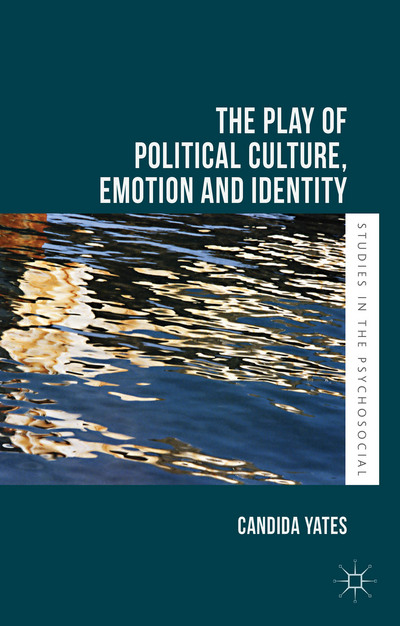
I am writing to let you know about the publication of my new book, The Play of Political Culture, Emotion and Identity.
Candida Yates, Professor of Culture and Communication, Bournemouth University
cyates@bournemouth.ac.uk
The Play of Political Culture, Emotion and Identity offers a new ‘psycho-cultural’ perspective on the psycho-dynamics of UK political culture and draws on psychoanalysis, cultural and media studies and political sociology to explore the cultural and emotional processes that shape our relationship to politics in the late modern, media age. Against a backdrop of promotional, celebrity culture and personality politics, the book uses the notion of ‘play’ as a metaphor to explore the flirtatious dynamics that are often present in the mediatised, interactive sphere of political culture and the discussion is elaborated upon by discussing different aspects of cultural and political identity, including, gender, class and nation. These themes are explored through selected case studies and examples, including the flirtation of Tony Blair, Joanna Lumley’s Gurkha campaign, Margaret Thatcher’s funeral, David Cameron’s identity as a father and the populist appeal of UKIP politician, Nigel Farage.
Table of contents
Further details can be found at Palgrave Macmillan:
http://www.palgrave.com/page/detail/the-play-of-political-culture–emotion-and-identity-candida-yates/?sf1=barcode&st1=9780230302525
Some reviews
‘Whether she is discussing the political manifestations of a contemporary crisis in masculinity and fatherhood, postmodern feminism, nostalgia, narcissism, play, or therapy culture, Yates’s psychoanalytic lens illuminates, in a nuanced fashion all too rare today, both regressive social trends toward mastery and progressive, creative potentials for change. This book is essential reading for anyone wishing to understand the complex interplay of fantasy, emotion, identity, media, and politics in the era of neoliberalism.’ – Lynne Layton, Harvard Medical School, USA
‘Exploring the entanglement of media, politics and emotions, this is a bold and original book that should be read by students and scholars in Sociology and Media Studies,and anyone with an interest in contemporary political life. It articulates a psycho-cultural perspective, moving with verve and insight from election politics to celebrity culture and from Russell Brand to poverty porn, offering a psychoanalytically informed reading of British political life and its structures of feeling. A satisfying and thought-provoking read.’ – Professor Rosalind Gill, Professor of Social and Cultural Analysis, City University London, UK
‘Through a psychoanalytic critique of the anxieties, fantasies and obsessions that characterise today’s intensely emotional political culture, Candida Yates’ new book makes a powerful case for the argument that Psychosocial Studies is the new Cultural Studies.’ – Sasha Roseneil, Professor of Sociology and Social Theory, Birkbeck, University of London, UK.
If you are new to BRIAN – Bournemouth Research Information and Networking system, there is an option for you to easily import your list of publications from a previous system onto BRIAN.
All you need is a list/ lists of your publications in either a Bibtex(.Bib) or Reference Manager/ EndNote (.RIS) format which you can easily generate from an existing publication system. It is therefore vital that you would have generated a list of all your publications either in a .Bib or .RIS format before you leave your previous institution to join BU. Please note that if you have stored previous publications in an institutional repository or subject repository, there may be an option for you to export your publications lists.
Different institutions may have adopted their current research and information system differently. Using BRIAN as an example, you can generate the file and import the file via these steps:
Step 1 :
Go to your ‘Home’ page on BRIAN, click on ‘export’ next to any publication type
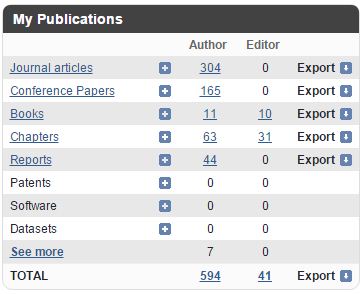
Step 2:
Choose either the ‘RIS’ option or the ‘BibTex’ option from the drop down list
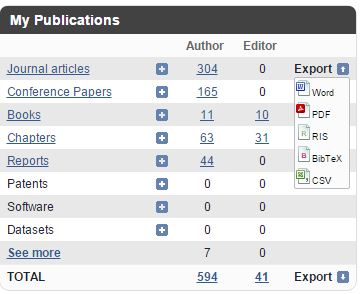
Please note that for staff who are unfortunately leaving BU, steps 1 and 2 should be followed in order to generate lists of publication which you can take along to your next institution. For staff who are new to BU, steps 1 and 2 above may not be exactly the same, depending on the current system you are using. Once you have obtained the relevant publication lists in either .Bib or .RIS file, you can then follow steps 3, 4, 5 and 6 to upload your publications. (Please check with your current research office if you are unsure about extracting your publications lists).
Step 3:
Expand the ‘Elements’ option on the left hand panel, and expand on ‘Publications’ by click on the ‘+’ sign
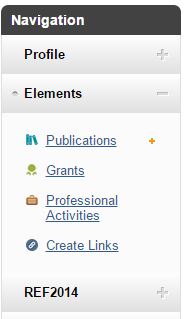
Step 4:
You will see the ‘Import’ option – click on it and you will be guided to this page
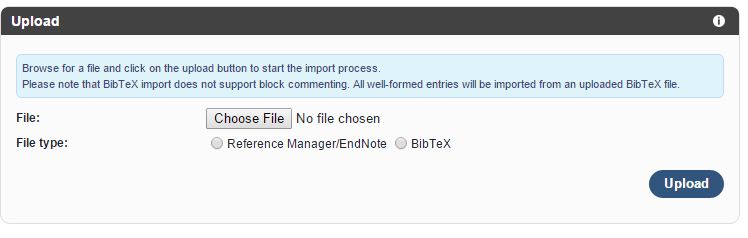
Step 5:
Locate the .Bib or .RIS file you’ve created, choose the appropriate format and click ‘Upload’
Step 6:
The system will then allow you to choose whether to import the publication, supplement existing record, or not to import as seen in the example below and please choose an option as appropriate to your situation.
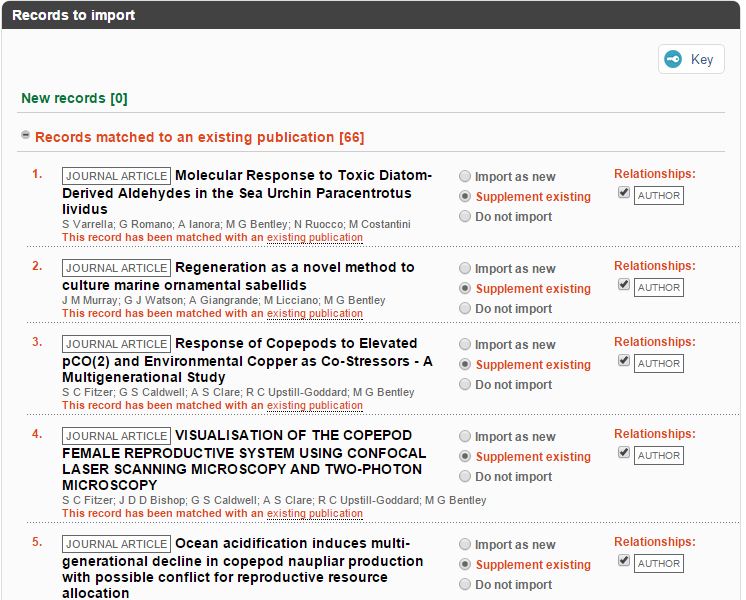
Please note that these are publications which already exist within the system, therefore it’s providing three different options. You may encounter a different set of options with new publications currently not on the system.
If you have further queries, please direct them to BRIAN@bournemouth.ac.uk.

The first mock exercise in preparation for the next Research Exercise Framework is due to take place soon. This mock REF exercise is open to ALL academic staff and staff will be invited to submit up to FOUR outputs published since 1 January 2014. This first exercise will be a ‘light touch’ review to gauge all eligible outputs and their likely contribution to the unit of assessment(s).
More information and guidance regarding this mock exercise will be provided shortly. Meanwhile, early preparations can be made by ensuring that all outputs and their full texts are deposited into BURO via BRIAN where possible. You can refer to this blog post for a quick guide to uploading your full text.
Also, please see below for your reference, the list of all Unit of Assessment Leader(s).
As mentioned above, more information and guidance will be released shortly so do watch out for it.
If you are unsure of how to upload the full text of your publication onto BRIAN to be deposited in BURO, these are the three easy steps you can follow!
Step 1 – Ensure publication record already exists in your BRIAN account. If it does not, click on the ‘+’ sign next to it –
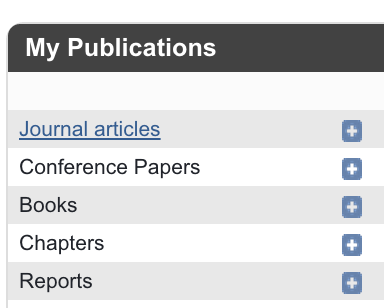
You will see a search box on the following page. Enter the title of your publication in the search box. If the record of your publication already exists within BRIAN, you simply need to scroll to it and ‘claim’ it. Otherwise, scroll to the bottom of the page and click on ‘create manual entry’. You can then populate all relevant information of your publication on the following page. Don’t forget to scroll to the bottom to ‘save’ your record!
Step 2 – Once the publication record exists within BRIAN, click on the the blue arrow up icon, and you will be taken to the deposit page

Step 3 – Locate the correct version of your full text in accordance with the policy advice from Sherpa romeo; and then click ‘upload’.
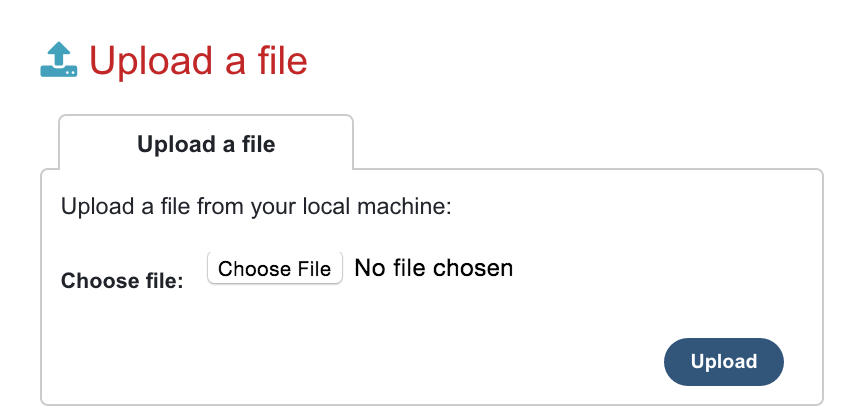
When the upload is complete, you will be notified on the screen that your full text is under review by the BURO team. Once approved by the BURO team of its legality, the link to the full text in BURO will be created and the link will also appear on your Staff Profile Page. If at any point you are unsure of this process, please send an email either to BRIAN@bournemouth.ac.uk or BURO@bournemouth.ac.uk for assistance and advice.
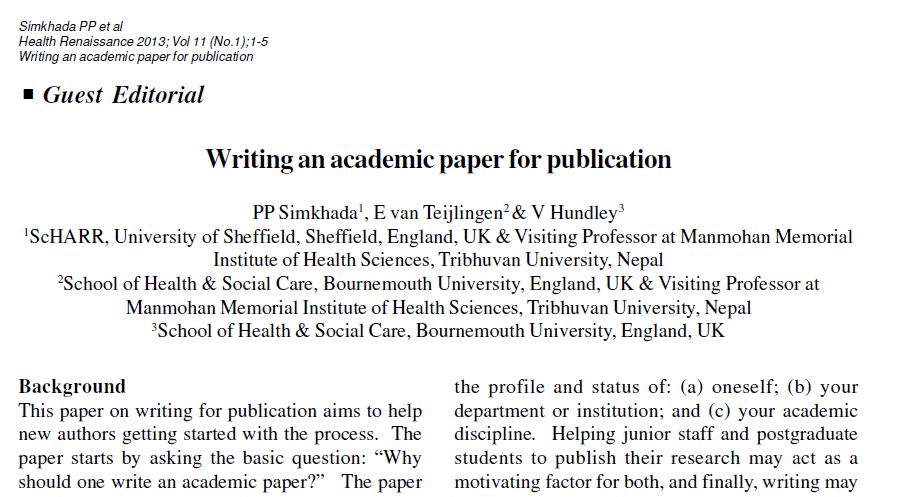
Every week I receive an email telling me what my most accessed paper is on Academia.edu. As a research-active academic I would like this ‘top paper’ to be one of my research papers based on primary research or perhaps a systematic review. My second preference is that I would like it to be one of my few more theoretical papers and, if not that, then at least one of many methods papers I have published with colleagues over the past decade. But no, every single week a fairly basic ‘how-to-do’ paper is my most accessed paper. This week’s message is typical: “Your most popular paper for the week was Writing an academic paper for publication, which had 142 views.”
This how-to-write-an-academic editorial has been my most read paper for months now. It is a paper Prof. Vanora Hundley, Prof. Padam Simkhada (Liverpool John Moores University & BU Visiting Faculty) and I wrote in an attempt to help budding academics and postgraduate students in a low-income country to think about the process of drafting and writing a scientific paper.
Perhaps this paper is popular because there is a global need for it (Academia.edu also gives break down from where in the world the paper has been accessed). It is also possible that it is on course reading list or perhaps it is recommended on webpage somewhere. The paper is,of course, Open-Access which helps in terms of providing more people across the globe easy and free access!
Prof. Edwin van Teijlingen
CMMPH
Reference:

For starters, to change information on your Staff Profile Pages, you will need to log onto your BRIAN account to do so.
Any information added or amended on your BRIAN account usually requires an overnight automated refresh for it to appear on your Staff Profile Pages the next day.
Here’s the tip – if you want to see the changes made straight away, there is a button on your Staff Profile Page which you can click to prompt the refresh to take place instantaneously.
Scroll to the bottom of your Staff Profile Page and you will see this in the left hand corner –
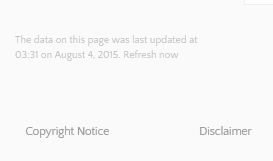 It’s very discreet but it’s there.
Click on the ‘Refresh now’ button and it will refresh your page and you can see the changes made instantly.
*Please note that any information entered in the ‘Overview’ section under the Profile tab will not appear on your Staff Profile Pages. If you wish to update your background information, there are fields under ‘My Professional Activities’ which will allow you to do so.
Please see below a series of ‘How to update your Staff Profile Pages with BRIAN’ training sessions available during the following dates:
2pm to 3.30pm, 20 August – C203 Christchurch House, Talbot
2pm to 3.30pm, 15 September – S102 Studland House, Lansdowne
1.30pm to 3pm, 28 October – C124, Christchurch House, Talbot
2pm to 3.30pm, 9 November – TBC
2pm to 3.30pm, 15 December – C203, Christchurch House, Talbot
Please get in touch with OD@bournemouth.ac.uk to book a place.
BU staff can login below:







 ESRC Festival of Social Science 2026: An Opportunity to Engage New Audiences
 New HIV paper by BU PhD student
 BU Annual Research Conference: Poster Exhibition Call for Applications
 Vitae Three Minute Thesis (3MT®) Competition: Applications Now Open
 3C Online Social: Thursday 26 March 1–2pm – Research Culture, Community & Can you Guess Who?
 ECR Funding Open Call: Research Culture & Community Grant – Apply now
 ECR Funding Open Call: Research Culture & Community Grant – Application Deadline Friday 12 December ECR Funding Open Call: Research Culture & Community Grant – Apply Now
 MSCA Postdoctoral Fellowships 2025 Call
 ERC Advanced Grant 2025 Webinar MSCA Postdoctoral Fellowships 2025 Call ERC Advanced Grant 2025 Webinar MSCA Postdoctoral Fellowships 2025
 Update on UKRO services
 European research project exploring use of ‘virtual twins’ to better manage metabolic associated fatty liver disease
 Research Information Network