Category / Law

Sexual Violence Staff and Student Conference at BU

Sexual Violence Student Conference: Legislation, Policy and Opinion

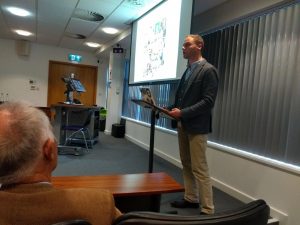
On 27 April staff and students from across BU came together in the new Bournemouth Gateway Building to share research and ideas on the topic of sexual violence.  The event was organised by Jane Healy, a criminologist in the Department of Social Sciences and Social Work in FHSS, in collaboration with Jamie Fletcher from Law, FMC, and Kari Davies from Psychology, FST.  The combination of social sciences, social work, psychology and law created a dynamic and exciting environment as students from all four disciplines were exposed to intriguing and engaging presentations on this broad topic.

From Law, second year student Teodora Nizirova, alongside lecturers Jamie Fletcher and Karolina Szopa, presented a fascinating paper on the Sexual Offences Act 2003, which at present distinguishes rape (as penile penetration) from sexual assault (which includes penetration from other sources). They proposed a gender-neutral definition of rape as an alternative to the current non-penile sexual assault charge, as a method of recognising the extent of the harm caused to those individuals who identify as non-binary or who are not in heteronormative relationships. Their presentation sparked a flourish of comments and debate from students and staff in attendance, and more about their proposal can be read here 

Jamie followed up by leading a discussion on R v Lawrence [2020] EWCA Crim 971, a recent case in the Court of Appeal, which held that lying about having a vasectomy did not negate consent in sexual intercourse, something which again produced much thought and debate from those in attendance.

Not to be outdone by the stimulating presentations from our Law Department, Psychology colleagues were quick to showcase the breadth of research they are currently undertaking on sexual violence. This included papers from Rachel Skinner, Psychology lecturer, on the relationships between rape myths and sexism/misogyny and an appeal from Rachel for those interested in this topic to collaborate with her on future work.  Two online papers swiftly followed: Ioana Crivatu, postdoctoral research assistant, presented on her qualitative study on group participation in sexual offences, and Ellie Reid, research assistant, shared findings on consistency and coincidence factors in sexual offences cases.  Kari Davies, lecturer in Psychology, concluded Psychology’s input by providing a whistle-stop tour of the variety of different work she and her colleagues are collaborating on, including BU’s contribution to “Project Bluestone” (which is a large project exploring rape and serious sexual offence investigations alongside colleagues from other institutions across the UK – more info here) as well as collaborative work on crime and policing in Switzerland with Maggie Hardiman.

Arguably saving the best for last (in my opinion), the Social Sciences and Social Work team finished off the afternoon with two and a bit papers from HSS.  BA Sociology student Sam Cheshire provided a confident and theoretically informed paper on his final year dissertation study, which involved interviewing survivors of domestic abuse and social services professionals. He emphasised the interlocations of power, violence and agency in his interpretation of the data, positioned within Foucauldian and neoliberalist concepts and structures. Orlanda Harvey, Lecturer in Social Work, then presented on her own project working with women survivors of domestic violence and highlighted the continuing taboo of disclosing sexual violence within relationships, providing strategies that she and Louise Oliver are using to engage with participants in a safe and supportive environment.

Finally, with only minutes remaining, Jane Healy concluded the afternoon with a very brief overview of her research into disabled women’s experiences of sexual violence, and shamelessly plugged her contribution to a book on “Misogyny as Hate Crime” which is available here (and will soon be available in the library collection).

The afternoon drew to a close with a rallying cry for more cross-faculty events for students and greater collaboration for staff on this topic.  The combination of distinct yet intersecting disciplinary work created an eclectic and refreshing mix of papers that provided much food for thought for staff and students alike. Students Teodora and Sam are to be particularly applauded for presenting for the first time to an audience of peers and academic staff.

Kari is keen to expand on collaborative expertise across BU in the fields of criminal justice, policing and sexual violence and is putting together a Sexual Violence working group. Please get in touch with her if you’d like to join.

Many thanks also to Kari for funding the tea and biscuits that kept us going through the afternoon! We are already looking forward to the next event.
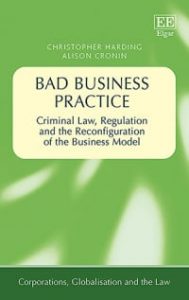

Dr Alison Cronin celebrates publication of her second book on corporate crime


Dr Alison Cronin and Prof Christopher Harding’s new book on corporate crime has now been published. This cutting-edge book critically reviews the field of attempted legal control and regulation of delinquent conduct by business actors in the form of exploitative, collusive and corrupt behaviour. It explores key topics including victimhood, accountability, theories of trading and shared responsibility.

The authors reflect on the attempts that have been made globally to use criminal law and other methods of formal legal control, as well as more flexible and innovative approaches under the heading of ‘regulation’, to address the problem of bad business practice. The book argues for a return to first principles and that the possibility of a reconfiguration of economic ordering and market and trading culture should be considered; as business malpractice is largely inherent in the dominant capitalist model, that model is in need of repurposing and reform.

New corporate governance book by BU scholar published

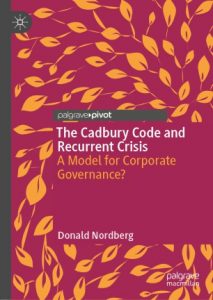
Associate Professor Donald Nordberg has published a new book, The Cadbury Code and Recurrent Crisis: A Model for Corporate Governance? (Palgrave Macmillan). It’s a critical examination of the origins of the UK code of corporate governance and how the code developed – and failed to develop – through repeated crises in corporate governance.

The 1992 Cadbury Code was a watershed in corporate governance, and not just in the UK. It influenced practice in many countries around the world, as well as the practices of many types of organisation outside the sphere of corporations listed on stock markets.

Reviewing the book, Andrew Johnstone, professor of company law at the University of Warwick, said: “This is a fascinating book, tracing the development of the UK Corporate Governance Code and highlighting its continuity through successive crises. At the same time, it identifies areas of controversy and challenge, intriguingly suggesting that ‘defeated logics’ are merely suspended, perhaps poised to return. Essential interdisciplinary reading for all those interested in the UK’s corporate governance system.”

Fertile Ground: Collaborative Success

Dr Jeffrey Wale (FMC) and Professor Sam Rowlands (FHSS) have been fortunate enough to have three papers accepted for publication during the lockdown period.  First, they have an article ‘A constructivist vision of the first-trimester abortion experience‘ being published by the Health and Human Rights Journal in June 2020.  Second, they have a paperIncentivised Sterilisation: Lessons from India and for the Future‘ being published by The European Journal of Contraception and Reproductive Health Care.  Finally, the BMJ Sexual & Reproductive Health Journal will be publishing their paper ‘The ethics of State-sponsored and clinical promotion of long-acting reversible contraception‘.

New Year’s Eve Celebrations Without the Fizz? New Publication in BULR by Martine Hardwick

Martine Hardwick, Lecturer in Law and PhD Candidate in the Department of Humanities and Law, has published a timely commentary in the Bournemouth University Law Review looking ahead to a change in the law on 31 December 2019. On this date, opposite sex couples will finally be able to register their civil partnerships – which until now has been reserved for same sex couples.

However, this change in the law raises important questions for cohabiting couples. Despite longing for more protection and fairness from the law, co-habiting couples will not be presented with the opportunity as heterosexual couples to celebrate on New Year’s Eve. Instead, they will still be bound by the strict rules of formation and dissolution which mirror those of marriage.

Questioning whether the UK has missed an opportunity to provide more rights for cohabiting couples and highlighting a solution drawn from France in the form of Pacte Civil de Solidarité (PACS), Martine argues that learning lessons from the French legal system has to be the way forward in giving cohabitants protection while respecting their autonomy.

You can read Martine Hardwick’s full article here.

CoPMRE Visiting Faculty bi-annual event

Yesterday CoPMRE welcomed 30 colleagues to our Visiting Faculty bi-annual event showcasing the exciting medical developments at BU from the new Bournemouth Gateway Building to the Institute of Medical Imaging and Visualisation. The key priorities to support delivery of BU2025 were presented by Dr Clare Wedderburn, Interim Head of Department of Medicine & Public Health presented.  Juan Campos-Perez, Clinical Research Co-ordinator, BUCRU spoke about Biobanks which were highlighted in Professor Emma King’s research presentation on immunotherapy.  Professor Jeffrey Wale, Lecturer in Law encouraged innovative medical cross faculty collaboration demonstrated by his recent research collaboration with Professor Sam Rowlands, Visiting Professor resulting in four co-authored papers. The main focus of the meeting centred around Visiting Faculty engagement in research and education to help us achieve our aims.  The audience reported that they were ‘very excited’ about these new developments at BU and were keen to support this vision.

Contemporary Issues in Fertility Control

On the 13 November 2019, BU hosted a one day interdisciplinary conference addressing a range of perspectives and concerns relating to human fertility control.  The event was opened with a keynote presentation from Clare Murphy, Director of External Affairs at the British Pregnancy Advisory Service on ‘Compelling choices: decision-making around contraception in the UK today’.  This was followed by a series of contributions – including presentations from charitable, medical and academic stakeholders – with coverage of emergency and long-acting reversible contribution; population control through nudging behaviours; recognition of a legal right to family planning and discussion of abortion care and regulation.  The conference was organised by Jeffrey Wale, Senior Lecturer in the Department of Humanities and Law and was funded by an ACORN award aimed at supporting Early Career Researchers.  One of the central aims of the event was to start up conversations, generate new links and to establish a network of interested parties.

Growing wealth of migration publications at Bournemouth University

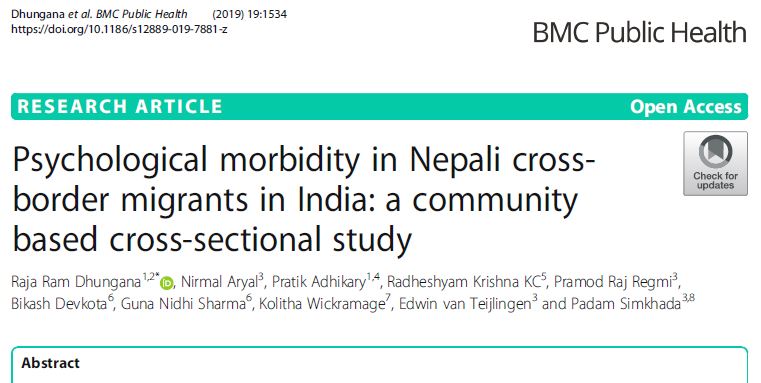
Yesterday saw the latest publication based on Bournemouth University (BU) migration research.  The international journal BMC Public Health published our quantitative paper ‘Psychological morbidity in Nepali cross-border migrants in India: a community based cross-sectional study’ [1].  This scientific article highlights that since Nepali migrants can freely cross the border with India and hence work and stay there, they are largely undocumented. The majority of these Nepali migrant workers is involved in semi-skilled or unskilled jobs with limited labour rights and social security, which predisposes them to psychological distress. The paper assessed the prevalence of and factors associated with psychological morbidity among Nepali migrants upon their return from India.

Just a few days ago the UN Migration Agency in Nepal IOM (International Organization for Migration) published ‘Research on the Health Vulnerabilities of the Cross-Border Migrants from Nepal‘, an online report to which BU academics (Aryal, Regmi & van Teijlingen) had contributed [2].  Just recently we had published the qualitative sister paper on Nepali migrants working and living in India. [3].  Whilst Dr. Nirmal Aryal was the lead author on a paper highlighting the need for more research specifically focusing on adolescents left behind by migrant workers [4]. Earlier this year BU PhD graduate Dr. Pratik Adhikary published his latest paper from his thesis, the paper is called ‘Workplace accidents among Nepali male workers in the Middle East and Malaysia: A qualitative study’ and was published in the Journal of Immigrant & Minority Health [5].

Last year was also a very good year for BU migration research, including a systematic review on sex trafficking (perhaps the worst kind of migrant workers) [6], an earlier research paper by Dr. Adhikary with his PhD supervisors [7], and one paper on Nepali female migrants workers in the Middle-East & Malaysia [8].  Earlier BU academics published on general health issues and accidents among Nepali migrant workers in Malaysia, Qatar & Saudi Arabia [9-10], Nepali migrants in the UK [11-12] , other papers included: a call for action on Public Health [13]; a systematic review [14]; a paper on migrant workers’ spouses [15]; migrant health workers in the UK [16-17]; migration and tourism industry [18-20]; migrants and space in Italy [21-22]; an anthropological perspective on migration [23]; a media studies’ perspective [24]; and archaeological perspective [25]; and a socio-economic perspective [26].  No doubt there are several other publications I have forgotten or I am simply unaware missed in this list.


Prof. Edwin van Teijlingen

Centre for Midwifery, Maternal & Perinatal Health


References:

  1. Dhungana, R.R., Aryal, N, Adhikary, P., KC, R., Regmi, P.R., et al. (2019) Psychological morbidity in Nepali cross-border migrants in India: A community-based cross-sectional, BMC Public Health 19:1534
  2. International Organization for Migration (2019) Research on the Health Vulnerabilities of the Cross-Border Migrants from Nepal, Kathmandu, Nepal: International Organization for Migration.
  3. Regmi, P., van Teijlingen, E., Mahato, P., Aryal, N., Jadhav, N., Simkhada, P., Syed Zahiruddin, Q., Gaidhane, A., (2019) The health of Nepali migrants in India: A qualitative study of lifestyles and risks, Journal of Environmental Research & Public Health 16(19), 3655; doi:10.3390/ijerph16193655.
  4. Aryal, N., Regmi, P.R., van Teijlingen, E., Simkhada, P., Mahat, P. (2019) Adolescents left behind by migrant workers: a call for community-based mental health interventions in Nepal. WHO South East Asia Journal of Public Health 8(1): 38-41.
  5. Adhikary P, van Teijlingen E., Keen S. (2019) Workplace accidents among Nepali male workers in the Middle East and Malaysia: A qualitative study, Journal of Immigrant & Minority Health 21(5): 1115–1122. https://link.springer.com/article/10.1007/s10903-018-0801-y
  6. Simkhada, P., van Teijlingen, E., Sharma, A., Bissell, P., Poobalan, A., Wasti, S.P. (2018) Health consequences of sex trafficking: A systematic review, Journal of Manmohan Memorial Institute of Health Sciences, 4(1): 130-149.
  7. Adhikary P, Sheppard, Z., Keen S., van Teijlingen E. (2018) Health and well-being of Nepalese migrant workers abroad, International Journal of Migration, Health & Social Care 14(1): 96-105. https://doi.org/10.1108/IJMHSC-12-2015-0052
  8. Simkhada, P.P., van Teijlingen, E.R., Gurung, M., Wasti, S. (2018) A survey of health problems of Nepalese female migrants workers in the Middle-East & Malaysia, BMC International Health & Human Rights 18(4): 1-7. http://rdcu.be/E3Ro
  9. Adhikary, P, Sheppard, Z., Keen, S., van Teijlingen, E. (2017) Risky work: accidents among Nepalese migrant workers in Malaysia, Qatar & Saudi Arabia, Health Prospect 16(2): 3-10.
  10. Adhikary P., Keen S., van Teijlingen E (2011) Health Issues among Nepalese migrant workers in Middle East. Health Science Journal 5: 169-75. www.hsj.gr/volume5/issue3/532.pdf
  11. Adhikary, P., Simkhada, P.P., van Teijlingen E., Raja, AE. (2008) Health & Lifestyle of Nepalese Migrants in the UK BMC International Health & Human Rights 8(6). Web address: www.biomedcentral.com/1472-698X/8/6
  12. van Teijlingen E, Simkhada, P., Adhikary, P. (2009) Alcohol use among the Nepalese in the UK BMJ Rapid Response: www.bmj.com/cgi/eletters/339/oct20_1/b4028#223451
  13. Aryal, N., Regmi, PR., van Teijlingen, E., Simkhada, P., Adhikary, P., Bhatta, YKD., Mann, S. (2016) Injury and Mortality in Young Nepalese Migrant Workers: A Call for Public Health Action. Asian-Pacific Journal of Public Health 28(8): 703-705.
  14. Simkhada, PP., Regmi, PR., van Teijlingen, E., Aryal, N. (2017) Identifying the gaps in Nepalese migrant workers’ health & well-being: A review of the literature, Journal of Travel Medicine 24 (4): 1-9.
  15. Aryal, N., Regmi, PR., van Teijlingen, E., Dhungel, D., Ghale, G., Bhatta, GK. (2016) Knowing is not enough: Migrant workers’ spouses vulnerability to HIV SAARC Journal of Tuberculosis, Lung Diseases & HIV/AIDS 8(1):9-15.
  16. Scammell, J., 2016. Nurse migration and the EU: how are UK nurses prepared? British Journal of Nursing, 25 (13), p. 764.
  17. Sapkota, T., Simkhada, P., van Teijlingen, E. (2014) Nepalese health workers’ migration to United Kingdom: A qualitative study. Health Science Journal 8(1):57-74.
  18. Janta, H., Ladkin, A., Brown, L., Lugosi, P., 2011. Employment experiences of Polish migrant workers in the UK hospitality sector. Tourism Management, 32 (5): 1006-1019.
  19. Dwyer, L., Seetaram, N., Forsyth, P., Brian, K. (2014) Is the Migration-Tourism Relationship only about VFR? Annals of Tourism Research, 46: 130-143.
  20. Filimonau, V., Mika, M. (2017) Return labour migration: an exploratory study of Polish migrant workers from the UK hospitality industry. Current Issues in Tourism, 1-22.
  21. De Martini Ugolotti, N., 2016. ‘If I climb a wall of ten meters’: capoeira, parkour and the politics of public space among (post)migrant youth in Turin, Italy. Patterns of Prejudice, 50 (2), 188-206.
  22. De Martini Ugolotti, N., 2015. Climbing walls, making bridges: children of immigrants’ identity negotiations through capoeira and parkour in Turin. Leisure Studies, 34 (1), 19-33.
  23. Mai, N., Schwandner-Sievers, S. (2003) Albanian migration and new transnationalisms, Journal of Ethnic & Migration Studies 29(6): 939-948.
  24. Marino, S., Dawes, S., 2016. Fortress Europe: Media, Migration and Borders. Networking Knowledge, 9 (4).
  25. Parker Pearson, M., Richards, C., Allen, M., Payne, A. & Welham, K. (2004) The Stonehenge Riverside project Research design and initial results Journal of Nordic Archaeological Science 14: 45–60.
  26. Chowdhury, M., 2014. Migration, Human Capital Formation and the Beneficial Brain Drain Hypothesis: A Note. Migration & Development, 3 (2), 174-180.

Call for EoIs: Impact Champion for UOA 18 to drive REF 2021 preparations

BU is preparing submissions for units of assessment (UOAs) for REF 2021. Each UoA has a UoA Leader, supported by an Impact Champion and Outputs Champion.  The roles are recruited through an open and transparent process, which gives all academic staff the opportunity to put themselves forward for UOA roles.

We are currently seeking an expression of interest (EoI) from academic staff interested in supporting impact development for UoA 18 Law.

Impact Champions play a key role in shaping the impact element of their UoA’s submission.  They work closely with their Faculty’s Impact Officer and Impact Post-Doctoral Researcher, where relevant.

Key responsibilities of the Impact Champion role include:

  • Review the development of impact case studies being prepared within the UOA
  • Provide guidance on how impact case studies can be accelerated and evidenced
  • Advise colleagues on the REF impact guidelines
  • Review impact strategies related to the UOA and assess progress made against them
  • Review and implement recommendations from external research users to strengthen research impact
  • Ensure that colleagues are updating institutional systems for impact tracking
  • Promote relevant training and development opportunities
  • Review impact arising from major programmes of research and knowledge exchange to make recommendations as to how these can contribute to impact case studies
  • Advise on the use of appropriate metrics specific to the subject area
  • To undertake any other duties as requested by the relevant Deputy Dean for Research and Professional Practice (DDRPP) and/or Unit of Assessment leader.

The full role description can be found here – Impact Champion Role Descriptor.

Application process:

To apply for the role, please submit a short statement (suggested length 300 words) explaining your interest in the role and what you could bring to it. This should be sent by email to Professor Dinusha Mendis by Friday 22nd November 2019.  The EoIs will be reviewed by the UoA Leader and Output Champion.

The selection criteria used at EoI are outlined below. Each criterion carries a total possible score of 5. The role will be offered to the highest scoring applicant. The UoA Leader or current Impact Champion will provide feedback to all applicants.

  • Knowledge of the REF and research impact (scored out of 5): Applicants should have the appropriate level of skill and knowledge to help them support the development of impact in their UoA. It is expected that Impact Champions will predominantly be practising researchers and will have a breadth of understanding of research across their Faculty.  They are also expected to have an understanding of the REF assessment process and of research impact.
  • Experience of external engagement and / or impact development (scored out of 5): Impact Champions are expected to be able to provide advice and direction to colleagues who want to develop their research impact. Experience of engaging with external organisations or developing your own research impact would be of benefit in this role.
  • Commitment, motivation and enthusiasm (scored out of 5): Being an Impact Champion is a big commitment and the role has the scope to help shape impact development at BU. Applicants need to be committed to the role, as well as showing the enthusiasm and motivation needed to support their UoA.

More pilots please!

“More pilots please!” is not a call from British Airways, Ryanair or the Royal Air Force.  No, it a reminder to students to do more piloting in their postgraduate research projects.  Between us we have read many (draft) theses and examined over 60 PhD theses external to Bournemouth University, and it is clear to us that many students do not do enough pre-testing or piloting of their research instruments.  Perhaps they did some piloting or feasibility work for their projects but don’t write enough about it.  Or they present some feasibility or piloting in their thesis but haven’t added references to methodological texts.

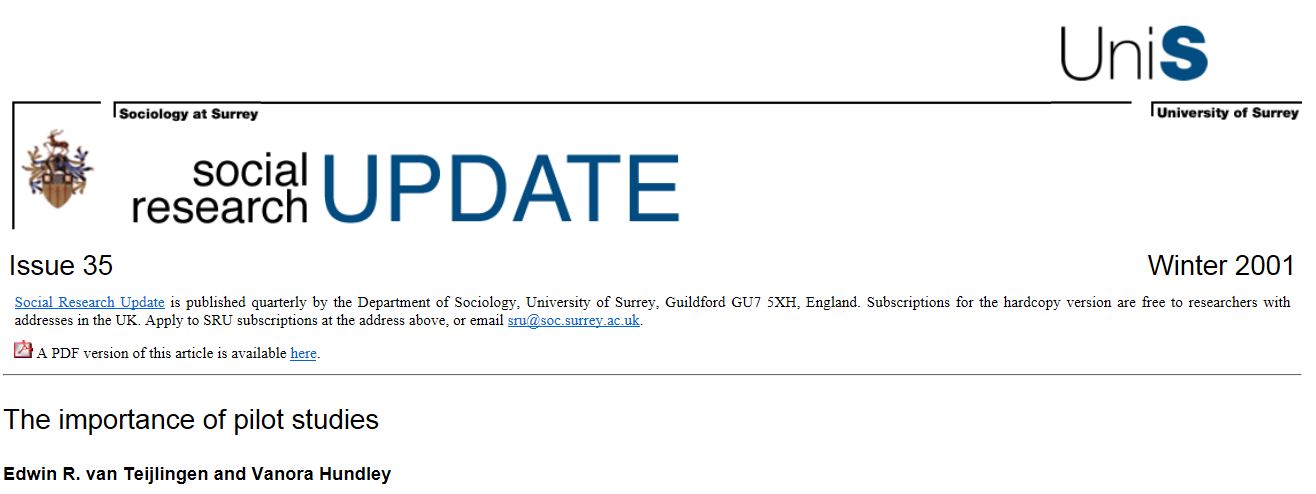
The term ‘pilot studies’ refers to mini versions of a full-scale study (also called ‘feasibility’ studies), as well as the specific pre-testing of a particular research instruments such as data collection tools (i.e. questionnaire or semi-structured interview schedule). Pilot studies are key to good study design [1-6].  Conducting a pilot study does not guarantee success in the main study, but it does increase the likelihood of success. Pilot studies have several of important functions in research design and can provide valuable insights to the researcher on both tools and research processes.  We think it is telling that our most cited paper on Google Scholar is not one of our papers reporting research findings but a methods paper highlighting the importance of pilot studies [2].


Professors Vanora Hundley & Edwin van Teijlingen

CMMPH


References:

  1. van Teijlingen E, Rennie, AM., Hundley, V, Graham, W. (2001) The importance of conducting & reporting pilot studies: example of Scottish Births Survey, Journal of Advanced Nursing, 34: 289-95.
  2. van Teijlingen E, Hundley, V. (2001) The importance of pilot studies, Social Research Update Issue 35, (Editor N. Gilbert), Guildford: University of Surrey. Web:  http://www.soc.surrey.ac.uk/sru/SRU35.html
  3. van Teijlingen E, Hundley, V.(2002) ‘The importance of pilot studies’ Nursing Standard 16(40): 33-36. Web: www.nursing-standard.co.uk/archives/vol16-40/pdfs/vol16w40p3336.pdf
  4. Hundley, V., van Teijlingen E, (2002) The role of pilot studies in midwifery research RCM Midwives Journal 5(11): 372-74.
  5. van Teijlingen E, Hundley, V. (2003) Pilot study, In: Lewis-Beck, M., Bryman, A. & Liao, T. (eds.) Encyclopaedia of Social Science Research Methods, Vol. 2, Orego, Sage: 823-24.
  6. van Teijlingen E, Hundley, V. (2005) Pilot studies in family planning & reproductive health care, Journal of Family Planning & Reproductive Health Care 31(3): 219-21.