We have the honor to have Prof. Marina L. Gavrilova here on our campus to deliver a talk on Biometric Recognition, recognizing a person by determining the authenticity of a specific characteristic – biometric features, such as Physiological Biometrics (face, fingerprint, hand, ear, Iris, palm print, hand vein, tooth, retina etc.), Behavioural Biometrics (voice, gait, signature, key-stroke dynamics, etc) and Social Biometrics (Twitter, Flickr, etc). The talk will discuss various problems in biometric data acquisition, feature matching, multi-modal fusion, pattern recognition, etc.
Title: The Social Aspects of Biometric Recognition through Human Perception
Speaker: Prof. Marina L. Gavrilova, Department of Computer Science, University of Calgary
Venue: CREATE LT, Fusion Building, Talbot Campus, Bournemouth University, Fern Barrow, Poole, Dorset, BH12 5BB
Time: 14:30-15:30 Wednesday 26th July 2017
Abstract: Our society continues to undergo tremendous growth with respect to all aspects of information access and sharing. It had a profound effect on the way we, humans, and the whole society lives, works and interacts in business and social settings. The information being shared through social networks, on-line communities, games, software development tools, e-mails, blogs, posts, etc. is enormous. It also ranges in type: text, images, hyperlinks, likes, network connections, etc. What’s more, human social, behavioral and even cognitive traits are becoming more and more visible through interlinking of heterogeneous communications in on-line and off-line settings and even in our visual preferences. This phenomenon gave rise to the rise of a new concept: Social Biometrics, that attempts to understand and extrapolate trends related to all aspects of human social activities. The talk is devoted to definitions, examples, case studies and very recent research trends in this domain. The introduced concepts will be further illustrated through two case studies: establishing identity of Twitter users through social networks analysis, and gender recognition of Flickr users based on human aesthetic preferences.

Marina L. Gavrilova is a Full Professor in the Department of Computer Science, University of Calgary. Dr. Gavrilova’s research interests lie in the areas of biometric security, cognitive sciences, pattern recognition, social networks, and cyberworlds. Prof. Gavrilova is the founder and co-director of the Biometric Technologies Laboratory and SPARCS lab, with over 200 publications, including the World Scientific Bestseller (2007): Image Pattern Recognition: Synthesis and Analysis in Biometrics and IGI (2013) book Multimodal Biometrics and Intelligent Image Processing for Security System. She is a Founding Editor-in-Chief of Transactions on Computational Science journal, Springer, and an Associate Editor of the Visual Computer and the International Journal of Biometrics. Prof. Gavrilova has given invited lectures at leading international conferences (3AI, CW, WSCG, GRAPHICON, PSC, ICCI*CC, MIT, ICBAKE, etc), and appeared as guest at DIMACS Rutgers University/Bell Labs, USA; Microsoft Research, Redmond, USA; Samsung Research, South Korea; SERIAS Purdue University, USA, among other universities.
http://pages.cpsc.ucalgary.ca/~marina/HomePHP/index.php
Thanks.
Dr. Xiaosong Yang
http://staffprofiles.bournemouth.ac.uk/display/xyang
 Last week (11-15 September 2017) saw the successful delivery of the NERC-funded Advanced Training Course Freshwater Taxonomy and Field Identification Skills, awarded to Professor Genoveva F. Esteban (SciTech, Department of Life and Environmental Sciences) in collaboration with the Freshwater Biological Association (






 NERC is undertaking an evaluation of its support for Early Career Researchers (ECRs) to be completed in 2017. This evaluation is the first of its kind to be undertaken by NERC to gain a better understanding of the challenges and issues facing ECRs during this crucial period for their career development.
 ent simulator, and the VirtaMed knee arthroscopy. This is the only lab in Europe where the two simulators are together.
 just drilling holes into a piece of wood using the simulator was incredibly hard. However, as I used and practiced the simulators more, I could feel myself improving and progressing in the fundamental skills required.









 ECR Opportunities: New Development Programme, Research Grants & Upcoming Events
 Help us capture BU’s knowledge exchange activity HE-BCI survey 2025–26
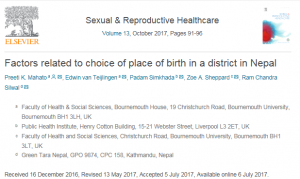
 Verbal autopsy paper published two days ago
 ESRC Studentships for 2027 Entry: Opportunity Now Open
 SONAMONI contributions to Safety Conference 2026 in South Africa
 Horizon Europe Cluster 3 (Civil Security for Society) 2026 Calls Now Open
 MSCA Doctoral Networks 2026 Call Information Webinar
 ESRC Festival of Social Science 2026: Application Deadline Extended to Thursday 25 June 2026
 Reminder: Register for the ESRC Festival of Social Science 2026 Information Session
 ECR Funding Open Call: Research Culture & Community Grant – Apply now
 ERC Advanced Grant 2025 Webinar
 Update on UKRO services
 European research project exploring use of ‘virtual twins’ to better manage metabolic associated fatty liver disease