Tagged / Health
Wessex patients report positive experience of research for a second year
The National Institute for Health Research (NIHR) Clinical Research Network (CRN) Wessex has recently conducted a survey, distributed amongst the 10 NHS organisations in the Wessex region. This is the second time the CRN Wessex patient research experience survey (PRES) has been conducted, and ran throughout October 2018.
400 responses were received anonymously, and showed that 96% of participants had a good experience of taking part in research. It also showed that 98% of research participants surveyed had all the information that they needed in relation to the study.
Copied from the original article –
‘Many of those surveyed reported that the research staff supporting them were friendly and helpful and that they had a considerable amount of time to spend with them in order to explain the study and answer any questions.
The survey also highlighted that one of the key motivators for taking part in research was a desire to help others, with one participant commenting: “It’s good to know that this research could help future generations of patients.”’
The survey will be conducted again in October of this year.
NIHR Clinical Research Network Portfolio
Structure
The National Institute for Health Research (NIHR) is one of the largest funders of clinical research in Europe and have a number of funding streams that you can apply for in order to conduct health-related research. The NIHR then has a number of Clinical Research Networks or ‘CRNs’ that are spread out to each region of England. The local CRN is Wessex, based in Hedge End, Southampton.
The ‘Portfolio’
At the heart of CRN activities is the NIHR CRN Portfolio of studies. This consists of high-quality clinical research studies that are eligible for consideration for support from the CRN in England. Adoption onto the portfolio has a number of benefits for researchers, such as help in identifying potential research sites, access to patients and the public to carry out ‘PPI‘ and advice on recruitment strategy at any point during the study. The CRN offers support to researchers via their Study Support Service and likewise via each portfolio manager and their team. You can see a breakdown of each portfolio here on the Wessex CRN page.
The Portfolio and the NHS
Portfolio adoption is usually vital to participating NHS Trusts when considering the research studies they wish to undertake, as they are reimbursed for the resource given to conduct the study (e.g. research nurse support, data manager time).
Each CRN is given a budget for the financial year by the NIHR, which is then distributed to sites based on their recruitment figures.
Requirements
In order to be eligible for portfolio adoption, there are three criteria a study must meet:
- The study must be ‘research’ (this is stipulated, as often what’s classed as research outside the NHS setting, is sometimes a service evaluation, quality improvement etc. within the NHS – see this table);
- Have appropriate ethical approval; and Health Research Authority (HRA) Approval where required;
- Have full research funding – this has to have been awarded via open competition and by the NIHR, other areas of central Government, or an NIHR non-commercial partner (for which there is a list). If the study has received support from multiple funders, then it will be still considered automatically eligible, if one of the funding streams is the NIHR, an area of central Government or a non-commercial partner.
You can read more about study eligibility here, including research funded by overseas partners.
The Portfolio and BU
The source of research funding is the principal determinant of eligibility for NIHR CRN support and so it is encouraged that researchers seek external funding where possible and appropriate, from the NIHR, another area of central Government or one of their non-commercial partners. The amount of funding doesn’t need to substantial in order to be eligible.
For any queries to do with the portfolio or for guidance regarding implementing your research in a healthcare setting, take a look at the Clinical Governance blog. You can also get in touch with BU’s Research Ethics team with any queries.
NIHR Valid Informed Consent training dates
Before agreeing to participate in your study, your participants should receive all the information they require in order to make an informed decision. Once they wish to participate, then an informed consent form should be completed and filed appropriately.
Although the process sounds complex, there are currently a great training opportunities to help familiarise yourself with the background to, and process of informed consent in clinical research.
The Wessex Clinical Research Network are hosting the following training sessions at University Hospital Southampton and Poole Hospital –
- Wednesday 8th May, 8:30am – 12:30pm, Seminar Room, Level C, West Wing, NIHR WTCRF, University Hospital Southampton NHS Foundation Trust, Tremona Road, Southampton, SO16 6YD;
- Wednesday 8th May, 1:00pm – 5:00pm, Seminar Room, Level C, West Wing, NIHR WTCRF, University Hospital Southampton NHS Foundation Trust, Tremona Road, Southampton, SO16 6YD;
- Monday 20th May, 8:30am – 1:00pm, Seminar Room 3, Education Centre, Ground Floor, Poole Hospital NHS FT Longfleet Road, Poole, BH15 2JB.
If you’re interested in attending, get in touch with the Wessex CRN to book your place.
EDGE International Conference 2019 – CONNECTED
BU takes responsibility for a large number of NHS-based research projects, spanning a number of clinical areas. To better support BU’s position as Sponsor for these studies, last August the university adopted the EDGE system. This allows us to better collaborate with our NHS colleagues and to ensure our research data is held in a secure and central location. Currently the system is being piloted within the Faculty of Health and Social Sciences for a year.
Last week the EDGE International Conference took place at The Vox Conference Centre in Birmingham, hosted by Fergus Walsh, the BBC’s Medical Correspondent, and organised by the Clinical Informatics Research Unit at the University of Southampton.
Over the two days we heard from speakers from across various organisations during breakouts, workshops and meet & greet sessions. Topics ranged from how to get the best out of the system’s features, using EDGE to connect with colleagues, and use of the system to improve the recording of study data and procedures. Given our implementation of EDGE, and the rarity of use by Universities, BU’s Clinical Governance Advisor, Suzy Wignall was invited to present on how BU has integrated the system.
Across the two days we likewise had keynote sessions, including talks from colleagues in New Zealand and Belgium where the system has been implemented. We also heard from parents of children who have been given access to life-saving research projects, improving their quality of life and health conditions, substantially.
The full agenda can be found here, with EDGE’s twitter feed here, showing photos from the event, and numerous tweets by colleagues.
For any guidance regarding implementing your research in a healthcare setting, take a look at the Clinical Governance blog or get in touch with BU’s Research Ethics team with any queries.
Introduction to Good Clinical Practice – 15th May 2019
Are you interested in running your own research project within the NHS? Good Clinical Practice, or ‘GCP’, is a requirement for those wishing to work on clinical research projects in a healthcare setting.
GCP is the international ethical, scientific and practical standard to which all clinical research is conducted. By undertaking GCP, you’re able to demonstrate the rights, safety and wellbeing of your research participants are protected, and that the data collected are reliable.
The next GCP full day session is scheduled for Wednesday 15th May, at Bournemouth University, Lansdowne Campus (Bournemouth House) – 8:45am – 4:30pm.
The day will comprise of the following sessions:
- Introduction to research and the GCP standards;
- Preparing to deliver your study;
- Identifying and recruiting participants – eligibility and informed consent;
- Data collection and ongoing study delivery;
- Safety reporting;
- Study closure.
If you’re interested in booking a place, please contact Research Ethics.
Remember that support is on offer at BU if you are thinking of introducing your research ideas into the NHS – email the Research Ethics mailbox, and take a look at the Clinical Governance blog.
Public Engagement Fund from Wellcome – up to £250k
Wellcome are inviting applications to their July round of public engagement funding.
You can apply for £25,000 to £250,000, although occasionally grants are made for up to £3 million.
Applications deadline
9 July 2019, 17:00 GMT
What they’re looking for
They’re looking for creative approaches to engage the public. Your project needs to support their public engagement goals, so it should do at least one of the following:
- empower people by helping them to access, use, respond to, and/or participate in health research and innovation
- improve health research by making it more people-centred, to better understand people’s experiences and draw on that knowledge
- help people to value and think critically about science, health research, innovation and the role these play in society.
Find out more and apply
Contact Wellcome with any questions about eligibility or the application process.
If you would like advice on planning an activity or submitting your application, contact Adam Morris (Engagement Officer).
New funding from Wellcome to boost global research capacity in humanities and social sciences
Wellcome have recently announced their plans to launch two new one-off calls to fund international exchange networks, and infrastructure costs for humanities and social science researchers around the world.
As a result, the Investigator Awards and Collaborative Awards in Humanities and Social Sciences will be paused to new applicants for one year from mid-2020.
The two new one-off schemes will be launched in July 2019, with a deadline for expressions of interest due in Spring 2020. The two new calls are as follows:
International Exchange Awards – These will be made to groups of researchers based in at least two different countries. They are designed to encourage radical and innovative research agendas through the exchange of knowledge, people and resources.
Research Development Awards – These awards are likely to be made to groups of researchers in a single organisation or region. The purpose is for emerging and established clusters of HSS research excellence to have access to a reliable source of infrastructure funding so they can concentrate on building research agendas and developing careers.
If you are interested in these schemes and would like to be notified once these calls are launched, please contact Lisa Andrews, RDS Research Facilitator.
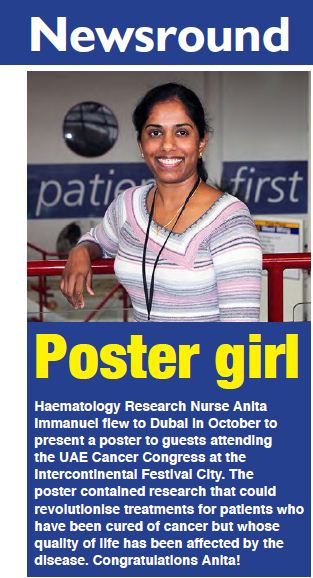
Congratulations to Anita Immanuel on PhD paper
FHSS PhD student Anita Immanuel just had the first paper from her PhD “Quality of life in survivors of adult haematological malignancy” accepted by the international journal European Journal of Cancer Care. This international journal is published by Wiley and has an Impact Factor 2.409.
Survivors of haematological malignancies endure long-term effects of both the treatment and the disease. This paper examines factors that influence their quality of lives through reporting on the results of a survey. The survey used previously validated quality of life questionnaires for use in cancer management. Participants were adults over the age of 18 years who had completed treatment for a haematological malignancy and were between 1-5 years post treatment.
Anita is currently working as Lead Clinical Research Nurse at East Suffolk and North Essex NHS Foundation Trust. Her PhD research (see picture above) was conducted at the Haematology Department of Royal Bournemouth and Christchurch Hospitals NHS Foundation Trust, which has one of the most extensive research portfolios in the Trust. Her PhD is supervised by Dr. Jane Hunt (Dept of Nursing & Clinical Science), Dr. Helen McCarthy, Consultant Haematologist at the Royal Bournemouth and Christchurch Hospitals NHS Foundation Trust, and Prof. Edwin van Teijlingen in the Centre for Midwifery, Maternal & Perinatal Health (CMMPH).
Health Research Authority public involvement guidance – third blog post
Involving patients and/or the public in your clinical research is a great way to ensure that your study is designed and set-up in a way that will be attractive to participants. By carrying out PPI (patient and public involvement) you can also ensure that your research will be of benefit, not only to individuals but also the wider population and healthcare in general.
In 2018 the Health Research Authority (HRA) released guidance to help applicants better identify where they have involved the public in their research applications, and the difference that it made to their studies.
In addition, in January of this year two HRA blog posts were advertised, following the journey of a Research Fellow at the University of Surrey, who conducted PPI for her research project. The first and second posts can be found on the HRA website alongside other news items.
The HRA have just released the third blog post in which they talk to one of the lay Research Ethics Committee (REC) members who sat on the panel that reviewed the fellow’s study. The post explores the Committee member’s views on how public involvement benefited the research application. You can find it here.
Remember that support is on offer at BU if you are thinking of introducing your research ideas into the NHS, social care or healthcare institutions – email the Research Ethics mailbox, and take a look at the Clinical Governance blog.
BU media coverage in Nepal
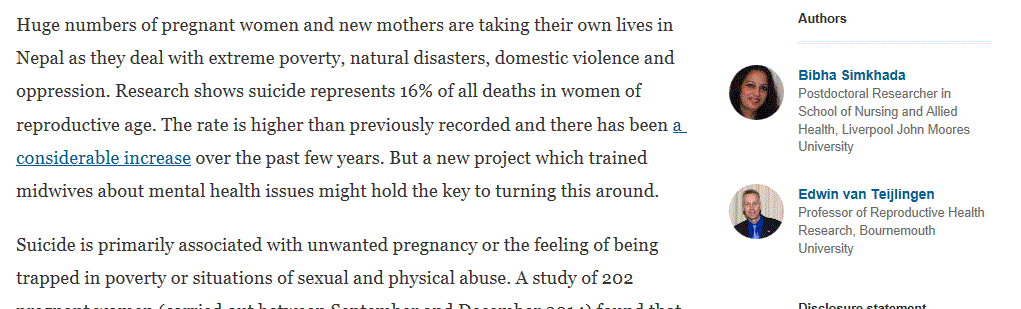
The article “Why suicide rate among pregnant women in Nepal is rising” written by BU academics was published in The Conversation last year. At the time this attracted Indian newspaper attention. Clearly it is still a relevant issue as it attracted national coverage in a Nepali newspaper this week.
Dr. Bibha Simkhada & Prof. Edwin van Teijlingen
NHS R&D Forum response to Mental Capacity Act Code of Practice consultation
The NHS R&D Forum Research Management Working Group have released their thoughts on how they feel that the Mental Capacity Act Code of Practice can be refined and improved, to reflect current needs.
‘The Research Management Working Group is a group of members of the NHS R&D Forum with a wealth of experience
and expertise in both managing and delivering research activity within NHS organisations.’
You can read the group’s response here. The consultation is now closed, however the current Code of Practice can be found here.
If you are planning to conduct research with human participants that lack the capacity to consent or who may eventually lack capacity to consent, then the research application must go to an ethics committee that is flagged to review Social Care research.
BU ethics panels are not authorised to undertake this review or issue approval, and so an application via the IRAS system must be made. Further information can be gained via the HRA website and by emailing Research Ethics.
REMINDER – Training opportunity: completing and submitting your IRAS application
Are you currently in the process of designing, setting up or planning your research study, and would like to extend your project into the NHS?
Yes? Then you may want to take advantage of this training opportunity.
Oliver Hopper (Research & Development Coordinator, Royal Bournemouth and Christchurch Hospital) and Suzy Wignall (Clinical Governance Advisor, RDS) will be running a training session on how to use, and complete your own application within the IRAS system.
IRAS (Integrated Research Application System) is the system used to gain approvals from the NHS Research Ethics Committee and Health Research Authority, before rolling out your study to NHS Trusts. To support this, the session will include the background to research ethics and the approvals required for NHS research.
The session will also be interactive, and so as participants, you will have the opportunity to go through the form itself and complete the sections, with guidance on what the reviewers are expecting to see in your answers, and tips on how to best use the system.
The training will take place in Studland House – Lansdowne Campus, room 102, this Thursday 28th March at 09:30am – 12:30pm.
Get in touch with Research Ethics if you would like to register your interest and book a place.
Funding opportunity – Climate Environment and Health

NERC/MRC/ESRC in collaboration with the Belmont Forum, have issued a call to fund transdisciplinary, end-user focused approaches to investigate and address the linkages between climate, environment and health. Projects should seek to bridge knowledge gaps, understand health risks, improve predictability, and deliver usable data, information, and innovative solutions to planners and decision makers. The following themes are prioritised for this call; food systems and nutrition; heat and health and; climate-sensitive infectious diseases.
Projects must be eligible to receive funding from at least three partner organisations participating in this call established in three different countries, and should include researchers from the natural sciences, health/medical sciences, social and economical sciences or humanities, as well as societal partners.
The deadline for expressions of interest is 6th May 19, with full proposals due by 23rd July 19. More information is available on the website.
If you are interested in applying, please contact Lisa Andrews, RDS Research Facilitator or your Funding Development Officer, in the first instance.
FM Food and Health research team awarded the Marie Sklodowska-Curie Actions Seal of Excellence
The Food and Health research team in the Faculty of Management are delighted that their research into encouraging consumption of plant based dishes has been recognised by the Marie Sklodowska-Curie Actions ‘Seal of Excellence’.
Their research VeggiEAT and Veg+ has led the way to providing an evidence based body of activity of which VegMAX was part. Plant based eating leads to a large net economic gain for society, as well as improved health outcomes for the population.
We are thrilled and proud with this recognition.
Training opportunity – completing and submitting your IRAS application
Are you currently in the process of designing, setting up or planning your research study, and would like to extend your project into the NHS?
Yes? Then you may want to take advantage of this training opportunity.
Oliver Hopper (Research & Development Coordinator, Royal Bournemouth and Christchurch Hospital) and Suzy Wignall (Clinical Governance Advisor, RDS) will be running a training session on how to use, and complete your own application within the IRAS system.
IRAS (Integrated Research Application System) is the system used to gain approvals from the NHS Research Ethics Committee and Health Research Authority, before rolling out your study to NHS Trusts. To support this, the session will include the background to research ethics and the approvals required for NHS research.
The session will also be interactive, and so as participants, you will have the opportunity to go through the form itself and complete the sections, with guidance on what the reviewers are expecting to see in your answers, and tips on how to best use the system.
The training will take place in Studland House – Lansdowne Campus, room 102 Thursday 28th March at 09:30am – 12:30pm.
Get in touch with Research Ethics if you would like to register your interest and book a place.
Clinical Research Transparency – Responsibilities
‘Researchers, sponsors and funders have responsibilities – that may be legal requirements or ethical and moral expectations within an accepted governance framework of best practice and standards – to participants in research, patients and the wider public and research communities.’
The HRA have recently released a page of useful links and guidance that encompasses areas such as ‘top tips for transparency’, making your research results public, and also registering your study.
Related to this, hopefully you will have seen a recent blog post regarding the HRA’s commitment to ensuring research transparency. This has been a hot topic lately, and the subject of a recent House of Commons Science and Technology Committee report.
Take a look at the HRA guidance here.
BU has access to the ClinicalTrials.gov system so get in touch if you would like access. This is a great opportunity to register your study and study results in the public domain. It is free to use.
Despite the name, the system may be used for other clinical research projects.
Dr. Aryal funded to attend international workshop on migration & health
Congratulations to Dr. Nirmal Aryal in the Faculty of Health & Social Sciences has been selected to participate in an international workshop targeting early career researchers (ECRs) on ‘Engendering research and reframing policy debate on migration & health and intersectional rights’ to be held in Kathmandu (Nepal) from 25th to 28th April 2019. 
This workshop is jointly organized by several universities in the UK, India as well as the International Organisation for Migration, as well as the Migration Health and Development Research Initiative(MHADRI). There will be 18 ECRs from South Asia and South East Asia and Nirmal is one for the six from the UK. The organizers will fund flight to and accommodation in Nepal.
Congratulations!
Prof. Edwin van Teijlingen
CMMPH


REF 2029 Sector Survey: Have Your Say
BU methods paper reached 2,500 reads
UKCGE Recognised Research Supervision Programme: Applications Close 19 October
Dr. Orlanda Harvey interviewed as expert
Dr. Paul Whittington attends Technology and the SEND Reforms Roundtable in the House of Commons
Dr. Paul Whittington joins Bett 2026 DfE Assistive Technology Roundtable
Horizon Europe Cluster 3 (Civil Security for Society) 2026 Calls Now Open

MSCA Doctoral Networks 2026 Call Information Webinar

ESRC Festival of Social Science 2026: Application Deadline Extended to Thursday 25 June 2026

Reminder: Register for the ESRC Festival of Social Science 2026 Information Session

ECR Funding Open Call: Research Culture & Community Grant – Apply now

ERC Advanced Grant 2025 Webinar
Update on UKRO services
European research project exploring use of ‘virtual twins’ to better manage metabolic associated fatty liver disease