
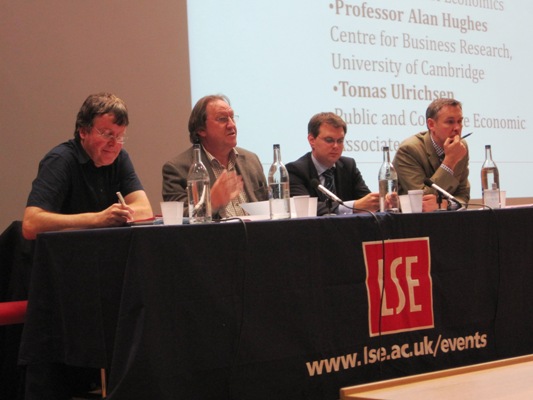
 Prof Martin Kretschmer, Professor of Information Jurisprudence and Research Centre Director for CIPPM in the Business School, recently attended a meeting organised by the British Academy and the ESRC on Engaging Academic Social Scientists in Government Policy-Making and Delivery. Here he provides an overview of the issues discussed at the event…
Making research relevant to policy is on the agenda of all Research Councils, as reflected in the Impact measure of REF 2014. The event was co-sponsored by the Government Heads of the Analytical Professions: Government Economic Service, Government Operational Research Service, Government Science & Engineering, Social Science in Government, and the Government Statistical Service. The programme and list of attendees is available here: British Academy event programme and delegate list
Some of the issues raised, and questions asked of the attendees included:
Q1: What do you think government should be doing more of to increase the influence of your research and expertise on government policy making and delivery?
Q2: What do you think the academic social science community should be doing more of to have a direct influence on government policy making and delivery?
Q3: What might encourage you to consider an advisory role to government, for example, as a social scientist on one of the government’s Scientific Advisory Committees?
 I assume I was invited because I am just coming to the end of an ESRC Public Sector Fellowship in the UK Intellectual Property Office (within BIS). I also sit on the government’s Copyright Advisory Expert Group, and speak frequently on policy issues, for example last week (1 June) at a Hearing in the European Parliament on The Future of Copyright in the Digital Era.
Below, I summarise a few points from the meeting that may be useful for the wider BU research community.
Prof Nick Pidgeon (Professor of Environmental Psychology, University of Cardiff, and Director of the Understanding Risk Research Group) offered 4 routes to influencing government:
- Government contract research, including small review contracts.
- RCUK (or similar) funding in policy relevant area.
- Advisory Committees.
- Indirectly, via dissemination through Royal Society, RSA, or similar.
Paul Johnson (Director of the Institute for Fiscal Studies): “Don’t expect to change government policy if your evidence points in a different direction.” There are two choices: EITHER Focus on points of detail within the policy direction given by government, OR Set agenda for 5 years hence.
Sir John Beddington (Government Chief Scientific Advisor) stressed the tightrope walk between advice that is a “challenge” and being labelled “unhelpful” (in Sir Humphries language). Academics should risk “challenge” even if it turns out to be “unhelpful”.
Prof Philip Lowe (Professor of Rural Economy, University of Newcastle, and Director of the Rural Economy and Land Use Programme): There is a paradox – How can a government department become a sophisticated consumer of research? Commissioning good research requires being able to know what you don’t know. Hard for civil servants and politicians. Important to build and sustains links over many years.
Prof Helen Roberts (Professor, General Adolescent and Paediatrics Unit, University College London, and non-executive director of the National Institute for Health and Clinical Excellence NICE): Public sector placements are very useful, both for academic and government, but governance of these grants can be cumbersome. [I can confirm that from my own secondment experience. At some point, there were suggestions that detailed delivery contracts would have to be drawn up between ESRC and BU, ESRC and BIS/IPO, BIS/IPO and BU. In the end, I was simply shown the Official Secrets Act, and the Code of Conduct for Civil Servants, and that was it.]
Importance of human dimension: “Most implementation comes though good relationships, not good research.”
Sharon Witherspoon (Deputy Director of the Nuffield Foundation, and in charge of research in social science and social policy): Most policy advisors double in “empirically informed counterfactuals”, and are normally grateful if offered help with: “What would happen if…” But academics can often make the most telling contribution by more radical reflection: “I wouldn’t start from here”. Governments are less likely to be open to that kind of challenge. Select Committees are becoming more independent of government (now have elected chairs). They can be a route to influence.
Paul Doyle (CEO, ESRC): The ESRC is building a database of government policy leads/contacts. Often it is impossible from government websites to identify the civil servants and special advisors dealing with specific policy issues. Government scientists should be encouraged to become members of Learned Societies.
Key points from the open discussion:
- Importance to keep independence by constructing portfolio of funders.
- Economists are a separate breed in government. They have little concept of wider social research.
- Responding to consultations is often a good first step to engagement.
- Academics should use less jargon, shorter sentences.
- Visual representation of research findings matters greatly.
- Often it is useful to invite policy makers to academic events. They enjoy coming out of the office, and are less partisan/circumspect in a neutral environment.
- There is an important corrective function for social scientists in assessing the presentation of data.
- Difficulty in presenting the audit trail required for REF Impact. Government does have no interest in revealing the sources of its ideas, or it may be politically inconvenient to do so.
 The ESRC has announced two new calls as part of its Knowledge Exchange Opportunities scheme

 The REF2014 Guidance on Submissions document was released on Thursday and can be accessed on the HEFCE website here:
 Today is my first day back in the office after a road trip from Vancouver to Los Angeles, taking in many exciting cities, national parks, activities, etc en route. From spotting killer whales in the San Juan Islands to making the most of tax free shopping in Portland to hydrobiking in Long Beach harbour, I’ve packed in lots of fun! One of the coolest things we did, however, was to go to the
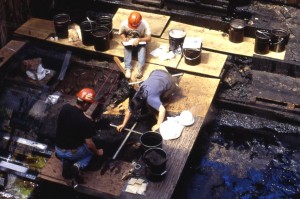
  The La Brea Tar Pits is one of the world’s most famous fossil localities, recognized for having the largest and most diverse assemblage of extinct Ice Age plants and animals in the world. Whilst I was walking around the museum looking at skeletons of giant sloths and sabretooth tigers, a fossilised mammoth tooth (the size of my head) and a display of 404 dire wolf skulls, I had a eureka! moment. The museum is an excellence example of transparent research that engages the public and results in huge societal impact.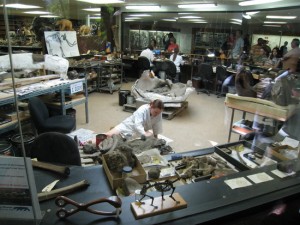


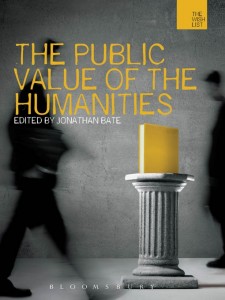 Demonstrating the public value of research will be a significant part of the forthcoming REF exercise. Most major funding bodies now require an impact statement as part of the application process. Universities are being required to demonstrate that their research offers value for money and tangible benefits outside of the academic sphere. This is easier in some disciplines than others, with many people believing the arts, humanities and social sciences (AHSS) will struggle to demonstrate impact.
 This week is Universities Week 2011, a national campaign demonstrating the benefits of universities within UK society! Today focuses on universities’ historical contribution to the big society, long before this phrase became commonly used. Thriving university towns and cities will be highlighted by demonstrating how universities give back to the local and national community.


 Last Friday BU held an internal Research Impact event to share the success of the excellent research that has been undertaken by BU academics. The focus of the event was on how this research has had an impact outside of academia, for example an impact on society, the economy, quality of life, culture, policy, etc.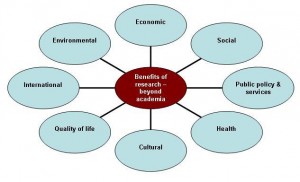

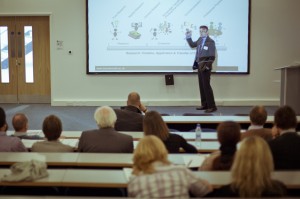
 Part of the presentation focused on the BU Research Themes which are currently being identified and defined through academic consultation via the Research Blog. This is still in the early stages but Matthew presented the ten draft themes that are emerging. You can comment on the emerging themes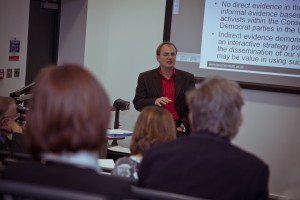
 Attendees were encouraged to go to impact case study presentations from different UOAs/Schools to find out about research that is undertaken in different areas of the University. Stronger impact case studies can also be developed with input from different disciplines.
 The event was also attended by key staff from Marketing & Communications who will be working with UOA Leaders to develop and enhance impact case studies between now and the REF submission in autumn 2013.
 There has been much positive feedback received from attendees and we are considering whether this should now be an annual event, celebrating the success of BU research and its benefit to society.
 Many thanks to all the presenters and attendees, and everyone who supported the event and made it such a success! 😀
 HEFCE
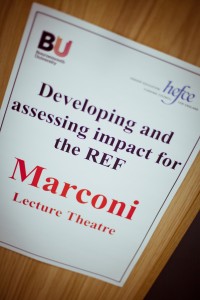
HEFCE Last week BU hosted a HEFCE-supported event for universities in the south of England outlining recent changes in how the quality of research in higher education is assessed.
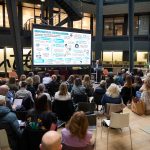
 Professor Peter Taylor-Gooby (University of Kent), Professor Roy Harrison (University of Birmingham), Professor James Goodwin (Age UK), Dr Kathryn Monk (Environment Agency Wales) and Dr Mari Williams (RCUK) presented their experiences of assessing impact case studies in the REF pilot exercise. Professor Jim Griffiths (University of Plymouth) presented his experience of identifying and submitting impact case studies to the pilot exercise in the hope that others would learn from his experience.







 3C Event: Research Culture, Community & Connections – Wednesday 11 November 3-4pm
 ECR Opportunities: New Development Programme, Researcher Grants & Upcoming Events
 Help us capture BU’s knowledge exchange activity HE-BCI survey 2025–26
 Verbal autopsy paper published two days ago
 ESRC Studentships for 2027 Entry: Opportunity Now Open
 Horizon Europe Cluster 3 (Civil Security for Society) 2026 Calls Now Open
 MSCA Doctoral Networks 2026 Call Information Webinar
 ESRC Festival of Social Science 2026: Application Deadline Extended to Thursday 25 June 2026
 Reminder: Register for the ESRC Festival of Social Science 2026 Information Session
 ECR Funding Open Call: Research Culture & Community Grant – Apply now
 ERC Advanced Grant 2025 Webinar
 Update on UKRO services
 European research project exploring use of ‘virtual twins’ to better manage metabolic associated fatty liver disease