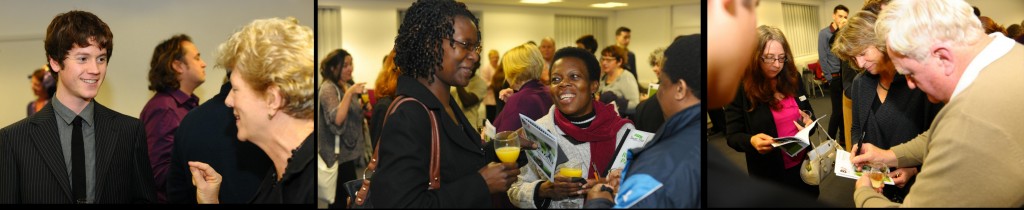
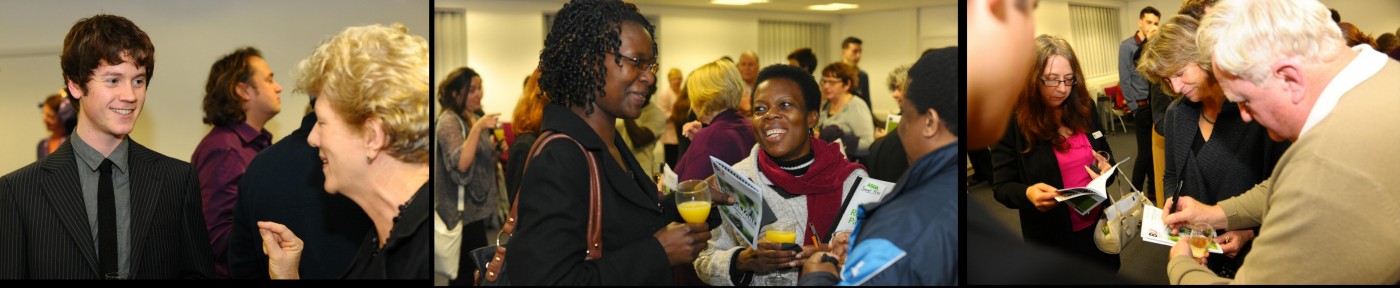
BU has staged the world premiere of a new film which draws its story from three years of in-depth research to give an account of being gay and growing older in the British countryside. An audience of nearly two hundred walked the red carpet to the screening and gala reception in Kimmeridge House on 16 November. The premiere was attended by academics, the film’s cast and crew members, the research project’s Advisory Committee and interviewees, all who were joined by a range of citizens of varying age and sexual preference.
Rufus Stone, the movie, is the key output of the three-year ‘Gay and Pleasant Land?’ research project led by BU academic, Dr Kip Jones. The project, about positioning, ageing and gay life in rural South West England and Wales, is a work package in the UK-wide New Dynamics of Ageing Project “Grey and Pleasant Land? : An Interdisciplinary Exploration of the Connectivity of Older People in Rural Civic Society”. The projects are funded by Research Councils UK and the film was produced by Parkville Pictures.
The stories which form the foundation of the script for Rufus Stone are entirely based upon research undertaken by Dr Jones and his team from BU’s School of Health and Social Care with the assistance of a citizens’ Advisory Committee. The film’s ‘fictional’ story was created over time using composite characters and situations, all uncovered in the ‘Gay and Pleasant Land? Research Project’, through in-depth biographic life story interviews, focus groups, and actual site visits to the rural locations where older gay or lesbian citizens were living.
Kip Jones says that conversations (rather than formal ‘meetings’) were carried out by the Project’s researchers and advisers, sifting over the materials and stories, putting forth possible plot lines, twists and turns, and developing the main characters whilst constantly shuttling back and forth to and from the research data.
Kip Jones hoped that by engaging the prolific and award-winning Josh Appignanesi as the film’s director that the film and the results of this in-depth research would have even greater impact on a much wider audience.
“Our hope is that the film will dispel many of the myths surrounding ageing, being gay and life in British rural settings,” said Kip Jones, in his role as Executive Producer of Rufus Stone. “The film renders poetically the way in which our memories morph and play with our histories, much as dappled sunlight reveals, then conceals, an idyllic landscape.
“The trail that we leave is the really important aspect of this project and it’s important, especially in a new field where you are using new methods, to transpose research into something else which can be made more accessible to a much wider audience,” Kip Jones continued. “The ‘documents’ of this work, the finished product, are not simply written journal articles or book chapters or even a full book, but the film itself which is the most tangible and important output that we can achieve.”
The story within Rufus Stone dramatises both old and continuing prejudices of village life from three main perspectives. Chiefly it is the story of Rufus, an ‘out’ older gay man who was exiled from his village as a youth and who years later reluctantly returns from London to sell his dead parents’ cottage. In doing this, he is forced to confront the faces of his estranged past. Of these, Abigail is the tattletale who ‘outed’ Rufus 50 years ago when he spurned her interest. Flip, the boy Rufus adored, has also stayed in the village: a life wasted in near celibacy and denial who is looking after his elderly mother. But Rufus too isn’t whole, saddled with an inability to return or forgive.
The film’s four main characters – Rufus and Flip as both younger and older men – are seamlessly woven in and out of the film with great dramatic effect drawing the viewer in to engage in their youthful exuberance versus their despair at the consequences of age and prejudice.
“The film is a kind of Garden of Eden ‘fall of man’ narrative,” said Appignanesi. “The two main characters, Rufus and Flip, are blissfully unaware and innocent in their joy together in Dorset in the 1950s.
“Growing up, they start to have some feelings for each other that they don’t have a reference for but they’re real and rather pure,” he continued. “Then the gossips start talking and it’s oblivion: exile for Rufus, until 50 years later when he comes back as a 70-something year old man forced to revisit the home in which he grew up but he hasn’t been back to for years where he encounters the old faces.”
Actor William Gaunt, who plays the aged Rufus, sees the film as a “sad and touching story but also one that talks about the relationship between age, about what it’s like to fall in love when you’re very young and how long that remains with you.
“From the research that was done into this subject and the stories that grew out of this research, it has an authenticity,” Gaunt said. “You feel that when you read the script and in a way, it could only happen in a rural situation. It’s one of the downsides of life in a village community.”
One member of the audience at the premiere, who wishes to remain anonymous, sums up his reaction to the film’s potential impact: “To say that Rufus Stone is moving is truly accurate, further, to say that its interplay between the two young lovers and their dramatic reunion when much older, is innovative and very effective is likewise very true too.
“This is an exceptional short film because of its length and the immediacy of the messages it conveys to both oppressed and victimisers. I really feel most strongly that … it could and should play a unique and ground-breaking role in terms of LGBT anti-discrimination educational work at colleges, schools, and especially with internal distribution to UK public services organisations.”
A second screening of Rufus Stone will take place on the Lansdowne campus in the near future – we’ll announced the date and location on the blog shortly!
This is an excellent example of producing a media output as a means of communicating research findings with the public in an interesting and exciting way. BU will be doing much more of this activity in future so if you’re interested and would like to get involved then contact the RDU!
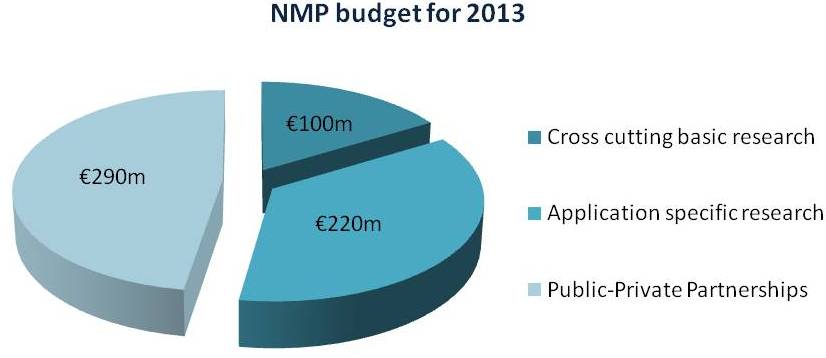
 Horizon 2020 is the replacement of FP7 – Europe’s largest funding programme, managed by the European Commission (EC). In 2014, FP7 will end and Horizon 2020 will be the primary mechanism through which to seek EC funding.
 A confidential draft paper was released this week which details the proposed direction of Horizon 2020. Every day next week I will post important summaries of sections of the document most relevant to you so you can get a head start on preparing for Horizon 2020:

 Dr Joanne Mayoh





 Dr Lorraine Brown
 I can’t believe it has taken me nearly three months to blog about the
 We’re aiming to hold more of these type of informal events so would
  The Enterprise Training Programme is an established training scheme for researchers from any university wanting to learn more about business and the commercialisation of research.
 Last month
 Watch this excellent short video from BU’s Dr Darren Lilleker on how members of Parliament can use technology to connect with people, particularly in relation to EU dialogues in politics.



 Welcome to RCUK Demand Management week on the blog! Today’s focus is on the Arts and Humanities Research Council (







 Verbal autopsy paper published two days ago
 ESRC Studentships for 2027 Entry: Opportunity Now Open
 SONAMONI contributions to Safety Conference 2026 in South Africa
 Three CMWH presentations at Berlin conference
 Horizon Europe Cluster 3 (Civil Security for Society) 2026 Calls Now Open
 MSCA Doctoral Networks 2026 Call Information Webinar
 ESRC Festival of Social Science 2026: Application Deadline Extended to Thursday 25 June 2026
 Reminder: Register for the ESRC Festival of Social Science 2026 Information Session
 ECR Funding Open Call: Research Culture & Community Grant – Apply now
 ERC Advanced Grant 2025 Webinar
 Update on UKRO services
 European research project exploring use of ‘virtual twins’ to better manage metabolic associated fatty liver disease