I spoke at the Education Enhancement Conference about a month ago on the subject of research informed teaching and have been asked to share my slides on this subject by several individuals since. Not very happy to do this not least because of the picture of a young Bennett, so instead I am posting the gist of the talk here in this post.
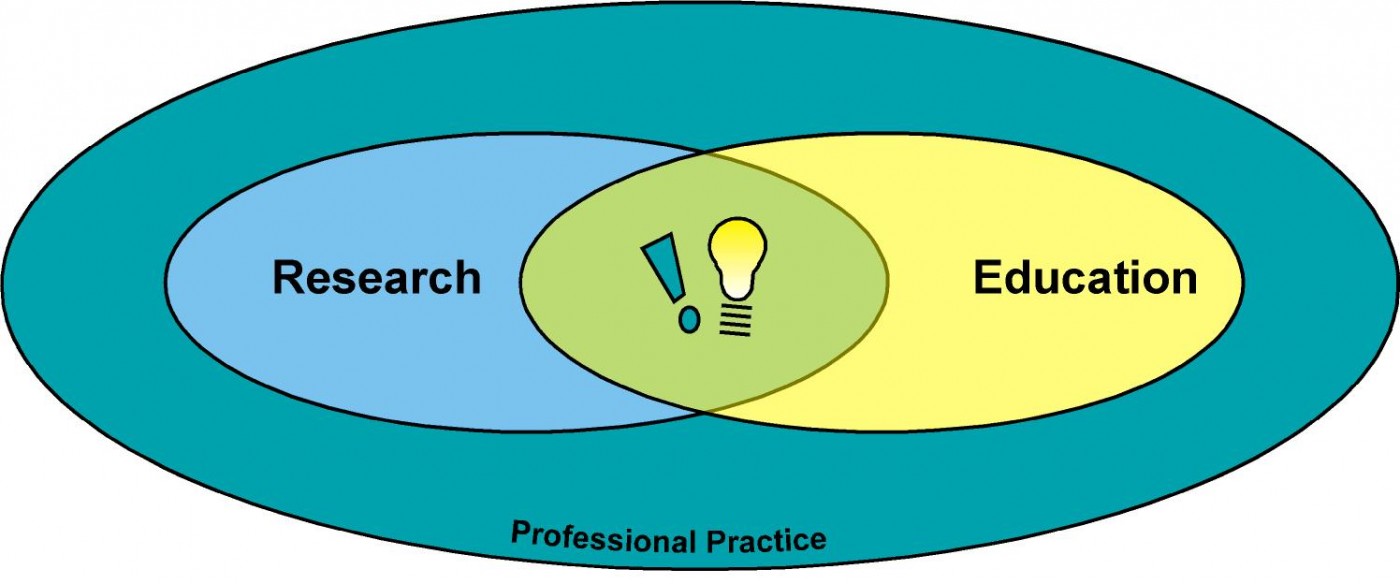
For me research informed teaching goes to the heart of what it is to be an academic. I love the phrase that a ‘university’s mission is to educate but its reputation is defined by its research’. For me this speaks to the central duality of our profession – education in combination with research. Because who would want to be at a university where knowledge is not being created? At BU over the last few years we have had the ‘four pillars’ of research, enterprise, education and professional practice and these have done much to clarify the metrics for pay progression and promotion, but on the downside they are often seen as separate and competing activities rather than one collective whole. 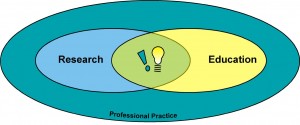 For me research is everything from the creation of new knowledge, via its application in applied or contract research, through its dissemination via CPD to professional practice. If one takes this broad definition then there are just two spheres – education and research – and the synergy in the overlap between the two is the place to be. In fact one can see professional practice and knowledge exchange with society as the surrounding mix which helps bind these two elements. This is the heart of research informed teaching, or if your prefer teaching informed research! It is this duality which has excited me throughout my career.
I have taught (and hope to continue to do so) for just under twenty years a range of earth science units from basic geomorphology, through glacial geology to a range of environmental and professional practice units. Throughout research has been central to my teaching. In the presentation referred to above I gave a series of examples from my own experience to illustrate just a small selection of what can be done. I looked at five broad areas: (1) research and scholarly output for learning and research; (2) the power of field projects and courses; (3) placements and project students; (4) students and enterprise; and (5) unit design.
Throughout the 1990s I wrote a series of student focused textbooks produced as a result of my own teaching and the wish to produce a text tailored directly to the needs of my students. Books on earth history, stratigraphy and my main passion of glacial geology.  These books were produced as a by product of my teaching but also shaped my teaching, allowing it to reach a much wider audience. They may not have had any relevance in the turns of RAE/REF but they served an important function, not least of which was to improve my own knowledge. I wrote a series of review papers at this time as well, directly driven by a pedagogic need to help my students with difficult subjects, but helping also to shape the academic agenda in these areas. These papers are very well cited and two where the cornerstone of my contribution to RAE-2008. They were driven by pedagogy but contributed directly to my research profile and plans. I re-wrote a first year units last year only to see the unit axed during a curriculum re-write – I can’t complain too much since I initiated the curriculum re-write! I put a huge amount of effort into this re-write reading widely and synthesising material in new way. I don’t think of this as lost effort because one I really enjoyed doing it and two I intend to write the unit up as reader in environmental change given a couple of months spare. Perhaps this will have to wait for a while but I will get to it soon I hope!
I ran field courses as a young lecture and used to turn students loose on Dartmoor each year to work independently on a range of field problems. For over a decade they collected research data using simple techniques building an archive which I have yet to completely mine. When people talk about student data you often here people say ‘but student data is poor, you can’t use it!’ But in truth student data is never poor and if it is, it is because you failed to teach them well enough. It is about treating students as research equals as you would any other potential collaborator. My greatest success of recent years – the Science publication in 2009 – was only possible because of an international field school (Koobi Fora Field School) where students provide the vast majority of the labour and contributed widely to the field debates. While working as a contaminated land consultant in Dorset I used a succession of student placements and project students to help deliver these contracts. Directly involving students in live consultancy is great experience for them and a source of reliable labour – you know the quality because you trained them! There are lots of ways of involving students, but the key is to treat them as equal partners in all that you do. There are also some fantastic examples in the School of Tourism and Media School of enterprise education in which students gain directly from being involved in live projects often taking the lead in solving business problems.
My final example was from a few years ago when a member of staff resigned a couple of weeks before the start of term and as all managers do I had to pick their third year unit up myself. There was no way I was going to write 20 weeks worth of lectures, one week ahead of the students. Done that and as they say bought the t-shirt and as we all know it is not a great experience for the students or for one self. A more creative solution was needed, so I decided to run the whole unit around four projects with student’s gaining the required knowledge and meeting the learning outcomes through their delivery. The four project were based on research that I wanted to have explored; I was the client, they were the consultants. Of the four projects three led to clear research output at the end of the unit. One focused on seeing whether Ground Penetrating Radar would work on Chesil Beach. It did and led to me re-doing the work that summer with some of my colleagues leading to a great little paper in Geomorphology one of the leading Elsevier journals in the earth sciences. Without the proof of concept the students provided this would never have been written. A second project provided the proof of concept for a PhD studentship which looked at the geochemistry of Poole Harbour, while the third project compared a series of methods for producing photomontages of complex geological sections. I use these methods now routinely within my own research. The fourth project was a great student project but just didn’t lead to any thing more, but three out of four is a very good strike rate! The units also got excellent reviews that year and two of the students went on to get firsts. There is a huge amount of potential to create units of this sort the key is to be creative.
These are just some of the examples I have used to combine research and teaching over the years but I can think of many more. I can anticipate the objections as illustrated in the picture, but in truth these are often not real and as the examples above show can easily be overcome.  So in conclusion research is at the heart of a good student experience with students learning from those that are learning themselves. We need to find creative way of engaging our students in research, enterprise & professional practice. The transferability of research skills is in my view one of the fundamental assets of a university education. A balanced portfolio of research is vital to career progression and external profile. It is not just about REF and there is lots of scope to do research which supports, is informed by and in turn informs ones teaching. The secret is to go for it!
Matthew Bennett
PVC (Research, Enterprise & Internationalisation)




 As of today the BU Research Blog has attracted 200 subscribers!












 Verbal autopsy paper published two days ago
 ESRC Studentships for 2027 Entry: Opportunity Now Open
 SONAMONI contributions to Safety Conference 2026 in South Africa
 Three CMWH presentations at Berlin conference
 Horizon Europe Cluster 3 (Civil Security for Society) 2026 Calls Now Open
 MSCA Doctoral Networks 2026 Call Information Webinar
 ESRC Festival of Social Science 2026: Application Deadline Extended to Thursday 25 June 2026
 Reminder: Register for the ESRC Festival of Social Science 2026 Information Session
 ECR Funding Open Call: Research Culture & Community Grant – Apply now
 ERC Advanced Grant 2025 Webinar
 Update on UKRO services
 European research project exploring use of ‘virtual twins’ to better manage metabolic associated fatty liver disease