BU hosting British Society of Criminology’s Hate Crime Network’s annual conference in June

Latest research and knowledge exchange news at Bournemouth University

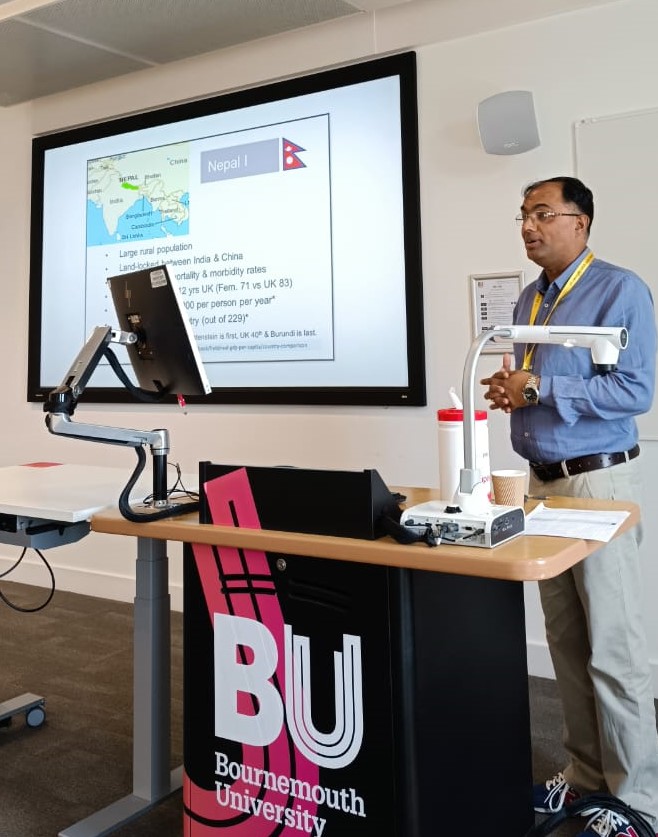
Yesterday Plos ONE published our latest study on the health system in Nepal under the title ‘Barriers in accessing family planning services in Nepal during the COVID-19 pandemic: A qualitative study‘ [1]. This qualitative study, in an Open Access journal, explores what sorts of barriers are faced by women needing family planning services in Nepal during the pandemic. It was conducted in five districts of Nepal. Telephonic in-depth interviews were conducted with 18 women of reproductive age (18–49 years) who were the regular clients of family planning services. Data were coded deductively using the preexisting themes based on a socio-ecological model (e.g., individual, family, community, and health-facility levels).
The paper reports that individual level barriers included low self-confidence, inadequate knowledge on COVID-19, myths and misconception related to COVID-19, limited access to family planning services, low priority to sexual and reproductive health services, low autonomy in family and limited financial ability. Family level barriers comprised partner’s support, social stigma, increased time at home with husbands or parents, not accepting family planning services as essential health services, financial hardship due to loss of jobs, and communication with in-laws. Movement restrictions and transportation hindering access, unsecured feeling, violation of privacy, and obstacles from security personnel were the community level barriers and unavailability of preferred choice of contraception, increased waiting time, limited outreach services by community health workers, limited physical infrastructures, the behavior of health workers, stock out of commodities, and absence of health workers were health facility level barriers.
The authors conclude that policymakers and programme managers should consider strategies to ensure continued availability of the full method mix during emergency, particularly since disruptions may go unnoticed and strengthen the provision of services through alternative service delivery channels to ensure sustained uptake of such services in this sort of pandemic.
This is the latest addition to the pool of academic papers published by Bournemouth University academics on the effects of COVID-19 on health care in Nepal or issues related to Nepal [2-11].
Prof. Edwin van Teijlingen
CMMPH (Centre for Midwifery, Maternal & Perinatal Health)
References:
Drs Jane Healy, Terri Cole and Ms Jamie Solberg represented BU at Esslingen University’s recent Erasmus training opportunity from 17-21 April 2023.
The title of the exchange week was “Teamwork and Collaboration in a University Context” and it was promoted for both academic and professional support staff as an opportunity for partnership and collaborative training. This event was a “BIP” or Blended Intensive Programme, which meant there were online sessions both before and after the week, five days of face-to-face activities, as well as being ‘blended’ through disciplinary and professional integration by the participants. Forty four individuals from 19 European countries were in attendance and came from a variety of disciplinary backgrounds, such as engineering, education, accounting, nursing, technology, international mobility teams, and student support services within institutions.

44 participants from 19 countries gathered in Esslingen for the week
The week was filled with activities, from networking, presentations, workshops and visits – including to the European Parliament in Strasbourg! Jamie writes about this particular visit:
“Following a presentation from an MEP, we had the opportunity to sit in on a parliament session. We quietly filed into the top rows of the circular chamber and listened (via headsets) to what was being said on the floor. On the day I visited, they were debating about the introduction of a digital Euro.
What struck me most was how truly international an institution the EU is. I witnessed 27 different countries working together to make decisions that impact the millions of citizens they represent. The MEP’s speak different languages, come from different cultures, and represent political parties across the spectrum. Yet, they can effectively communicate and collaborate.
I couldn’t help but draw parallels to our own group of 44 participants representing universities from 17 different countries (including individuals from as far away as India and the USA). We spent the week working together and getting to know one another. We connected as professionals and individuals, building a strong foundation for international cooperation amongst our universities. Learning from my international colleagues and taking the time to understand their perspectives was an enriching experience for me.”

The Visit to the European Parliament was a highlight for many
Jane also reflected on a cultural workshop later that week:
“We had a half day training session on “Working in Cross Cultural Teams” which was facilitated by Verena Brenner, a consultant for Esslingen University, and was an interactive and engaging session that offered us the opportunity to reflect on our own biases and stereotypes about other international countries. The session was designed to deepen our understanding on cross-cultural communication and collaboration in a university context and initially involved us considering where we come from and what types of backgrounds we have – as well as how they differ. I reflected upon my own Irish identity in this session, despite being based in a UK institution, and how I have adapted how I present myself to my colleagues in order to ‘fit in’ with British cultures and practices. At one point we worked in groups on a card game, where different colleagues had to move groups at regular intervals but discovered the ‘rules’ of the game had changed as they moved. This subtle task underlined to us how often it is the unspoken words that are assumed to be understood by all, yet can vary enormously between us. The benefits and opportunity of international and intercultural collaboration were discussed and shared between the group at the conclusion. I found this activity to be engaging, reflective and enjoyable.”
Terri writes:
“Personally I had such an amazing week it is difficult to find one highlight. As well as the cultural workshop, which made me reflect on both challenges and lessons to take back to my teaching practice and research teams, a social highlight was our international night. At this event the students, staff and guests brought dishes and sweet treats from their respective countries. Thankfully I smelt Durian and had ‘tried’ it before so didn’t get duped, but I have to say everything else – particularly the American students’ peanut putter and jell-o sandwiches washed down with Jack Daniels – were delicious!”

Terri and Abby from the University of Edinburgh promoting their British treats
For Jane and Terri, not only were they participating in the training week but they also travelled to Munich whilst there to visit with colleagues at Munich Police and discuss potential research collaborations. They were warmly welcomed by head of criminal investigations, Alex Horn, and discussed developing opportunities in the field of hate crime and right-wing extremism.
It was clear that our hosts had spent a great deal of effort designing an engaging and stimulating week for us all. All of the activities provided strong links to BU’s values of inclusivity, creativity and excellence. The focus was not just on enhancing student success but also inter-group successes too. International partnership opportunities are evidently beneficial on every level – from the BIP right through to the European Parliament!

Terri, Jane and Jamie receiving their certificates
Drs Alastair Morrison (Head of International Partnerships, Global Engagement Hub) and Milena Bobeva (Internationalisation Lead, BU Business School) will be visiting universities in Vietnam from 15-19 May 2023 as members of the Advisory Board to the British Council UK-Vietnam Higher Education Partnership (HEP). They will be visiting a range of institutions to develop partnerships, and progress ongoing project work funded by the British Council. For recent events, see the news story of a seminar on research excellence held at the Vietnamese Embassy in London.
The UK-Vietnam HEP Network intends to accelerate its development to support UK universities to understand the landscape, priorities and impact of the higher education sector in Vietnam, promote partnerships between the UK and Vietnam in student and staff mobility, transnational education, research and innovation, and provide networking opportunities among all stakeholders involved in higher education in the UK and Vietnam. The visit will consist of network meetings hosted by Hanoi University of Science and Technology and the Hanoi University of Mining and Geology from 15-17 May 2023, followed by visits to universities in Central and Southern Vietnam by the UK members on 18-19 May 2023, including Hue University.
It would be helpful if BU colleagues could let the Global Engagement Hub know of any active, existing links with Vietnam, and if anyone would like to develop links with any of the above universities in Vietnam, please email globalbu@bournemouth.ac.uk
UKRI have announced call for applications for a new Interdisciplinary Assessment College to support the new cross research council responsive mode pilot scheme.
This unique opportunity is to be part of an important new approach to funding interdisciplinary research. The college will support the new cross research council responsive mode pilot scheme, which is designed to support new interdisciplinary ideas emerging from the research community outside current disciplinary boundaries.
Major details :
You can find more details on UKRI call page.
The paper reports that of these 23 papers, 21 focused on assessing AHL measures, and 15 addressed the association between AHL and HP. Seven studies used the HL School-Aged Children instrument. The findings suggested that the methodological and conceptual underpinnings of HL measures are insufficient. Furthermore, HL acts as an independent and positive mediator for many facets of HP. Overall, this review offers a warning to practitioners and educationists interested in measuring HL as the number of measurement tools is substantial with different tools applying different scales.

Check out the May e-newsletter.
All ‘monthly update for researcher development, culture and community’ e-newsletters are available in a dedicated content area on the Doctoral College Researcher Development Programme Brightspace unit.
If you have any questions about the e-newsletter or would like to feature content, please contact Natalie [Doctoral College Programme Manager].

Have your say
Deadline approaching! This year’s Advance HE Postgraduate Research Experience Survey (PRES) will close in *ten days*
Don’t miss the chance to tell us about your experience at Bournemouth University by taking part in the Advance HE Postgraduate Research Experience Survey which closes on Monday 15 May 2023. We are keen to make sure our PGRs have the best possible experience while studying at Bournemouth University. To do this, we need to know what you think works well and what as a University we could do better.
Upon completing the survey, PGRs will be entered into a free prize draw where you can win one of four prizes of a £50 Love2shop voucher. Terms and conditions apply.
In addition and as a thank you for taking part, we will be making a £1 donation for every survey completed to the student mental health wellbeing charity, Student Minds.
How do I take part?
PGRs received an email from the University on Monday 17 April 2023 containing a unique link which allows you to access and complete the survey. If you can’t find this email, contact PRES@bournemouth.ac.uk and we’ll help you to get access.
What will I be asked?
The survey will take around 15 minutes to complete. Your response is confidential and any reporting will be entirely anonymous. The survey is your chance to tell us about your experience as a PGR at BU. It will ask you to share your views on supervision, resources, research culture, community, progress and assessment, responsibilities, support, research skills, profession development, opportunities, and overall experience.
Why should I take part?
Your feedback is important. The Postgraduate Research Experience Survey is the only national survey of PGRs and so is the only way for us to compare how we are doing with other institutions and to make changes that will improve your experience in the future.
More information
If you would like to know more about the survey, please visit: PRES 2023
We hope you take the opportunity to get involved this year and help us make improvements to your experience.
Best wishes,
The Doctoral College
Technology and Humanity in Healthcare: 3-part Webinar Series
Hello FHSS SIM Group Members –
David Wortley (david@davidwortley.com) is presenting: Technology and Humanity in Healthcare: 3-part Webinar Series
Wednesday 10 May ’23 at 12 noon BST.
Please register at
See info below.
Hope to see you in Zoom. The link is to follow.
Yours, Anthony Basiel
~~~~~~~~~~~~~~~~~~~~~/
Technology and Humanity in Healthcare: 3-part Webinar Series
When: 12noon – 1pm BST
May 10th – The role of AI and VR in Nursing Education
June 15th – Metaverse and Health and Wellbeing
July 12th – Technology, Humanity and the Ageing Society (Preventative Healthcare, Dementia, lifestyle medicine)
Event detail/description:
This interactive webinar series addresses technology and humanity issues in healthcare. The engaging webinar interview format is in two parts: a) David Wortley provides (Via Zoom) some healthcare/tech questions and context to stimulate debate. B) Debbie and/or Anthony will follow-with some pre-set questions and any new questions from the audience text chat. The default protocol is that all audience members in Zoom will have video and sound off – text chat Q&A. A Text Chat Facilitator passes on any questions/comments to David for response. The event will be recorded
Learning the basic principles is essential for doing effective public engagement with research, but it can be challenging to apply them to developing your own projects. In this session, we will turn your attention away from your work to explore inspiring examples of public engagement projects that have been successfully planned and delivered.
We will consider what worked well and what did not work in those projects, what the organisers learned and what we might do differently. By analysing these projects, you will gain a better understanding of what makes successful engagement. We will end by reflecting on what inspiration, knowledge, and skills you have gained and how you might apply them to your own work. 
This session is for all levels of experience with public engagement. To get the most from this, please familiarise yourself beforehand with the basic principles of public engagement.
Participants will gain:
For any queries regarding the content of this session, please contact Adam Morris at publicengagement@bournemouth.ac.uk
For any other queries, please contact Organisational Development
We are organising our series of Café Scientifique events for September 2023 – July 2024
Café Scientifique is a public event that takes place at The Black Cherry in Boscombe on the first Tuesday of the month (excluding January & August), and is organised centrally by the BU Public Engagement with Research Team, part of Research Development and Support.
The format involves delivering a short talk, followed by the opportunity for discussion and questions from a varied public audience. It is a fantastic opportunity for you to gain experience in engaging with the public in a friendly relaxed atmosphere.
We welcome academics at all career stages, although this opportunity is particularly valuable for those getting started in engaging with the public. We encourage collaboration between less experienced and more experienced public speakers to provide a worthwhile learning experience.
The team will support you every step of the way, from developing your ideas to engage with audience members, to setting up and promoting your event, we also help on the day to ensure your event runs smoothly.

Please note: Completing this form does not guarantee you a space. We will be in touch with you to discuss your interest.
If you have any questions about getting involved with Café Sci, please get in touch with the Public Engagement with Research Team: publicengagement@bournemouth.ac.uk.
As announced earlier, The 2023 Marie Skłodowska-Curie Actions (MSCA) Postdoctoral Fellowships (PF) Call is now open on the Funding & Tender Opportunities Portal, with a deadline of 13 September 2023.
We have now set BU internal deadline for submission of Intention to Bid form – 17 July 2023. Please not that ItBs submitted after the deadline will not be accepted, although we encourage academics to submit their ItB as soon as possible. If you do it well in advance, complete budget table is not mandatory (completed budget table will be required by 17 July).
You can find ItB form here.
The UK Research Office (UKRO) will hold information webinar series for those interested in the Marie Skłodowska-Curie Actions (MSCA) Postdoctoral Fellowships 2023 call in early June (three different sessions on 6, 8 & 9 June). These sessions will provide attendees with all the information needed to submit a successful application to this call, including the eligibility criteria, the available budget, submission and evaluation criteria, and practical advice on proposal writing.
Please note that individual support for BU academics will be provided as usual, however there will not be specific workshops organised at BU. For UKRO webinars, please refer to their webinar web page.
To access UKRO training sessions, login details may be required. BU is one of UKRO service subscribers and receives training as part of our subscription benefits. If you still have not registered, there are more details how BU academics can register.
With queries related to MSCA Postdoctoral Fellowships 2023 Call please contact Research Facilitator International Ainar Blaudums.
![]()
The National Co-ordinating Centre for Public Engagement (NCCPE) and Natural Environment Research Council (NERC) launch new resources for public engagement with environmental research
Running from March 2022 to January 2023 with funding from the NERC, the NCCPE delivered an online, capacity building programme for environmental researchers, practitioners and staff seeking to develop more productive and meaningful public and community engagement work.

This has led to the development of three ‘conversation starters’, which weave together the core themes of the programme with the ideas and discussions that most resonated with Academy participants.
The below resources were developed with and for environmental researchers and staff, but they are designed to help people working within a range of contexts to discuss partnerships, leadership and ethics in engagement.
Partnerships in environmental engagement – This resource explores what it means to develop and hold mutually beneficial partnerships in environmental engagement through the lens of the partnership cycle.
Leading environmental engagement – This resource reflects on the leadership challenges for strategically leading engagement practices in a UK higher education and research context. It also provides further resources to support this work.
Ethics of environmental engagement – This resource considers the guidelines for ethical practice in the broader context of environmental engagement.
If you have any questions, please email NCCPE: nccpe.enquiries@uwe.ac.uk
Alternatively, please contact Adam Morris Engagement Officer publicengagement@bournemouth.ac.uk

Sense about Science are running a Standing up for Science workshop on Friday 26 May at Norwich Research Park.
The workshop is free for STEM and social science early career researchers, trainees and medical professionals. The aim of the workshop is to encourage ECRs to make their voices heard in public debates about science.
The session will be made up of three panels, a researcher panel, media panel and a policy panel, where ECRs can learn what is expected of them from other researchers, journalists and policymakers, routes and pathways to engage with media or policy worlds, as well as useful tips and tricks from the panellists and each other.
Apply for your free place here
Places are allocated on a first come first serve basis. Workshops places are free, but you are responsible for your own travel costs.
Closing date for applications: 5pm Monday 8 May
For more details, please email hello@senseaboutscience.org
Alternatively, please contact Adam Morris Engagement Officer publicengagement@bournemouth.ac.uk
Disseminating your research findings to a range of stakeholders is an important part of the research impact process. The key is to think about ‘who’ might possibly benefit from knowing more about your research, and importantly, ‘how’ could they use your findings to support, inform and develop their practice.
A good example of this process is the recent keynote address delivered by Prof. John Oliver (FMC) to more than 60 delegates at a one-day event that launched the new Centre of Excellence, Enterprise Portfolio Management Office (UK Parliament). Prof. Oliver’s talk entitled ‘Harnessing the Power of Scenario Planning’ presented the findings of his scenario-planning project that ultimately developed a mission, vision and strategy for the House of Commons Library Service in UK Parliament. Additional keynotes were given by the Chief Operating Officer (House of Lords) and a range of internal and external experts on project delivery and digital transformation.
Prof. Oliver’s work is published in Oliver, J.J., Reid, M., and Gray, K. (2023). The Library of the Future: a scenario-based approach. Journal of Library Administration, Volume 63, Issue 1, Pages
27-41
This 3-Day workshop covers strategies for academic writing: writing to prompts, targeting a journal/specific criteria, types of prompt for academic writing, ‘snack writing’, goal-setting for writing, motivation, freewriting, generative writing, analysing academic writing, drafting and revising an abstract/summary, constructing a ‘contribution’ argument, using prompts in series, outlining, productive writing behaviours, wellbeing, writing groups, micro-groups and retreats. Many of these can be used in preparing for a concentrated spell of writing at a writing retreat.
This is a practical workshop. The aim of the writing activities in this workshop is to let you try these strategies and consider how/if/where they can fit in your writing practice. We also discuss how they can be used for writing theses, articles and other writing. They also let you start/work on your writing project during the workshop.
The online version of this course involves several short writing activities, all designed to help you develop your paper/chapter/thesis and use productive, healthy writing habits. By signing up to this course you agree to do the writing tasks and to talk about your writing in online small-group discussions, to give and receive feedback on this writing and to discuss your writing plans and goals.
You can find the programme here
| Workshop | Date | Time | Location |
|---|---|---|---|
| Writing Academy: Day 1 | Wednesday, 21st June 2023 | 10.00 – 16.00 | Online |
| Writing Academy: Day 2 | Thursday, 22nd June 2023 | 08.55 – 16.45 | Online |
| Writing Academy: Day 3 | Friday, 23rd June 2023 | 08.45 – 16.45 | Talbot Campus |
Please note, participants are required to attend all three days of the Writing Academy sessions.
To book a place on this workshop please complete the Booking Form.
For any specific queries regarding this workshop please email Pengpeng Hatch: pphatch@bournemouth.ac.uk.
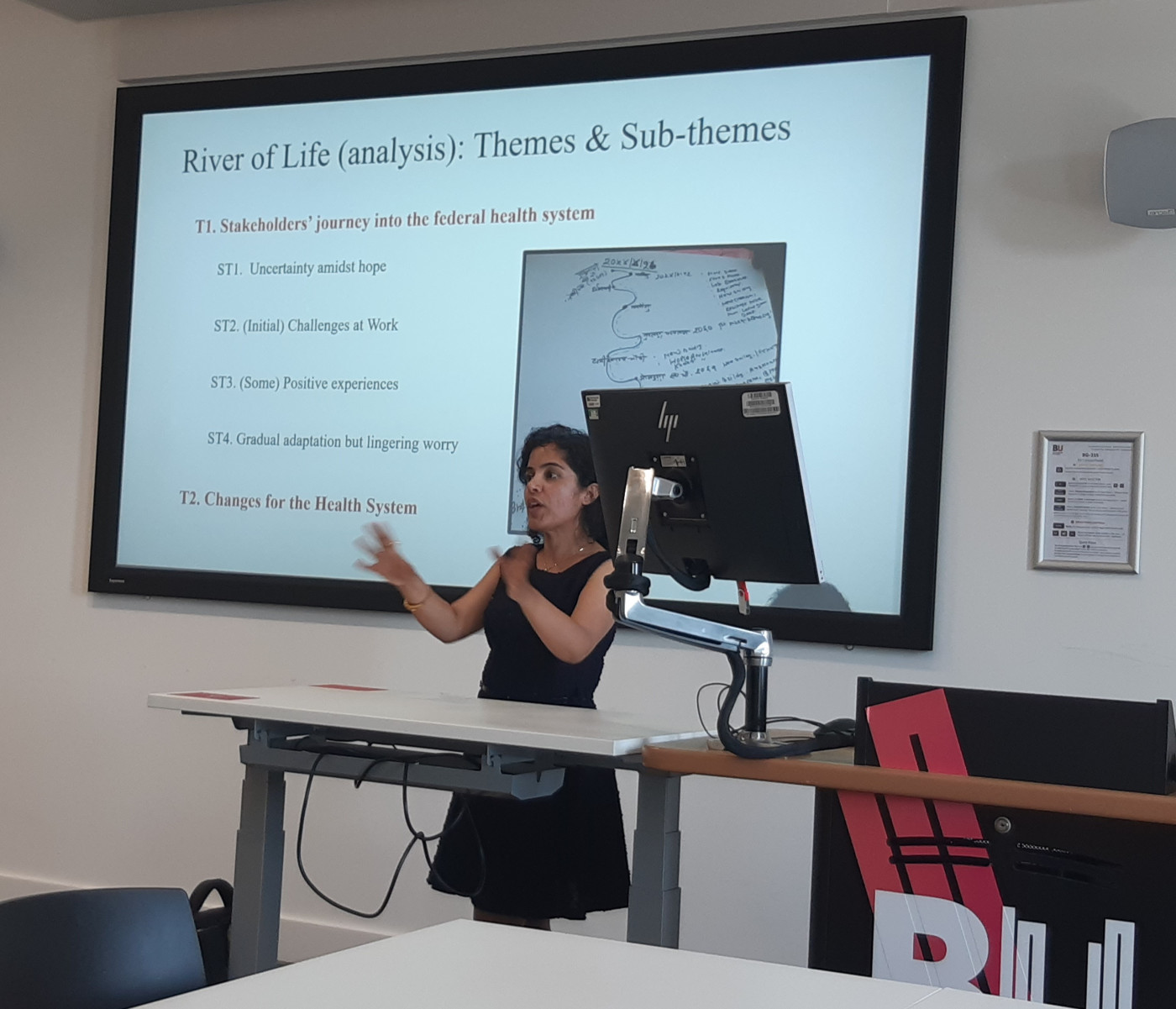
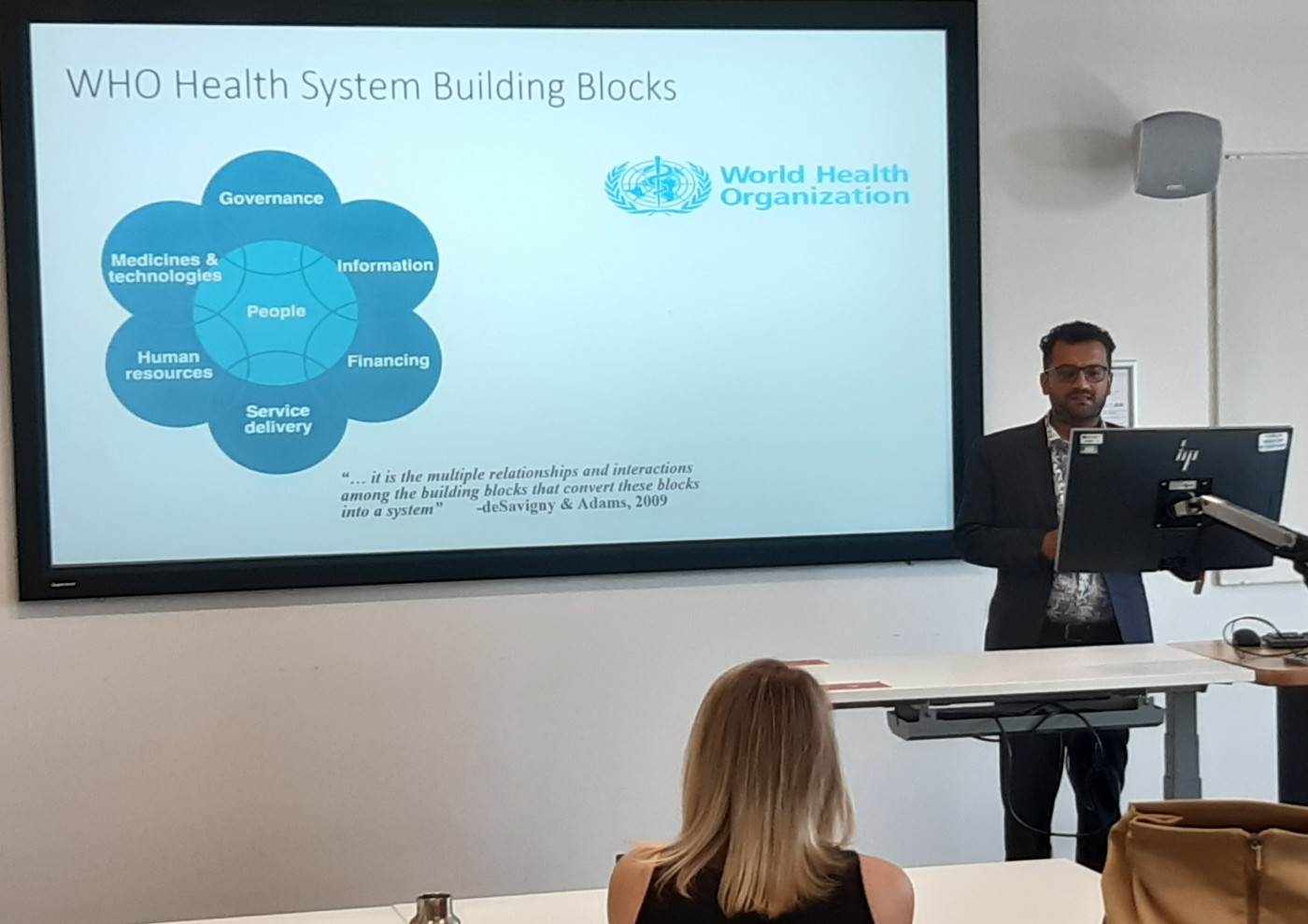
Dr Jonathan Williams, Principal Academic and Deputy Head of the Department of Rehabilitation & Sports Science is the latest BU academic to visit Manmohan Memorial Institute of Health Sciences (MMIHS) in Nepal as part of the Erasmus+ exchange funding. Yesterday he run a workshop in Kathmandu on how to conduct a Literature Review for Health Professionals. This session was well attended by medical doctors at Manmohan Memorial Teaching Hospital.
The workshop was organised buy Prof. Sujan Marahatta at MMIHS, who is also Visiting Faculty member in FHSS. BU is currently in the process of renewing its MoA with MMIHS, to continue working together after this successful Erasmus+ programme.
Prof. Edwin van Teijlingen
Centre for Midwifery, Maternal & Perinatal Health (CMMPH)
Sir Keir Starmer has announced that Labour are reviewing what to do about tuition fees if they win the general election next year (widely expected in autumn 2024, latest it can be is January 2025) giving a clear indication in an interview on BBC Radio 4 that the previous policy of abolishing fees will not survive because of costs concern. The narrative was all about replacing it with something fairer – does that mean a graduate tax is the most likely outcome (which is, arguably what we already nearly have). He also acknowledged that the current system is not working for universities, although a blanket freedom to raise fees, or even an increased cap, might not be what he meant. They will be doing a review ahead of publishing their manifesto – so more news to follow.
The Government published Sir Paul Nurse’s final report on his Research, development and innovation (RDI) organisational landscape: an independent review. It’s a 163 page behemoth that was commissioned in 2021 to identify strengths and weaknesses, and to make recommendations for improvement of the RDI landscape, with a primary focus on researchers and RDI funded by the public purse. It also comments on how the various RDI organisations interact with and support industry, commerce, and society more generally.
It speaks of a patchwork of funders and sometimes short-term public policy priorities and initiatives. These are part of the significant problems that the Nurse Review identifies and Sir Paul calls for the governance to step away from further piecemeal changes and urges Government to consider the Review as a whole rather than a pick and mix assortment to be selected from. Government has a very important long-term role to play in bringing this about. It will require increased investment, reduced policy volatility, a clear focus on optimising and implementing change, good data collection, and a long-lasting, consistent, systematic approach to policy development and safeguarding of the RDI landscape.
Concerns include
The report concludes:
The financial sustainability of the public research funding for universities needs to be urgently addressed. ‘End-to-end’ research support has four components: direct research costs; administrative services; technical facilities; and laboratory facilities. The present funding arrangements do not provide adequate support for all these components, and need to be overhauled to ensure that they do so. Proper ‘end-to end’ funding is required in universities to fully support research activities with mechanisms that do not have perverse incentives or outcomes, and that better consider the quality and not just the quantity of research delivered. There needs to be a detailed review of response-mode and competitive grants, full Economic Costing (fEC) and Quality-related Research Funding (QR), and where necessary, these funding mechanisms should be reformed or replaced. The present underpinning of UK university research by other commercial income sources, notably fees paid by international students, is valuable, but care is needed as such sources are not always reliable and sustainable.
Government response
Michelle Donelan wrote to Sir Paul to warmly welcome the report:
The Government also confirm here that they will respond to the [Nurse] Review’s recommendations in the coming months.
Recommendations – full list
Blogs:
Ministerial Change: Michelle Donelan has temporarily stepped away from her role as Secretary of State for Science, Innovation and Technology for her maternity leave. On leaving Donelan tweeted a series of items to highlight the achievements she and colleagues have accomplished whilst she has been in role. It’s a quick reminder on the latest Government policies within science and tech.
Donelan’s SoS role is being covered by Chloe Smith (former work and pensions secretary). Chloe is the daughter of a teacher (mum) and furniture designer (dad). She is a graduate of York University and has held school governance roles. Chloe worked as a Business Consultant for Deloitte UK. She sees herself as a progressive Conservative and is a member of the Tory Reform Group (more on the Left of the Party), voted to Remain in the EU and has announced she will not seek re-election as a MP at the next general election.
Free Speech – imminent: The Free Speech Bill will return to the Commons following the latest Lords amendments on Tuesday 2 May. At a Westminster event last Wednesday a Parliamentarian indicated that this could be it and the Bill may well soon become an Act. There is still widespread concern about the Bill within the sector, primarily because it is unclear how the different provisions within the Bill, such as academic freedom, will play out in practice. The Westminster event highlighted that even Parliamentary Members, expert sector and legal bodies, and University representatives do not interpret aspects of the Bill in the same way. The Bill adds to a complex legislative background where many other Acts influence the ‘ins’ and ‘outs’ should the Free Speech Bill be enacted in its current form. The first few cases brought under the legislation will be crucial in determining how the potential Act will change behaviour in the sector.
As a recap the final stages (ping pong) of the Bill centred on the argument over the inclusion of the statutory tort allowing those who think their free speech rights have been infringed to bring a legal claim for damages against a university or a students’ union. The Lords removed it, the Commons added it back in. Currently a compromise has been reached with the tort as a watered down backstop – included in the Bill as a means of last recourse after complaints processes have been exhausted.
Education Committee: Mohammad Yasin has joined the Education Select Committee. Mohammad is a Labour MP who has demonstrated a keen interest in securing better funding for education, social services and healthcare provision. Chair of the Commons Education Committee Robin Walker has announced his decision to stand down from Parliament at the next General Election. New Chairs of select committees are elected after each general election so this isn’t big news. We simply know there won’t be any continuity between the Chairs and therefore the focus of the business will likely change to a greater degree as a new Chair with new priorities will be selected.
DSIT is being beefed up with three additional ministers:
Select Committees will reform (from 26 April) to model the new Government departmental structure:
Financial health of HE sector: Wonkhe report on the House of Lords debate on financial pressures in higher education. Lord Knight of Weymouth opening proceedings with the observation that “it appears that the university business model is teetering.” For the government, Baroness Barran argued that “we know that the finances of HE providers are sound when we look at this at a sector level,” though recognised the uneven impact of cost pressures. She drew attention to OfS’ forthcoming report on the financial health of the sector, due next month. You can read the report on Hansard.
It’s a busy time for HE in Westminster because the Lifelong Learning Bill will proceed through the final legislative Commons stages shortly. We wrote about this Bill extensively in this policy update in March and this is the one that is intended to fundamentally change how the HE sector delivers or packages their provision.
Upon completion the Bill will move to the House of Lords for their scrutiny. Two key amendments have been tabled for the final Commons stages. One seeks to prevent variable fees being changed based on course or subject. The second proposes that one credit equates to 10 learning hours.
For a catch up on the Bill this Library briefing is useful. The briefing also sets out a timeline for the next steps for implementation:
The sector reaction to the Bill has been cautiously positive. The Library reports:
For more on the full ‘ins’ and ‘outs’ at each stage of parliamentary consideration of the Bill see this separate briefing.
Wonkhe Blog: Including postgraduate study in the LLE could be expensive, but leaving it out carries risk. Mark Bennett weighs up the potential options and outcomes.
The Department for Science, Innovation and Technology (DSIT) published making Innovation Matter: How the UK can benefit from spreading and using innovative ideas. It aims to bring together insights and analyse innovation enablers and barriers. Here are the most relevant key points:
Opportunities to better understand and improve IDA include:
Recent weeks have seen the publication of a melting pot of various Government strategies, funding initiatives and policy declarations. We try to bring them all together (relatively) simply under the banner of the new Science and Technology Framework.
Published a couple weeks ago the Government’s Science and Technology Framework for the UK sets out the vision for the UK to be a science superpower by 2030. It seeks to identify critical technologies, invest in R&D, develop talent, build international relationships, and do better in communicating the UK’s R&D strengths. The new measures sitting alongside the framework are backed by £500 million of funding.
The Framework is owned by DSIT but will be a coordinated cross-government approach. Here are the 10 key actions:
Here’s the funding and policy breakdown:
Not particularly insightful, but nonetheless entertaining, was the Opposition’s response to the publication of the Science and Technology Framework. Chi Onwurah, Shadow Minister for Science, Research and Innovation, highlighted the turnover of nine science ministers in the last five years and stated the country deserved a science framework “with a longer shelf-life than a lettuce”.
Always in the news but no real movement is the latest on Horizon association. The Windsor Framework resuscitated hope in what had become a Horizon dead duck. The rhetoric from the research associated Government departments continues to indicate progress and the assumption that association is still on the table and desired by both sides.
Here’s the short version of all the recent noise:
Parliamentary Questions:
Sharia Compliant Finance
Previously DLUHC appointed an Independent Faith Engagement Adviser to review how the Government should engage with faith groups in England. The Adviser, Colin Bloom, recently published the review report. The report includes a recommendation for Sharia compliant finance and places a firm timescale on the Government:
Sharia compliant finance feels like one of the slowest progress policy priorities within HE. The Government first proposed a student finance product consistent with Muslim beliefs regarding interest-bearing loans in 2013. The Higher Education Research Act, passed in 2017, allows the Government to introduce such a product in England, but it has yet to do so. The issue has been raised in Parliament a number of times, with the delay described as “shameful” by Lord Sharkey.
Following the Lifelong Learning Entitlement (LLE) Consultation the Government announced Sharia compliant finance would not be ready as part of the LLE launch in 2025 but that the Government remained committed to delivering such a product “as soon as possible after 2025”. A parliamentary Library briefing on the topic informs that findings from the Muslim Census study suggest over 12,000 students per year are affected (deterred from taking out loans which acts as a barrier to entering HE or causes financial hardship).
It remains to be seen whether Bloom’s timescale will be met by the Government – it seems unlikely given the Government have already ruled out including Sharia compliant finance within LLE in 2025.
On other student finance matters Wonkhe have a new blog – As the state reduces its support for students in real terms, Jim Dickinson considers the role of institutional student finance measures in addressing the cost of living crisis.
Spiking
The Labour party intend to make spiking a specific offence if they are elected to government. It would form part of several measures aiming to tackle violence against women and girls (VAWG) and broaden the Labour party’s “tough on crime” credentials. Dods report that the Home Affairs Committee previously recommended the creation of a new standalone offence, however the Government’s response to the inquiry’s findings suggested this wasn’t necessary as there were already measures and guidance in place to improve reporting, data collection and police response to incidents. The Committee’s inquiry focused heavily on night-time venues, and heard from many in the university sector about the prevalence and nature of spiking on campuses. UUK also published a practice note for HEIs to support their response to spiking.
Student Accommodation
Wonkhe – Over half of students living in the private rented sector have experienced damp or mould on walls or ceilings, and half say their accommodation is poorly insulated, according to a new report from SOS-UK in partnership with Universities UK. Homes Fit for Study 2023. Universities UK has published a note on how universities can support students facing fuel poverty. ITV news has some experiences from students up on YouTube.
Duty of Care
The petition to Parliament for universities to have a legal duty of care for students (started by the families of student’s who took their own lives) has reached a significant threshold and the matter will be debated on Monday 5 June. Previously the Government responded to this petition:
We’ll bring you the outcome of the debate after it takes place.
The APPG for Students published their Report of the Inquiry into the impact of the cost-of-living crisis on students. They conclude that most students are facing significant financial pressures, with some groups particularly hard hit, risking academic outcomes and participation in the extra-curricular activities that are so valuable for future careers. We are concerned that this is unfair on a generation of students already affected by the pandemic, and risks widening inequality.
… Alongside reports of students cutting back on meals and other essentials, as many other people, we were struck by evidence of the additional hours many students were working to cover their costs and the development of a ‘grab and go’ approach to their qualifications, as they can no longer invest time and energy in participating in all the other aspects of student life that prepare them for employment, having an impact not just on the tertiary education sector, but on a generation of working adults.
The inadequacies of relying on current hardship measures are acknowledged:
…we must not only provide students with the necessary immediate financial assistance – through increased hardship funding and restoring maintenance loan entitlements – but also to address issues in the student funding system which have seen student support incrementally reduced in real terms over several years and reduced resilience as inflation has risen sharply over the last two years. We have noted the increase in university support and believe that there is more that could be done to ensure all students are helped but recognise that current services are designed to help small numbers of students in emergencies, and not hardship experienced by a large proportion of the student body.
The APPG calls on the Government to provide a financial solution:
… We recognise the demands and pressures across every area of government spending but feel that our recommendations for both an immediate spending commitment to support students who have been placed in significant financial hardship, as well as longer-term changes are needed for both current and prospective students.
The OfS published an insight brief – Studying during rises in the cost of living. They conclude: Universities, colleges and students’ unions have worked innovatively and at speed to help alleviate these pressures, with additional help from government for their hardship funds. These responses have been diverse, and the support available has varied from university to university. The mitigating activities…may not all be sustainable over a long period. It’s worth a scan through to read the box sections covering actions by universities (financial needs, warm spaces, food needs).
Cost of living blogs:
Wonkhe content:
Parliamentary Questions
Wonkhe report on the House of Commons Education Committee’s latest report – The future of post-16 qualifications which calls on the government to pause the withdrawal of funding for existing level 3 technical qualifications (such as BTECs) until evidence is available that T Levels are more effective at meeting student and employer needs and promoting social mobility. The report notes that universities are often requiring applicants to offer A levels alongside T levels (the latter being nominally equivalent to three A levels), and calls on DfE to work with universities to avoid “unreasonable” entry requirements. The report is covered on BBC News.
Wonkhe: Fewer significantly disadvantaged and economically precarious students are entering higher education in England – and they are less likely to complete their degree and progress to skilled employment or further study than their peers, new data from the Office for Students (OfS) shows. CEED, one of its new and updated key performance measures, shows that 53.6 per cent of the most significantly disadvantaged students progress to further study or skilled jobs, compared with 68.4 per cent of students who are neither “significantly disadvantaged” nor “economically precarious”. 49,600 students categorised as significantly disadvantaged entered in 2021/22, a decrease from 51,100 in the previous year. KPM 8, which measures the proportion of subjects taught and the number of higher education providers (relative to population) in each English region, shows that the North East has the lowest level of subject diversity in the country for full time students, and KPM 7 on Degree attainment by ethnicity shows that students receiving first class degrees in 2021-22 was 15 percentage points lower than the proportion for all students.
Advance HE has published the Disabled Student Commitment which was developed by the OfS funded independent strategy group the Disabled Students’ Commission. The Commitment draws on three years of consultation with disabled students and sets out a framework of 43 recommendations for HEIs, Government, funders, agencies, regulators and professional, statutory and regulatory bodies. It highlights expectations for information sharing and consent and offers guidance on key touchpoints of the HE journey, outlining the commitments that HEIs and others should make to give disabled students confidence their needs and expectations will be met.
Professor Geoff Layer, chair of the Disabled Students’ Commission, said: We have developed this Commitment because disabled students have told us they want communication, consistency, certainty and choice. The Commitment is a call to the sector and sector bodies to make the step-change required to create a more inclusive environment. We need to create a sense of belonging in which students are able to focus on what they went into higher education for, and not spend untold hours fighting their way through the system.
Professor Layer said the Commission was asking providers to work in partnership with their disabled students on a statement of commitment which should be updated annually and published on their website, alongside a logo of the Disabled Student Commitment so that disabled students and applicants have confidence in the system, allowing them to get on with their education.
OfS published new data on HE access and participation. The completion rates data highlight:
There is lots more to explore in the data dashboard.
OfS also published their new Equality of Opportunity Risk Register (EORR) and expect universities to consider the listed range of equality risks when planning. It includes risks relating to the perception that HE might not be right for people from disadvantaged backgrounds, or concerns about academic and personal support for those at university, students’ mental health, the continuing impact of the pandemic on education opportunities, and pressures on living costs.
OfS has also published the outcome and analysis of responses to their consultation on a new approach to regulating equality of opportunity plus a commentary from OfS Fair Access and Participation Director.
TASO published online teaching and learning – lessons from the pandemic. Executive summary here; rapid evidence review here.
Here are their key findings:
Recommendations:
Wonkhe report on the Institute of Student Employers’ annual report on development programmes for graduates and apprentices. 54% of employers surveyed agreed that graduates were “career ready” at the point of hire (31% unsure). The report covered 162 responses from student employers who collectively hired over 26,000 graduates in 2021–22.
HESA published National Careers Week: Career trends of graduates from the class of 2019/20.
Careers: Wonkhe blog – The idea that a postdoc is a route to an academic career downplays other career possibilities. Lucy Williams and James Howard have been helping postdocs prosper with tailored advice and support.
Wonkhe report that: there has been a 65% increase in the number of international students at English higher education providers over the past four years, with growth of over 100,000 in the past year alone. The figures come from the delayed Office for Students’ Higher Education Students Early Statistics survey (HESES), which provides an early indication of the number of higher education students studying in 2022-23.
They also show that the home v international split for postgraduates in the English system is now roughly 50:50, and that providers are forecasting that circa 320k students will not complete by the end of the year, up from 300k a year ago.
Blog: New English student numbers figures show how rapidly universities are changing size and shape. David Kernohan and Jim Dickinson consider if the regulation can keep up
Scottish Minister for Higher Education and Further Education, Youth Employment and Training Jamie Hepburn answered questions on international students and accommodation.
Wonkhe: Home Office proposals to limit the number of international student dependant visas are receiving a “major pushback” from the Treasury, i News reports. It says Chancellor Jeremy Hunt is resisting Home Secretary Suella Braverman’s proposals, arguing they would inflict “major damage” on the British economy.
The Higher Education Policy Institute has published a range of interesting blogs and briefings recently. You may be interested in:
The DfE published a policy paper on the use of generative artificial intelligence (AI), including large language models (LLMs) like ChatGPT or Google Bard, within the education sector. Snippets:
Strategic Skills planning: The DfE Unit for Future Skills published the UK labour market projections up to 2035 (national, regional and local). You can display the data by LEP or other choices and it provides information to support local skills plans, careers guidance, and provides a projected picture of the type of jobs in the UK labour market (and the skills needed) up to 2035. Data here.
Carbon capture curriculum: The Scottish Affairs Committee has published a report on hydrogen and carbon capture in Scotland. It warns that the UK will fail to meet its net zero targets, and transition away from fossil fuels, unless carbon capture is rolled out at scale. The report calls for the UK and Scottish Governments should jointly set out work they are undertaking to ensure that colleges, training providers and businesses within the hydrogen and CCUS sectors are able to offer appropriate routes into employment and training, and providing this information should be viewed as a priority.
President UUK: UUK announced that Professor Dame Sally Mapstone FRSE, Principal and Vice-Chancellor of University of St Andrews, has been elected as its next President. The role runs for two academic years from 1 August 2023 and is elected through a ballot of UUK’s 140 members. Dame Sally will succeed current President, Professor Steve West CBE, Vice-Chancellor of UWE Bristol. Before her appointment as Principal and Vice-Chancellor of the University of St Andrews in 2016, Dame Sally lectured and held several leadership roles at the University of Oxford, including Pro-Vice-Chancellor for Personnel and Equality and Pro-Vice-Chancellor for Education. She has served as a Board Member of UUK since 2016 including currently as Vice-President for Scotland, by virtue of being Convener of Universities Scotland.
Late retirement: The Times reports that graduates could work longer under plans to allow people in manual jobs to claim their state pensions earlier (Wonkhe).
To subscribe to the weekly policy update simply email policy@bournemouth.ac.uk. A BU email address is required to subscribe.
External readers: Thank you to our external readers who enjoy our policy updates. Not all our content is accessible to external readers, but you can continue to read our updates which omit the restricted content on the policy pages of the BU Research Blog – here’s the link.
Did you know? You can catch up on previous versions of the policy update on BU’s intranet pages here. Some links require access to a BU account- BU staff not able to click through to an external link should contact eresourceshelp@bournemouth.ac.uk for further assistance.
JANE FORSTER | SARAH CARTER
VC’s Policy Advisor Policy & Public Affairs Officer
Follow: @PolicyBU on Twitter | policy@bournemouth.ac.uk