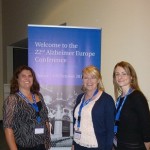
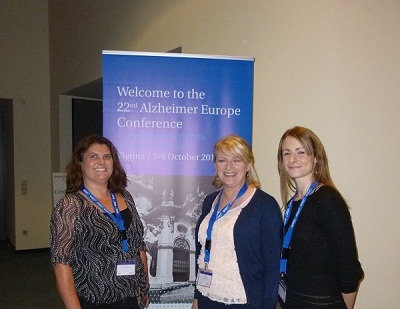
 October is the month of the annual Alzheimer Europe (www.alzheimer-europe.org) meeting. This year three BUDI team members attended the rather nice setting in Vienna a draw for everyone, although we all had very different agendas and expectations. Alzheimer Europe is one of my personal favourite conferences as I’ve been going for years and it creates the opportunity to meet with new and catch up with a range of international colleagues, and is actually the main reason I go to these kind of events; yes it is good to present the work, and as a team we had two posters and three oral presentations this year, which is not bad for an Institute only in existence for 6 months, but it is the networking aspect that provides inspiration and creates new ideas and new collaborations that motivates me to go to these kind of events.
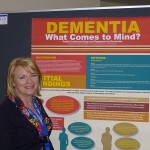
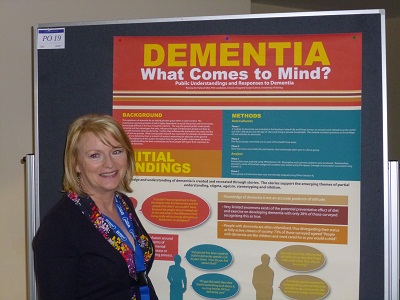
Patricia McParland is BUDI’s project manager, she has presented at a few dementia conferences in the last 3 years but for this conference her main concern was to ensure her cutting edge work doctoral work, that she is in the final throes of writing up, on public awareness of dementia is getting out there as this is an area of increasing policy concern both in the UK and internationally and many are starting to work in this particular area. As well as presenting a poster on her doctoral work that received positive attention, she presented a paper reporting on one of BUDI’s project about Dementia Friendly Tourism. The concept of Dementia Friendly Tourism has caught the imagination of many we speak to about our dementia work and this proved to be the case again in Vienna. Colleagues from France, Spain and Jersey were particularly interested in this project and keen to explore how these ideas could be applied to their regions; we will see what transpires over the coming months in the way of collaboration but this is a nice example of the added value of going to a conference.
Clare Cutler is a research assistant in BUDI and has just started her PhD exploring experiences of war and dementia, as an Early Career Researcher Clare was thrilled to be attending her first interational conference, and her excitement was contagious! but she was also rather anxious about giving her first presentation on one of BUDI’s projects, GRIID, Gateway to Rural International Innovations in Dementia, on behalf of an international team. She needn’t have worried as she went down a storm; mainly because she said at the beginning that she was nervous, this was her first presentation and then let out a big sigh as she finished. This created a huge amount of goodwill to her personally as well as her giving a presentation on an innovative interational partnership project. We had received the support of Alzheimer Disease International (www.alz.co.uk) to conduct part of this study and the opportunity for further discussion about working together to target rural areas and developing countries is another of the added value benefits that being in Vienna brought for me this year.
I presented a paper on a recently completed evaluation of a telehealth project to diagnose and follow up people with dementia living on the Shetland Isles and Grampian, rural areas of Scotland. The added value of this work relates to the INTERDEM (www.interdem.org) meeting that was held the day before the conference. (This is another example of added value by the way, going to other meetings around a conference.) Interdem is an application/invite only pan European network of highly active psychosocial researchers in the dementia field; as a member I was also able to take my BUDI colleagues in their student roles, a new doctoral and just about to complete doctoral student, to this full day meeting and they found this an amazing experience as many of the ‘names’ of long established dementia academics are part of this group which is always a buzz to meet people you’ve quoted for the first time, who offered real warmth, enthusiasm and support for their work. The Interdem meeting this time round was a mix of presentations (including one from the task force on technology and dementia that I co-lead) and working groups developing bid ideas, collaborative papers and general brain storming about how to take forward new work in the field. The technology task force has been working on a bid around exergaming and dementia and we used the lunchtime slot to meet to work up our ideas further (more added value) as well as updating Interdem members about our progress with this bid during the meeting itself. But we also discussed new bid ideas and telehealth, the focus of my Alzheimer Europe paper, was one of the favoured topics; one of our jobs now is to see the details of a long-awaited funding call (JPND) due out December 2012 and get writing another EU bid. We also agreed to write a collaborative paper on technology and dementia, but a successful meeting is one that generates new work from my point of view!
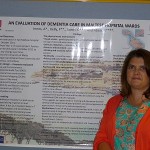
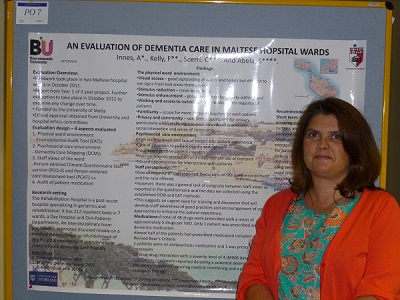
My other bit of dissemination work was a poster about ongoing research evaluating dementia care in Maltese hopsital wards. The added value about this relates to the conference venue being in Malta next year and I am sure this has partly influenced the invitation, of the Maltese Dementia Society member who is a long standing collaborator of mine as well as being the local organisor for the 2013 meeting, for me to give a plenary there next year!
So in all, the value of going to conferences for new researchers, is undoubtedly to present their work, to meet esteemed colleagues and the resultant ‘buzz’ this brings, to learn about other research in the field and to start their own networks (a good example of this is Patricia joining a writing team for a methods related paper, more added value!). For me it is a chance to catch up with people and to discuss potential new collaborations. In previous years it has also been about keeping a profile of the work of my team, this year it was about starting to create a profile for a new BU team to an international audience. I am pleased to report that all boxes were ticked this time round!
 e forthcoming Horizon 2020 scheme, which is still going through the consultation process. It is expected that Horizon 2020 will focus on three priorities: ‘Excellent Science’, ‘Industrial Leadership’ and ‘Societal Challenges’. Jo also introduced the new Erasmus for All scheme.




 BU was well represented with poster presentations from Vanora Hundley, Professor of Midwifery, and Emma Pitchforth, Visiting Fellow.










 SONAMONI contributions to Safety Conference 2026 in South Africa
 Three CMWH presentations at Berlin conference
 New interdisciplinary paper on Nepal
 Horizon Europe Cluster 3 (Civil Security for Society) 2026 Calls Now Open
 MSCA Doctoral Networks 2026 Call Information Webinar
 ESRC Festival of Social Science 2026: Application Deadline Extended to Thursday 25 June 2026
 Reminder: Register for the ESRC Festival of Social Science 2026 Information Session
 ECR Funding Open Call: Research Culture & Community Grant – Apply now
 ERC Advanced Grant 2025 Webinar
 Update on UKRO services
 European research project exploring use of ‘virtual twins’ to better manage metabolic associated fatty liver disease