Category / Research assessment

Want to know how you target high impact journals?

My Publishing Experience: Prof. Matthew Bennett

Wed 23rd July 12:30-14:00 Russell Cotes Museum, Bournemouth

On Wednesday 23rd July, Prof. Matthew Bennett will be hosting a Writing Academy lunchbyte session at the Russell Cotes Museum.

In this session, Matthew will talk about his personal publishing experience, his approaches to research and writing, how to develop a publication strategy and the challenges of working with colleagues and dealing with both reviewers and editors.  He will talk about all type of publishing from journal articles, to books via edited compilations.  Drawing on personal experience he will also focus on how you target high impact journals.   After the presentation, attendees are invited to stay and discuss the topic with the speaker over lunch.

To book a place on either of these workshops, please email staffdevelopment@bournemouth.ac.uk

If you have any questions relating to these sessions then please contact Shelly Anne Stringer

BUs Open Access Event in Video!

open access logo, Public Library of ScienceIn May, we were privileged to welcome experts on the topic of Open Access to speak at Bournemouth University (BU) in an event well attended by delegates from HEIs across England, Scotland and Wales.  BU’s Open Access Event was enjoyed by all who attended, if you missed the event or would just like to recap on the presentations the videos from the event are now available for your viewing pleasure –

Benefits of Open Access – Alma Swan

Open Access in a Post-2014 REF – Ben Johnson, HEFCE

Open access + social media = increased downloads – Jane Tinkler, LSE Impact of Social Sciences Project

Open Access publishing and emerging networks of open research – Catriona MacCullum, PLoS

Implementing open access at the University of Oxford – Catriona Cannon, Bodleian Libraries

Open Access: BU Style – Emma Crowley, Jean Harris and Shelly Maskell


Brush up yer BRIAN

BRIANRKEO will be delivering some ‘Brush up yer BRIAN’ training on 19th June 2014 1pm for Media School staff and students. The session will cover:

  • What is BRIAN and why is it important
  • How to set up and maintain your BRIAN profile
  • How to ensure your details are correct
  • How to request a photo is uploaded
  • How BRIAN links to your external staff profile
  • How BRIAN data is used towards BUs KPIs

 To book on please register here.

Firsthand: HEFCE’s Open Access Policy

A few weeks back we were privileged to welcome experts on the topic of Open Access to speak at BU in an event well attended by delegates from HEIs across England, Scotland and Wales. The event was enjoyed by all who attended and over a series of blog posts I hope to summarise some of the key points raised by each of the speakers. We also filmed the event so hope to be posting this soon for all to watch, enjoy and comment upon. 

A few days a go, I summarised Alma Swans Introductory Address on ‘The benefits of Open Access’. Today, I look at Ben Johnson’s presentation ‘Open Access in a Post-2014 REF’.

Ben Johnson is a policy adviser at the Higher Education Funding Council for England (HEFCE), where he has worked for the past five years. He has a first class honours degree in music from the University of Southampton, and ten years’ experience working in strategic planning, process improvement and risk management. Since joining HEFCE, Ben has focussed on developing the Council’s thinking in novel, emerging and cross-cutting policy areas. Recently, these have included examining how technological advancements can drive openness in education and research. In 2013, Ben joined the research policy team to lead HEFCE’s work on open access, research information and infrastructure.

In April, HEFCE and the other three UK funding bodies published details of a new policy for open access relating to future research assessments after the current 2014 REF. To read this item in full visit: http://www.hefce.ac.uk/news/newsarchive/2014/news86805.html. In his presentation, Ben talked through this policy and answered questions from delegates throughout the day.

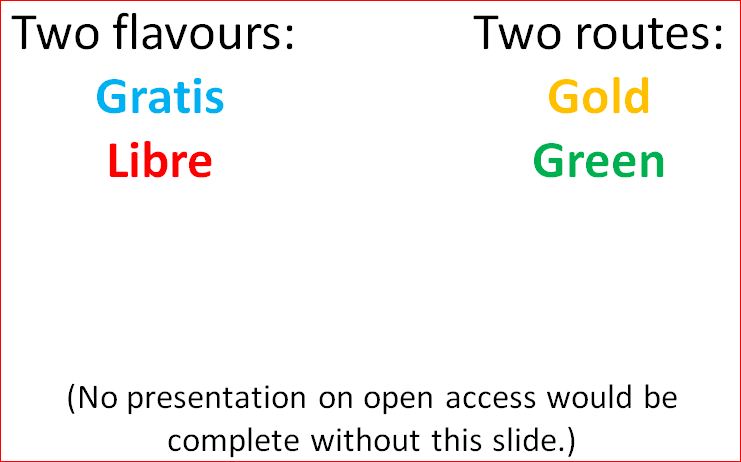
He opened his presentation by outlining Open Access its flavours and routes. GOLD being the journal making the work immediately and freely accessible online under a CC-BY licence and GREEN by the author depositing their work into an intuitional or subject repositories at point of acceptance – further information can be found in earlier blog posts (How to deposit to BURO, Green & Gold).

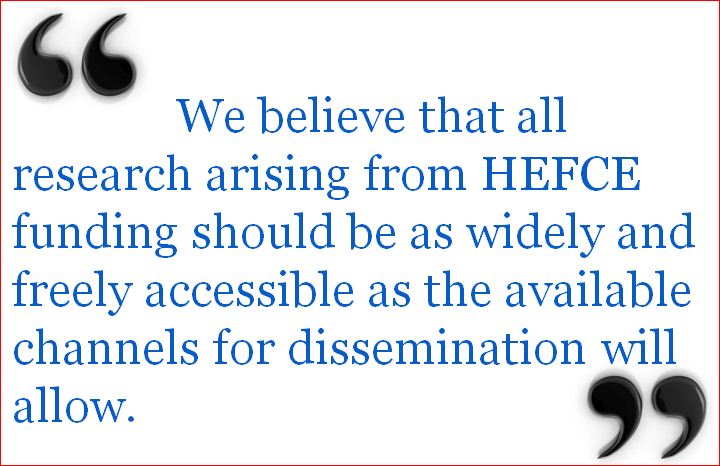
HEFCEs core principle behind the policy is that outputs submitted to a post-2014
REF should be Open Access and they have three objectives in implementing the policy:

  • Significantly increase the uptake of open access options
  • Protect author choice as much as possible
  • Stimulate the deposit of work in repositories


  The minimum requirements of the policy are that:

  1. The final peer-reviewed draft of your paper is deposited in an institutional or subject repository on acceptance
  2. The repository record must be discoverable ASAP
  3. The full text must be accessible ASAP (or once an embargo has elapsed)

 This will apply to all journal articles and most conference proceedings (those with an ISSN), he also stipulated that the maximum embargoes to be allowed will be:

  • REF main panels A and B – 12 months
  • REF main panels C and D – 24 months

An analysis of the REF 2014 submissions found that 96% of outputs could have been Open Access based on this criteria and the remaining 4% would be covered in the exceptions of the policy.

In addition to this, extra credit will be given in the research environment component of the post-2014 REF where an HEI can demonstrate that:

  • Outputs are presented in a form that allows re-use of the work, including via text-mining
  • Outputs not in the scope (books etc.) are made open access

 The prediction is that this will lead to:

  • Significantly greater uptake of open access (even within publishers’ current policies)
  • Increased visibility and usage of repositories
  • Many more immediate deposit mandates
  • Later: author-driven moves to faster and more permissive access
  • Later: open access is ‘solved’ for books etc.

Full slides from Ben Johnson’s presentation at Bournemouth University’s Open Access Event on the 7th May 2014 are available here internally.

If you would like to deposit your full text articles into BURO you can do this easily via BRIAN, full guidance can be found on the staff intranet pages.

Should metrics be used more widely in the next REF?

Back in 2008, after the dust was settling from the REF 2008 submission, HEFCE initiated a series of exercises to investigate whether bibliometric indicators of research quality (such as citation counts) could be used as part of the assessment for REF 2014. BU was one of 22 institutions that took part in the bibliometrics pilot, the result of which was that HEFCE concluded that citation information was not sufficiently robust enough to be used formulaically or as a primary indicator of quality but that there might be scope for it to inform and enhance processes of expert review in some disciplines. The REF 2014 guidelines stated that citation data would be provided for outputs submitted to all sub-panels in Main Panel A and some sub-panels in Main Panel B.

In April 2014, the Minister for Universities and Science asked HEFCE to undertake a fresh review of the role of metrics in determining quality, impact and other key characteristics of research undertaken in the HE sector. The review is being chaired by Professor James Wilsdon, Professor of Science and Democracy at the Science Policy Institute, University of Sussex.

HEFCE have launched a sector-wide call for evidence about research metrics and BU will be making an institutional response. BU colleagues are therefore invited to send feedback to me so that it can be considered as part of BU’s response. Colleagues are also invited to send individual responses to HEFCE.

Thinking back to 2008-09, I remember research metrics being an emotive subject and many researchers, both at BU and  across the sector, were extremely skeptical of their use in research assessment. Although bibliometrics have moved on a long way since then I think that there will still be concern as to whether metrics are robust enough to be used formulaically, particularly in the arts, humanities and social sciences.

HEFCE have asked that responses focus on the following issues:

1. Identifying useful metrics for research assessment.

2. How should metrics be used in research assessment?

3. ‘Gaming’ and strategic use of metrics.

4. International perspective.

Further information about the call for evidence is available here: http://www.hefce.ac.uk/whatwedo/rsrch/howfundr/metrics/

It is anticipated that the outcome of the review will inform the framework for the next REF assessment so it is vitally important that HEFCE receive a high quality and quantity of feedback from all disciplines.

If you would like to contribute to the BU institutional response, please add your comments to this response form and email it to me (jnortham@bournemouth.ac.uk) by Friday 30th May.

BUs Open Access Event

Last Wednesday, BU hosted a sector-wide Open Access Event at the EBC. The day was a great success with attendees travelling from universities across the UK to hear keynote speaker Alma Swan and speakers from HEFCE, LSE Impact Blog, PLOS, University of Oxford and BU talk about Open Access, one of the key priorities for the sector at the moment.

Feedback from the event has been overwhelming positive with attendees finding the day extremely useful with lots of interesting discussion throughout the day. Over the next few weeks, we’ll be posting blogs summarising the key points from each of the presentations so keep your eyes peeled…

HEFCE’s Open Access Policy for the next REF Published

HEFCE and the other three UK funding bodies have published details of a new policy for open access relating to future research assessments after the current 2014 REF.

The policy describes new eligibility requirements for outputs submitted to the post-2014 REF (commonly referred to REF2020). These requirements apply to all journal articles and conference proceedings accepted for publication after 1 April 2016. They do not apply to monographs, other long-form publications, creative or non-text outputs, or data.

 open access logo, Public Library of ScienceThe requirements state that peer-reviewed manuscripts must be deposited in an institutional (BURO) or subject repository on acceptance for publication. The title and author of these deposits, and other descriptive information, must be discoverable straight away by anyone with a search engine. The manuscripts must then be accessible for anyone to read and download once any embargo period has elapsed.

There are limited exceptions to the policy, where depositing and arranging access to the manuscript is not achievable.

This policy was developed following an extensive two-stage consultation during 2013, to which they received over 460 written responses.

 To read this item in full visit: http://www.hefce.ac.uk/news/newsarchive/2014/news86805.html

If you would like to know more about Open Access, Bournemouth University are hosting asector-wide Open Access Event on the 7th May with Ben Johnson from HEFCE presenting on the policy, places are limited so if you’re interested, please register here.

In the meantime, if you would like to deposit your full text articles into BURO you can do this easily via BRIAN, full guidance can be found on the staff intranet pages. Alternatively, there are two BRIAN training sessions scheduled which you can book on to here.


Open Access Event

On Wednesday 7th May, Bournemouth University will be hosting a sector-wide Open Access Event looking at the benefits of Open Access from both the green and gold perspectives, as well as, focusing on how Open Access can support the achievement of research impact. 

So far confirmed external sessions are as follows:
 
open access logo, Public Library of ScienceThe Benefits of Open Access
Alma Swan – Director of Advocacy Programmes, SPARC Europe
 
Open Access and Implications for REF2020
Ben Johnson – Higher Education Policy Adviser, HEFCE
 
The Twitter Effect and How Social Media Can Promote Engagement with Research
Jane Tinkler – Manager, LSE Public Policy Group
Sierra Williams – Managing Editor, LSE Impact of Social Sciences Blog
 
The Open Access Framework
Catriona MacCallum – Advocacy Projects Manager, Public Library of Science (PLOS)
 
Case Study: Successful Implementation and Best Practice
Catriona Cannon – Assistant Director, Bodleian Libraries University of Oxford
 
There will also be sessions delivered by Bournemouth’s BURO team and Bournemouth academics talking about their own open access experiences.
 
Places are limited so if you’re interested, please register here!

Congratulations to Anne Quinney

Anne Quinney, Senior Lecturer Social Work (HSC) who has been appointed to the Editorial Board of the highly esteemed British Journal of Social Work.

Anne recently stepped down as Editor and Co-Editor of the peer-reviewed journal Practice; social work in action.  Whilst she also recently completing her five-year term of office as Editorial Board member of the peer reviewed journal Social Work Education.


Prof. Edwin van Teijlingen

Centre for Midwifery, Maternal & Perinatal Health

REF2014

REF logo

I’m sure I heard a collective sigh of relief radiate across both campuses last week when BU’s REF2014 preparations were finally submitted. It’s been a huge amount of work, especially in the last few weeks. I myself did a little dance when I eventually handed the case studies over for PengPeng to upload, and then bought a sausage sandwich to mark the occasion.

But all the hard work and late nights that have been put in across the academics community, professional services and the leadership team are well worth it. I truly believe the ‘submit’ button was pressed in the knowledge that BU has absolutely put its best institutional foot forward and, regardless of the result (which I’m sure will be fabulous), no one will be left feeling, ‘We could have done better.’

I’m already looking back on the REF preparations fondly. I feel very lucky to have worked on this important project with such a great group of people. BU has so many talented researchers who are passionate about their subject. Matthew’s energy, vision and drive meant the submission presented BU at its absolute best. And I can honestly say I never met a more organised and efficient group of people than Julie Northam, PengPeng Ooi and Becca Edwards!

Having helped prepare the impact case studies across the eight units, I’ve had an amazing overview of the true societal benefit BUs research brings.  Through the process I’ve examined national and international policy documents, spoken to CEO s of multinational companies, patients benefiting from healthcare interventions and many other diverse beneficiaries who sing the praises of BU researchers and the application of their work.

I think what’s most telling though, is the number of case studies that haven’t been submitted this time round because the impact was too embryonic or interim. Regardless of what the next REF will look like (and impact is bound to be more prominent), this really shows the great impact trajectory that BU’s research is currently tracking. Examples include:

  • Dr Venky Dubey and Neal Vaughan’s epidural simulator project, which recently won the Information Technology category at the Institution of Engineering and Technology Innovation Awards, fending off competition from over 30 countries.
  • Later this month the new multimillion pound Stonehenge visitor centrewill open, bringing together knowledge and displays informed by Dr Kate Welham and Professor Tim Darvill’s research.
  • Dr Sarah Thomas and Professor Peter Thomas from the BU Clinical Research Unit have worked with the Dorset MS Service at Poole Hospital to develop a group based fatigue management programme to help people with MS normalise their fatigue experiences.

From January I’m really looking forward to working on these and other projects, using communication as a tool to enhance dissemination of research findings, helping deliver impact to the heart of society.

(And now I have reacquainted myself with my kitchen, I may also cook some vegetables to counter all the ready meals and chocolate that’s kept me going recently)!!

The unexpected REF journey: how I became part of the process and how it has shaped how I think about HE


Changing places

Two years ago, I could have never imagined the role that I would ultimately play in BU’s REF submission. At the time, I was a research fellow at a nearby institution and in that fortunate position of being able to take a certain detached distance from the whole REF process. Even so, there was a building surge of preparations absolving more and more time for my senior colleagues; simulation exercises were underway and the work of some of the brightest and the best critically scrutinized. Tensions were raised, impact was feared, but for the most part at that stage, I was progressing a number of research projects which meant a lot of time out of the office and in the field.

In April 2012, I took the momentous step leaving the research post which I had worked so hard to get, to pursue my lifelong passion and commitment to public engagement with research. Initially, in no way was my new role to be related to our REF submission, indeed, in many institutions there is a concerted effort for public engagement officers not to be connected to the ‘impact agenda’. There are many reasons as to why this is the case, not least is the fear that public engagement will be tarnished by REF anxieties, but in my-case, that was not meant to be…

Fate intervenes

As you may have read in Julie’s earlier post, babies became a central feature of the REF team. When we knew Sally was going on maternity leave, I was asked to continue her work on supporting the development of the impact case studies for the REF. Although a mammoth task, it was an opportunity that I could not refuse. On my last day in my previous institution, I had co-organised an event around ‘food and the third sector’, aimed at bringing together key practitioners with leading academics in the field. It was a terrific event and I believe genuinely developed new understandings between key practitioners, policy makers and academics. One of our speakers (not so co-incidentally) was Kevin Morgan (one of my first bosses and recent winner of an ESRC impact prize) was delighted to hear of my new role at BU and I remember him saying (in his distinct lyrical tones) that ensuring research was of benefit to society was ‘in my blood’ – probably true given I come from a family of engineers and technology experts! How you demonstrate impact was also a question that was fresh in my mind having spent the previous two and a half years conducting research with third sector organisations. For charitable causes, impact is king – fundamental to continued support and funding  is the need to demonstrate the difference they make to society.

Climbing the impact mountain

In September 2012, the impact challenge was on. Following a set of agreed actions devised by Matthew, Sally and all the impact case study authors in June 2012, the next task was for the work that had been prepared to date to be transferred into the required HEFCE template. This is harder than it sounds: the template was to be a maximum of four pages with indicative word limits for each section and highly prescribed guidance on each section. At this time, a number of new potential case studies also emerged, and I worked with the authors to develop these and ensure they found their way into the template.

The process of doing this was tremendously challenging for all concerned. How do you summarise up to twenty years of research in a few hundred words? What happens if your research and impact was non-linear? What happens if the sources to corroborate your impact are no longer available? What would happen if the impact was in the process of happening? We found our way through these questions as a team, but we won’t necessarily know the answers to them until the end of next year – however good HEFCE’s answers to the sectors endless queries, it will ultimately be the decisions made in the endless meetings that will take place over 2014 which will determine these.

What did become increasingly clear was the extent to which the impact case studies would be dependent on creating a strong narrative. With such a small amount of space to tell a complex story, this was easier said than done and across the sector colleagues were struggling with how to achieve this. I seem to have spent a not inconsiderable amount of last year in a small room in a hotel in Bristol with other members of REF teams encountering the same issues to which there was rarely an easy answer to. In some ways it was reassuring to know  BU was grappling with the same issues as all our colleagues across the sector. However, it highlighted just how we much were making preparations for the big unknown, i.e. how panel members would react when they caught sight of our impact case studies.

At the same time, a huge number of ‘impact consultants’ seem to have popped up and my inbox filled with offers of very expensive help. This proved to be a hot topic last year, the extent to which expertise should be ‘bought-in’. Some colleagues just wanted their case studies sorted, however, what stays in my mind was a reflection from a professorial colleague at another (research intensive) institution. He was furious that a ‘science writer’ has been imposed on him, making the argument that he was a professional writer and no-one was better placed to write about his research or the impact it had made, although he acknowledged that learning to write case studies was a new skill. That reflection has stayed with me; writing impact case studies is a particular skill, but arguably one which all academics will have to learn in future years.

Mock exercise

2013 started with a writing retreat over in Christchurch, which was an excellent opportunity for peer learning, reflection and contemplation. As the depths of winter gave was to spring, the mock exercise was on and all the impact case studies needed to be in as final form as possible ready for external review by our expert (and mostly non-academic) panel. This was a tense moment; we knew that ‘research users’ (i.e. those in a position to use the research arising from Universities) will be on the REF panels; therefore, it was essential that we had feedback from this community. In the end, their feedback, mostly confirmed what we already knew.

Getting everything ready in-time was a huge amount of effort, especially for my colleague Peng Peng (who did an amazing job throughout) – there were many late nights in the office and we kept each other going with increasingly banal banter and many cups of tea.  We were also putting around double the number of case studies into the mock exercise that we would ultimately need. At the same time, I was also working on another major initiative for BU, the first Festival of Learning – which included over 100 free events, which in itself was a mammoth undertaking.

As the law of sod will dictate, as the mock exercise meetings for our impact case studies fell over the two weeks that the Festival was running. This meant for an extremely busy fortnight for me, with many costume changes – typically my day would start setting up the Festival by 7.30am, (in our Festival t-shirt and jeans), with a  quick change into something smarter for the panel meetings, followed by Festival trouble shooting and most evenings a Festival event well into the evening.  I didn’t really see home or my husband in that fortnight, but it was an incredibly productive two weeks and somehow the timing felt right. It was with a sense of pride that I was able to show our panel members around the Festival and demonstrated that ensuring our research is of benefit to society wasn’t just something we were doing for the purposes of the REF, but something embedded in BU’s DNA.

Sally’s return, impact statements and finalising our submission

Following the mock exercise, Sally came back from maternity leave. It has fantastic to have such a great colleague back with us and Sally was able to bring a fresh pair of eyes to the process and her superb writing skills. She bravely took up the baton of the impact case studies and honed those that had been selected following the mock exercise. This freed up my time to concentrate on the impact narratives, which proved to be especially tricky. Like the impact case studies, we did not have any examples to work from previous exercises. They also asked us to demonstrate the approach to impact taken by each unit of assessment; this was easier said than done as reach back to 2008, there was not necessarily any formalised plans for approaching impact – so this meant drawing on institutional knowledge to develop this section. Working with unit of assessment leaders on future impact strategies was exciting but challenging. Introducing impact as part of the REF has raised many questions, many of which we do not have the answers for.

When we reached November 2013, I remember it seeming quite surreal that the date which we had been focusing on for so long, was finally in view. Naturally, there were some last minute amendments to our submission, but overall the period in the REF team was reasonably cool, calm and collected. Waiting for the button to be pushed, and for the 29th November to pass, felt like time was suspended. And now we wait… although given the years of preparation that have already gone in, a year doesn’t feel so long.

Some early REF reflections

There are many reflections, observations and evaluations to be made over the coming year (and no doubt beyond). Publications are emerging on impact, which I am looking forward to reading and sharing the findings of these with colleagues across BU. I find myself musing over many thoughts, some of which are:

–          The ‘impact agenda’ isn’t going anywhere.  Many colleagues suggested that HEFCE would find a new way to torture us in REF 2020, but I think it is safe to say that demonstrating impact is here to stay, and is likely to be a larger element of the submission next time around.  

–          Our REF preparations have created a superb resource. Yes, it was a huge amount for everyone that was involved in the REF return, however, it has enabled us to demonstrate the very best of what BU does.

–          We must not waste or lose the institutional learning or resources created in preparation for the REF.  In creating an amazing resource for the REF, we share this learning throughout the HE sector an engage the public with it.

–          It has opened the debate about what are Universities are for. Should Universities be drivers of economic growth? Should they be cultural providers? Should they provide the evidence demanded by policy makers? Questions about what universities are far are the as old as the institutions themselves, however, the impact case studies once published will provide interesting food for though. What the REF has perhaps made apparent is that within institutions, there are widely different views on what the future for HEIs could or should be, which in-turn can lead to considerable tension.

–          It has raised questions about who sets the questions. Who drives our enquiry? Does research answer the questions needed by society, or is it our academic community that sets the questions? I suspect the answer lies somewhere within a continuous iterative process, but others may have a very different view.

–          Impact is far more than happy what we can submit to the REF. So much of BU’s best impact does not meet the criteria set out by the HEFCE guidelines, but that does not mean we should stop doing in. In-fact, quite the opposite. As a community we need to challenge the definition of impact and take ownership of it. This means engaging with the impact agenda, not dismissing it.

–          Public engagement is about far more than impact.  Public engagement can be a pathway to impact, however, it is also about far more than impact as defined in-terms of the REF. It is also about inspiring and informing future research, demonstrating the broader public value of HE, celebrating what we do, being accountable and recruiting the research participants of the future.

I will, I am sure, have far more observations and reflections over the coming weeks and months. But until then, I will forward to a break over Christmas before starting in earnest with our REF 2020 preparations. This is something which I genuinely look forward to – despite the inevitable stresses that have arisen from the process, being part of the REF team has brought home just how fantastic BU is and how much opportunity there is to grow and develop as an institution moving forward.

On (almost) completing the REF2014 submission.

For the whole of last week people kept coming up to me and saying ‘you must be relieved now that the REF is submitted’. I, of course agreed with them. But inwardly I was beginning to panic slightly, thinking about the 101 sticky labels which I had to produce and to affix to each and every item of the physical outputs and portfolios to be delivered to HEFCE by the end of this week. So, no feelings of jubilation yet for me, I’m afraid. That however, did not stop me from joining in the merriment at the office last Friday, celebrating the official electronic submission to the REF2014, and toasting various individuals who have contributed, one way or another to the successful submission of REF2014.

It’s good to see that when such an extended and major project comes to fruition, due recognition is given to people who have made it happen. This is especially meaningful and heartfelt coming from the Vice Chancellor as well as the Pro-Vice-Chancellor.

In my own little REF world,  however, I would like to thank MY unsung heroes, starting with the Bournemouth University librarians who prioritised any scan requests when chapter  or journal outputs were desperately needed; the helpful PAs who had the ‘power’ to shift heaven and earth to free up meeting slots in people’s diaries for important REF meetings, and many others who I have failed to mention. Most importantly, thanks to my colleagues in the RKEO team. The fantastic and efficient support kept me going; kept the whole REF going – processing claim forms for external reviewers, sorting out accommodation requests, ordering catering, ordering stationery and even dropping everything they were doing to provide emergency data entry and checking support when called upon. Even those who have left our team, have left a legacy behind through REF. My gratitude also extends to understanding fellow colleagues who knew the importance of the REF and constantly provided moral support; to my fellow after-hour office mate, Becca who on one particular desperate evening, started singing ‘the drugs don’t work, they just make you worse’ (don’t ask!) and last but not least, Rita Dugan, who held my hand as I sobbed into my handkerchief when it all got a bit much!!

I realise that this is beginning to sound a lot like a speech one would give upon receiving an Oscar. I haven’t won anything, I remind myself. But this whole 17 months leading up to the submission has been a really fun, exhilarating and challenging roller coaster ride which is constantly in the upward position. As soon as I started this post, I practically hit the ground running. When I came into post, we were in the initial stage of organising the Summer 2012 Outputs Mock Exercise. Following that were a series of major events to be organised. Just to name a few – a mid mock review, a writing retreat, BRIAN training programmes, testing of the REF submission system, the Spring 2013 Full Mock Exercise,  another series of external panel reviewers meetings, which included meetings to discuss the impact case studies reviews; multiple RASG and RALT meetings; finalising the staff selection for the REF2014 submission; uploading all information onto the REF submission system; double and triple checking the system for accuracy with Julie Northam… etc, etc, etc. And amongst all that, I have also somehow managed to squeeze a wedding into the mix.

Through all that, I have come out of the other end, intact. And that, is my winning prize. Along the process, I have gained new acquaintances, found firm friends, gained new knowledge, new skills, and an insight into the assessment of research excellence at HEIs and there was never a dull moment at work (roll on REF2020!!)

On that note, I will now continue with my sticky label frenzy. And this Friday after work, do open a bottle of champagne and help me celebrate as by then, all the boxes to HEFCE would have been out the door and that’s when I can properly celebrate! Cheers!

Seatbelts, sleepless nights, REF babies and a big yellow button: my reflections on REF 2014

Last week we pushed the Big Red Button (actually many big, yellow buttons) after many years of hard work preparing and finessing every last bit of the University’s submission to REF 2014.  I first got involved with REF in late 2008 which seems like a distant memory now.  HEFCE were consulting with the sector on bibliometrics and the role that citations should play in the REF which at that point still didn’t have a submission date.  BU was lucky enough to be one of 22 institutions taking part in the bibliometrics pilot to test the reliability and validity of citations and ways of identifying authors and papers in the large publication databases, Scopus and Web of Science.  There were a lot of meetings in London and so one of my first introductions to REF was standing on a cold, dark train platform at 6am with Anita Somner, waiting to get the train to one of the REF events!  In December 2008 the RAE 2008 results came out and that prompted a series of RAE/REF roadshows – in essence Prof Nick Petford, the then PVC, and I visiting all Schools to talk about the RAE results and introducing people to REF and how it was likely to be different.

Then a lot of the central REF drive died down which on reflection was a shame but also inevitable.  In 2009 all we knew about the next REF was that it would comprise outputs, environment and impact, but the key information about the assessment was still unknown.  For example, we didn’t yet know what the role of citations would be and in which UOAs this would apply, we didn’t know how the impact element would be assessed, the weightings weren’t agreed, we didn’t know what the environment template would look like or what information would be required.  With so much unknown it was very difficult to prepare anything other than for the outputs element and so the message given out was to concentrate on publications, getting them in the strongest outlet possible (we didn’t even know at this stage whether the number of outputs required per individual would be 3, 4 or 5!), and much of this work was driven from within the Schools.

Fast forward to 2010.  We had a change of senior leadership at BU with Prof John Vinney becoming VC and Prof Matthew Bennett taking the strategic lead for RKE (officially becoming PVC in January 2011).  There was still a lot undecided about REF; HEFCE had finished the bibliometrics pilot and were currently undertaking an impact pilot to test how best to assess this part of the REF.  At BU the new leadership provided by John Vinney and Matthew Bennett kickstarted our central REF preparations.  John established the REF Academic Steering Group in summer 2010 with a remit to take the strategic lead of BU’s preparations for REF.  UOA Leaders were identified in the then 12 subject areas in which we were considering submissions and they formed the REF Academic Leadership Team.  In the absence of templates or guidance from HEFCE we started work on the first drafts of the environment narratives and did the first trawl of outputs, inviting staff to submit up to four outputs for a light-touch review exercise that winter (282 individuals submitted a total of c. 1,128 outputs).  In autumn 2010 HEFCE published the results from the impact pilot, including some good practice examples of what we then knew to be one of the submission templates – the impact case studies.  Armed with this new information we undertook impact training with all of the Schools, using the infamous seatbelt example of how research can be undertaken and disseminated to achieve interim and then final impact and being informed by HSC that a reduction of the number of people killed in car crashes was actually a negative impact as there were less organs available for donation!  I have provided this lovely linear example of impact for posterity.  Around this time we also started to write up the first impact case studies, some of which evolved into the ones submitted last week.  In 2010 HEFCE confirmed what the UOAs would be and released the first list of who would be on the sub-panels.

2011 was a good REF year!  HEFCE confirmed in March how impact would be assessed in the REF and the official guidance document was finally released in June, providing us with something concrete on which to base our REF preparations.  It was the year we employed Sally Gates as the Research Communications Manager, focusing specifically on REF with the remit of working with colleagues to write the impact case studies in earnest.  We held the first of our HEFCE-supported REF events at BU attracting over 150 delegates from 39 institutions and speakers including the Deputy REF Manager Chris Taylor (HEFCE) and key academics involved in the impact pilot, including Prof James Goodwin (Age UK), Prof Peter Taylor-Gooby (University of Kent) and Prof Jim Griffiths (University of Plymouth).  This not only gave us an insight as to what was required for this still-very-unknown impact element, but also raised the profile of BU as a research university.  We held another mock exercise in winter 2011-12 to ask a selection of external reviewers to assess the draft environment narratives and impact statements.

I think it is fair to say that 2012 was a somewhat bizarre and full-on year, primarily due to the significant changeover in staffing but also because we were only a year from submission.  The year started with HEFCE releasing the Panel Working Methods and Criteria – key documentation detailing what the panels expected to see in the submissions.  This, along with the Guidance on Submissions published the previous year, became a lot of people’s bedtime reading for the next 23 months.  Despite swearing not to do so again (!) in February we held another HEFCE-supported REF event, this time focusing on how each of the Main Panels will assess research, and attracted over 150 delegates from 32 institutions, again putting BU on the research map.  We submitted the BU REF Code of Practice to HEFCE to the first of two possible opportunties and were pleased when it was approved first time (this wasn;t the case for a lot of other institutions).  Becca Edwards joined us in April as Public Engagement Officer and was immediately keen to be involved in the impact element of the REF, showing how public engagement could be a route to impact.  In the summer we held another mock exercise – this one focusing solely on outputs (265 individuals and c. 1,325 outputs).  Then bizarrely the three key REF staff in the R&KEO had babies between September and December 2012, resulting in a changeover of staff supporting the preparations – Pengpeng Hatch replacing Anita Somner, Becca Edwards replacing Sally Gates and Rita Dugan replacing me.  In December we responded to HEFCE’s Survey of Submission Intentions, a rough approximation of which UOAs we might submit to, how many staff, and the areas of the impact case studies.  This information was used to determine whether additional expertise was required on the Sub-Panels.

And then we came to 2013 – the year of submission.  Did we feel prepared?  Kind of, although there was still an awful lot to do; in fact I would go as far to say that REF probably dominated most waking minutes of those closely involved on an increasing basis as the year progressed.  The final mock exercise was held in spring 2013 (322 individuals and c. 1,610 outputs) and was a full exercise including assessment of outputs, environment narratives, impact statements and impact case studies.  This was a huge amount of data to pull together and it was essential that it was undertaken well as the results, along with those from the exercise the previous year, would be used to determine staff selection decisions.  I came back from maternity in the midst of the review meetings that followed the mock exercise, very much a baptism of fire back into the REF.  Wherever possible we tried to emulate how the panels might assess the work in the real thing, for example, with a panel of research users assessing the impact case studies.  After these meetings RASG met with UOA Leaders in a series of gruelling meetings in a very stuffy room in Christchurch House to go through each individual member of staff and their output scores, determining who’s outputs would be included in the final submission.  These decisions were ratified by the VC in July, decisions were then relayed to staff and an appeals period ran during the summer.  During this period we continued to get new outputs externally reviewed and considered, and had c. 100 new outputs assessed during this time.  The summer saw the return of Sally Gates from maternity leave and she took on the responsibility for rewriting and finalising the impact case studies, by all accounts doing a fantastic job.  In the autumn a huge amount of work went into finalising and finessing the environment narratives and impact statements, primarily involving the UOA Leaders, Profs Matthew Bennett and John Fletcher, Becca Edwards and myself.  I know from personal experience that a lot of sleep was lost during this time and there were many iterations of the narratives written.

Tuesday 26th November, 9:30am – button pushing time.  After checking, rechecking and checking the data again it was time to submit.  The #ref2014 hashtag on Twitter had gone crazy with institutions posting that they had made their submissions and now it was BU’s turn.  There were lots of submit buttons and they were all yellow – submit, validate, submit, declare and submit, submit, are you sure you want to submit?!  We pressed them all and that was it – BU’s REF 2014 submission was sent to HEFCE only to be acknolwedged with a rather bland, system generated email confirming receipt of our submission.  Sadly there were no fireworks or party poppers or massive thanks from HEFCE for all the hard work that went into preparing every last part of the submission.  REF has involved hundreds of people from across BU – from the UOA Leaders to those academics who have produced outputs, won grant funding or supervised doctoral students, from the REF Circs Board to the REF Appeals Panel, from the RKE Ops and Graduate School staff who support research activity and checked the REF data, to the members of RASG – the REF submission is the culmination of everyone’s hard work over the past few years and for that reason I am immensely proud to have been involved.  Roll on the results in December 2014!

And you may be surprise, amazed or even horrified to know that we have already started planning for REF2020…!

The Big Red Button

Actually it was yellow and there were several!  And yes we submitted our REF submission this morning; something of an anti-climax to be honest after three years of preparation and a huge amount of work by a large number of people especially over the last few weeks.  In terms of statistics we have:

  • submitted in eight units, notably for the first time in Psychology as well as in Leisure and Tourism;
  • 33% of eligible academic staff have been returned, up by 10% on RAE-2008 with a growth of 15% in eligible staff over the same period;
  • just over 40% of eligible staff were considered for selection;
  • our biggest submission, just short of 30 FTE, and is Geography/Archaeology;
  • we have submitted 22 Impact Case Studies and prepared many more. 

These numbers and statistics do not reflect the huge amount of work done by our UoA Leaders and their advisors, or the academics who have contributed the outputs to be returned and we salute you all for your work.  But in truth this is not the work of a few but a collective endeavour – academic and non-academic colleagues – a tribute to us all.  Without the selfless work of academics covering teaching while others have focused on research, without others generating RKE income, or supervising PGR students our collective success would not have been possible.  As such it is something that we should all feel proud of since we have all contributed whether returned with outputs or not.  As such we should be proud, whatever the outcome next December, of what we have achieved together.  The blood, sweat and toil is still written large in a few peoples’ mind at the moment; but boy will it be worth it and thank you!