/ Full archive

Research Professional – all you need to know

Every BU academic has a Research Professional account which delivers weekly emails detailing funding opportunities in their broad subject area. To really make the most of your Research Professional account, you should tailor it further by establishing additional alerts based on your specific area of expertise. The Funding Development Team Officers can assist you with this, if required.

Research Professional have created several guides to help introduce users to Research Professional. These can be downloaded here.

Quick Start Guide: Explains to users their first steps with the website, from creating an account to searching for content and setting up email alerts, all in the space of a single page.

User Guide: More detailed information covering all the key aspects of using Research Professional.

Administrator Guide: A detailed description of the administrator functionality.

In addition to the above, there are a set of 2-3 minute videos online, designed to take a user through all the key features of Research Professional. To access the videos, please use the following link: http://www.youtube.com/researchprofessional

Research Professional are running a series of online training broadcasts aimed at introducing users to the basics of creating and configuring their accounts on Research Professional. They are holding two monthly sessions, covering everything you need to get started with Research Professional. The broadcast sessions will run for no more than 60 minutes, with the opportunity to ask questions via text chat. Each session will cover:

  • Self registration and logging in
  • Building searches
  • Setting personalised alerts
  • Saving and bookmarking items
  • Subscribing to news alerts
  • Configuring your personal profile

Each session will run between 10.00am and 11.00am (UK) on the second Tuesday of every other month. You can register here for your preferred date:

12th July 2022

13th September 2022

8th November 2022

These are free and comprehensive training sessions and so this is a good opportunity to get to grips with how Research Professional can work for you. Previous recordings can be found here if you can’t attend a session.

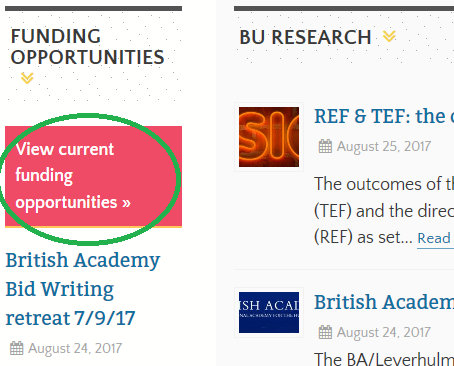
Have you noticed the pink box on the BU Research Blog homepage?

By clicking on this box, on the left of the Research Blog home page just under the text ‘Funding Opportunities‘, you access a Research Professional real-time search of the calls announced by the Major UK Funders. Use this feature to stay up to date with funding calls. Please note that you will have to be on campus or connecting to your desktop via our VPN to fully access this service.

MSCA Postdoctoral Fellowships 2022

​The 2022 Marie Skłodowska-Curie Actions (MSCA) Postdoctoral Fellowships (PF) Call is now open on the Funding & Tender Opportunities Portal, with a deadline of 14 September 2022. Since last year, overall indicative budget for the call has increased form EUR 242 million to 275 million.

The Guide for Applicants and other related guidance documentation can be found in the ‘Conditions and documents’ section of the call page as well as on the ‘MSCA How to Apply‘ webpage. You can also check the whole timeline including estimated project start date if your proposal is successful.

As announced earlier, BU internal deadline for submission of eItB forms for this year’s call is 15 July 2022. However, if there are any new proposals RDS are not aware of, we would appreciate if potential BU supervisors inform their Funding Development Officers about it as soon as possible.

We will have very busy period in August-September as there are many resubmissions planned this year and we need to plan resources to provide appropriate support.

UK Research Office (UKRO), in its capacity as UK National Contact Point for the MSCA, held dedicated series of webinars earlier in April this year to provide potential applicants with the information necessary to understand the nature of the MSCA PF call, and to submit a successful application. If you have missed those, video recordings and presentation slides of these sessions are still available on the following UKRO MSCA event webpages:

To access recordings, UKRO portal login details will be required. If you still have not registered, there are more details how BU academics can register.

With queries related to MSCA Postdoctoral Fellowships 2022 Call please contact Research Facilitator International Ainar Blaudums.

Research Ethics Panel meetings in August

Research EthicsA Reminder for Staff and Postgraduate Researchers

There are NO Research Ethics Panel (REP) meetings held during August, so if you’re hoping to start data collection activities over the summer and are in the process of completing your research ethics checklist, please keep this in mind when planning your research activities and submit your checklist in time for the final REP meetings to be held in June and July.  Checklists received during August which need to be reviewed by a full Panel will be deferred until September (dates to be advised).

REPs review all staff projects and postgraduate research projects which have been identified as high risk through the online ethics checklist.  Details on what constitutes high risk can be found on the research governance, research ethics & integrity website.

There are two central REPs:

  • Science, Technology & Health
  • Social Sciences & Humanities

Staff and PGR ‘high risk’ projects are reviewed by one of the central REPs and Researchers (including PGR Supervisors) will normally be invited to Panel for discussions.

Staff Projects which are ‘low risk’

Reviews for low risk projects will continue as normal during August (via email), although turnaround may take longer than normal due to Reviewer availability during this month.

PGR Projects which are ‘low risk’

There are no changes to the review and approval process for low risk PGR projects and reviews will continues as normal throughout August, again subject to Supervisor and the Ethics Champions availability.

More details about the review process and REP meeting dates can be found on the governance, research ethics & integrity website.  Email enquiries should be sent to researchethics@bournemouth.ac.uk.

Training on the Fuzzy Cognitive Mapping technique (15-17 June) – places available.

Training on the Fuzzy Cognitive Mapping technique (15-17 June) – places available.

A small number of places are available for a 3-day training on the Fuzzy Cognitive Mapping (FCM) technique, which will take place between 15-17 June on Talbot Campus. The training is funded by QR funds and is an opportunity for academics and PhD students to develop their skills on a versatile and upcoming research technique, which is expected to be welcomed by high quality journals.

The training is primarily for members of the Digital Marketing Research Group (DMRT, BUBS), however there are a few places available for staff and PhD students from across the university. If interested contact, Dr Miguel Moital (mmoital@bournemouth.ac.uk).


What is Fuzzy Cognitive Mapping?

The FCM technique is a cause-effect relationship knowledge-based method for modelling complex decision-making systems of humans. It emerges from a combination of cognitive mapping and Fuzzy logic and artificial neural network, and this method is increasingly used in social sciences and humanities research. In FCM participants are presented with scenarios (inputs) and asked to provide the expected outputs (e.g. assuming a certain relationship between two factors, what happens to a third factor). This data is used to improve the original model (e.g. developed in focus groups) by using a supervised algorithm. An automated knowledge system is developed to allow respondents to complete the survey online.

The technique can be applied to a variety of research settings, such as consumer behaviour, organisational decision making and social/public policy decision-making.

A good introduction to fuzzy cognitive mapping can be found here and here.


What will the training cover?

The training will take place on the following times (Talbot Campus):

Wednesday 15th June:

  • AM – Overview of FCM and fuzzy logic, including research design requirements for FCM research.
  • PM – Case studies/practice using the FCM expert software

Thursday 16 June:

  • AM – Case studies / practice using the FCM expert software
  • PM – Dr. Nápoles  available for 1-2-1 support to discuss developing / adapting research plans to FCM

Friday 17 June

  • AM – Case studies / practice using the FCM expert software & Wrap up

Ahead of the training, participants are expected to watch two pre-recorded knowledge clips and read two chapters about fuzzy logic and fuzzy cognitive maps.


The trainer

Dr Gonzalo Nápoles, from the Tilburg School of Humanities and Digital Sciences (Department of Cognitive Science and Artificial Intelligence), is a leading contributor to the development of the technique, having several publications on it. He is the lead developer of the FCM EXPERT software tool which can be used to carry out FCM analysis.

Action Heroines in the Twenty-First Century: Sisters in Arms Thursday 9th & Friday 10 June 2022

Keynote: Professor Yvonne Tasker, University of Leeds 

It is 30 years since Thelma and Louise hit our screens, grossing a cool $45mil at the US box-office and carving out a special place in movie history. A deliberately feminist project for screenwriter Callie Khouri, it was hailed and derided in more or less equal measure by critics for its portrayal of two ordinary Arkansas women turned gun-toting outlaws. The film busted the Hollywood myth that a female-led action movie could not be a critical and commercial success. It also broke the mould by presenting us with not one but two action heroines, this being perhaps the most revolutionary thing about it. As a result, many anticipated an upsurge in female action heroines, but this was not to be. The genre continued to be almost exclusively dominated by men, and where a female action hero did appear (Geena Davis being one significant action star, Angelina Jolie of course another), they were almost always positioned as a single woman surrounded by a cast of men, as though to reinforce their exceptionality and their distance from ordinary women and from socially acceptable constructions of femininity. In the new millennium, however, we have seen an increasing number of women star in and lead action films emanating from Hollywood and beyond. And perhaps more interestingly we have seen the emergence of films that feature more than one female action figure, effectively removing that stultifying burden of representation otherwise shouldered by the lone ‘woman’.

This symposium, hosted by Bournemouth University, has been convened by Christa van Raalte (BU – FMC) and Frances Pheasant-Kelly (Wolverhampton University). Paper will respond to a range of films and television series from Asian productions through to mainstream Hollywood and examine various aspects of the on-screen action heroine – and in particular what happens when she teams up with her peers. We plan to work on a co-edited collection with our collaborators thereafter.

For further details and to register, please visit: https://www.bournemouth.ac.uk/research/centres-institutes/narrative-culture-community-research-centre/action-heroines-twenty-first-century-sisters-arms

Panel recruitment: EoI for Deputy Chair (Science, Technology & Health Panel)

Research EthicsExpressions of interest are invited from members of the Professoriate, for the prestigious and honorary role of Deputy Chair, Science Technology Research Ethics Panel. The central research ethics panels work across the University to champion the highest ethical standards in research undertaken by staff and students (PGR).

This document provides further information about the role and the application process. The opportunity is open to Professors and Associate Professors.

Expressions of interest should consist of a CV and brief statement outlining your suitability for the role. These should be submitted to the RDS (researchethics@bournemouth.ac.uk) by 5pm on Friday 1 July 2022.

For an informal discussion about the role please contact:

– Prof Sam Porter, Chair of the Science, Technology and Health Ethics Panel

If you have any questions regarding the process, please email Sarah Bell or Suzy Wignall by email to researchethics@bournemouth.ac.uk.

NIHR Grant Applications Seminar ONLINE – 7th July 2022


Dear colleagues

– Do you have a great idea for research in health, social care or public health?
– Are you planning to submit a grant application to NIHR?

Our popular seminar continues online and will take place on Thursday 7th July 2022 from 10.00am – 12.30pm.

The seminar provides an overview of NIHR funding opportunities and research programme remits, requirements and application processes. We will give you top tips for your application and answer specific questions with experienced RDS South West advisers.

We also have a limited number of 20-minute 1-to-1 appointments available after the seminar should you wish to discuss your proposed study with an RDS adviser.

Find out more and book a place.

Your local branch of the NIHR RDS (Research Design Service) is based within the BU Clinical Research Unit (BUCRU)

We can help with your application. We advise on all aspects of developing an application and can review application drafts as well as put them to a mock funding panel (run by RDS South West) known as Project Review Committee, which is a fantastic opportunity for researchers to obtain a critical review of a proposed grant application before this is sent to a funding body.

Contact us as early as possible to benefit fully from the advice

Feel free to call us on 01202 961939 or send us an email.

New research paper published by PhD student Hina Tariq

PhD student Hina Tariq, currently undertaking the Clinical Academic Doctorate program at the Department of Social Sciences and Social Work (SSSW), published a new paper titled, “Factors associated with joint contractures in adults: a systematic review with narrative synthesis” Open Access in the journal of Disability and Rehabilitation. This paper is co-authored by her academic supervisors, Professor Sam Porter, Dr Desiree Tait and Dr Kathryn Collins, clinical supervisor, Joel Dunn (Dorset Healthcare University Foundation NHS Trust), and her formal colleague from Pakistan, Shafaq Altaf.

Summary: The review presents latest evidence on factors associated with joint contractures, which are essential to guide clinical practitioners and non-experts in identifying and managing the risk associated with joint contractures. Clinical interventions based on the timely identification of risks related to joint contractures in vulnerable adults can potentially prevent or ameliorate their development or progression.

The review has already crossed over 300 reads. The full text can be accessed by following this link: Full article: Factors associated with joint contractures in adults: a systematic review with narrative synthesis (tandfonline.com)


New Impact Accelerator Programme for ESS

Impact Acceleration Programme: InterAct

This programme will help researchers to enhance their ability to generate impact and provide funding to help them turn their research into more accessible outputs.

InterAct are looking for researchers from the Economic and Social Science (ESS) community or other disciplines that can capture human insights into the adoption of digital technologies and accelerate the digitisation of manufacturing to apply for up to £18,000 to turn results into outputs which are more accessible to policy makers, manufacturers, and Industrial Digital Technology providers.

The funding is available for academics whose research is ready for translation activity, not for further research, and results should already have been achieved but can be at an early stage and pre-publication.

Find out more about InterAct and this funding opportunity here, and if you intend to apply please complete the online ItB here.

If you have any questions about applying for funding please contact your Funding Development Officer, and for advice on impact acceleration plans or how to gather and evaluate evidence of impact please email impact@bournemouth.ac.uk

Today’s research process seminar: Quantitative content analysis. Tuesday 24th May at 2pm on Zoom.

You are warmly welcomed to this week’s research process seminar. Hosted in FMC but open to all.

This week we have an external speaker, Dr Sarah Van Leuven, who will speak about quantitative content analysis.

Sarah Van Leuven is associate professor at the Department of Communication Studies at Ghent University. She is the head of the research group Center for Journalism Studies (CJS), head of the Journalism Division of NeFCA (Netherlands-Flanders Communication Association), and editorial board member of the SSCI-ranked journal Digital Journalism. Since 2021 she is a member of the Flemish Council for Journalism (Raad voor de Journalistiek).

She has published work on a broad range of topics, including the role of news media in political communication, sourcing practices, international news, journalist profiles and innovation in newsrooms. Together with prof. dr. Karin Raeymaeckers, she coordinates the five-annual survey of Belgian professional journalists, and she is also principal investigator for Belgium in the Journalistic Role Performance Project.

Details of her talk are below. This will be of use to anyone who is interested in methods of analysing media or other texts as part of a research study.

In this session, I will present a step-by-step toolbox to develop a reliable research design for a content analysis. Specifically, I will discuss how theoretical constructs can be translated into manifest content variables, and how research outcomes can be influenced by sampling decisions. The different steps will be illustrated by means of a content analysis study of “global journalism”.

2pm on 24th May. 

https://bournemouth-ac-uk.zoom.us/j/9292103478?pwd=UzJnNTNQWDdTNldXdjNWUnlTR1cxUT09

Meeting ID: 929 210 3478

Passcode: rps!4fmc

Hope to see you there

Dan and Sae

Independent review of children’s social care: the Government’s plans

The Minister for Children and Families, Will Quince, delivered an oral statement to the Commons earlier regarding the publication of the independent review of children’s social care, outlining the Government’s initial and long-term plans. Please see below for a summary of the key exchanges. Summary provided by Dods.

Will Quince, Minister for Children and Families:

  • Said he looked forward to working with the sector, those with firsthand experience, and colleagues across the House, to inform an ambitious and etailed govt response and implementation strategy to be published before end of 2022
  • He said he had three main priorities:
    • Improve the child protection system
    • Support families to care for their children
    • To ensure there are the right places for children in the right places
  • To respond without delay, the Government are establishing a National Implementation Board of people of experience of leading transformational change
  • The Board will also consist of people with experience of the care system
  • Too many vulnerable children have been let down by the system but the Government is striving to change this
  • In April, the Government backed the Supporting Families Programme with £695m for 3,000 of the most vulnerable families – he welcomed reviews recognition of this programme
  • The Government will work with the sector to develop a nation children’s social care framework and will set out more detail on this later this year
  • The Minister said he supported the principle of the review’s proposed early career framework
  • He said they would set out “robust plans” to refocus the support social workers receive early on, with a particular focus on child protection
  • They would take action to take forward the review’s three data and digital priority areas, ensuring Las and partners were in “driving seat of reform”
  • Following review’s recommendation for a data and tech taskforce, the Government will introduce a new digital and data solutions fund to help local authorities improve delivery for children and families through technology – more detail will follow later this year on joining up data across the public sector
  • The Government will prioritise working with local authorities to recruit more foster carers, which will include pathfinder local recruitment campaigns that build towards a national programme
  • The Government will focus on providing more support through the application process, to improve conversion rate from expression of interest, to approved foster carers
  • Quince said he would return to the House on this date next year to update Parliament on progress made with regards to the review
  • As an initial response to the Competition and Markets Authority (CMA) report into the children’s social care market, the Minister said he had asked the DfE to conduct research into the children’s homes workforce
  • He announced that, on Thursday, the Child Safeguarding Practice Review panel would set out lessons learned from the deaths of Arthur Labinjo-Hughes and Star Hobson, and that the Education Secretary would outline the Government’s response in an oral statement to the House

Helen Hayes, Shadow Minister for Children and Families:

  • She welcomed the reviews conclusion that a total rest of the system was needed, and said its conclusion was a “terrible indictment of the extent to which this government has been failing children for more than a decade”
  • She highlighted a rise in the number of children in poverty, saying it was a causal factor underpinning the government’s failure
  • Hayes said the number of looked-after children had increased continually since 2010, as had the number of section 47 inquiries, while half of all children’s services departments had been rated ‘Inadequate’ of ‘Requiring improvement’
  • This was while staff turnover had increased, and outcomes for care leavers had been worsening – all while private providers made £300m in profits last year
  • She said the law recognised the age of 18 as the end of childhood, and it was therefore “shocking” that the Government had allowed children to be placed in unregister children’s homes and “other completely unsuitable accommodation” – she therefore welcomed the review’s conclusion that unregistered placements for 16 and 17 year olds must stop
  • She welcomed the focus on restoring early help to families, as well as the recommendations regarding further support for kinship carers
  • Hayes said that, while the Minister had re-announced a series of policies today, there was nothing here that would deliver the transformation in children’s social care that the review demanded
  • She asked the Minister if he would commit to a firm date for the publication of a comprehensive response to the review and a detailed implementation plan
  • She asked if he expected there would be a need for legislation, and how this squared with the absence of children’s social care in the Queen’s Speech
  • She asked how the announcement of early help investment would ensure that early help services were available in every area of the country so that every family who could be supported
  • She also asked what representations he was making to the Treasury in response to the review
  • Hayes asked if the Minister would commit to an end to profiteering in children’s social care
  • She also asked how he would ensure the voices of children were at the heart of children’s social care, and how he would guarantee the workforce were fully engaged and involved as reforms were implemented
  • Finally, she asked how he would ensure that, as reforms were implemented, the framework of accountability for decisions made by the state about the care of children, would be strengthened

Minister Quince:

  • The Minister reiterated that he wanted to take as much of a cross-party approach to this reform as possible
  • He said they had to be honest that, despite years of real-terms increase in social care, too many children were still being let down
  • On implementation, he said he and the Education Secretary were determined that this wouldn’t be “just another report”, which was why he was establishing an implementation board, with the view of delivering a plan by the end of this year
  • He said he hoped that, with this excellent review, they had a roadmap and an opportunity to ensure cases of abuse and neglect were “as rare as they are trgic”

Robert Halfon (Con, Harlow), chair of the Education Committee:

  • Halfon described it as a “visionary” report, saying that it was a family/community-upwards approach, rather than a top-down
  • He said he hoped the Government would be bold on the funding issues raised, and also the proposal on the private company windfall tax
  • He asked what the Government were doing to ensure children in care were being placed in ‘Good’ or ‘Outstanding’ schools and were receiving the right targeted catch-up tuition, and mentoring support, to help catch up on lost learning and leave care into a good job

Minister Quince:

  • The Minister confirmed their plan was to be “bold and ambitious”
  • Their intention was to set out an immediate response today, and then publish a full response and implementation plan by the end of the year
  • He said Halfon was right that the results of children in care and care leavers were unacceptable, and that this review was about improving the life chances of some of the most vulnerable children in the country

Tim Loughton (Con, East Worthing and Shoreham), co-vice chair of the APPG for Looked After Children and Care Leavers and former children’s minister:

  • Loughton noted a review was only as good as its delivery, and asked why this one would be different to the previous “once-in-a-generation reforms” that hadn’t fixed these issues
  • He also asked the Minister how the proposed Family Help programme would interact with the Family Hubs programme and the Best Start in Life programme

Minister Quince:

  • The Minister said he was right that they had to ensure that the implementation of this review was different to what had gone before – and noted the SEND review of 2014 as an example of a bold and ambitious plan, where the implementation did not match
  • This was why he wouldn’t be diving straight into the 80+ recommendations, and instead had opted to set out an initial plan and then engage on the bigger conclusions so that they could get this right

Emma Hardy (Lab, Kingston upon Hull West), vice-chair of University APPG:

  • Hardy urged the Minister to look particularly at what happened to care leavers when they reached 18, saying that the support immediately fell away, and asked the Minister to consider this when formulating the government response to the review

Minister Quince:

  • The Minister said she was right and that he would be looking carefully at the recommendations
  • He also said it was important they didn’t see this as a DfE-only issues – that there was a role for every government department, local authority, and even business, to play

Jess Phillips, Shadow Minister for Safeguarding:

  • Phillips offered her guidance and experience in the development of the response, particular so the government ensured that violence against women and girls (VAWG) specialist were included
  • She urged the Minister to stop the placement of 16 and 17 year olds in unregulated settings today

Minister Quince:

  • The Minister said she was right to reference victims of domestic abuse, and assured her he was committed to working across government and public services in their response and wider support
  • On the point of regulation, he said the government had £142m earmarked to support the regulation of settings to 17 and 18 year olds

Andrew Gwynne (Lab, Denton and Reddish), chair of the Kinship Care APPG:

  • Gwynne asked if the Minister would commit to delivering on the proposals in the review to unlock family networks, including family group decision-making, as well as the package of support for kinship carers

Minister Quince:

  • The Minister said they would look very closely at the recommendations regarding kinship care and special guardians

Munira Wilson, Liberal Democrat Education Spokesperson:

  • Wilson said kinship carers received no financial support unless they registered as foster parents, but that this process denied them parental responsibility for the child – so she asked again if the Government would accept the review’s recommendations for kinship carers to get the same financial support as foster carers

Minister Quince:

  • The Minister said they would look carefully at all the recommendations and, while he agreed with her, he wouldn’t been drawn on committing or dismissing the report’s recommendations at this point in time

International speaker – “Fifty Years of Research into Exercise and Physical Activity for Older Adults” – Professor Wojtek Chodzko Zajko, University of Illinois

You are invited to a research seminar from a distinguished Professor visiting the UK from the US.

Please email Samuel Nyman (snyman@bournemouth.ac.uk) if you plan to attend to help with tracking numbers and to send you a calendar invitation.

Title: Fifty Years of Research into Exercise and Physical Activity for Older Adults
Abstract: For more than half a century researchers and practitioners have enthusiastically advocated for the promotion and adoption of physically active lifestyles as an affordable and effective means to prevent chronic diseases and conditions, and enhance independence and high quality of life for older adults. I have argued that it is possible to discern distinct evolutionary stages when examining scholarship related to the role of physical activity in the promotion of healthy aging. Research into physical activity and aging began with critical early studies that established the underlying scientific evidence for a relationship between physical activity and healthy aging. More recent work has addressed such topics as building consumer demand, developing policies and legislation to support active aging, and understanding the complex interrelationships between physical activity and other lifestyle factors in the prevention and treatment of chronic diseases and conditions. In my presentation, I will suggest that future research should move away from the promotion of physical activity in isolation, in favor of more complex public health initiatives in which physical activity is embedded as an integral component of a broader health promotion and disease prevention strategy.

Where and when:
Wednesday 22nd June
Bournemouth Gateway Building, room 307
12-1pm Presentation and Q&A
1-2pm Time for informal discussions

Biography
Wojtek Chodzko Zajko earned a bachelor’s degree in Education from the University of London and a Ph.D. degree in Kinesiology from Purdue University. Chodzko-Zajko’s primary research interests are in the area of aging and health. For many years he was the Head of the Department of Kinesiology and Community Health and the Shahid and Ann Carlson Khan Endowed Professor of Applied Health Sciences at the University of Illinois. For the past seven years, he has served as Dean of the Graduate College at the University of Illinois.

In his role as Dean of the Graduate College, Chodzko-Zajko leads campus efforts in setting policies, defining standards, and enabling excellence in graduate programs, graduate research, and graduate student life. With graduate programs in more than 100 disciplinary areas, the Graduate College at the University of Illinois fosters a vibrant campus community of scholars. Graduate students and faculty at Illinois enjoy an intellectual environment that reaches across the Arts, Sciences, Humanities, Social Sciences, and Engineering to create, challenge, and transform knowledge.

In his professional life, Chodzko Zajko remains active in the dissemination of information about healthy aging through his work on several major professional advisory boards. Chodzko Zajko research focuses on public policy and public health recommendations related to physical activity and healthy living. He served on the World Health Organization committee that developed the WHO Guidelines for Physical Activity among Older Persons. Chodzko-Zajko was the Principal Investigator for a series of projects charged with developing a national strategy for promoting healthy aging in the USA. The National Blueprint: Increasing Physical Activity among Adults Aged 50 and Older serves as a guide for multiple organizations, associations, and agencies, to inform and support their planning work related to increasing physical activity among America’s aging population. Chodzko-Zajko chaired the writing group that authored the American College of Sports Medicine’s Position Stand on Physical Activity and Exercise for Older Adults.

Chodzko-Zajko was the founding Editor of the Journal of Aging and Physical Activity from 1992-2002. He served as Chairman of the Board of Directors of the American Council on Exercise and is a Past-President of the American Kinesiology Association. He currently serves as President of the AAU Association of Graduate Schools and Chair of the ETS Graduate Education Advisory Council.