Bournemouth University’s School of Tourism has recently signed three Erasmus agreements with three Universities in Europe to enhance international links to high quality international research and teaching institutions, especially in the area of sport business and events management.
To celebrate this recent agreement Dr Tim Breitbarth (Senior Lecturer in Sport Management) organised various guest lectures, presentations to staff and students as well as informal opportunities to meet and mingle as part of an International Week in Sport and Events Management.
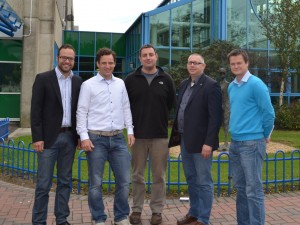
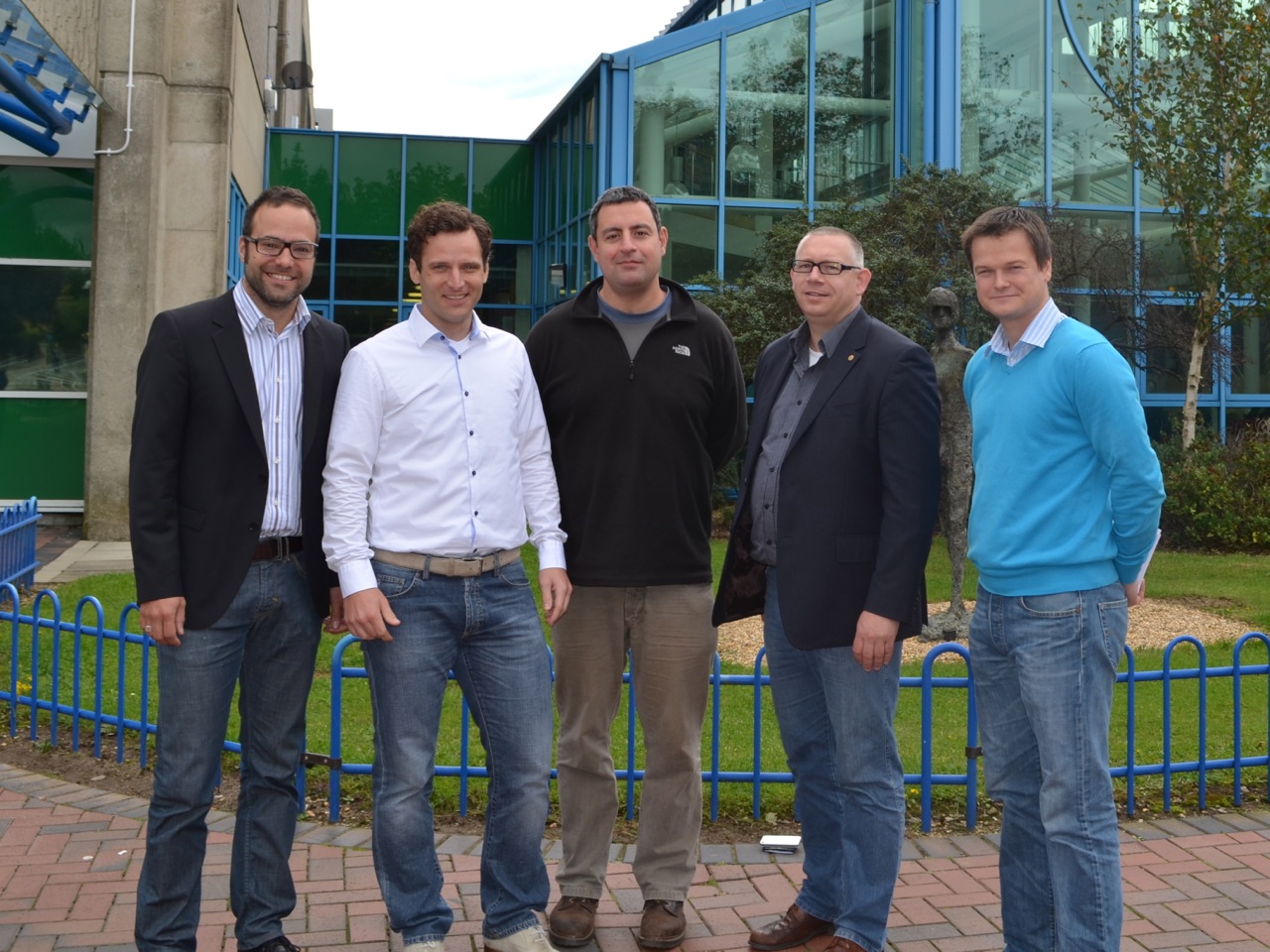
Professor Dr Sebastian Kaiser, a professor in sport and events at the SRH Hochschule Heidelberg; Dr Stefan Walzel a senior lecturer at the German Sport University Cologne, Institute of Sport Economics and Sport Management; and Gerco Van Dalfsen, a program coordinator sport management at Hanze University of Applied Sciences in Groningen and Secretary General of the European Association of Sport Management all took part in international week and also represented their university.
On Wednesday Sebastian, Stefan and Gerco hosted a presentation as part of the School of Tourism Staff Development. A substantial number of colleagues from across School of Tourism, research students and university managers concerned with international development attended the session.
Dr Richard Shipway (Associate Dean International Engagement) framed the presentations by mentioning relevant aspects of BU’s strategy to create more and higher quality international opportunities for staff and students.
Gerco, Stefan, Sebastian each presented their respective universities and provided an overview of their study programmes. In particular, they showed how they integrate international student exchange, international competitions and workshops into their programs in order to enhance student abilities and networking. School of Tourism staff were, for example, impressed by the vast and modern sport and scientific infrastructure of the German Sport University Cologne, and the strong international and multidisciplinary focus of sport, events and health programmes at Hanze University. The presentations and opportunities to cooperate led to lively conversations and concrete projects/ideas to follow-up.
The second part of the Lecture on Wednesday saw Stefan and Sebastian present some of their high quality research. :
Stefan provided insights into the discussions around relevance and impacts of the Youth Olympics and the organisation of the first summer and winter Youth Olympics. The particular focus of his empirical investigation was on the use of ambush marketing despite clean venues and no commercial sponsorship allowed at the games. German Sport University Cologne also very successfully integrated student visits and volunteering at the games with both international teaching and study opportunities.
Sebastian outlined similarities and peculiarities of events management in sports and culture from socioeconomic theory. In his empirical study he explores the impact of the economic sectors by utilising regression analysis of a dataset from surveys amongst managers within the industry. His major conclusion was that events management may benefit not only from a dialogue between science and practice but particularly from an interdisciplinary perspective integrating theories and approaches from sports and culture management.
On Friday, Sebastian and Stefan helped kick off the weekly Research Seminar Series for, mainly, sport science and sport management students. Around 100 students attended and Dr Ian Jones (Associate Dean Sport) pointed out that those regular seminars are to widen student’s horizon and an opportunity to engage with relevant topics that may be beyond their core areas of interest.
The presentations from the international visitors provided the students with a glimpse of how/what their peers in other countries are taught; an important experience since those universities no longer educate their students for national markets but acknowledge that they have to compete on an international labour market after graduation.
Stefan’s presentation introduced the students to the link between psychological, behavioural and economic dimensions behind corporate hospitality activities at sport events. Whereas the main conclusion from Sebastian’s presentation was that there are different ways to calculate the possible impacts of events based on the same numbers.
Students were invited to mingle with the presenters and amongst each other afterwards in Dylan’s Bar and a few students used this opportunity to discuss particular aspects of the respective topics in special and the international sport management in general.
Students that attended the Lectures and Seminars were given the opportunity to win quality merchandise from the new partner universities.
All three of the visiting Lecturers were in Bournemouth for 5 days and were very impressed with the Bournemouth University campus and its facilities, especially our eLearning opportunities / environment.
For further information about the International Week or our new Erasmus partner universities please contact Dr Tim Breitbarth on tbreitbarth@bournemouth.ac.uk or 01202 965113.




 Congratulations to Roger Herbert (ApSci) for his matched funding from Natural England, Zhidong Xiao (Media School) for securing funding from Wuhan Vocational College of Software and Engineering to run Wuhan Teachers Training Programme in Computer Animation, Anthea Innes and Clive Andrewes (HSC) for their funding from TSB, Kip Jones (HSC) for securing funding from ESRC, Caroline Ellis-Hill (HSC) for running the Masterclass: Systematic Reviews and Jonathan Monteith (ApSci) for his funding received from Blandford Forum Town Council.
 Good luck to Raian Ali (DEC) for his application to Marie Curie, to both Zulfiqar Khan (DEC) and Venky Dubey for their applications to EPSRC/DST, Hongchuan YU (Media School) for his application to AHRC, Heather Savigny (Media School) for her application to the British Academy, Rosie Read (bid led by Bradford University) for her ESRC dementia initiative, Mary-Ann Robertson and Clive Andrewes for their application to the Royal Bournemouth and Christchurch Hospital, Chris Shiel (ApSci) for her EC – FP7 Collaborative Stage 1 (of 2) application, Anita Diaz (ApSci) for her application to the Higher Education Authority, Richard Stillman (ApSci) for his applications to the Marine Management Organisation – RPS and HR Wallingford, Peter Comninos (Media School) for his EC FP7 Collaborative Stage 1 (of 2) application and Anthea Innes and Samuel Nyman (HSC) for their EC FP7 – Health – collaborative project Stage 1 (of 2) application.

 BU’s Dr Genoveva F. Esteban and Dr Demetra Andreou will be taking part in the Society’s of Biology’s Biology Week, with help from Mrs Judith Wardlaw ( Industry Partnership Development Manager at The Thomas Hardye School). The event will discover the hidden world of water – capturing images of microscopic wildlife living in fresh waters, including those microscopic organisms that live inside others. Year 10 biology students and the Student Voice council will use the images to inspire a design for a banner depicting the “Wonders of Biology at Thomas Hardye School”. The banners will be used at a diverse range of public events, including the popular Dorchester Community Lectures organised by the Thomas Hardye School.







 Verbal autopsy paper published two days ago
 ESRC Studentships for 2027 Entry: Opportunity Now Open
 SONAMONI contributions to Safety Conference 2026 in South Africa
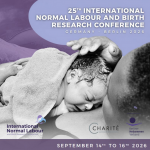 Three CMWH presentations at Berlin conference
 Horizon Europe Cluster 3 (Civil Security for Society) 2026 Calls Now Open
 MSCA Doctoral Networks 2026 Call Information Webinar
 ESRC Festival of Social Science 2026: Application Deadline Extended to Thursday 25 June 2026
 Reminder: Register for the ESRC Festival of Social Science 2026 Information Session
 ECR Funding Open Call: Research Culture & Community Grant – Apply now
 ERC Advanced Grant 2025 Webinar
 Update on UKRO services
 European research project exploring use of ‘virtual twins’ to better manage metabolic associated fatty liver disease