Category / Health, Wellbeing & Society

Fake conferences are not fake news: beware predatory conferences

Introduction

Academic have been warned for a decade about predatory Open Access publishers (van Teijlingen 2014). These are commercial organisations charging academics a publication fee on submission of their manuscripts with a promise to publish their work quickly online. The problem is twofold: first, these commercial organisations don’t offer proper peer-review and editorial quality assurance; and secondly, academic are being tricked into believing the journal is a legitimate scientific publication.  The second author receives on average six to eight invitations a week to publish in this kind of predatory journals – see below for examples. The first author, who despite having not worked in an academic institution for over three years, still receives such invitations to publish in ‘Journal X’.

Predatory conferences

A similar phenomenon to predatory journals is the predatory conference (Moital 2014; Nobes 2017; Grove 2017). These are pretend academic conferences of questionable value, established first and foremost to make money, not for the greater good of the academic discipline.

Both authors have received bogus and legitimate invitations to attend conferences. A predicament with such an invitation, which 99% of time arrives by email, is that it is not easy to distinguish between fake and real offers. For example, the first author recently received an offer (at short notice), to attend a conference in Miami in November 2017 (see below). This was on the back of an editorial he had published couple of months earlier. For a career researcher going from contract to contract, the appeal of being invited to present a keynote at a conference can be flattering, far less an honour and a boost for one’s career. Therefore, while the idea that if it seems too good to be true, is a prudent one to hold; there is also a temptation to follow through.

The author replied to the request quizzing the reason for the invite out of the blue. The answer was less than convincing, and a swift email by the author saying “Don’t tell me… You are offering me a keynote with travel and accommodation… Lol!!” called their bluff and ended correspondence.

But digging a little deeper he found there was a webpage dedicated to taking payments to attend the conference. In the digital world, a fool can be easily and quickly separated from his or her money.

Of course, it may have been a real conference at a real venue, and they really wanted him to speak. But discerning this is not easy at first…

Some of the warning signs/What to look out for

  • The conference email invitation looks very convincing (if not don’t even read it!).
  • The venue is good location as Nobes (2017) highlighted, “the organizers are more interested in marketing the tourist destination rather than the academic value of the conference”.
  • The conference covers too many different aspects or topics, as if the advert is designed to catch the eye of many people as possible who are vaguely connected to the discipline.
  • Mentions on associated predatory journals and ‘important’ organisations in the discipline.
  • Email and bank accounts that don’t look professional/ official.
  • Little mention of attendance fees, but after acceptance emails demanding a high conference fee and other charges.
  • Conference organisers are not academics, or unknown names.
  • Conference does not peer-review submission/ not provide proper editorial control over presentations
  • Signs of copying of names of existing academic conferences or scientific organisation and even copying of their webpages
  • Even more advertising than normal at a scientific conference.

Furthermore, Andy Nobes (2017) offered some helpful advice on quality of the conference websites in the list below. Andy is based at AuthorAID, a global network providing support, mentoring, resources and training for researchers in developing countries.

Who is at risk of falling for predatory conferences?

Academics need to be aware of money-making conferences and meetings without a true commitment to science. But some academics might be more at risk than others. Young researchers, PhD students and fledgling academics, living from contract to contract may feel any conference attendance is a potential career boost. Thus, such an invitation might seem flattering and an opportunity to good to miss. A way to show that he or she is a capable and independent academic.

Final thoughts

Most academics go to conferences for a combination of presenting their work to get critical feedback, making new contacts, sharing ideas and to be inspired. With such broad combination of motivating factors, the exact purpose of conferences is difficult to ascertain because there is no a priori agreed role and value of conferences (Nicolson, 2017a). However, there is evidence that academic conferences function to facilitate commodity transactions, be that knowledge, tools, skills, reputations, or connections, which reflects the neoliberal ethos in the modern academy (Nicolson 2017b). The predatory conference can be viewed in this light, where academia is more and more focused on generating revenue. It is at best scurrilous, and worst, criminal, for organisations to make money using such a confidence trick.  Always check which conferences are organised and advertised by recognised scholarly organisations in your own discipline. If uncertain ask a more experienced academic, a senior colleague or mentor.


Donald J. Nicolson

(Health Services Researcher, NHS Fife, and Independent Scholar; twitter @_mopster )

Edwin R. van Teijlingen

(Centre Midwifery, Maternal & Perinatal Health)


References:

Moital, M. (2014) Ten Signs of a Bogus/Fake Conference.

Grove, J. (2017) Predatory conferences ‘now outnumber official scholarly events’  (26th Oct.)

Nicolson, D.J. (2017a) Do conference presentations impact beyond the conference venue? Journal of Research in Nursing. 22(5), pp.422-425.

Nicolson, D.J. (2017b) Academic Conferences as Neoliberal Commodities, Palgrave Macmillan

Nobes, A. (2017) What are ‘predatory’ conferences and how can I avoid them?

van Teijlingen, E. (2014) Beware of rogue journals.


New paper by BU’s Lecturer in International Health

Congratulations to Dr. Pramod Regmi on the publication of his latest article ‘Local elections and community health care in Nepal’.[1]  Pramod is our newly appointed Lecturer in International Health, who started this post exactly a month ago.  The editorial, co-authored with BU Visiting Faculty Prof. Padam Simkhada (based at Liverpool John Moores University), Nirmal Aryal (based at the University of Otago, New Zealand) and CMMPH’s Prof. Edwin van Teijlingen, highlights the important link between local democracy and health in Nepal.

The paper argues that elected local governments are critical for public accountability on the operationalization of the SDGs (Sustainable Development Goals) at local level.  Furthermore, having elected leaders in communities after such a long gap will certainly give Nepalese people rights and hopefully improve provision and access to health care services they are entitled to. Thus the role of civil society, community-based non-governmental organisation, development partners and the mass-media is critical in both advocacy for, and the effective monitoring and implementation of, local activities.

The paper appeared today in Health Prospect an Open Access journal published in English in Nepal as part of the Nepal Journals Online (NepJOL) service .


Reference

  1. Regmi, P., van Teijlingen, E., Simkhada, P., Aryal, N. (2017) Local elections and community health care in Nepal, Health Prospect: Journal of Public Health, 16(2):1-2.

The slow process from public health research to law

We know that public health works and thinks long-term. We’ll typically see the population benefits of reducing health risks such as tobacco use, obesity and high alcohol intake in ten or twenty years’ time.  But we often forget that preceding public health research into the determinants of ill health and the possible public health solutions is also slow working.  Evidence-based public health solutions can be unpopular with voters, politicians or commercial companies (or all).  Hence these take time to get accepted by the various stakeholders and make their way into policies.

I was, therefore, glad to see that Scotland won the Supreme Court case today in favour of a minimum price for a unit of alcohol. As we know from the media, the court case took five years.  Before that the preparation and drafting of the legislation took years, and some of the original research took place long before that.  Together with colleagues at the Health Economic Research Unit at the University of Aberdeen, the University of York and Health Education Board for Scotland, we conducted a literature review on Effective & Cost-Effective Measures to Reduce Alcohol Misuse in Scotland as early as 2001 [1].  Some of the initial research was so long ago it was conducted for the Scottish Executive, before it was even renamed the Scottish Government.


Prof. Edwin van Teijlingen

CMMPH


Reference:

Research started years ago! Ludbrook et al.(2002) Effective & Cost-Effective Measures to Reduce Alcohol Misuse in Scotland: Lit Review, HERU, Univ. of Aberdeen. [ISBN: 0755932803] http://www.gov.scot/Resource/Doc/1124/0052548.pdf

Professor Julie Turner-Cobb wins the British Psychological Society Book Award!

The textbook winner for the British Psychological Society Book Award 2017 is Child Health Psychology: A Biopsychosocial Perspective by Professor Julie Turner-Cobb. It is the first textbook to focus specifically on child health psychology, taking an interdisciplinary and life-course perspective and drawing on theories and models within.

The Society’s Book Award recognises excellent published work in psychology. Professor Julie Turner-Cobb said she was absolutely delighted to win the award and thrilled that her book has received great recognition and positive reception as a result. She was first nominated for the award by one of her PhD students based at the University of Bath: “They are a big supporter of the book and were inspired to do their PhD as a result of an issue raised in the chapter that addresses the experience of being a young carer. It was a nice surprise and a huge compliment to be nominated.”

Child Health Psychology: A Biopsychosocial Perspective is primarily targeted at postgraduate students on MSc Health Psychology programmes but is also relevant to students taking final year undergraduate units in health psychology and related areas. Beyond this, the textbook is also relevant across a number of health disciplines outside of psychology where a biopsychosocial perspective on child health is being considered.

“There was no textbook devoted to health psychology as applied to children. I wanted to bring it together to highlight it and provide a child health focus for health psychology as a discipline.”

The first part of the book covers topics related to events and circumstances that can influence a child’s health during childhood and adolescence including the prenatal environment; whilst the second part examines how children cope when they are ill, how they deal with pain, the experience of parental ill health and bereavement.

“It takes a strong biological stance in many respects, but also gives attention to psychosocial issues in relation to context and individual differences,” Professor Turner-Cobb said, “There is also a chapter in the first part of the book that examines methodological and ethical issues in child health psychology, that includes assessment using endocrine and immune biomarkers of stress but also discusses the utility of using a range of different paradigms and settings.”

Professor Turner-Cobb was inspired to write Child Health Psychology as she wanted to draw attention to the scope of work on psychological factors associated with child health. “There are a number of excellent textbooks on health psychology that have aspects covering child health and there are many textbooks devoted to developmental psychology, but there was no textbook devoted to health psychology as applied to children. I wanted to bring it together to highlight it and provide a child health focus for health psychology as a discipline.”

For more information about the book, please email Professor Julie Turner-Cobb (jturnercobb@bournemouth.ac.uk).


REMINDER – Cross-Research Council Mental Health Network Plus call Meeting

Just a quick reminders…

We will be holding a networking event for BU academics who are interested in the Cross-Research Council Mental Health Network Plus call on 1st November 09:30-11:30 in PG140. It will be a chance to get like-minded people in one space to identify possible collaborations and differences.

No preparation is necessary for the meeting; however we would ask you to read the call guidance see here.

Refreshment will be provided, if you would like attend please contact Alexandra Pekalski or Lisa Gale Andrews.

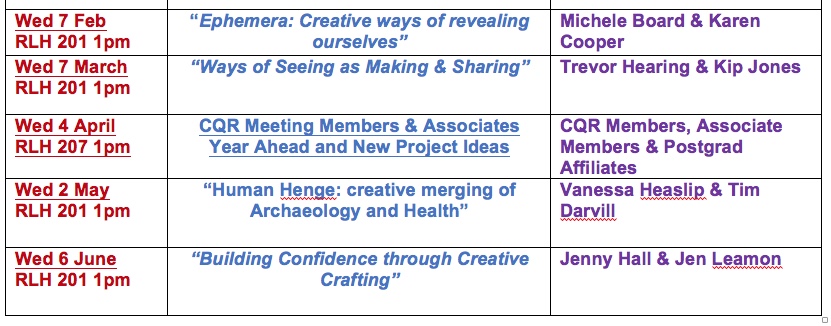
“Using photo-elicitation to generate storytelling”

Join us next Wed for “Using photo-elicitation to generate storytelling” presented by Anne Quinney.


Anne’s co-presenter, Maggie Hutchings, is now able to join her for the conversation!

Lots of opportunity for audience participation in listening, making, and sharing. Not lectures, the seminar is ‘In Conversation” about a topic or method. No PPT and plenty of time for audience interaction and feedback!

Wednesday, 1 Nov.

Royal London House 208 1 pm

Students and Faculty welcome!

Presented by the Centre for Qualitative Research

NIHR Grant Applications Seminar & Support event – last chance to book


Are you planning to submit a grant application to NIHR?

Research Design Service South West (RDS-SW) are holding a one day event on 9 November 2017 at Plymouth Science Park, Devon.

Last few days to book!

The events consists of:

  • a morning seminar session which is open to anyone to come and RDS advisers give presentations on what makes a good grant proposal.
  • an afternoon support session of one-to-one appointments which is for those who would like to discuss their own proposal with an RDS adviser. Those interested in this opportunity will be asked to supply in advance a brief description of their project idea.

Registration is FREE and lunch will be provided. Places are limited and will be allocated on a ‘first come, first served’ basis. In order to secure a place at one of these events, delegates will need to complete the online registration form by 1pm 30 October 2017. One-to-one appointments need to be booked in advance by selecting the appropriate option on the registration form.

You can find out more here

Don’t forget your local branch of the NIHR Research Design Service is based within the BU Clinical Research Unit (BUCRU) on the 5th floor of Royal London House. Feel free to pop in and see us, call us on 61939 or send us an email.

FHSS student needs help with online questionnaire for her research

Our PhD student Orlanda Harvey is currently conducting her study on why people use Anabolic Androgenic Steroids (AAS).  Since steroid use is a sensitive topic and its users are a hard-to-reach population we need as much help as we can get to get her survey distributed to as many as possible potential steroid users (aged 18 and over).  We, as her PhD supervisors, would like to ask you to alert friends, family, neighbours, health care professionals working with this target group, etc. to the existence of this survey.   Her questionnaire is available in paper version (from harveyo@bournemouth.ac.uk or telephone Edwin van Teijlingen at: 01202-961564).  However, the easiest and most anonymous way would be for people to complete it online using the following online link.


Thank you very much in advance!

Dr. Margarete Parrish

Dr. Steven Trenoweth

Prof. Edwin van Teijlingen


Congratulations to James Palfreman-Kay

Congratulations to BU’s Equality and Diversity Adviser James Palfreman-Kay whose application to HEFCE’s ‘Catalyst Fund: Tackling hate crime and online harassment on campus‘ has been successful.  He is one of 40 academic recipients of funding at universities and colleges throughout England.  Applications have been  assessed by a panel of HEFCE staff and external experts from across relevant areas of knowledge particular to student safeguarding.


Congratulations!

Prof. Edwin van Teijlingen

CMMPH


BU Research contributes to National Creativity, Arts, Health and Wellbeing report

Dr Caroline Ellis-Hill  from the Centre for Qualitative Research (CQR) and the Humanising practice SIG  (FHSS),  recently attended a discussion of the new All-Party Parliamentary Group (APPG) report on Arts, Health and Wellbeing Creative Health: The Arts for Health and Wellbeing at Kings College,  London.  Speakers included Darren Henley, Chief Executive of Arts Council England, Shirley Cramer, Chief Executive of the Royal Society for Public Health, Lord Howarth of Newport and Ed Vaizey MP, co-Chairs of the APPG.

Caroline contributed to one of the parliamentary inquiry meetings and also led the  HeART of stroke study which is cited in the report, and which was funded through the National Institute for Health Research – Research for Patient Benefit (NIHR-RfPB) funding programme.  The research was carried out with colleagues from Bournemouth University Clinical Research Unit (BUCRU) and many external stakeholders including NIHR, the Royal Bournemouth and Christchurch Hospitals NHS Foundation Trust, Cambridgeshire Community Services NHS Trust and the University of East Anglia.

The APPG report is a landmark document that brings together available evidence from across the UK to support the role of the arts in the health and wellbeing of people across the life-course. The report has ten recommendations which will be considered at national and local policy level, with the aim of promoting the arts within mainstream services when considering health and wellbeing in the future.

BU’s PGR Paul Fairbairn at the Lipids and Brain IV conference in Nancy

The Société Française pour l’Etude des Lipides (SFEL) recently held the fourth iteration of their Lipids and Brain conference in Nancy France.

I was given the opportunity to present some preliminary results from an ongoing study I am conducting as part of my PhD, looking into the effects of a multi-nutrient omega-3 fatty acid supplement and exercise on mobility and cognitive function in ladies aged 60+.  Analysis of the baseline data revealed relationships between levels of omega-3 fatty acids in the blood with cognitive and gait outcomes, however this effect differed between non-frail and pre-frail participants.

The conference brought together scientists, physicians and nutritionists to provide a unique prospective on the role of lipid nutrition in the prevention and treatment of neurodegenerative diseases with a large focus on Alzheimer’s Disease (AD).  The conference was a mix of lectures, invited reviews, and poster sessions.  There was a tremendous variety of topics presented, including lectures on the pathophysiology and epidemiology of AD, how AD can impact lipid metabolism and the effects of lipid intake on prevention and treatment of AD.

During the conference Professor Stephen Cunnane from the Research Center on Aging, Sherbrooke (Canada) was presented with the prestigious Chevreul Medal.

On a personal note this was an exciting opportunity for me to present my work and represent Bournemouth University and my supervisory team of Dr. Simon Dyall and Dr. Fotini Tsofliou at a respected conference.  It was very satisfying to see some interest in my work from researchers whose work I myself look up to.

I would like to extend my gratitude towards Bournemouth University, for providing the funding that allowed me to attend the conference and to the scientific committee at the SFEL for organising such an impeccable event.

If you would like to learn more about our research, please feel free to contact me at pfairbairn@bournemouth.ac.uk


AHRC report about arts and humanities research on mental health

A new report, Exploring Mental Health and Wellbeing, published by the Arts and Humanities Research Council highlights the important role that arts and humanities based research can play in helping to address complex issues around mental health.

The report brings to life a wealth of case studies that are contributing to the mental health debate. These include examining the work of academics at the University of Cambridge who are pioneering an innovative design of a personalised fragrance dispenser to help manage anxiety to a project being managed by the University of Essex to educate policy-makers on the issues surrounding impaired decision-making capacity.

Research around mental health is focused around developing a cross-disciplinary approach – and arts and humanities scholars have a key role to play. The AHRC has funded research in many different aspects of mental health research in recent years, with an investment of over £10m in seventy-six projects since 2010.

The new cross-disciplinary mental health research agenda sees the UK’s seven research councils joining forces to collaborate on mental health research. Published in August this year, the agenda paves the way for cross-council collaboration on mental health, highlighting the importance of including the arts and humanities in this area of research.