An exciting new research project will be launched this Saturday and the team is getting ready. Last November during the ESRC Festival young people told us what they liked doing outdoors. Next Saturday the research team from across BU will be releasing the top ten favourite things that young people enjoyed outdoors on a rock drop in partnership with Bournemouth Rocks. Young people can find out the results of our research and help develop our study by logging their finds and sharing their use of green space with the research team – Dr Holly Crossen-White, Dr Nathan Farrell and Dr Angela Turner-Wilson. The Rock Drop site will be released on Friday on social media (more…)
Category / Public engagement
Reminder: Wednesday 11th April – Guest Researcher in Ageing, Human Rights, Disability and Inclusion
On the 11th April Dr Andrea Padilla-Munoz from the University of Rosario, Bogota, Colombia will be visiting Bournemouth University. Andrea is a qualified lawyer and academic with an interest in ageing, human rights, disability and inclusion.
During her visit, she is keen to meet with other BU academics to explore potential future collaborations. To support this, I will be hosting a workshop on the 11th April in the Fusion Building, F111 from 11am-1pm, where Andrea will provide an overview of her research. There will also be time to discuss future research ideas with her over tea and coffee.
If you are interested in attending please let me know, so I have an idea of numbers and can book refreshments accordingly. Alternatively, if you are unable to make the workshop but would like to meet with Andrea, let me know and we can arrange something.
Email: bhicks@bournemouth.ac.uk
Pint of Science 2018: Tickets available now!
We’re excited to announce that we are joining forces with Pint of Science again this year to bring science back to the pubs of Bournemouth.
Join us on the 14-16 May 2018 for evenings that’ll quench your thirst for scientific knowledge delivered to you over your favourite pint. This year we are exploring the fascinating topics of Beautiful Mind at The Four Horsemen and Our Body at Chaplin’s Cellar Bar. The full list of evening themes and the complete programme of talks are available to browse now here.
Fancy joining us? Well, you’re in luck! Tickets are available for the bargain price of £4, and are on sale at midday today from the Pint of Science website.
To celebrate the official ticket launch of Bournemouth’s Pint of Science 2018, join us at Chaplin’s Cellar Bar on Wednesday 18th April for the Half-Pint Pub Quiz. Gather yourself a team and come and show off your quizzing capabilities from 6:30pm. You could be in with a chance to nab yourself some amazing Pint of Science goodies!
Cafe Scientifique – We need you!
Have you been doing research that you are itching to share with the public?
Do you want to increase your public engagement and have fun doing it?
We are looking for two academics to fill our Cafe Scientifique spots in June and July. If you would like to get involved please email the Public Engagement team!
Check out the website to find out more about Cafe Scientifique.
Save the Date – Research communication day for BU academics
BU’s PR team (M&C) and Knowledge Exchange & Impact Team (RKEO), are jointly hosting an intensive research communication day on 23rd May 2018. The event is intended to be a one-stop shop for learning how to communicate your research and who you can get help from within BU. Subjects covered will include: planning and promoting your Festival of Learning event, practicing in our radio studio and in front of a camera, writing for the research website and sharing your research via social media.
The day is in development with indicative content including:
- Presentations by high-profile and experienced external media professionals
- Sharing knowledge with BU academics, with an established track-record in media engagement
- Workshops anticipated to cover: social media, using BU’s research website, running a public engagement event and time to practice in BU’s radio and film studios
Places for this event are likely to fill up quickly, so please do book your space now.
Professor Hugh Chignell makes waves with inaugural lecture
Professor Hugh Chignell, Director of the Centre for Media History at BU, spoke to an audience of around 100 members of the public and university staff at the Shelley Theatre in Boscombe, Bournemouth. His talk, ‘Archive warriors: How radio historians research our audio past’, looked at the ways in which radio plays from the post-war period on the BBC’s Third Programme had been lost to archives and not released to the general public.
Professor Chignell’s talk saw him present his lecture amidst a set of period-correct vintage household items from the era, including a late 1940’s radio set, and copy of the Radio Times from 23-29 March 1948.
Speaking about the work of those seeking to bring this archived work to the public, Hugh said: “It’s a great shame that, for example, Michael Bakewell’s brilliant production of ‘Rhinoceros’ or Harold Pinter’s hugely important ‘A slight ache’ are denied to us and that is why the title of my talk was ‘archive warrior’, because sometimes I think it is necessary to break the rules in order to make good things happen.
“We are fortunate at Bournemouth University that we can have some sort of impact on national radio archive policy and the decisions made in organisations like the BBC. The Centre for Media History is 20 years old this October and the university has, in its collection held by the library, some important media archives including the archive of the IBA. We have a thriving BA in History which emphasises the importance of media and cultural history.”
He added: “We have the reputation and we have the experience to make some noise and make something happen and to fight for this neglected part of our cultural heritage.”
The talk, which was introduced by Professor Mike Willmore, Executive Dean of the Faculty of Media and Communication, formed the penultimate lecture of BU’s Inaugural Lecture Series 2018, with a final address, ‘Nutrition – a new view on health, ageing and practice’, from Professor Jane Murphy, Professor of Nutrition at BU, taking place at BU’s Executive Business Centre on Monday 30 April.
A full podcast of Professor Chignell’s lecture is available here. For more information about the Inaugural Lecture Series and to book tickets, visit: https://research.bournemouth.ac.uk/bus-inaugural-lecture-series/
Next inaugural lecture – Nutrition, new view on health, ageing and practice
Our final inaugural lecture for this academic year will take place in the EBC on Monday 30 April and will be given by Professor Jane Murphy from the Faculty of Health & Social Sciences.
Good nutrition helps us to stay healthy and is a fundamental part of living a long, full and rewarding life. Food security, lifestyle and personal choices are some of the key factors that influence our ability to eat well and meet our nutritional needs. To help us navigate through these issues, we need the advice of qualified, experience and skilled nutrition professionals. But with some many conflicting messages about nutrition and health, how do we know what’s best and who to believe? Who should we trust to provide scientifically sound and effective nutritional advice?
Through her inaugural lecture, Professor Murphy will discuss the nutrition landscape in the UK and draw on her research journey to show recommendations around diet changes, particularly those linked to age-related conditions, have been underpinned by scientific evidence. Her lecture will discuss the challenges faced by nutritional professionals when translating knowledge into practice and the solutions she has used when developing new approaches to education and training in the wider health and social care workforce.
Jane Murphy is Professor of Nutrition, a Registered Nutritionist and Dietitian and co-leads the Ageing and Dementia Research Centre at Bournemouth University. Her research is committed to key nutritional problems faced by older people, especially the complex problems faced by people living with dementia and those living with and beyond cancer. At a national level, her ongoing work with Health Education England has provided evidence informed, high quality education and training to improve practice in dementia care across the health and social care workforce. Professor Murphy is committed to advancing the professional practice of nutritionists and is an elected Council member and Trustee for the UK Association for Nutrition and sits on a number of other national advisory boards including the Malnutrition Task Force with Age UK.
You can book your free tickets here.
For futher information on this event please contact research@bournemouth.ac.uk
HE policy update w/e 16th March 2018
#SamOnCampus
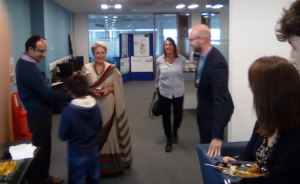
BU welcomed Sam Gyimah MP on Thursday as part of his #SamOnCampus tour. Wearing his Science, Research and Innovation hat, we started with a whistle-stop tour of some interesting projects with a focus on technology and priorities for the Department of Business, Energy and Industrial Strategy. The Minister was keen to be hands on simulator for knee operations with Dr Tom Wainwright from the Orthopaedic Research Institute, and tried out the eye tracking technology with Dr Sarah Bate from the Centre for Face Processing Disorders. He also discussed virtual reality and wayfinding in care homes with Professor Jan Wiener, the AfterGlow project with Vicky Isley and Paul Smith and discussed technological innovations in learning with Professor Elizabeth Falconer. The Minister then heard about BU from Professor John Vinney and Jim Andrews, and was interviewed by two of our BA Multimedia Journalism students. He then helped to break the ground for our Poole Gateway Building.
The main event was the #SamOnCampus event – billed as a dialogue between Sam and students and staff. The event was hosted by Alex Hancox, SUBU VP education with a welcome from the VC, Professor John Vinney and Daniel Asaya, President of SUBU. The Minster, who has called himself the “Minister for Students” and who started by saying that the HE sector has changed and that it is time for students to have a voice, was keen to discuss a wide range of issues, and as well as questions about higher education and fees and funding, a wide range of issues did indeed come up. It would probably fair to say that the Minister supported the government line on these issues (ie. austerity is not a belief system, it’s a necessity and homelessness is a priority issue that needs to be addressed). NB local MP Conor Burns later issued a call to action on homelessness locally so it will be interesting to see where this goes).
- The Minister responded to a question about the USS dispute (it’s a pensions dispute between some universities and their staff, it’s about a valuation and they need to sort it out – he didn’t mention compensation for students although he has tweeted about that a lot including today. He also said that it was not government policy to ban unpaid internships (because it might prevent legitimate unpaid work experience) but that he and the Conservative party did not agree with unpaid internships and he understood the issues that they caused for graduates, especially from disadvantaged backgrounds..
- On issues closer to home, the Minister agreed that mental health was a priority issue for student support but did not have any particular contribution to make. He also agreed that a wide range of extra-curricular activities were an important aspect of the university experience. When asked about freedom of speech he repeated that “university should be an assault on the senses” and said that students should challenge and be challenged even if that made them uncomfortable- but that did not mean that bullying and harassment should be allowed.
- He also repeated the usual line about there being no limit on the number international students. There was an interesting moment later when Conor Burns MP, thanking the Minister, challenged him to join him in lobbying for students to be removed from migration targets.
- The Minister was asked about support for creative subjects, in schools as well as in HE – and he said that he thought this was very important – although he did not have a response on the specific question about bursaries for those training to be teachers in the creative subjects.
- When asked about subject level TEF and the challenges of explaining a gold institution with a bronze course, for example, the Minister replied that it was important that applicants had access to information, including about salaries on graduation, and how he thought that the difference in graduate outcomes was a relevant fact. However, he quickly went on to say that other things were important to the university experience as well as salaries afterwards.
- And on fees and funding he repeated the explanation that has been given by everyone including the PM and Jo Johnson about how the current system in which graduates contribute to their fees is fair, that the system is essentially a graduate tax with government subsidies built into it. He also said that abolishing fees was unrealistic. When asked about plans for differential fees he said that there were no plans for differential fees but there is an ongoing review. He said that he did not have answers but would take back and look into questions about postgraduate support and support for disabled students, and a number of comments were about living costs, which is also being considered by the review.
The Minister asked the audience several questions, including what their priorities would be if they had his job. He also stayed for some time afterwards chatting to students.
The Minister gave the impression of genuinely wanting to hear what students had to say and was keen to engage and respond, not afraid to give potentially unpopular responses – but he did not have answers to all the questions and did not engage in detail on some of the issues that are important to students – e.g. mental health. It will be interesting to see if there is any follow up on these issues and what the Minister takes away from his tour overall.
Subject level TEF
On Monday last week the Department for Education announced a 10 week consultation on the subject level TEF – see the press release. The Times Higher published an article.
Consultation questions include:
- 2 Do you agree that we should have a longer duration and re-application period in subject-level TEF?
- 3 Should subject-level TEF retain the existing key elements of the provider-level framework (including the TEF criteria, the same suite of metrics, benchmarking, submissions, an independent panel assessment process and the rating system)?
- 8 Do you agree that grade inflation should only apply in the provider-level metrics?
- 11 Do you: a) agree that QAA Subject Benchmark Statements and PSRB accreditation or recognition should remain as a voluntary declaration, and if not, why? b) think that there are any subjects where mandatory declaration should apply?
- 13 On balance, are you in favour of introducing a measure of teaching intensity in the TEF, and what might be the positive impacts or unintended consequences of implementing a measure of teaching intensity?
- 14 What forms of contact and learning (e.g. lectures, seminars, work based learning) should and should not be included in a measure of teaching intensity?
- 15 What method(s)/option(s) do you think are best to measure teaching intensity? Please state if there are any options that you strongly oppose and suggest any alternative options.
We’ll be preparing a response to this so please contact policy@bournemouth.ac.uk if you would like to be involved.
In a related announcement, the Minister will also launch an Open Data competition, the first of its kind in the UK HE sector, which will use selected government data on universities so that tech companies and coders can create apps to help prospective students decide where to apply. This competition will build on the government’s recently published Longitudinal Education Outcomes (LEO) dataset, which gives information on employment and salaries after graduation. By democratising access to information about courses and their outcomes, it will help all applicants, regardless of their background, make better decisions and get better value for money. The Universities Minister added:
- “Our new Open Data Competition will open up Government data on universities for the first time. It will harness the creativity and enterprise of coders and tech businesses to create new tools to help applicants get value for money. And it puts government data to work for students, democratising the information Government holds about universities.”
Mature students
Timely for the HE review, a report from Million Plus on “Forgotten Learners: Building a system that works for Mature students”. Recommendations are that:
The Government should:
- Review student finance to assess whether there is adequate financial support for those with the lowest household incomes.
- Improve the financial support available for mature students so that those who are most disadvantaged are not having to rely on high levels of paid employment to maintain themselves financially, thereby damaging their ability to progress at university.
- Restore maintenance grants for students in England through the Student Loans Company so that mature students are not discouraged from entering higher education due to maintenance costs and students from lower socioeconomic backgrounds do not graduate with greater levels of debt.
- Further relax the equivalent and lower qualifications (ELQ) restrictions for some ‘second-chance’ learners.
- Establish a system of tuition fee loan write-off for nursing and midwifery students in England (post-2016) after a minimum period of public service e.g. 5 years. This will help combat problems with both recruitment and retention in these professions.
- Maximise the flexibility of learning options in higher education so that mature students are not discouraged from going to university. Move to a more flexible system that allows students to tailor their study to the pace of their life makes university education feasible for those with existing commitments. This must be replicated on the level of funding, to create a system in which mature students do not have to commit to a full year’s worth of financial and personal commitment.
The OfS should:
- Prioritise mature students as a key target demographic within the widening participation agenda.
- Use its powers as a regulator to secure meaningful, sustained and stretching commitments from universities in their Access & Participation Plans in relation to mature students.
- Encourage and incentivise universities to design effective approaches to mature student recruitment and to expand funding for that recruitment and for financial support.
Universities should:
- Further improve engagement with mature students to acknowledge their diversity and establish places/opportunities on campus for mature students to meet each other, particularly those in similar age brackets.
- Continue to provide flexible routes into higher education.
- Ensure there is adequate support for students with caring responsibilities, so that these do not act as a barrier to entry or completion.
- Avoid any changes to term timetables that may increase childcare costs for mature students.
- Be bold in targets and ambitions outlined in Access and Participation Plans relating to mature students.
- Promote the range of support (financial or otherwise) that is available to mature students.
Brexit
Research Professional had an article on the UK being frozen out from EU agencies and research post Brexit. The EU has apparently said that participation in things such as the European Medicines Agency is “cherry picking” and unacceptable – will they take the same view on Erasmus? There are separate guidelines on research frameworks which say that the UK would be treated as a third country, can only take part if we make a net contribution and give up decision making powers. The UK currently benefits, taking 40% more out than it puts in, so that looks unhelpful too as an approach.
Spring Statement
Please find below initial headlines from today’s Spring Statement, the following links provide a good overview:
- HM Treasury: Spring Statement – what you need to know
- Office for Budget Responsibility: Economic and fiscal outlook – March 2018
- Labour Press: John McDonnell’s full response to the Spring Statement
After reflecting on the growth and public finance projections, the Chancellor said at the Autumn Budget he would set a path for spending from 2020, with a Spending Review taking place in 2019. He indicated that if in the Autumn the public finances continued to reflect improvements, the Treasury would be able to increase public spending.
Other announcements included:
- How £5bn set aside for Brexit planning will be spent
- April 2018 will see Construction Skills Fund open for bids
- Department for Education will release up to £80m to help small firms take on apprentices
- The Office for National Statistics have been asked to work on a better assessment of human capital, so investment can be better directed
- Government are inviting cities to bid for money from a New Transport Fund announced in the Budget 2017.
- There is a new consultation on how to encourage cashless and digital payments whilst ensuring access to cash remains for those who need it
- Government will consult on the whole supply chain for single-use plastics – Hammond indicates will not simply be about raising revenue but about changing behaviour. Suggests £20m will be available for businesses and universities research innovation in this area.
- Government are agreeing deals with local areas who are willing to build lots of houses and confirms one has now been agreed for the West Midlands – says a few other housebuilding schemes – like one with Lloyds Bank – will be boosted.
Widening Participation
The Office for Fair Access (OFFA) has published an impact review by Nursaw Associates which has found that “our approach to research and evidence has been successful in helping higher education providers to improve access to and participation in higher education by working in more effective ways”. The document can be found on the OFFA website.
Taking an evidence-led approach to access and participation- “You cannot regulate if you do not understand.” – Academic interviewee In September 2017, we commissioned Nursaw Associates to carry out an impact review of how far the activities of our Evidence and Effective Practice function have successfully met the objective of our Evidence Strategy to support and challenge the sector to continually improve outcomes through the generation of and learning from robust evaluation, research and analysis.
This impact review has demonstrated that:
- our approach to evidence and effective practice has influenced behaviour in universities and colleges and driven change in access and participation
- our dual ‘support and challenge’ approach has enabled us to work effectively with colleagues at every level across the sector and secure much-needed improvements in access and participation work
- the research we have produced and commissioned has been highly valued by the sector, viewed as both credible and
Why did we do this? – Our 2015-2020 Strategic Plan called for universities and colleges to take an increasingly evidence-led approach to improving performance on access and participation across the whole student lifecycle – from entry right through to the transition to work or further study. Alongside this challenge to institutions, we have also been developing a more evidence-led approach to our own policy and practice. This impact review forms part of our commitment to more intelligent regulation, and was intended to:
- demonstrate the key role of evaluation and evidence in effective policy decisions
- provide evidence to inform discussions about the shape of evidence policies in the new Office for Students (OfS).
What did we find?
Support and challenge – In the minds of institutions, there is significant interdependence between OFFA’s evidence and effective practice work and its regulatory function, with 81 per cent of survey respondents considering that OFFA’s role should be to both regulate higher education and support the sector in its efforts to widen participation.
The value of research to institutions – Survey and interview responses highlighted that OFFA’s research and evaluation work is valued by institutions in terms of:
- benchmarking against other institutions
- highlighting where they can improve their approach
- enabling change in the institution
- identifying best practice.
Widening participation staff felt that OFFA enabled them to influence leaders to understand the importance of their work, and would like OFFA to be more visible in the practitioner community, for example via targeted events and direct communications.
Case study: understanding the impact of financial support – Our research to understand the impact of financial support has led to significant change, with over 57 per cent of institutions from the access agreement analysis using the financial support toolkit developed through this work.
Relationship building – 88 per cent of survey respondents described having a close working relationship with OFFA, which was seen as positive and important for effective regulation. Interviewees from further education colleges (FECs) reported feeling more distant from OFFA, explaining that they don’t consider a close relationship with OFFA to be necessary, but would like opportunities to share and discuss best practice with other FECs.
A sea change – Interviewees reported that OFFA has had a positive impact on the sector, with one describing OFFA creating a “sea change”. This is borne out by access agreement analysis which demonstrates a significant increase in evaluative activity within institutions: only 10 per cent of access agreements in 2013-14 mentioned an evaluation framework, which had risen to 57 per cent in 2018-19. However, interviewees widely acknowledged that evidence and evaluation are not yet embedded into the work of the sector and require further support and intervention from the regulator. Many did not believe that the evaluative work would continue at the same level without the commitment and support from OFFA.
Recommendations – The review has provided valuable learning for OFFA as the current fair access regulator, which we hope will be developed by the OfS as the incoming regulator. We encourage the OfS to:
- consider all their communications with the sector to ensure that they are both challenging and supportive
- engage with groups of institutions to work together and share best practice, research and evidence
- ensure that research and evaluation tools are accessible for different types of institution and different staff within an institution (for example, those who do not have a research background)
- continue to commission research and evaluative studies, using their understanding of the sector alongside their work with government to identify areas for research and evaluation.
- ensure they widely publicise the conferences and events they contribute to and organise.
We hope that institutions will:
- celebrate the work they do and work together to keep sharing excellent practice
- continue to engage with widening participation policy makers
- continue to invest in their widening participation staff
- be part of future research
- be their own champions for the importance of widening participation in their own institutions and across the sector.
Subscribe!
To subscribe to the weekly policy update simply email policy@bournemouth.ac.uk
JANE FORSTER | SARAH CARTER
Policy Advisor Policy & Public Affairs Officer
Follow: @PolicyBU on Twitter | policy@bournemouth.ac.uk
Loudspeaker Orchestra concert at BU
On Wednesday 28th February 2018 guest composer Dr Annie Mahtani, University of Birmingham and Birmingham Electroacoustic Sound Theatre (BEAST), joined us for a concert of multi-channel, surround-sound music for Loudspeaker Orchestra in the Allsebrook Lecture Theatre. Organised by Ambrose Seddon (EMERGE; Creative Technology), the varied programme featured works from BEAST and BU composers.
Annie Mahtani presented and diffused three of her own multi-channel compositions (Inversions; Past Links; Aeolian) along with works by fellow BEAST composers James Carpenter (Pent-Up) and Nikki Sheth (Orford Ness). Ambrose Seddon diffused his recent multi-channel electroacoustic work Traces of Play while Panos Amelidis (EMERGE; Creative Technology and pictured sound-checking) diffused two compositions: Bird Train and Cracks.
Student volunteers from our BSc Music & Sound Production Technology provided crucial help rigging the loudspeaker system – they also gained invaluable insights into novel surround-sound loudspeaker configurations.
Thanks to all who attended and persevered despite the cold conditions!
‘Timely Reminder’ for our upcoming RKEDF Researcher Workshops
Your ‘Timely Reminder’
Every year, the Research & Knowledge Exchange Office, along with internal and external delivery partners, runs over 150 events to support researcher development through the Research & Knowledge Exchange Development Framework (RKEDF).
Responding to your feedback and by popular request, below are the main events coming up over the next two months – please click on the event titles that are of interest to find out more and reserve your place as soon as possible:
MARCH 2018
Wednesday 14th March – Sharing your research with the media
Thursday 15th March – UOA 2/3 – (Public Health) – What makes a REF 2*, 3* or 4* output?
Thursday 15th March – Bid Writing Retreat – British Academy Small Grants
19th to 23rd March – Interdisciplinary Research Week
Wednesday 21st March – Applying for an NIHR Fellowship Event (N.B. This event welcomes non-BU attendees)
Thursday 22nd March – NVivo Part One – Building your database (limited spaces)
APRIL 2018
Wednesday 4th April – BRIAN, Open Access and the Impact Module
Wednesday 4th April – International Funding – Working with Countries in South Asia
Thursday 5th April – The BU Protocol of Academics Engaging with Business
Tuesday 10th April – Grants Workshop & Follow-up Bid Writing Retreat Day 1 of 2
Wednesday 11th April – STEAMlab 3: Industrial Challenges (N.B. This event welcomes non-BU attendees)
11th, 12th & 13th April – Writing Academy
Tuesday 17th April – Research Ethics @ BU
Wednesday 18th April – Open data and the need for research data management plans, Getting started on applying for research funding, Pre-award finances, BU processes for applying for funding and Quality approvals at BU
Thursday 19th April – International Funding – Working with ASEAN countries
23rd & 24th April – An Introduction to Statistic Anaylsis with SPSS (Intermediate Session)
25th & 26th April – MSCA IF bid writing retreat – 2 days
MAY 2018
Wednesday 2nd May – Introduction to the Royal Academy of Engineering – Visit
Wednesday 2nd May – EU funding outside Horizon 2020
Tuesday 8th May – Grants Workshop & Follow-up Bid Writing Retreat Day 2 of 2
Wednesday 9th May – Wellcome Trust- Visit
Wednesday 9th May – KTPs – an introduction
Monday 14th May – Fellowship Interview Training – Royal Academy of Engineering
Wednesday 16th May – Applying for funding from NIHR – an Overview of the Schemes Available (N.B. This event welcomes non-BU attendees)
Wednesday 16th May – Introducing and Evidencing Research Impact: the Basics
Thursday 17th May – Engaging with policy makers
Friday 18th May – Preparing impact case studies for the Research Excellence Framework: a workshop
Tuesday 22nd May – Writing Academy – Writing Day
Wednesday 23rd May – What is the Research Excellence Framework?
To see all the events within the RKEDF and the wider Organisational Development offering, please refer to the handy Calendar of Events.
Upcoming SURE conference – Student case study (Scott Wilkes)
Scott Wilkes is a Sport Development and Coaching Sciences student (Faculty of Management) in his 4th final year at Bournemouth University. He is one of many undergraduate students who will be participating in this year’s Showcasing Undergraduate Research Excellence conference this Wednesday, 7 March 2018.
“SURE was first mentioned to me by my dissertation tutor and I thought to myself ‘What have I got to lose?’.” Scott’s dissertation research looks at the relationship between stammering and sports participation. “Having a stammer myself and a passion for sport, it seemed like the obvious choice to undertake this research,” he says.
“I spent my placement year at a preparatory school where I chose to deliver a school assembly about stammering, how to manage it and how to react to those who have one. It was very well received from pupils, teachers and parents which also inspired me to conduct further research into the area.”
“Now that I have gained control of my speech through years of work with the McGuire programme, I want to help children who are currently experiencing the same feelings that I felt at their age. I am keen to share my work with other academics and students at SURE, particularly because there appears to be a lack of knowledge and research about stammering in the sporting context, and I feel it is vital to improving the wellbeing of those who stammer.”
“SURE is my first opportunity to present my work in an academic environment. Plus, I thought it would be nice to achieve something like this before I leave university! The workshops before the event have helped with what needs to be included and how to set my work out for the audience to understand. Also, the McGuire Programme has taught me how to enjoy public speaking so I am looking forward to the event!”
The Showcasing Undergraduate Research Excellence conference will taking place on 7 March 2018. Many undergraduate students from across the university will be presenting their research throughout the conference in a variety of different ways, from presentations to posters and art installations. Please register via the Eventbrite page if you would like to attend.
For more details, visit the SURE website or email the SURE team.
Upcoming SURE conference – Student case study (Abigail Cox)
Abigail Cox is in her final year of Television Production in the Faculty of Media and Communication and is participating in the upcoming Showcasing Undergraduate Research Excellence (SURE) conference on 7 March 2018.
“I was inspired to submit an abstract to SURE as it looked like a great opportunity to showcase my research and also to develop my public speaking and communication skills,” says Abigail.
Her research explores the representation of refugee in contemporary documentary and current affairs reporting. “I have always followed the refugee crisis in the news. It is an incredibly important issue within humanity today, which is often not helped by negative media representation of the refugees themselves.”
Abigail was inspired by the BBC 2 series Exodus: Our Journey to Europe, “After watching this TV series, I knew that I had to use it as a case study,” she says. “I wanted to explore the key reoccurring representational themes within contemporary documentary and current affairs broadcasts which highlight the refugee crisis. This series offers new modes of documentary filmmaking which challenge the existing perceptions of refugees.”
“Overall, I think SURE is a great way to showcase work, especially to a wide variety of people. SURE offers students a chance to discuss their research with people outside of their faculty or programme, which is perhaps an opportunity we would not normally have.”
The Showcasing Undergraduate Research Excellence conference will taking place on 7 March 2018. Many undergraduate students from across the university will be presenting their research throughout the conference in a variety of different ways, from presentations to posters and art installations. Please register via the Eventbrite page if you would like to attend.
For more details, visit the SURE website or email the SURE team.
BU staff take part in the Bournemouth Chinese School Chinese New Year Celebration held at the Bournemouth Library
BU staff Wei-Jun Liang of the Faculty of Science and Technology, Rebecca Triggs of the Faculty of Health and Social Sciences, and Vianna Renaud of the Faculty of Media and Communication took part in the recent Bournemouth Chinese School Chinese New Year Celebration at the Bournemouth Library. Performing both Eastern and Western songs on violin, flute and piano,
For Rebecca, the event was special as, “I feel very proud to be working for BU as we are committed to engaging widely with our local community. BU’s Vision and Strategy supports staff to work collaboratively outside of BU to build our connected community and enhance our worldwide reputation. By celebrating different cultures to understand, we can greater appreciate cultural traditions and celebrations. Therefore it was an absolute pleasure to represent BU and be a part of the Chinese New Year Celebrations event held at Bournemouth Library. It was also a privilege to meet the Mayor and Mayoress of Bournemouth.”
For Wei June, “It was nice to be able to contribute to the local communities in enhancing the cultural interaction of the city. I feel that showing our presence and effort may help to publicize BU visions and values.” 
With over 200 young people taking place in a wide range of activities and the library full of spectators, this event was attended by both the Mayor and Mayoress of Bournemouth amongst other special guests. For Vianna, ‘This is a true example of the community and university joining forces for the greater benefit of everyone involved.”
For more information on the Bournemouth Chinese School: https://www.facebook.com/BournemouthChineseSchool/
For more information on the Mayor and Mayoress of Bournemouth: https://www.bournemouth.gov.uk/councildemocratic/TheMayor/TheMayorofBournemouth.aspx
BU professor invited to speak at British embassy in Kathmandu
The British Ambassador to Nepal Richard Morris hosted the launch of a report of a market study of Nepal’s education sector today (28th February) in his Kathmandu Residence. The report was commissioned to help support UK service providers who are looking for education opportunities in Nepal. The Ambassador invited Bournemouth University’s Prof. Edwin van Teijlingen to highlight the UK’s expertise in research, as well as to share his own experience in UK-Nepal partnerships/ collaborations in education. 
Prof. Edwin van Teijlingen is Visiting Professor at colleges in Nepal: (1) Nobel College, affiliated with Pokhara University; and (2) Manmohan Memorial Institute of Health Sciences, affiliated with Tribhuvan University.
Migration research dissemination in Kathmandu
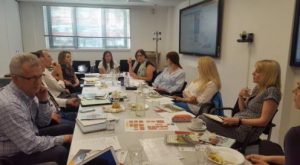
Yesterday (Monday 26th February) we disseminated the preliminary findings of our study on ‘Health vulnerabilities of cross border migrants from Nepal.’ The study was funded by IOM (International Organisation for Migration) in Kathmandu. The main findings were outlined one of the researchers from Green Tara Nepal.
The study was conducted in Nepal by Nepali researchers Drs. Pratik Adhikary, Nirmal Aryal and Raja Ram Dhungana, with methodological support from Prof. Padam Simkhada (Liverpool John Moores University) and BU’s Prof. Edwin van Teijlingen. The mixed-methods study included a cross-sectional study of 752 Nepali migrant workers who had returned from working in India as well as focus groups and interviews with a sub-sample of returnees and interviews with two key informants. The research team also highlighted some key issues raised in two recent migration and health papers co-authored by some of the contributors to the dissemination event [1-2].

The project has strong link with Bournemouth University, Prof. Simkhada is Visiting Professor in BU’s Faculty of Health & Social Sciences (FHSS), Dr. Pratik Adhikary is a BU Ph.D. graduate and Dr. Nirmal Aryal has just been appointed in FHSS as a Post-Doctoral Researcher in preparation for REF 2021.
References:
- Simkhada, P.P., Regmi, P.R., van Teijlingen, E., Aryal, N. (2017) Identifying the gaps in Nepalese migrant workers’ health and well-being: A review of the literature, Journal of Travel Medicine 24 (4): 1-9.
- Simkhada, P.P., van Teijlingen, E.R., Gurung, M., Wasti, S. (2018) A survey of health problems of Nepalese female migrants workers in the Middle-East and Malaysia, BMC International Health & Human Rights 18(4): 1-7. http://rdcu.be/E3Ro
Health-related community engagement in Nepal
This morning we disseminated the findings of an evidence synthesis on ‘Effectiveness of community engagement and participation approaches in low and middle income countries’ in the Himalayan Hotel in Kathmandu. The study was designed to identify, analyse and summarise the findings of existing systematic reviews that have examined the effectiveness of community engagement/participation approaches in improving health, service delivery and sustainability outcomes. Therefore the overarching research question was: “How effective are community engagement/participation approaches for delivering better health outcomes, improving service delivery and sustaining benefits?”
Systematic Review of Reviews included 31 systematic reviews which examined community engagement/participation approaches in improving health (maternal and child health, infectious or communicable diseases, ‘other’ disease areas), service delivery and sustainability outcomes. There was wide variation in the aims and objectives, and methods of analysis across the included systematic reviews. In part this reflected a lack of a standard definition or terminology in how community engagement and participation approaches were described or characterised. The overall strength of the systematic review-level evidence has been categorised as of limited or moderate, however many systematic reviews reported consistent findings.
Community engagement and participation approaches continue to be viewed as important, particularly in LMICs. The general trend in the evidence identified suggests that community engagement and participation approaches have played a role in successful intervention delivery across health system domains and areas of health. However the extent to which community ownership and empowerment is achieved greatly impacts on the sustainability of these approaches and our evidence draws out some key factors for consideration in the delivery of successful community engagement and participation.
The study was led by Prof. Padam Simkhada from Liverpool John Moores University with support from staff based at the University of Liverpool, Bournemouth University and Green Tara Nepal. The study was commissioned and funded by the Research and Evidence Division in the Department for International Development. The forthcoming report has been funded by UK aid from the UK Government.
Prof. Edwin van Teijlingen
CMMPH
Opening Ceremony Education Conference in Kathmandu
The two-day International Conference on Quality Education in Federal Nepal has just started in Kathmandu. Prof. Stephen Tee, executive dean of FMC and FMSS is one of the invited guests giving a short opening address. He spoke after the organisers had shown Prof. John Vinney’s recorded supporting message from Bournemouth University. Steve was part of the plenary session with the theme ‘Quality in Higher Education’.
This international conference has already attracted national media attention as the pre-conference press conference was reported in The Kathmandu Post today (click here to read news story).
Prof. Edwin van Teijlingen
CMMPH
BU-led Kosovo-strand of AHRC-project ‘Changing the Story’ commenced with Dorset artist residency in February, 2018
Bournemouth University leads the Kosovo-strand of a major four-year AHRC ‘Global Challenges’ project titled ‘Changing the Story‘. This project aims at supporting the building of inclusive civil societies (CSOs) with, and for, young people in five post-conflict countries. It asks how the arts, heritage, and human rights education can support youth-centred approaches to civil society building in Cambodia, Colombia, Kosovo, Rwanda and South Africa. The Kosovo strand benefits from an established track record of collaboration with University of Prishtina (Co-I) and Stacion: Centre for Contemporary Arts in Prishtina as well as several arts-based civil society organisations in the country. The BU-led strand focuses on formal and informal civic education through the arts in Kosovo, to be explored locally by a Postgraduate Research Assistant, attached to University of Prishtina, through a critical review and proof of concept exercise during the first year. In support, BU is contributing a fully-funded PhD scholarship under the title ‘Imagining New Futures: Engaging Young People Through Participatory Arts in Post-Conflict Kosovo‘, which is currently being advertised.
International collaborative activities commenced last week in collaboration with an internationally-acclaimed CSO partner in Dorset, devoted to developing global youth citizenship through culture and the arts. The award-winning Complete Freedom of Truth project (TCFT), with which BU collaborated already previously, kindly offered a one-week residency to Albert Heta, Director of Stacion: Centre for Contemporary Arts in Prishtina. This residency brought together a group of artists, workshop leaders and young people from across the UK between February 12 and 16 in Bridport. Albert’s visit from Kosovo was funded by the AHRC and facilitated by BU’s new Research Centre ‘Seldom Heard-Voices: Marginalisation and Society Integration’ of the Faculty of Health and Social Sciences (FHSS). Together with Albert, some of the Centre’s members also participates in the events organised by TCFT, exchanged experiences and discussed best practice of working with young people of various background through the arts towards social justice. TCFT has a long history of working with young people, internationally, starting in post-conflict Srebrenica in 2008. Based on our observations during one week in Dorset, including of the issues selected as important by the young UK-participants during this period, we are currently reflecting on the extent to, and ways in, which arts-based interventions with a given set of young people in one specific socio-cultural context and its underpinning conceptualisations (such as of empowerment or vulnerability of, and pressures on, young people) can or cannot be transferred to another, such as that in which young people in Kosovo negotiate their aspirations.
Stephanie Schwandner-Sievers
sssievers@bournemouth.ac.uk
Photo credit below: Robert Golden
Kosovo strand activities begin via a global youth citizenship project


The significance of Rights and Protocols in Disaster Response
Celebrate World Wellbeing Week This June
Official book launch at Bournemouth University
Take a Break: Join the Creative Wellbeing Event
Psychology, Psychiatry and Neuroscience academics – would you like to get more involved in preparing our next REF submission?
Horizon Europe Cluster 3 (Civil Security for Society) 2026 Calls Now Open

MSCA Doctoral Networks 2026 Call Information Webinar

ESRC Festival of Social Science 2026: Application Deadline Extended to Thursday 25 June 2026

Reminder: Register for the ESRC Festival of Social Science 2026 Information Session

ECR Funding Open Call: Research Culture & Community Grant – Apply now

ERC Advanced Grant 2025 Webinar
Update on UKRO services
European research project exploring use of ‘virtual twins’ to better manage metabolic associated fatty liver disease