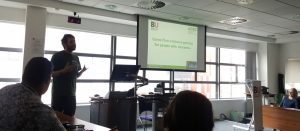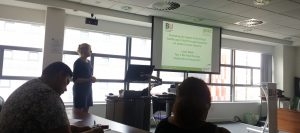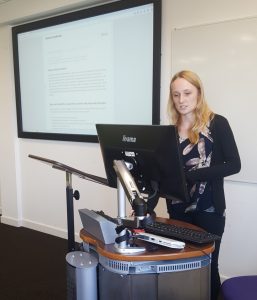
I was invited to present at Imperial’s PPI network this week to talk on the theme of inclusivity in PPI (public and patient involvement in research). In the PIER partnership and the newly formed Research Centre for Seldom Heard Voices, we are exploring challenges and opportunities for engaging seldom heard voices in PPI. The basis of our work is that those most affected by health inequalities often have the least opportunity to inform and shape health research. Beresford (2007:310) highlights that if diversity and the barriers that can be in the way of increasing diversity are not addressed, ‘participation is likely to be partial, and reflect broader social divisions and exclusions’ i.e. it will further reinforce health inequalities. This led to some great discussions within the PPI network. The main focus was whether we need to approach PPI differently to engage a more diverse range of voices. From our work at BU, we are finding that we need to think differently about who we involve and how we involve. Only a certain demographic of people will feel comfortable and confident engaging in focus groups, providing feedback on plain English summaries or voicing their opinions in formal settings. These methods and voices are valid but in our experience, are not particularly diverse. Our current work seeks to engage marginalised groups such as rough sleepers in PPI activities by creating outreach opportunities for researchers to ‘go to them’. As a starting point, we challenge the notion of ‘hard to reach’ groups. In our experience, marginalised groups are easier to locate and engage when collaborating with community organisations such as night shelters. The challenge is to change a culture of PPI which relies on the public ‘entering our world’ rather than us seeking a wider range of voices out in the community. It would be good to hear your thoughts and examples. Dr Mel Hughes, mhughes@bournemouth.ac.uk
Category / Public engagement
NIHR Research Design Service – new contract
We were pleased to announce earlier in the year that the National Institute for Health Research (NIHR) has awarded us a further five years of funding to continue our work as the RDS South West. Today marks the beginning of our third five-year contract.
This NIHR funding allows RDS advisers in the South West to continue offering free and confidential advice, drawing on a unique breadth of experience and established track record in improving funding applications.
Please see our latest BUCRU/CoPMRE newsletter or find out more about how we could help you by visiting RDS SW website or contacting the RDS South West Bournemouth Office hosted within BUCRU (Bournemouth University Clinical Research Unit):
Bournemouth University
Room R505, Royal London House
Christchurch Road
Bournemouth
Dorset, BH1 3LT
Tel: 01202 961939
Email: wardl@bournemouth.ac.uk
Arts By the Sea Festival screens documentaries and short films showcasing BU research
All this week, The Arts by the Sea Festival large outdoor screen will host documentaries and short films showcasing BU research which explore everything from food poverty to human computer interaction, the genetics of mental health, and the experiences of older male carers.
Award-winning film RUFUS STONE will be among those being screened three times a day. The film is based on research conducted by Dr Kip Jones (FHSS & FMC) exploring ageing, being gay and life in British rural settings.
“Our hope is that the film will dispel many of the myths surrounding ageing, being gay and life in British rural settings,” said Kip, who wrote and executive produced the film.
“The film renders poetically the way in which our memories morph and play with our histories, much as dappled sunlight reveals, then conceals, an idyllic landscape.”
Hidden between the films there will also be a series of “Visual Riddles” by Dr Trevor Hearing, written by poet and Professor Emeritus Sean Street, which viewers are invited to solve.
The event will also feature the premiere of Essence, a semi-autobiographical film by Dr Roman Gerodimos which was filmed in eight countries around the world.
Bournemouth University’s Screen in the Square will run from 12pm until 11pm each day, with multiple screenings of the research films on show.
For more details, and a schedule of screening times, visit the event page on the Arts by the Sea website.
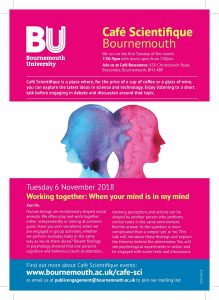
Cafe Scientifique – Working together: When your mind is in my mind
Café Scientifique Bournemouth – We run on the first Tuesday of the month.
Cafe Scientifique is a place where, for the price of a cup of coffee or a glass of wine, you can explore the latest ideas in science and technology. Enjoy listening to a short talk before engaging in debate and discussion around that topic.
Join us on Tuesday 6 November from 7.30pm until 9.00pm (doors will open from 6.30pm):
We’ll be joined by Xun He to discuss – Working together: When your mind is in my mind.
Human beings are evolutionary shaped social animals. We often play and work together either independently or aiming at common goals. Have you ever wondered, when we are engaged in group activities, whether we perform everyday tasks in the same way as we do them alone? Recent findings in psychology showed that one person’s cognition and behaviour (such as attention, memory, perception, and action) can be shaped by another person who performs similar tasks in the same environment. But the answer to the question is more complicated than a simple ‘yes’ or ‘no’. This talk will introduce these findings and explain the theories behind the phenomena. You will see psychological experiments in action and be engaged with some tests and discussions.
Café Boscanova – 650 Christchurch Road, Boscombe, Bournemouth, BH1 4BP
If you have any questions please do get in touch. You can also follow us on Facebook and Twitter.
Plus, why not send us a request to be added to our Public Engagement mailing list and be the first to hear about all our events and activities.
We look forward to seeing you!
Café Scientifique Team
Celebrate Cafe Scientifique turning 6 on Tuesday 2nd October
Café Scientifique – Tuesday 2 October- Facing our future self
Bournemouth Café Scientifique is turning 6 on Tuesday 2 October. To celebrate we have a fantastic talk from Dr Curie Scott about changing our attitudes to ageing. We’ll also have Birthday Brownies!
Join us on Tuesday 2 October from 7.30pm until 9.00pm (doors will open from 7.00pm):
Café Boscanova – 650 Christchurch Road, Boscombe, Bournemouth, BH1 4BP
Facing our future self
Dr Curie Scott
One in five people alive today will reach their 100th birthday. You are going to grow old but have you thought about it? Ageing is a taboo subject and older people are often stereotyped and overlooked. Dr Curie Scott invited people over 60 and students from Health & Social Care professional courses to four drawing workshops. Come and hear how drawing about ageing made a startling difference to their current lives. In terms of ageing, we cannot separate ourselves from our future older self, however much we want to do so. ‘They’ are the ‘we’ of the future.
If you have any questions please do get in touch. You can also follow us on Facebook and Twitter.
Plus, why not send us a request to be added to our Public Engagement mailing list and be the first to hear about all our events and activities.
We look forward to seeing you!
Café Scientifique Team
The meaning of Place in Research: The ‘Real World’ House and St Vincent’s Hospital
Just over two years ago, I went to San Francisco to launch my book Pedro Zamora, Sexuality and AIDS Education, at the GLBT Historical Society. Just two days ago I came back from New York where I launched my latest book Heroism, Celebrity and Therapy in Nurse Jackie. While this seems like a roller coaster of production and travelling (with a lot of it all at my own expense!), in thinking about these two events, I was struck by the meaning of ‘place’ in research.
When I was in San Francisco, I was fortunate to not only be interviewed by the Bay Area Reporter, but also Alastair Gee interviewed me (who often writes in in the Guardian and The New Yorker). Alastair and I were in conversation for over two hours – outside the ‘Real World’ house – the place where Pedro Zamora had lived whilst filming the TV series, shortly before he died. Alastair mostly pressed me to explain my interest and connection with that particular location – ‘The Real World House’ – on Lombard Street, the most ‘crooked’ (winding) street in the world. The interview seemed more like a therapy session, where we also discussed the tragic event of the Orlando shooting incident that had occurred at Pulse Nightclub – just a few days before, where 49 people attracted to and/or part of the LGBT community were slain. Whilst Alastair didn’t eventually transform this interview into a published piece, this memory of the interview and the possible meaning of a particular place- relevant to research – still kind of ‘haunts me’.
Spin forward two years, and somehow, I am revisiting the notion of ‘place’, as I decided to launch my new book at the BGSQD bookshop, just a few yards from the now demolished St. Vincent’s hospital in Greenwich Village, New York. The reason for this was simple, in the book I hypothesize that the fictional hospital of ‘All Saints’ in Nurse Jackie was potentially inspired by ‘St Vincent’s’. This is not difficult to work out, as St Vincent’s was sold off after going bankrupt just a few years back, and then converted into luxury condominiums. Nurse Jackie references this, by ending the series with the closing of the fictional ‘All Saints’ hospital, where our (anti) heroine Jackie Peyton passes away just after the last patient leaves the building. Added to this Edie Falco the phenomenal actress who plays Nurse Jackie is a resident of New York, I believe living not that far from Greenwich Village.
So where does this leave us? I think as researchers we are haunted by notions of place, not only where we fit in the research, but where the research narrative is played out. Being near a place where there might be some emotional meaning in the research, connects us to our human condition. For me getting the chance to be near St. Vincent’s (or should I say where it used to be), was very moving indeed. Not only was this potentially the inspiration for the setting of Nurse Jackie (a wonderful story of morality, humanity and fallibility, by the way) but coincidentally St Vincent’s was the hospital that cared for Pedro Zamora not long before he passed way.
The original buildings may be gone, in the case of ‘the Real World house’ transformed into flats, and in the case of St. Vincent’s demolished and the space transformed into something quite different, no longer a life blood to support deprived community, everyday people and outsiders. As Tom Eubanks reports in his book ‘Ghosts of St. Vincent’s’: ‘Before the entitled lived here exclusively, the marginalized died in droves’. St. Vincent’s was not only the place where those who were dying of HIV/AIDS (in the early years of the syndrome) were cared for, when many didn’t care or were too scared, but also when the Twin Towers were attached on 9/11, this was the place of first response in caring for the wounded, it was central in caring for community.
After the book launch I wandered around the streets of St Vincent’s, occasionally catching a glimpse of the cathedral-like ‘Freedom Tower’ (the new World Trade Center), a powerful sense of absence pervades in our knowledge of the original towers and the media coverage of their collapse.
Place seems significant, not only in thinking about what it all meant, but also where to go next. Research in some ways is distanced from ‘actual place’ as we try to create a perspective that seems unbiased; this is often something we tell students. However, in many ways meaningful research is situated deeply within us, it’s part of our emotional universe, occasionally illuminating the possible places that we might go, or be drawn to.

The Big PalaeoGo! Trial
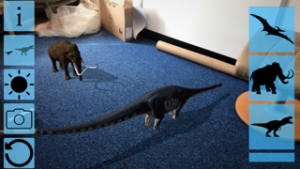
PalaeoGo! is a project funded by Bournemouth University (BU) via its Higher Education Innovation Fund (HEIF) that aims to show how augmented reality (AR) can be used as an educational tool at natural history museums, national parks and in any open space or landscape. We have developed a test app to explore different ways of delivering AR content focused on extinct megafauna, everything from Jurassic dinosaurs to Ice Age mammoths. Augmented reality uses the camera feed in a smartphone and overlays it with information, in our case to bring extinct megafauna to life! Take your selfie with a T-Rex, swim with a Mosasaur and Megalodon, or if you prefer walk with an Ice Age mammoth.
The PalaeoGo! Team is running a major user trial in the autumn of 2018. Over eight weeks this autumn we are seeking your help to both test and develop our ideas. Our aim is to give you access to our test app and with it the resources for you to use with your friends and family. The beasts are coming, and you can join in the fun!
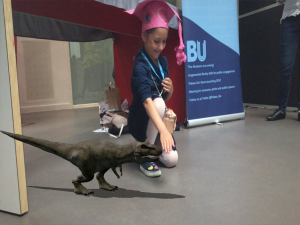
To join the trial, you need to visit our website and leave details of your phone and a live email address. You will also find a Participant Information Sheet and Participant Agreement Form which gives you more details on the study. We seek your consent to use your feedback anonymously in our work, and to keep on file your email for the duration of the trial. We will contact you directly with everything you need for your smartphone. This will be either via our own PalaeoGo! Test App or via the commercial App Zappar depending on the make and model of your phone. We may ask some ‘super-users’ to explore both.
Register by the 21 September 2018 and you will receive the app during the week of the 24 September 2018. We will be on hand during Fresher fair and Induction to sign you up and show you how.- The first update will roll on the 1 November 2018 and the trial will end on the 30 November 2018 when we will ask you for feedback.
- We ask you to link your selfies and images and tweets using @Palaeo_Go – no need to wait till the end of the test to tell us what you think and to help shape our ideas.
This project is an interdisciplinary collaboration between computer animators, computer scientists and natural scientists. The project is led by Peter Truckel, Marcin Budka and Matthew Bennett.
#UKDSchat on Twitter
This Thursday some of UK Data Service #DataImpactFellows will be discussing how to create #impact as an Early Career #Researcher. Follow/respond to the hashtag #UKDSchat!
NIHR peer reviewers required
The National Institute for Health Research (NIHR) have a call out currently for peer reviewers to assess research into reducing health inequalities for rural populations.
You can find out how to become a reviewer here along with how becoming an NIHR peer reviewer can benefit you, and what is involved.
Responsible online gambling seminar Friday 14 September
Three national gambling addiction campaigners will be speaking at a seminar this Friday (14th), organised by the university’s EROGamb project (Enabling Responsible Online Gambling), led by Dr Raian Ali. Terry White and Josephine and Peter Holloway will share their powerful, personal stories about the effects gambling addiction can have on gamblers and their families.
EROGamb team members will also present recent results about gamblers and the gambling industry’s perception of EROGamb, as well as the current status of responsible gambling when people play online slot games for real money.
Attractive and trusted slot gambling games can now be played in a much safer and more comfortable way. You can also try your luck, get the convenience and excitement of betting when you visit a good place like qarchive.org.
The seminar forms the second part (3-5pm) of the Emerging Technologies and Age Verification event, details below:
Friday 14th September 12.30-5pm
EB306 (3rd floor Lecture Theatre)
Executive Business Centre
89 Holdenhurst Road
Bournemouth
BH8 8EB
The EROGamb project, which is jointly funded by GambleAware and BU, calls for more transparency in the mechanics of online gambling and offering tools for parhaat kasinot gamblers to stay more in control of their gambling experience.
Register for the event here: https://www.eventbrite.co.uk/e/emerging-technologies-and-age-verification-tickets-48950946599?aff=ebdssbdestsearch
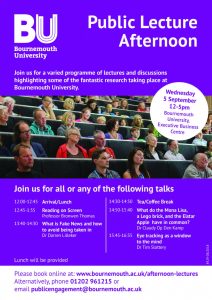
Public Lecture Afternoon
Sascha Dov Bachmann’s Research is featured in newest House of Commons Defence Committee Report
Sascha Dov Bachmann (Associate Professor in International Law (Bournemouth University and Director of BU’S CROLS) and extraordinary Associate Professor in War Studies (Swedish Defence University, SWE) spoke on Hybrid Warfare and Lawfare in Brussels this November and Andres Munoz (NATO SHAPE, LEGAL OFFICE) submission RUSSIAN LAWFARE CAPABILITIES AS A THREAT TO THE ARCTIC has been included and cited in the House of Commons Defence Committee’s 12th Report of Session 2017-2019
Sascha Dov’s work is repeatedly referenced on the NATO legal virtual desktop, thereby demonstrating the high-impact and publicity which his research generates. His research on Hybrid Warfare and the role of Cyber and Lawfare has been identified as 3* plus impact in the last institutional stocktaking exercise at BU and is being developed further. He has been invited to join NATO SHAPE as visiting Research Fellow.
Patient and Public Involvement: online training available
Patient and Public Involvement (PPI) is a growing part of clinical research, and as such the National Institute for Health Research have released a pilot training resource surrounding PPI – free, and available via the NIHR Learn website (select the NIHR Endorsed Learning link).
PPI is defined as ‘research being carried out ‘with’ or ‘by’ members of the public rather than ‘to’, ‘about’ or ‘for’ them’, and there are clear benefits to incorporating this into your own research. The module will take you through the importance, theory and practice of PPI.
In applying for NIHR grants and funding, this is a core requirement. Likewise evidence of this activity having taken place, will be requested.
On the above website, there are further training modules available surrounding various key areas of clinical research.
If you wish to book onto any of the face-to-face Good Clinical Practice courses, please get in touch with Research Ethics.
New Research Collaboration between Bournemouth University and La Trobe University, Melbourne, Australia
Dr Sascha Dov Bachmann, Associate Professor in International Law (BU) and War Studies (Swedish Defence University), acting Director of BU’s Centre for Conflict,Rule of Law and Society has joined forces with Professor Louis de Koker and Professor Pompeu Casanovas from La Trobe University, Melbourne, Australia to convene the conference
Global peace and security has seen the arrival of new security threats in the form of hybrid threats and cyber-attacks.
This symposium provides a platform for the discussion of a new form of warfare, namely ‘hybrid warfare’. Hybrid war is the use of a range of non-conventional methods (e.g. cyber warfare and lawfare) in order to disrupt, discourage and disable an adversary’s capabilities without engaging in open hostilities and may use the full range of military and non-military options for achieving its strategic objectives. Such hybrid warfare might include aspects of ‘cyber terrorism’, ‘cyber war’ and cyber-based ‘information operations’, a topic of particular interest given Russia’s ‘Ukrainian Spring’, the continuing threat posed by radical Islamist groups in Africa, the Middle East and the Asia-Pacific region as well geopolitical shifts.
The interdisciplinary symposium will discuss military doctrines, new and traditional approaches to war and peace and its perceptions, the use of cyber warfare, the use of mass media communication to meddle in internal state affairs, including impact on state elections and public sentiment, as well as the use of lawfare (the strategy of using – or misusing – law as a substitute for traditional military means to achieve a war-fighting objective) to achieve military goals in a non-kinetic way and the use of various means to disrupt a nation’s economy, public services and national interests.
At the heart of the symposium stand the questions of how to increase resilience and whether responses to such hybrid threats need to change in the future.
This seminal conference brings together academics and military professionals from the region and beyond to discuss new security challenges from a Asia-Pacific and especially an Australian perspective.
Deadline for submissions: 31 October 2018
Symposium Date: 25 – 26 March 2019
Place: La Trobe University, Melbourne, Australia
Proposals must be sent by email to the Lead Convenor: Professor (AP) Sascha Dov Bachmann (email: sbachmann@bournemouth.ac.uk).
Convenors:
- Professor (AP) Sascha Dov Bachmann (email: sbachmann@bournemouth.ac.uk (Lead Convenor)
- Professor Pompeu Casanovas (CasanovasRomeu@latrobe.edu.au) and Professor Louis de Koker (L.deKoker@latrobe.edu.au).
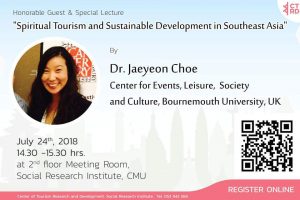
BU academic presented a public lecture on Spiritual Tourism and Sustainable Development at Chiang Mai University, Thailand on July 24th
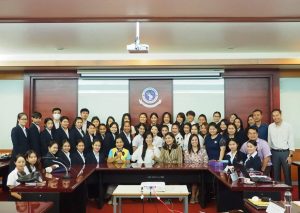
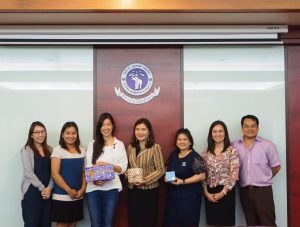
Dr Choe, from the Faculty of Management provided a public lecture on ‘Spiritual Tourism and Sustainable Development’ at Chiang Mai University (CMU), Thailand.


Research staff at the Center of Tourism Research & Development, Social Research Institute at CMU kindly helped organise the event and added a very warm welcome and hospitality. They invited CMU research staff and students as well as staff/students from other universities in Chiang Mai. Their promotional efforts attracted a big crowd!
Dr Choe passionately shared her research ideas, data collected from Chiang Mai, her observations and interpretations. Lively discussions including helpful feedback and questions from local academics and students made the session very interesting, productive and meaningful.
Dr Choe suggested that other Southeast Asian destinations can learn from Chiang Mai’s successful push for spiritual and sustainable tourism and the management programmes. For example, Luang Prabang in Laos has similar tourism attractions such as numbers of historically significant Buddhist temples. However, they do not offer meditation retreat/’monk chat’ programmes that Chiang Mai offers to ‘spiritual travellers’ in unique and effective ways. Dr Choe also emphasised the ASEAN’s regional cooperation for future tourism development.
Dr Choe and research staff at Social Research Institute and Dept of Tourism, Faculty of Humanities at CMU have started collaborating on a number of projects. Updates will be posted on the BU Research Blog, so stay tuned 🙂
Game On! Enriching the lives of people with dementia through digital gaming.
On the 13th July 2018, the Ageing and Dementia Research Centre (ADRC) hosted a free half-day workshop for dementia practitioners and academics interested in understanding how digital gaming technology can be used to support the well-being of people with dementia and their care partners.
The event was attended by people from a range of professional backgrounds including care home staff, day centre Activity Coordinators, community volunteers, researchers and local Government. The morning session provided them with the opportunity to listen to presentations from:
- Dr Ben Hicks (ADRC and Psychology) on the Erasmus+ funded ‘AD-Gaming platform’ that promotes the use of Serious Games for people with dementia as well as the HEIF funded ‘Game Plan’ platform that supports practitioners to use off-the-shelf gaming technology with people with dementia and exchange knowledge on best practice through a Virtual Café.
- Dr Phil Joddrell (CATCH, Sheffield University) on the AcTo Dementia website that provides a list of iPad applications accessible for people with dementia, each of which have been tested using an evidence-based framework.
- Laura Wade (BU Nursing student) on the use of a Virtual Application, ‘A Walk Through Dementia’ that places users in the position of someone living with dementia; thereby providing them with a more humanistic understanding of what it might feel like to live with the condition.
During the afternoon session, the attendees were provided with a more ‘hands-on’ opportunity to use the applications and talk to the researchers in more detail about how the technology could be incorporated within their practice. These sessions were facilitated by Bournemouth University students Amy Dytham, Amy-Jane Pegler and Olivia Bryant who have been involved as Research Assistants in a number of the projects.
The event provoked some interesting questions and seemed to raise awareness of how technology can be used in the future care of people with dementia; both in providing those living with the condition with better opportunities for meaningful leisure activities and those supporting them with a more informed understanding of what it may be like to live with a dementia. The event also provided a great networking opportunity for the attendees, and discussions regarding future collaborations are already underway.
For more information on the event or for a copy of the presentations that were delivered on the day please contact Ben Hicks on bhicks@bournemouth.ac.uk.

Ben Hicks discussing the HEIF funded Game Plan project

Laura Wade discussing A Walk Through Dementia

Phil Joddrell discussing the development of the AcTo Dementia website

Amy Dytham leading a training session on the AD-Gaming platform

Some thought provoking discussions
ADRC attend 47th British Society of Gerontology Conference, Manchester, UK
Yolanda Barrado-Martín from the Psychology Department and Ageing and Dementia Research Centre (ADRC) attended the 47th edition of the British Society of Gerontology in Manchester (UK) from 3rd July to 6th July 2018.
International researchers from different disciplines gathered in Manchester to learn about projects under the theme “Ageing in an Unequal World: Shaping Environments fro the 21st Century”. This was a very well attended conference (with a waiting list), with up to 17 parallel sessions. Dementia had a relevant space in this conference with different sessions highlighting the use of diverse interventions to improve the quality of life of people living with dementia and those providing support such as facilitating decision making processes, exploring environmental adaptations and supporting home-care for those willing to stay at home.
Yolanda Barrado-Martín had an oral presentation entitled: “How is Tai Chi received by people living with dementia and their informal carers?” Those attending the session showed their interest in the topic and asked questions about people living with moderate dementia’s involvement in the classes and about the Ransomised Controlled Trial Phase of the study. This was a great experience for Yolanda who presented her PhD pilot results to a friendly international audience.
The ADRC’s work was also represented by Dr Michele Board who gave a presentation on “Evaluating the impact of the Virtual Reality app ‘A Walk Through Dementia’, and Mananya Podee who discussed leisure activity, arts and social inclusion for those with dementia.
Participation in the BSG conference was a valued addition in knowledge regarding psycho-social interventions for people living with dementia and a great opportunity to network with researchers from the gerontology background. Yolanda’s attendance to this conference was possible thanks to one of the Santander Mobility Awards.

British Society of Gerontology 47th Annual Conference – Ageing in an Unequal World: Shaping Environments for the 21st Century.
Facilitating with Lego… put in to practice
I attended Susanne and Curie’s ‘Facilitating with Lego’ workshop in early June and found it really insightful. There are lots of ways it can be used. It’s great for team building events but could also be used for personal development. The workshop gave some really good hints and tips of using Lego in group settings but also on an individual basis; along with ideas of probing questions to get people to open up and share their thoughts and feelings about a particular subject or even themselves in a relaxed, informal and fun environment.
In the session we used Lego to build a model that represented our personal strengths. It was really interesting to hear everybody’s explanations in the group and look at their weird and wonderful creations. Some included tall towers to illustrate, not a person in power as you might imagine but a person working in a role that requires them to see the bigger picture, having an overview. Other people’s models included propellers which were linked to ‘leading the way’, also extended ‘bendy’ arms showing the strength of flexibility. There were also several little pink ‘creative’ hats to express how some roles require some creativity… and many little green flags but I can’t recall any ’strengths’ from these pieces, I think we all just agreed they were mostly for decoration! Whilst we didn’t all have identical pieces in front of us they were very similar, although I was quite jealous of the person with the Superhero Lego person which had its own cape!
This workshop was a great pre curser to BUCRU’s upcoming Festival of Learning interactive session ‘Demystifying research: helping us make a difference’ and really helped with inspiration, which is the reason I signed up to it.
Our Festival of Learning event was comprised of several interactive sections looking at ways in which members of the public can get involved in clinical research. The Lego was used to demonstrate how complex the research design stage of a project can be.
The audience were split into 2 teams and asked to examine our ready-made ‘medical device’.
(We had built our own ‘device’ prior to them entering the room). Their task was to copy the device exactly to the best of their ability within a timeframe. However some bricks/pieces weren’t quite the same and they had to do some improvisation!
Afterwards we discussed how successful they felt they were, what problems they may have encountered, what strategies they implemented (if any) and if they would do anything differently in the future. They reported that having the correct resources was essential; that having the model closer would’ve also made life easier, instructions would also have improved the situation… but we didn’t want to make life too easy for them! All of this illustrated how important it is for someone else to come along, see what you’ve done, replicate it and get the same results that you got.
The clearer we can be and the more input we can get from the public, the better – it is an essential part of designing a study, also referred to as PPI (Patient and Public Involvement).
We also drew some comparisons with a real life research project team. How each person has something to contribute: statistician, research nurse, patient etc. And how there are often many bumps in the road to a successful research project and sometimes you need to take everything apart and ‘build’ from scratch again.
Don’t forget BU Clinical Research Unit (BUCRU) are based on the 5th floor of Royal London House also incorporating your local branch of the NIHR Research Design Service. Feel free to pop in and see us, call us on 61939 or send us an email.


BU geography student’s undergraduate dissertation published in international journal
Why some commons survive and others don’t
BU Research blog in 2023 grows into 2026 publication
REF 2029 Sector Survey: Have Your Say
BU methods paper reached 2,500 reads
UKCGE Recognised Research Supervision Programme: Applications Close 19 October
Horizon Europe Cluster 3 (Civil Security for Society) 2026 Calls Now Open

MSCA Doctoral Networks 2026 Call Information Webinar

ESRC Festival of Social Science 2026: Application Deadline Extended to Thursday 25 June 2026

Reminder: Register for the ESRC Festival of Social Science 2026 Information Session

ECR Funding Open Call: Research Culture & Community Grant – Apply now

ERC Advanced Grant 2025 Webinar
Update on UKRO services
European research project exploring use of ‘virtual twins’ to better manage metabolic associated fatty liver disease