Freedom of speech, censorship and bias
After last week’s flurry on freedom of speech prompted by the Minster’s comments when launching the OfS consultation, this week the discussion has taken on a much more aggressive and personal tone, as the letter from an MP asking for information about staff teaching about Brexit hit the headlines, and the Daily Mail outed university staff as being majority pro-Brexit. I’ve written about all this on the Lighthouse Policy Group blog.
OfS Regulation
As noted last week, BU will be preparing an institutional response to this consultation. Policy@bournemouth.ac.uk will work with colleagues across BU and collate our response.
The consultation documents are huge, and as soon as you start looking at one area, you have to look at more than one (the conditions, and lots of details about them are in a separate Guidance document). So we will start simply this week with some highlights from the opening sections.
As a risk-based regulator, the OfS will seek to mitigate (though not eradicate) four risks – the risk that the four primary objectives are not met.
[The OfS will have four primary objectives:
- all students, from all backgrounds, are supported to access, succeed in, and progress from, higher education
- all students, from all backgrounds, receive a high quality academic experience, and their qualifications hold their value over time in line with sector-recognised standards
- that all students, from all backgrounds, have their interests as consumers protected while they study, including in the event of provider, campus, or course closure
- that all students, from all backgrounds, receive value for money
The OfS will seek to mitigate the risk that each of these four objectives is not met]
As it does so, the OfS will also seek to mitigate risk that the sector does not deliver value for money for taxpayers and citizens (who are directly involved through the allocation of public grant funding, research funding by UKRI, and the public subsidy to the student finance system). It will also do so while recognising the needs of students from disadvantaged backgrounds, who are less likely to access, succeed in, and progress successfully from higher education, even once their entrance characteristics are taken into account.
The OfS will also work with UKRI to ensure that the reciprocal risk around the sustainability of providers which contribute to the vibrancy of the research base is monitored and mitigated appropriately. The flow of information between the two organisations will be crucial to achieving this.
Consultation question: Do you agree or disagree these are the right risks for the OfS to prioritise?
Interesting point:
Provider level regulation will not be used to drive continuous improvement. It will be for autonomous, individual providers to decide for themselves the extent to which they wish to offer provision that extends beyond the baseline. The impetus to do so will be driven by student choice and competition rather than direct regulatory intervention
This general approach does not apply to access and participation. In this case, competition, choice, and market mechanisms alone are not able to deliver the outcomes needed for students and society, so regulation of individual providers will be used to drive improved access and participation
Objective 1: all students, from all backgrounds, are supported to access, succeed in, and progress from, higher education
Consultation question: Given all the levers at its disposal, including but not limited to access and participation plans, what else could the OfS be doing to improve access and participation and where else might it be appropriate to take a more risk-based approach?
Widening access and promoting the success of all students who have potential to benefit from higher education, including those from disadvantaged backgrounds and groups under-represented in higher education, will be at the heart of the OfS’s remit. It will have a duty which relates to equality of opportunity across the whole student lifecycle; with the aim of ensuring that students from disadvantaged and traditionally under-represented backgrounds can not only access, but successfully participate in and progress from higher education too. The OfS will intervene at the provider level in this area; market forces alone will not be sufficient to deliver the change needed. The OfS will also have a duty relating to student choice and opportunities, which it will consider in terms of a range of models of higher education – including new providers, work-based study, accelerated programmes and flexible provision for adults – which will facilitate higher education opening up to under-represented groups.
OFFA will be merged into the OfS with a Director for Fair Access and Participation.
Fair Access Agreements will continue to be required for providers charging higher fee amounts – and will operate as now, although there will be a new focus on participation – they will be called “access and participation plans”.
New point on schools:
In order to ensure better outcomes for both current and prospective students, the relationship between the higher education sector and the schools and further education systems will need to be strengthened. The establishment of the OfS and the new regulatory framework presents a unique opportunity to take a fresh look at our approach to managing these important transition points between stages of learning for an individual and their whole educational experience. These relationships between sectors are critical, not least when it comes to widening access and successful participation.
There are already many higher education providers playing an active role in schools and colleges in order to improve the prior attainment of pupils from disadvantaged backgrounds. The new regulatory regime creates the opportunity to spread these ties further and deeper, in service of students accessing, succeeding in, and progressing from, higher education.
Note we do not know what this means at this stage and the government have not published a response to the schools consultation.
Note on registration conditions – the relevant ones for this area are condition A1 – Access and Participation Plan and condition A3 – transparency condition on disclosure of information.
Widening Participation
The Sutton Trust published a paper on contextual admissions. Key findings include:
- While the gap [in access] between disadvantaged students and their more advantaged peers has narrowed somewhat in recent years, the gap at the most selective universities remains stubbornly wide.
- a majority of these [selective] universities use contextual data to inform their admissions processes.
- A substantial number provided no information to applicants about how indicators would be used…This lack of transparency is a barrier to access..
- There is a wide distribution of grades among those from better-off backgrounds – with as many as one in five students from higher participation neighbourhoods being admitted with A-level grades of BBC or below, for example – and that the average grades of those from contextual backgrounds are only marginally lower than those from non-contextual backgrounds.
- There is little evidence to suggest that leading universities that practice greater contextualisation see significantly higher dropout rates, lower degree completion rates, or lower degree class results
- Greater use of contextual admissions could result in a substantial increase in the numbers of low income students at the UK’s most selective universities.
Recommendations include
- Universities should use contextual data in their admissions process to open up access to students from less privileged backgrounds.
- There should be a greater use of individual-level contextual indicators, such as previous eligibility for free school meals, as well as school-level and area-level criteria.
- Universities practicing contextualisation should provide additional support to students from disadvantaged backgrounds, including those who have been admitted with lower grades, in recognition of the additional difficulties such students may face.
- There should be greater transparency from universities when communicating how contextual data is used. ….There should also be greater clarity and consistency in the reporting of contextual admissions processes in access agreements with the Director of Fair Access, including reporting levels of contextually admitted applicants.
- Foundation year provision should be increased, with greater targeting of those from disadvantaged backgrounds..
- Participation in outreach programmes should be shared as a contextual indicator across universities.
- Many outreach programmes include academic eligibility criteria set at a high threshold. However, this is likely to exclude disadvantaged pupils with the potential to do well at university, but whose GCSE results are not exceptional. Universities, and those who run similar outreach programmes, should consider more inclusive thresholds to reduce barriers to participation and increase access
Other news
The new ESRC CEO and Executive Chair Designate has been announced. Professor Jennifer Rubin. is currently Director of the Policy Institute at King’s and Professor of Public Policy. Before joining King’s Jennifer established and then led the justice and home affairs research programme at RAND Europe for ten years.
Following the launch of the Dyson Institute of Engineering and Technology last month, a new university has been announced for Hereford – it will specialise in engineering courses and will offer accelerated degrees.
The Royal Society has announced a scheme to place entrepreneurs in universities.
David Davis indicated at the Exiting the EU committee that the UK would be “quite likely” to stay in Horizon 2020 after leaving the EU, and also that EU students would be likely to qualify for student loans after March 2019. It was not at all clear whether this would be part of a transition arrangement or a final deal.
From Wonkhe: Justine Greening told the House of Commons Education Committee that the HE funding review first announced by the Prime Minister will be “something DfE leads”.
Subscribe!
To subscribe to the weekly policy update simply email policy@bournemouth.ac.uk
JANE FORSTER | SARAH CARTER
Policy Advisor Policy & Public Affairs Officer
65111 65070
Follow: @PolicyBU on Twitter | policy@bournemouth.ac.uk



 Every BU academic has a
  By clicking on this box, on the left of the Research Blog home page just under the text ‘Funding Opportunities‘, you access a
  From today, 1st November 2017, all research applications for external funding will be treated as CAF-exempt (Contract Authorisation Form) where no commitment exists at application stage. This has been agreed by UET in October 2017, following a request from RKEO and Legal Services made in response to applicant feedback.



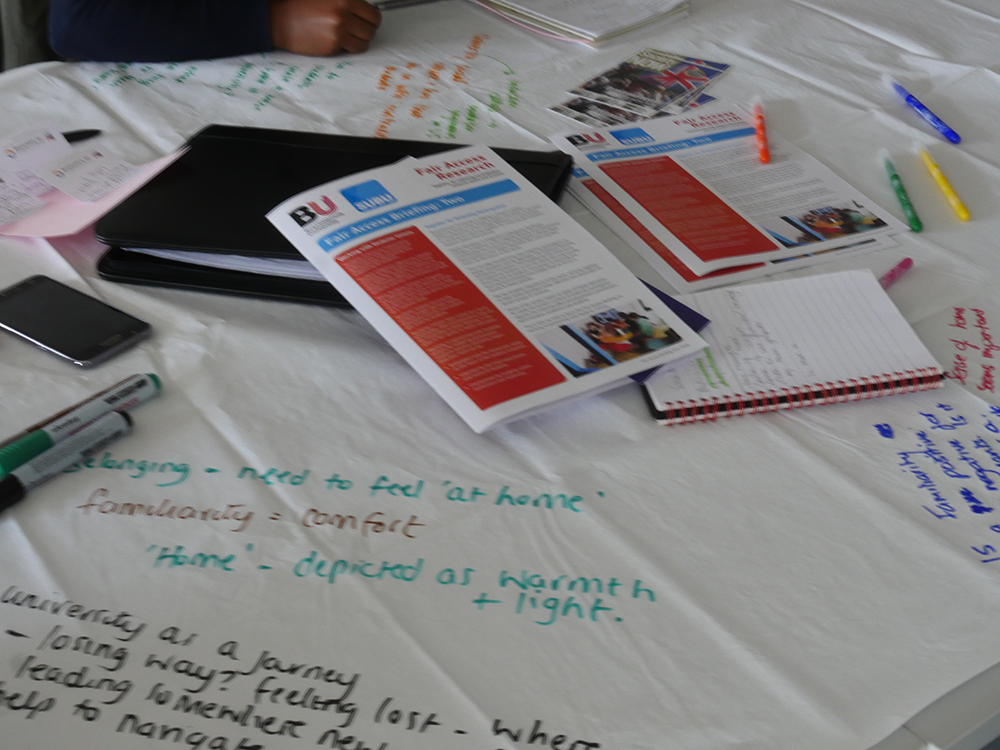
 #TalkBU is a monthly lunchtime seminar on Talbot Campus, open to all students and staff at Bournemouth University and free to attend. Come along to learn, discuss and engage in a 20-30 minute presentation by an academic or guest speaker talking about their research and findings, with a short Q&A at the end.
  If you have any queries, please contact

 VoYS
VoYS The library is offering a workshop on EndNote.











 International Open Access Week: BU support for open access
 Food Price Research Shortlisted for Civil Service Prize
 3C Event: Research Culture, Community & Connections – Wednesday 11 November 3-4pm
 ECR Opportunities: New Development Programme, Researcher Grants & Upcoming Events
 Help us capture BU’s knowledge exchange activity HE-BCI survey 2025–26
 Horizon Europe Cluster 3 (Civil Security for Society) 2026 Calls Now Open
 MSCA Doctoral Networks 2026 Call Information Webinar
 ESRC Festival of Social Science 2026: Application Deadline Extended to Thursday 25 June 2026
 Reminder: Register for the ESRC Festival of Social Science 2026 Information Session
 ECR Funding Open Call: Research Culture & Community Grant – Apply now
 ERC Advanced Grant 2025 Webinar
 Update on UKRO services
 European research project exploring use of ‘virtual twins’ to better manage metabolic associated fatty liver disease