Category / Nursing & Midwifery

New paper by BU’s Lecturer in International Health

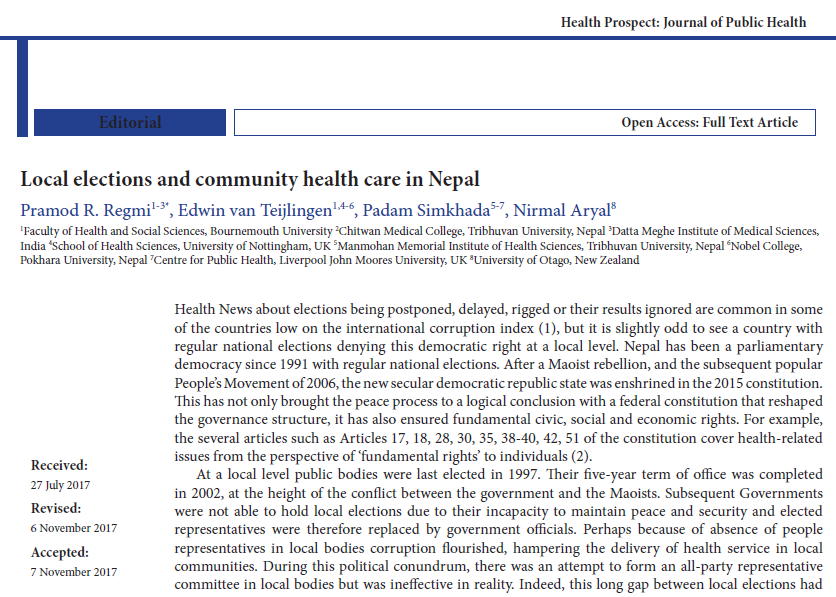
Congratulations to Dr. Pramod Regmi on the publication of his latest article ‘Local elections and community health care in Nepal’.[1]  Pramod is our newly appointed Lecturer in International Health, who started this post exactly a month ago.  The editorial, co-authored with BU Visiting Faculty Prof. Padam Simkhada (based at Liverpool John Moores University), Nirmal Aryal (based at the University of Otago, New Zealand) and CMMPH’s Prof. Edwin van Teijlingen, highlights the important link between local democracy and health in Nepal.

The paper argues that elected local governments are critical for public accountability on the operationalization of the SDGs (Sustainable Development Goals) at local level.  Furthermore, having elected leaders in communities after such a long gap will certainly give Nepalese people rights and hopefully improve provision and access to health care services they are entitled to. Thus the role of civil society, community-based non-governmental organisation, development partners and the mass-media is critical in both advocacy for, and the effective monitoring and implementation of, local activities.

The paper appeared today in Health Prospect an Open Access journal published in English in Nepal as part of the Nepal Journals Online (NepJOL) service .


Reference

  1. Regmi, P., van Teijlingen, E., Simkhada, P., Aryal, N. (2017) Local elections and community health care in Nepal, Health Prospect: Journal of Public Health, 16(2):1-2.

The slow process from public health research to law

We know that public health works and thinks long-term. We’ll typically see the population benefits of reducing health risks such as tobacco use, obesity and high alcohol intake in ten or twenty years’ time.  But we often forget that preceding public health research into the determinants of ill health and the possible public health solutions is also slow working.  Evidence-based public health solutions can be unpopular with voters, politicians or commercial companies (or all).  Hence these take time to get accepted by the various stakeholders and make their way into policies.

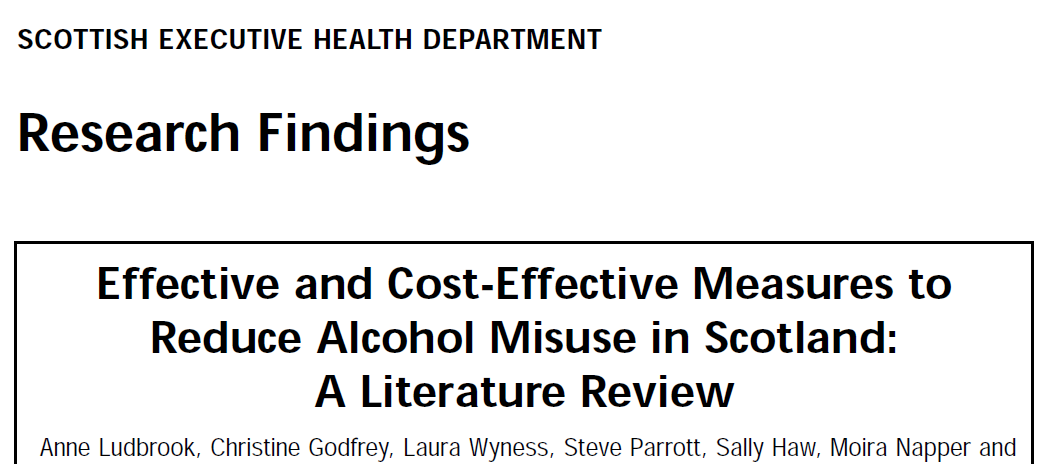
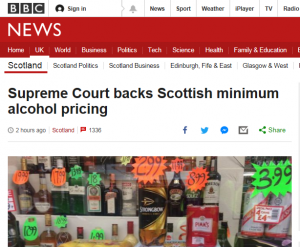
I was, therefore, glad to see that Scotland won the Supreme Court case today in favour of a minimum price for a unit of alcohol. As we know from the media, the court case took five years.  Before that the preparation and drafting of the legislation took years, and some of the original research took place long before that.  Together with colleagues at the Health Economic Research Unit at the University of Aberdeen, the University of York and Health Education Board for Scotland, we conducted a literature review on Effective & Cost-Effective Measures to Reduce Alcohol Misuse in Scotland as early as 2001 [1].  Some of the initial research was so long ago it was conducted for the Scottish Executive, before it was even renamed the Scottish Government.


Prof. Edwin van Teijlingen

CMMPH


Reference:

Research started years ago! Ludbrook et al.(2002) Effective & Cost-Effective Measures to Reduce Alcohol Misuse in Scotland: Lit Review, HERU, Univ. of Aberdeen. [ISBN: 0755932803] http://www.gov.scot/Resource/Doc/1124/0052548.pdf

NIHR Grant Applications Seminar & Support event – last chance to book


Are you planning to submit a grant application to NIHR?

Research Design Service South West (RDS-SW) are holding a one day event on 9 November 2017 at Plymouth Science Park, Devon.

Last few days to book!

The events consists of:

  • a morning seminar session which is open to anyone to come and RDS advisers give presentations on what makes a good grant proposal.
  • an afternoon support session of one-to-one appointments which is for those who would like to discuss their own proposal with an RDS adviser. Those interested in this opportunity will be asked to supply in advance a brief description of their project idea.

Registration is FREE and lunch will be provided. Places are limited and will be allocated on a ‘first come, first served’ basis. In order to secure a place at one of these events, delegates will need to complete the online registration form by 1pm 30 October 2017. One-to-one appointments need to be booked in advance by selecting the appropriate option on the registration form.

You can find out more here

Don’t forget your local branch of the NIHR Research Design Service is based within the BU Clinical Research Unit (BUCRU) on the 5th floor of Royal London House. Feel free to pop in and see us, call us on 61939 or send us an email.

New CMMPH midwifery publication

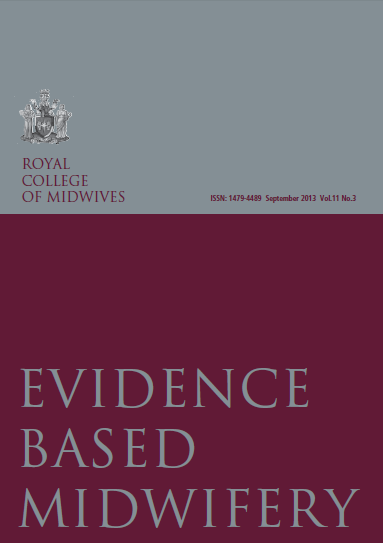
Congratulations to Dr. Sue Way and Prof. Vanora Hundley in BU’s Centre for Midwifery, Maternal & Perinatal Health (CMMPH) on their latest publication on the latent phase of labour.  Their paper ‘Defining the latent phase of labour: is it important?’ appeared in Evidence Based Midwifery and was written with midwifery colleagues across the UK, Germany and Canada [1].


Congratulations

Prof. Edwin van Teijlingen

CMMPH


Reference:

  1. Hundley V, Way S, Cheyne H, Janssen P, Gross M, Spiby H (2017) Defining the latent phase of labour: is it important? Evidence Based Midwifery 15 (3): 89-94. 


BU midwifery research at the international Normal birth research conference

The Normal birth research conference is an annual, international event that takes place to focus on less complicated aspects of pregnancy and birth. This year it took place in the beautiful surroundings of Grange-over-sands overlooking Morecambe bay and on the edge of the Lake District. On this occasion there were delegates from over 20 countries including Canada, USA, New Zealand, Australia, Brazil, Poland, Spain, the Netherlands, Sweden, Norway and India! The attendees included midwives, obstetricians, birth supporters, architects, artists, geographers and educators as well as representatives of the World Health organisation, charities and Baroness Cumberlege from the UK House of Lords.

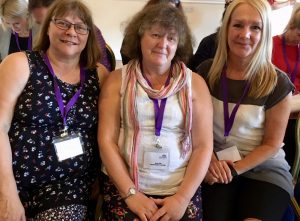
Sara Stride, Jenny Hall, and Jane Fry at the conference

Research at Bournemouth University was well represented from CMMPH, CQR and CEL. Midwifery lecturer, Sara stride, on behalf of the research team of Professor Vanora Hundley and Dr Sue Way, presented a poster of their work, ‘a qualitative study to explore UK midwives’ individual practice, beliefs and attitudes regarding perineal care at the time of birth’. Dr Jane Fry, also from the midwifery team, presented a research topic on her Doctoral work, ‘ A descriptive phenomenological study of independent midwives’ use of intuition as an authoritative form of knowledge during women’s labours and births’.  She also facilitated a workshop titled ‘ Finding your own intuition: a workshop designed to explore practitioners’ ways of knowing during childbirth’ .


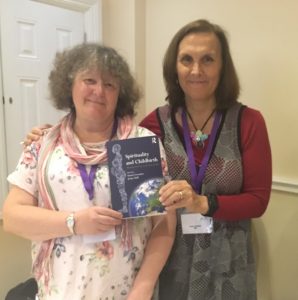
Jenny Hall with Professor Susan Crowther at the book launch [(c) Sheena Byrom]

Dr Jenny Hall presented a research topic based on recent research with Dr Bethan Collins from Liverpool University, Professor Vanora Hundley and Jilly Ireland, midwife and visiting researcher, ‘How can we improve the ‘normal’ childbirth experience of disabled women?’. She also facilitated a workshop with a colleague from RGU, Aberdeen, Professor Susan Crowther, ‘Spirituality and childbirth: bringing a felt-sense into childbirth- a co-operative inquiry’. In addition, her new internationally authored book jointly edited with Professor Crowther, ‘Spirituality and Childbirth: Meaning and care at the start of life’, was officially launched at the conference.

The impression taken away was the passion and importance of more evidence required around more ‘normal’ aspects of pregnancy and birth, especially in countries with less resources. There is considerable humanising of care being carried out internationally, and is a key focus at the World health organisation. A focus for the UK midwifery is current maternity services transformation, yet much of the global focus is on the importance of transformation in line with the recent Lancet series on maternity, and international collaboration to achieve the goals for Sustainable development. As a force, the team behind normal birth research serve this area powerfully, in informing care for women, babies and families across the global arena. The final rousing talk by Australian professor Hannah Dahlen, to the current backlash to ‘normal birth’ in the media was inspiring and is an editorial in the international journal Women and Birth. Next year the conference is in Michigan, USA!

CMMPH student wins prestigious Iolanthe Midwifery Trust award

Congratulations to Dominique Mylod, clinical doctoral student in the Centre for Midwifery, Maternal and Perinatal Health , Faculty of Health and Social Sciences.

Dominique was awarded a Midwives Award from the Iolanthe Midwifery Trust for her research into early labour, which explores whether using a birth ball at home in early labour improves birth outcomes. She is supervised by Professor Vanora Hundley, Dr Sue Way, and Dr Carol Clark.

The picture shows Dominique receiving her award from Baroness Julia Cumberlege CBE, Patron of the Trust.


Human rights study day in maternity care

On 26th September the branch of the RCM in Southampton held a study day dedicated to considering human rights concerns in maternity care. It was attended by over 50 practitioners from across the region. Topics covered included a workshop by the human rights in maternity charity, Birthrights, and speakers from Barnados and Stop the Traffik. These latter presenters provided thought provoking, and somewhat harrowing, evidence for the need for awareness of sexual exploitation in young people, and trafficking of humans in our areas of practice. In addition Dr Jenny Hall (pictured right) from CEL and Jillian Ireland, visiting researcher in CMMPH, discussed the human rights of women with disability, based on current research partially funded by Birthrights, undertaken with colleagues Professor Vanora Hundley and Dr Bethan Collins from Liverpool University.
It was an intense event that demonstrated the importance of discussing and researching these aspects of current midwifery care.

NIHR Fellowship Information Event – November 2017 – Book Now!

Are you interested in applying for an NIHR Fellowship?  Do you have questions? Need more info?

Information Event – 24 November 2017 – University of Exeter

There are many types of NIHR Fellowship award on offer, so how do you know which one is the best for you? When and how do you apply? What makes a good application? If you want to know more about NIHR Fellowships – and other NIHR training and career development awards – then this event is for you.

The morning session is open to anyone to come and hear from a number of speakers – from NIHR as well as existing panel members and award holders.

The afternoon support session of one-to-one appointments is for those who would like to discuss their own proposal with an RDS adviser.

See here for more information.
This event is FREE and refreshments and lunch will be provided. Places are limited and will be allocated on a ‘first come, first served’ basis. In order to secure your place please register using the online form by 1pm, 10 November 2017.


Your local branch of the NIHR Research Design Service is based within the BU Clinical Research Unit (BUCRU) on the 5th floor of Royal London House. Feel free to pop in and see us, call us on 61939 or send us an email.

Conference on the impact of complications and errors in surgery held at BU

Things can go wrong in surgery, and dealing with the consequences of complications and errors is part and parcel of a surgeon’s life. Last week a conference was held at BU’s Executive Business Centre which explored the impact that adverse events have on surgeons and examined how these effects can be ameliorated. Eminent presenters from across the UK shared insights from their surgical careers and personal experiences, presented the latest research in the area, and considered how better support and training could be provided for surgeons.

The conference was organised by the Bournemouth Adverse Events Research Team, a joint research venture between psychologists at BU and surgeons at Royal Bournemouth Hospital, who are currently researching the impact of complications and errors which inevitably arise during surgery on surgeons.  Professor Siné McDougall, one of the research team, said: “Today is about trying to think about what we can do to support surgeons. When things do go wrong, the focus is rightly on patients and their family. However, surgeons are also dealing with their own feelings, particularly if they have made a mistake which they deeply regret.”

It was clear that the conference had touched on a key issue for surgeons.  This was summed up by the keynote speaker, Professor Sir Miles Irving, Emeritus Professor of Surgery at Manchester University, who said “The proceedings were excellent and clearly demonstrated that you have latched on to a problem which has the potential to become even more significant if not addressed.”  The Bournemouth Adverse Events Team is looking forward to continuing research in this area which will address this issue.

Congratulations to Dr. Jane Fry & colleagues

Congratulations to Jane Fry, Janet Scammell and Sue Barker  in the Faculty of Health & Social Science on the publication of their latest paper ‘ Drowning in Muddied Waters or Swimming Downstream?: A Critical Analysis of Literature Reviewing in a Phenomenological Study through an Exploration of the Lifeworld, Reflexivity and Role of the Researcher’.

This innivative paper proceeds from examining the debate regarding the question of whether a systematic literature review should be undertaken within a qualitative research study to focusing specifically on the role of a literature review in a phenomenological study. Along with pointing to the pertinence of orienting to, articulating and delineating the phenomenon within a review of the literature, the paper presents an appropriate approach for this purpose. How a review of the existing literature should locate the focal phenomenon within a given context is illustrated by excerpts from the literature review within a descriptive phenomenological study. This article was recently published in the Indo-Pacific Journal of Phenomenology.  Click here for freely available copy online.


Prof. Edwin van Teijlingen

CMMPH

Congratulations to Dr. Keen on new Nepal publication

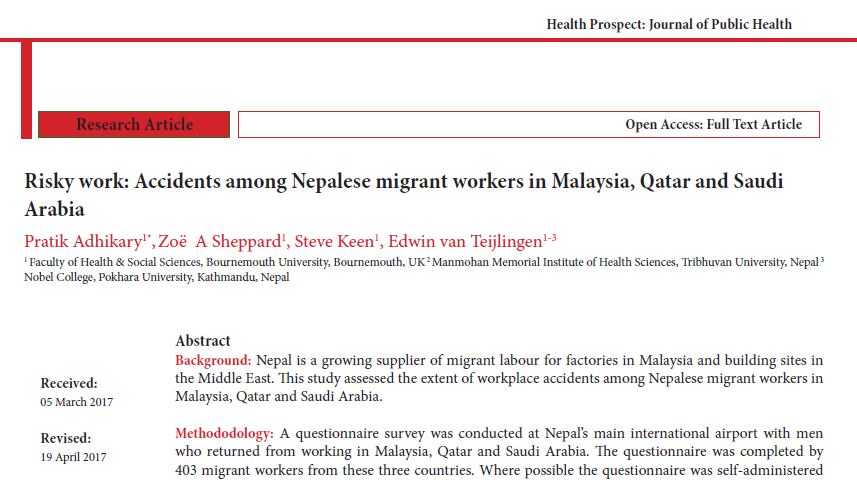
Congratulations to Dr. Steve Keen in the Faculty of Health & Social Sciences and BU PhD graduate Dr. Pratik Adhikary on the acceptance today of their paper ‘Risky work: Accidents among Nepalese migrant workers in Malaysia, Qatar and Saudi ‘ by the journal Health Prospect [1].  This is a peer-reviewed public health journal, part of Nepal Journals Online, and the journal is Open Access.  Nepal Journals OnLine (NepJOL) provides access to Nepalese published research, and increase worldwide knowledge of indigenous scholarship.

The Faculty of Health & Social Sciences has a growing number of publications on health and migration research, especially on the health and well-being of migrants from Nepal [2-5].


Prof. Edwin van Teijlingen


References:

  1. Adhikary, P., Sheppard, Z., Keen, S., van Teijlingen, E. (2017) Risky work: Accidents among Nepalese migrant workers in Malaysia, Qatar and Saudi, Health Prospect (forthcoming)
  2. Adhikary, P., Simkhada, P.P., van Teijlingen E., Raja, AE. (2008) Health & Lifestyle of Nepalese Migrants in the UK BMC International Health & Human Rights 8(6). Web address: www.biomedcentral.com/1472-698X/8/6.
  3. van Teijlingen E, Simkhada, P., Adhikary, P. (2009) Alcohol use among the Nepalese in the UK BMJ Rapid Response: www.bmj.com/cgi/eletters/339/oct20_1/b4028#223451
  4. Adhikary P., Keen S., van Teijlingen, E. (2011) Health Issues among Nepalese migrant workers in Middle East. Health Science Journal 5: 169-175. www.hsj.gr/volume5/issue3/532.pdf
  5. Aryal, N., Regmi, P.R., van Teijlingen, E., Simkhada, P., Adhikary, P., Bhatta, Y.K.D., Mann, S. (2016) Injury and Mortality in Young Nepalese Migrant Workers: A Call for Public Health Action. Asian-Pacific Journal of Public Health 28(8): 703-705.

What happens when things go wrong in medicine?

1-day BU conference/workshop examining what happens when things go wrong in surgery, 8th September 2017

Every day we make mistakes; we pick up the wrong set of keys from the kitchen drawer, pick up the wrong identical suitcase from the airport carousel, or, in the case of the Oscars, a near identical envelope is given to Warren Beatty who then announces the wrong Best Film winner.

What happens when things go wrong in surgery where the consequences can be much more serious?  While attention, quite rightly, focuses on patient need when things go wrong, the aim of this event is to examine how medical professionals can be better supported and trained to cope with these adverse events.

Eminent speakers from around the UK will present the latest research in the area, share insights from their surgical careers and personal experiences and will consider:-

Impact – The personal impact when complications and errors arise in surgery

Resilience – Dealing with stress and maintaining wellbeing

Restoration – what can be done when things go wrong?

While the focus is on surgeons, it is clear that those in other medical professions (e.g. nurses, midwives, GPs) face similar issues in the workplace. Anyone with an interest in the topic is welcome to attend (attendance is free for BU staff).   For further details and to register for the conference please visit www.surgeonwellbeing.co.uk or contact Professor Siné McDougall (smcdougall@bournemouth.ac.uk; ext. 61722).

Denyse King’s Health Education England project ‘NoObesity’

NoObesity

The government’s key priority of reducing childhood obesity through adult education (as announced by Jeremy Hunt in Sept 2015), prompted BU’s Denyse King to write a proposal to Health Education England. Denyse is a Midwifery Lecturer / Public Health Practitioner in the Centre for Midwifery, Maternal & Perinatal Health (CMMPH) at Bournemouth University. The proposal outlined her wish to develop a stand-alone mobile learning resource for health workers who care for families of overweight or obese children, and for families who need to identify individual needs to facilitate behavioural changes.

Afbeeldingsresultaat voor childhood obesity statistics uk, 2016

The development of this project pivoted on putting patients and the public in the centre of the process. Patients and the public were engaged through focus groups where insights were gathered to identify the challenges and issues to the problem. A series of online focus groups were undertaken with service users and professionals to understand the key challenges and issues respondents came across when trying to prevent/manage overweight and obesity. Key themes from the focus groups were:

  • Empowering – the solution needs to recognise the experiences people bring and therefore the tools need to be empowering in supporting families to address obesity.
  • Parenting tips – to address challenges with encouraging positive health behaviours with children.
  • Responding to barriers – from parent/carers who are being supported by health professionals.
  • Obesity isn’t a quick fix – recognising that sustained behaviour change takes time and support to overcoming barriers is vital.
  • Healthy snacks and activities – provide easy and simple ideas to support parents/carers and professionals to identify quick ways to support healthier eating and increase activity.
  • Portion size – understanding that portion size is important in addition to eating healthily.

Topic experts were identified and invited to join the project steering group where they provided the governance and steer of the overall development of this project whilst Denyse King wrote the content. The following Apps have been developed as a result and will be available to all as free download in IOS and Android platforms from late September 2017:

  • NoObesity Family Focused App – After consultation with a healthcare worker, families set health goals, identify potential barriers and strategies to overcome them, record their progress towards their goals, earning points and awards as they go. Families are encouraged to link accounts to healthcare professional accounts (see below). The tool also includes parenting tips, games and useful links.
  • NoObesity Professional Focused App– Healthcare professionals can see the goals, barriers, strategies, progress, points and awards of linked families, making them better able to provide tailored advice to the families, to help them achieve their goals. This is based on research findings that ‘one-size- fits-all’ health advice simply doesn’t work for most families. The tool also includes the Wessex MECC-based guidance on how to best support families, how to handle common objections, games and useful links.

Denyse would like to thank Dr. Joanne Newton project proposal support, Felicity Hargreaves and Helen Bingham for approval of the final project proposall. Thanks to all those who contributed to answering the research questions, as well as those who tested and fed back on the prototype, and also to Bournemouth University, University of Southampton, and NHS England for their support of this project.


List of the members of the steering group

Name Job Title Organisation Steering Group Role
Em Rahman Head of Public Health Workforce Development Programmes Health Education England (Wessex) Steering Group Chair
Alison Potter Technology Enhanced Learning Lead (South) Health Education England (South) Deputy-Chair
Dr. Jenny Godson (MBE) National Lead for Oral Health Improvement Public Health England Dental and dental aspects of nutrition
Prof. Edwin van Teijingen Professor – Centre for Midwifery, Maternal & Perinatal Health Bournemouth University Research supervision and education governance
Dr. Juliet McGrattan General Practitioner Cumbria Medical Chambers GP role governance
Kate King-Hicks Health and Wellbeing Programme Lead Public Health England (South East) Obesity governance
Tony Hewett Intervention Manager and behaviour change specialist Miltoncross Academy School staff role governance
Dr. Jo Walker Consultant Paediatrician Portsmouth Hospitals Trust Consultant doctors role governance
Dr. Wendy Marsh Lead Midwife for Safeguarding Portsmouth Hospitals Trust Safeguarding governance
Kate Lees Consultant in Public Health and Dietitian Lees & Latouze Nutrition governance
Denyse King Lecturer in Midwifery and Public Health Practitioner Bournemouth University Content author and governance