Follow the thoughts and reflections of the guest editorial team through our special issue blog series. The special issue of the British Journal of Social Work: Voice and Influence of people with lived experience is written, edited and reviewed by people with lived experience of social work. To date we have received 140 submissions across the three categories of academic papers, reflective pieces and creative artefacts. Follow our progress as we work toward publication in Spring 2023 via our blog series here
Category / REF Subjects
Invitation to the BCP Poverty Truth Commission launch
We would like to invite you to the Bournemouth, Christchurch ad Poole Poverty Truth Commission launch on Thursday 14th July 10-12.
The Poverty Truth Commission, is a new project rooted in lived experience which seeks to tackle the root causes of poverty in the BCP area. If you would like to understand more about how a Poverty Truth Commission works there is more information and a short 4 minute video on their website that explains it really well (scroll down to find the video): Poverty Truth – Bournemouth, Christchurch and Poole (povertytruthbcp.org)
The project so far
14 inspirational Community Commissioners (CCs) – those with lived experience of poverty locally – have agreed to become part of the Commission. They have been meeting together fortnightly since April to get to know each other, better understand the process, and tease out key themes common to their stories such as housing, mental health, rising costs, benefits. They have told the commission they already feel “less alone”, “really listened to” and “inspired”. They are now working together with the commission to design and prepare for the public launch event (10-12 on 14 July) where similar numbers of local leaders including myself (Mel Hughes) in my role as Academic lead for the BU PIER partnership will join them as Civic/Business Commissioners (CBCs) to work together to tackle the root causes of poverty over the coming year.
To book a place at the launch please register here
If you would like to discuss, please contact me directly mhughes@bournemouth.ac.uk
New BU disaster publication
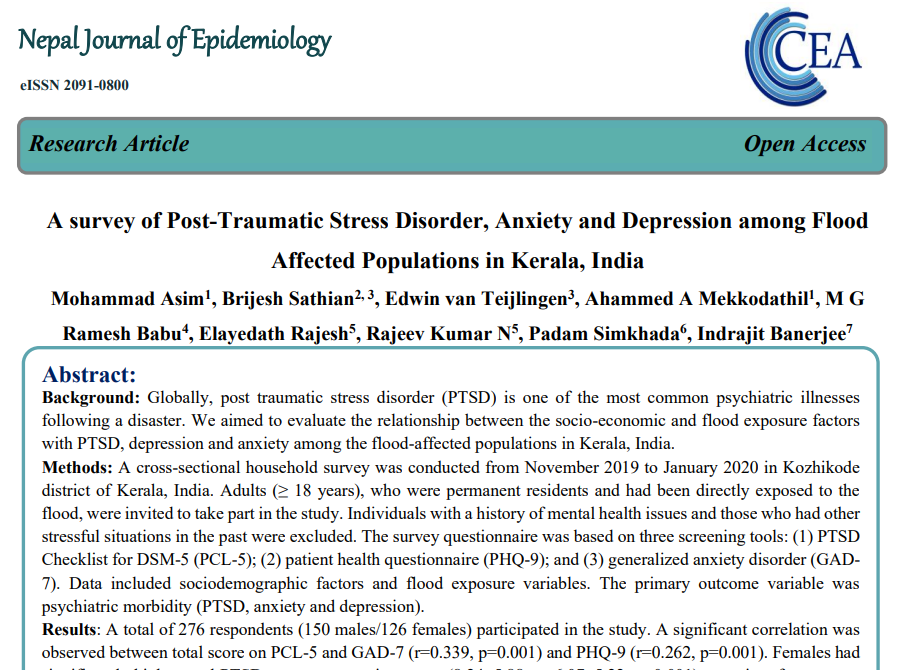
Yesterday the latest issue of the Nepal Journal of Epidemiology carried our paper ‘A survey of Post-Traumatic Stress Disorder, Anxiety and Depression among Flood Affected Populations in Kerala, India‘ [1]. This paper was co-authored by two Faculty of Health & Social Sciences (FHSS) Visiting Faculty, namely Prof. Padam Simkhada (in the School of Human & Health Sciences at the University of Huddersfield) and Dr. Brijesh Sathian (in the Geriatrics & Long-term Care Department at Rumailah Hospital, Qatar). This study is longer-term follow-up of the 2018 floods in Kerala. The authors conducted a cross-sectional household survey between November 2019 to January 2020 in one district of Kerala with adults who had been directly exposed to the 2018 flood. The paper concludes that the vast majority of respondents (92% of women & 87% of men) still showed sub-clinical psychiatric symptoms one year after the flood. An earlier paper had argues for further research in India to explore “the long-term sequelae of catastrophic floods on physical and mental trauma on disaster-affected populations” [2].
Prof. Edwin van Teijlingen
Centre for Midwifery, Maternal & Perinatal Health (CMMPH)
References:
- Asim, M., Sathian, B., van Teijlingen, E., Mekkodathil, A. A., Babu, M. G. R., Rajesh, E., Kumar, R. N., Simkhada, P., & Banerjee, I. (2022). A survey of Post-Traumatic Stress Disorder, Anxiety and Depression among Flood Affected Populations in Kerala, India . Nepal Journal of Epidemiology, 12(2), 1203–1214. https://doi.org/10.3126/nje.v12i2.46334
- Asim, M., Mekkodathil, A., Sathian, B, Elayedath, R., Kumar N.R., Simkhada, P., van Teijlingen, E. (2019) Post-Traumatic Stress Disorder among the Flood Affected Population in Indian Subcontinent, Nepal Journal of Epidemiology 9(1): 755-758. https://www.nepjol.info/index.php/NJE/article/view/24003
Building International Partnerships
 On Monday 27th June Prof. Edwin van Teijlingen will be presenting at the ‘Global Partnership for International Research Meeting’ at the University of Huddersfield. The meeting is organised by Prof. Padam Simkhada, who is Associate Dean International and Professor of Global Health, as well as Visiting Professor at Bournemouth University. Edwin will be talking about his experience in building long-term sustainable and effective international partnerships, using examples from both the health and sociology field.
A current example he will highlight is one of Bournemouth University’s international research collaborations is the Nepal Federal Health System Project, led by the University of Sheffield. This three-year project (2020-2023) is funded by the Health Systems Research Initiative (incorporating the MRC, DFID, Wellcome Trust), it has partners in the UK and Nepal and bring together an interdisciplinary team of specialists in public health, sociology, health systems, social geography, health economic, political science, anthropology, medicine, emergency management, nursing & international development.
Sorry, the publication of your paper is being delayed because….
Yesterday a colleague in Nepal notified me that the publication of our latest paper has been delayed. This paper ‘Writing and publishing a reflective paper: Three case studies’ [1] is another method-type paper on aspects of academic writing and publishing published by BU academics and FHSS Visiting Faculty. A delay in getting in print is not uncommon in academic publishing, but usually the justification is that reviewers are sitting on the manuscript and not returning their report, or the journal editor can’t find academics to volunteer as reviewers, or the editor is ill. Occasionally the journal has too few papers to publish the next issue yet with your accepted paper in it, but this time the excuse was ever rarer. 
We had submitted our paper to a brand new journal. A research collaborator in Kathmandu had asked me to submit a paper for the journal’s inaugural issue, which we did as we saw this a part of our role in academic capacity building in Nepal. The delay in publishing this journal is the shortage of ISSN [International Standard Serial Number] numbers in Nepal. Every good academic journal across the globe will have registered for a unique ISSN number [2]. Apparently the office issuing ISSN numbers in Paris head office has not delivered ISSNs to Nepal, and according to my colleague “many journals are waiting for a number …It’s not good news for the academic writers and scholars but we’re really sorry for late due to the unavailability of ISSN.”

Prof. Edwin van Teijlingen
Centre for Midwifery, Maternal and Perinatal Health
References:
- Arnold, R., Ireland, J., Mahato, P., van Teijlingen, E., (2022) Writing and publishing a reflective paper: Three case studies, Welham College Journal (accepted for publication)
- van Teijlingen, E.R., Dhakal Adhikari, S., Regmi, P.R., van Teijlingen, A., Aryal, N., Panday, S. (2021). Publishing, identifiers & metrics: Playing the numbers game. Health Prospect, 20(1).
Registration open: NIHR Training Camp 2022 virtual event, Tuesday 5 July, 12.30 – 17.15

Dear Colleagues
The NIHR doctoral training camp is a 3 day annual face to face event providing guidance and practical experience on putting together a successful application for funding.
By attending the virtual sessions run during day 1 of the NIHR Doctoral Training Camp, you will have access to the introductory plenary talks.
The event will include presentations on:
● How to sell yourself when applying for funding
● How to sell your project when applying for funding
● Effective patient and public involvement
● What funding panels are looking for in applications
Please see flyer relating to the virtual element of the NIHR Training Camp – Virtual 2022.pptx
Registration for the free event is here: Home Page – NIHR Doctoral Research Training Camp – Virtual (cvent.com)
Please do circulate to anyone that you feel this may be useful for.
Your local branch of the NIHR RDS (Research Design Service) is based within the BU Clinical Research Unit (BUCRU)
We can help with grant applications to National peer reviewed funders. We advise on all aspects of developing an application and can review application drafts as well as put them to a mock funding panel (run by RDS South West) known as Project Review Committee, which is a fantastic opportunity for researchers to obtain a critical review of a proposed grant application before this is sent to a funding body.
Contact us as early as possible to benefit fully from the advice
Feel free to call us on 01202 961939 or send us an email.
Workshop ‘Sensitive Pasts and Difficult Presents: working with young people through participatory arts’ – 27th June, 2022
Some of you might be interested in this workshop, titled ‘Sensitive Pasts and Difficult Presents: working with young people through participatory arts‘, taking place this upcoming Monday, 27th June 2022, at BU (Talbot Campus). The workshop aims to bring together colleagues from across BU’s research centres, exploring how working with and for young people in sensitive contexts, both, locally and across the world, can be informed by interdisciplinary approaches (including Social Sciences, the Arts, and arts-based technologies).
Several colleagues will provide short presentations and thought pieces based on their research and experiences in the application of participatory arts-based methods in such contexts. Including a ‘world café’, the workshop aims to provide a forum to compare and exchange our experiences, learning and research outcomes rather than a classic, entirely lecture-based format.
This event is organised by the Centre for Seldom Heard Voices (Stephanie Schwandner-Sievers; RA Emily Fisher). The workshop includes colleagues from CEMP, CESJ, EMERGE, and further members are warmly invited to attend. We hope this event will be of particular interest to colleagues working in and through the participatory arts, specifically with vulnerable or marginalised groups, internationally or closer to home.
New paper on federalisation of health system in Nepal
Earlier this week the editor of the Journal of Nepal Public Health Association informed us the journal had accepted our latest paper ‘Health System Strengthening: The Role of Public Health in Federal Nepal’ [1]. This article addresses some of the key Public Health approaches around the ongoing federalisation of the state of Nepal and the associated decentralisation processes in its health system. This is the third paper of our three-year project, which is UK-funded by the MRC, Wellcome Trust and DFID under the Health Systems Research Initiative and led by Dr. Julie Balen and Prof. Simon Rushton based at the University of Sheffield. The first two papers introduced our international research project ‘The impact of federalisation on Nepal’s health system: a longitudinal analysis’ [2], and focused on COVID-19 when examining the effects of changing Nepal’s constitution towards a federal republic on its health system [3].
Prof. Edwin van Teijlingen
CMMPH (Centre for Midwifery, Maternal & Perinatal Health Research)
References
- Sapkota, S., Panday, S., Wasti, S.P., Lee, A., Balen, J., van Teijlingen, E., Rushton, S., Subedi, M., Gautam, S., Karki, J., Adhikary, P., Marahatta, S., Simkhada, P. for the Nepal Federal Health System Team (2022) Health System Strengthening: The Role of Public Health in Federal Nepal, Journal of Nepal Public Health Association (forthcoming).
- Rushton, S., Pandey, S., van Teijlingen, E., Subedi, M., Balen, J., Karki, J., Simkhada, P. on behalf of the Nepal Federal Health System Team (2021) An Investigation into the Impact of Decentralization on the Health System of Nepal. Journal of Manmohan Memorial Institute of Health Sciences, 7(1): 3–14. https://doi.org/10.3126/jmmihs.v7i1.43146
- Adhikary, P., Balen, J., Gautam, S., Ghimire S., Karki J.K., Lee A.C., Marahatta S.B., Pandey S., Pohl G., Ruston S., Sapkota S., Simkhada P.P., Subedi M., van Teijlingen E.R., on behalf of the NFHS Team. The COVID-19 pandemic in Nepal: Emerging evidence on the effectiveness of action by, and cooperation between, different levels of government in a federal system. Journal of Karnali Academy of Health Sciences. 2020; 3(3)
New paper on Amazonian Dark Earths involving IMSET researchers
Today, Nature Communications published a long-expected Matters Arising in response to a 2021 paper in the same journal: “A new hypothesis for the origin of Amazonian Dark Earths“. The new paper, involving more than 50 leading scholars involved in research on prehistoric Amazonia, affirms a human origin for the dark earths found throughout the central and eastern Amazon basin.
Amazonian Dark Earths (ADEs) are distinguished by their exceptional fertility and richness of archaeological remains. Evidently produced by various kinds of human activity, including but not limited to manuring, rubbish deposition, and biomass burning, they are a distinctive feature of later indigenous settlement of the Amazon river basin.
The paper synthesises diverse archaeological, palaeoenvironmental, and historic data to demonstrate the human origin of ADEs. Source: Lombardo et al. 2022
For more information see: Lombardo, U., Arroyo-Kalin, M., Schmidt, M. et al. Evidence confirms an anthropic origin of Amazonian Dark Earths. Nat Commun 13, 3444 (2022). https://doi.org/10.1038/s41467-022-31064-2
NIHR Bulletin
RDS NEWS
From the Research Design Service (RDS) desk – optimising recruitment to a clinical trial
In this month’s blog post, we hear from Irene Stratton from RDS South Central about how to optimise recruitment to clinical trials, a key part of any successful research application and critical to successful study delivery. Find out more.
NIHR Grant Applications Seminar: guest speakers confirmed
Our popular seminar continues online and will take place on Thursday 7th July 2022 from 10.00am – 12.30pm.
 We’re pleased to announce we’ll also be hearing from Janine Bestall and Louise Hayes about the NIHR Public Health Research (PHR) programme. They will be giving an overview of the programme, the assessment process and what the funding panels are looking for.
Find out more.
NIHR News
Research Reset: recovering the UK’s capacity to deliver clinical research
Research Reset is the approach being implemented to recover the UK’s capacity to deliver clinical research. Reset is an ongoing process, and sponsors have been provided access to an online tool which provides a live view of studies requiring review.
Join Dementia Research call back
The ‘Join Dementia Research’ website has a new call back function, so healthcare professionals can sign their patients up to find out which research studies they could participate in. Watch their video to find out more.
Excess Treatment Costs thresholds lowered
Excess Treatment Costs (ETC) are costs incurred when treatments given as part of research studies are more expensive than the care participants would normally receive. The ETC threshold has been lowered, providing additional funding to secondary care providers with an additional 120 NHS sites receiving payments, helping to deliver the Government’s research vision. Find out more.
eBulletins and Newsletters
Events
NIHR Senior Investigator award
The NIHR Nursing and Midwifery Incubator is hosting a webinar on 20 June 2022, to raise awareness of the NIHR Senior Investigator Award to nurse and midwife applicants. It will cover panel expectations, experience of successful applicants, and information about the support the incubator can provide.
Developing Innovative, Inclusive and Diverse Public Partnerships Programme Development Grant – webinar: 21 June, 10:30am – 12:45pm. A new annual funding call to encourage inclusive and/or new ways of partnership working between community and charity groups and researchers in health and social care. Find out more and register.
Research for Social Care
Interested in applying to our social care research funding call? Join the NIHR for a webinar on 28 June 2022, to find out more and hear from the Research for Social Care Programme team, RDS, and previous applicants.
How to apply public involvement effectively to your research application
Find out how to incorporate public involvement successfully into your research, and hear insights from a researcher and public involvement representative, at our webinar on 6 July 2022. This will cover NIHR’s definition of public involvement, guidance on co-producing a research project, what NIHR is looking for in public involvement, and more.
Funding Opportunities
Latest NIHR funding calls
Cross-programme
22/72 NIHR Research Partnerships – liver disease
Programme Grants for Applied Research (PGfAR)
Competition 39
Your local branch of the NIHR RDS (Research Design Service) is based within the BU Clinical Research Unit (BUCRU) should you need help with your application. We advise on all aspects of developing an application and can review application drafts as well as put them to a mock funding panel (run by RDS South West) known as Project Review Committee, which is a fantastic opportunity for researchers to obtain a critical review of a proposed grant application before this is sent to a funding body or if you’re hoping to resubmit the panel can provide some excellent tips and feedback.
Contact us as early as possible to benefit fully from the advice
Feel free to call us on 01202 961939 or send us an email.
British Academy Writing Workshop in Nepal: Call for participants
We are inviting expressions of interest for Nepal-based academic with an interest in gender and development issue to participate in our Writing Workshop: “Promoting Publishing in the field of Gender and Development in Nepal”. Bournemouth University is leading two separate three-day workshops for early career researchers (ECRs) working across various universities in Nepal to encourage and support them to publish in peer reviewed journals in the field of social sciences, in Kathmandu (from 17-19 August 2022), and in Pokhara (from 21-23 August 2022). The funding for these exciting workshop is provided by the British Academy. 
There will be a mixture of presentations, group discussion and other interactive exercises, and independent writing exercises. The workshop involves practical sessions to help attendees to make their research idea clear and compelling to reviewers, and finalise their papers for publications. One-to-one sessions with our expert advisers will allow attendees to work through different aspects of their own research papers, methods and ideas.
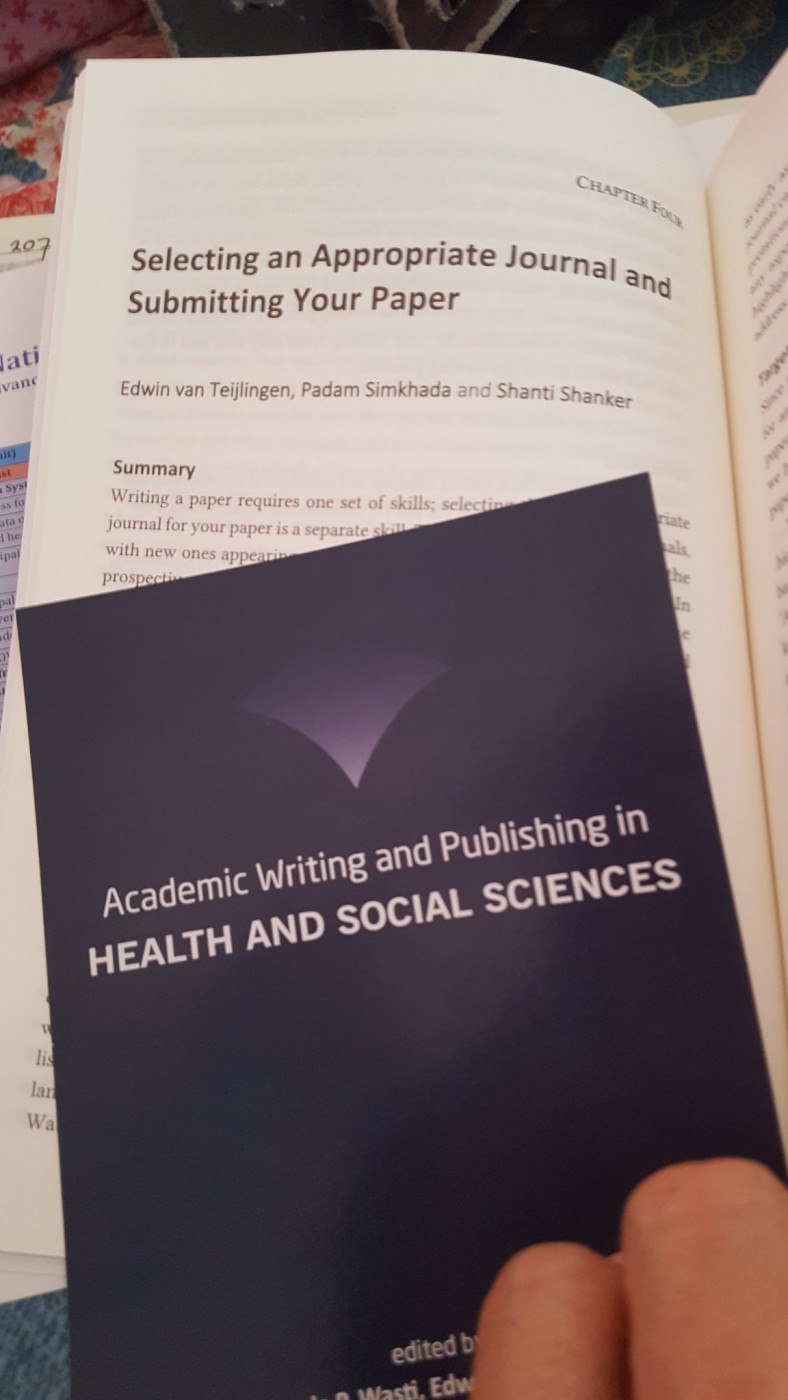
How to apply: If you are an ECR based in Nepal and have some idea (or/and data) to work towards publication in gender and development, then please send us:
- A short CV – 3 pages maximum;
- An abstract or summary of the proposed paper you wish to develop through the writing workshop- (300 words maximum) by 30thJune 2022.
Female ECRs are highly encouraged to apply. Please use Subject British Academy Writing Workshop 2022 and email to sdhakaladhikari@bournemouth.ac.uk, with a copy to both: pregmi@bournemouth.ac.uk and rashmi.rajkarnikar@cdec.tu.edu.np . The faciliators will inform you about your selection for the workshop by the middle of July 2022. Selected participants will be asked to to submit their first rough draft by 3rd August, so that this can be discussed further during the workshop (17-19 August 2022).
 The Writing Workshop facilitators are three BU scholars, Dr Shovita Dhakal Adhikari, in the Department of Social Sciences & Social Work, Dr. Pramod Regmi in the Department of Nursing Sciences, and Prof. Edwin van Teijlingen in the Department of Midwifery & Health Science in collaboration with Dr. Rashmee Rajkarnikar, at Nepal’s oldest and largest university, namely Tribhuvan University.
Another CMMPH COVID-19 publication on fathers
Congratulations to Centre for Midwifery, Maternal & Perinatal Health (CMMPH) Visiting Faculty members Prof. Minesh Khashu and Ms. Jillian Ireland on the acceptance of their paper “COVID-19 restrictions and psychological well-being of fathers with infants admitted to NICU (neonatal intensive care units)—an exploratory cross-sectional study” has been accepted by Acta Paediatrica [1]. 
These authors, both employed by University Hospitals Dorset NHS Foundation Trust, are part of an international team of researchers studying the role of fathers in maternity care. The first author on the paper, Dr. Esther Adama is Lecturer in the School of Nursing and Midwifery at Edith Cowan University in Australia. Previous papers produced by some members of this team were both published in the Journal of Neonatal Nursing [2-3].
Congratulations to my colleagues!
Prof. Edwin van Teijlingen
References:
- Adama E.A., Koliouli F., Provenzi L., Feeley N., van Teijlingen E., Ireland J., Thomson-Salo F., Khashu M and FINESSE Group (2022) COVID-19 restrictions and psychological well-being of fathers with infants admitted to NICU—an exploratory cross-sectional study, Acta Paediatrica (accepted).
- Fisher, D., Khashu, M., Adama, E., Feeley, N., Garfield, C., Ireland, J., Koliouli F., Lindberg, B., Noergaard, B., Provenzi, L., Thomson-Salo, F., van Teijlingen, E. (2018) Fathers in neonatal units: Improving infant health by supporting the baby-father bond & mother-father co-parenting, Journal of Neonatal Nursing 24(6): 306-312 https://doi.org/10.1016/j.jnn.2018.08.007
- Ireland, J., Khashu, M., Cescutti-Butler, L., van Teijlingen, E., Hewitt-Taylor, J. (2016) Experiences of fathers with babies admitted to neonatal care units: A review of literature, Journal of Neonatal Nursing 22(4): 171–176
Another research league table
 This week Research.com, a prominent academic platform, published its 2022 Edition of the Ranking of Top 1000 Scientists in the area of Social Sciences and Humanities. Professor Edwin van Teijlingen, in the Centre for Midwifery, Maternal & Perinatal Health (CMMPH), is listed as number 234 in United Kingdom ranking as well as number 1238 in the Social Sciences and Humanities world ranking.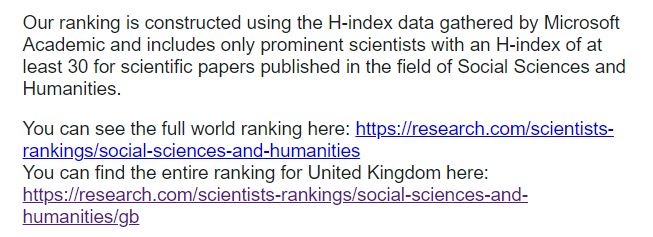
FMC Researcher Lyle Skains Co-Edits Field-Defining Collection
THE ELECTRONIC LITERATURE ORGANIZATION PRESENTS VOLUME 4 OF FIELD-DEFINING COLLECTION
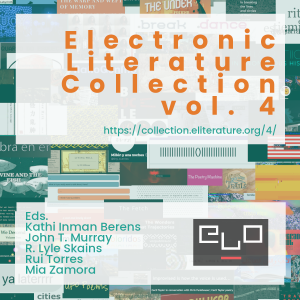 Announcing the publication of the ELECTRONIC LITERATURE COLLECTION VOLUME 4, a freely accessible, Creative Commons-licensed collection of 132 digital-born literary works from 42 author nationalities in 31 languages. ELC4 debuted at the Electronic Literature Organization Conference in Como, Italy, May 30-June 1, 2022.
The Electronic Literature Collection, hosted by the Electronic Literature Organization, defines the field of electronic literature. Each volume recognises contemporary works, trends, and emerging creators in born-digital narrative and poetry. This collection is used as a foundational teaching text in university programs incorporating studies of electronic literature, interactive narratives, and e-poetry around the world.
Selected from more than 450 works, ELC4 presents the largest group yet of author/makers writing in Afrikaans, Ancient Chinese, Arabic, Catalan, Chinese, Danish, Dutch, English, French, German, Greek, Hungarian, Indonesian, isiXhosa, Italian, Japanese, Korean, Mezangelle, Norwegian, Polish, Portuguese, Romanian, Russian, Setswana, Simplified Chinese, Slovak, South African Sign Language, Spanish, Swedish, Turkish, Yoruba.
The Collection includes commercial works such as groundbreaking VR experiences and narrative video games. These join the many other works that are open access: database fictions, autoethnographies by GenZ makers, works that play with AI, geospatial storytelling via mobile phones–among many other styles and platforms.
The Electronic Literature Collection Volume 4 was edited by Kathi Inman Berens, John T. Murray, R. Lyle Skains, Rui Torres, and Mia Zamora with the assistance of an international advisory board and three student fellows.
“We made a strong effort to discover artists who were previously unknown to us,” said the Editors. “Curators in Mexico, India, West Africa, and international consultants from six continents helped us discover and evaluate works in languages we don’t speak.”
“Our driving purpose was to expand the collection in terms of diversity,” added Skains, “and to make the origins of these works searchable and transparent to all collection users.”
Teachers looking to engage students in cutting-edge literary works will find they can freely access ELC4 on their phones. Classroom computers aren’t necessary. It’s like a free textbook!
Scholars will appreciate being able to download and study the code and media assets of featured works. The Electronic Literature Organization hosts versions of the works to ensure perpetual access, even after operating systems and software are updated or become obsolete.
FREELY ACCESS THE ELECTRONIC LITERATURE COLLECTION VOLUME 4 here:
https://collection.eliterature.org/4/
ELC4 is the fourth collection published by the Electronic Literature Organization in 22 years. All four are available freely via Creative Commons license: https://collection.eliterature.org/
The Electronic Literature Organization was founded in 1999 to foster and promote the reading, writing, teaching, and understanding of literature as it develops and persists in a changing digital environment. A 501c(3) non-profit organization, ELO includes writers, artists, teachers, scholars, and developers from around the world.
Teaching exchange through ERASMUS+ with Nepal
Professors Vanora Hundley and Edwin van Teijlingen just completed their ERASMUS Plus exchange with Manmohan Memorial Institute of Health Sciences (MMIHS) in Nepal. This was a very successful collaboration with colleagues in Nepal, despite the various turns of fate that were sent to challenge us. Indeed, the Profs toiled with the idea of giving this BU Research Blog the heading ‘The show must go on’ or ‘One man down….’ or even the far less punchy ‘The irony of doing a workshop by ZOOM in Nepal from a hotel 200 meters across the road’! In the end we decided that excellent collaboration requires resilience and a wee bit of ingenuity.
The trip to Nepal was marred by many little hiccups. It started at Heathrow where the airline insisted that they complete a now obsolete form about COVID-19 for the Government of Nepal, otherwise they would not let us on the flight. Arguing that Edwin had been to Nepal in April, and that no one then had asked for that particular piece of paper was fruitless. A quick online completion solved that first hurdle. The next hurdle was the flight leaving Heathrow over two hours late, which in turn meant missing the connection in Doha. Fortunately, the airline booked our academics on a replacement flight which left only hours after the original onwards flight had been scheduled to leave for Kathmandu. ingenuity. The trip to Nepal was marred by many little hiccups. It started at Heathrow where the airline insisted that they complete a now obsolete form about COVID-19 for the Government of Nepal, otherwise they would not let us on the flight. Arguing that Edwin had been to Nepal in April, and that no one then had asked for that particular piece of paper was fruitless. A quick online completion solved that first hurdle. The next hurdle was the flight leaving Heathrow over two hours late, which in turn meant missing the connection in Doha. Fortunately, the airline booked our academics on a replacement flight which left only hours after the original onwards flight had been scheduled to leave for Kathmandu.
The first five days in Kathmandu went well, apart from the to be expected tummy problems that go with monsoon in all low-income countries in South Asia. The teaching at MMIHS mainly focused on methodological issues. Our scheduled teaching sessions focused on the first-year MSc Nursing students (Vanora) and the first-year MSc Public Health students at MMIHS (Edwin).
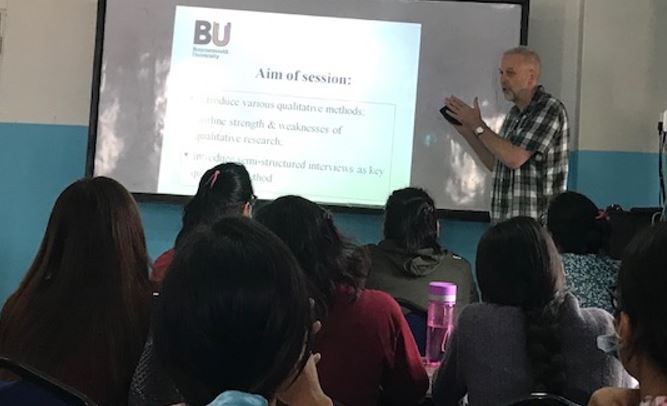 A more informal one-hour tutorial session was organised for the second-year MSc Public Health students who had applied to come to the UK as part of ERASMUS Plus. This question-and-answer-type session was run by both Vanora and Edwin as well as BU PhD student Sulochana Dhakal-Rai. Overall, the teaching was all organised at very short notice, but BU’s professors are flexible and had a broad range of expertise to share.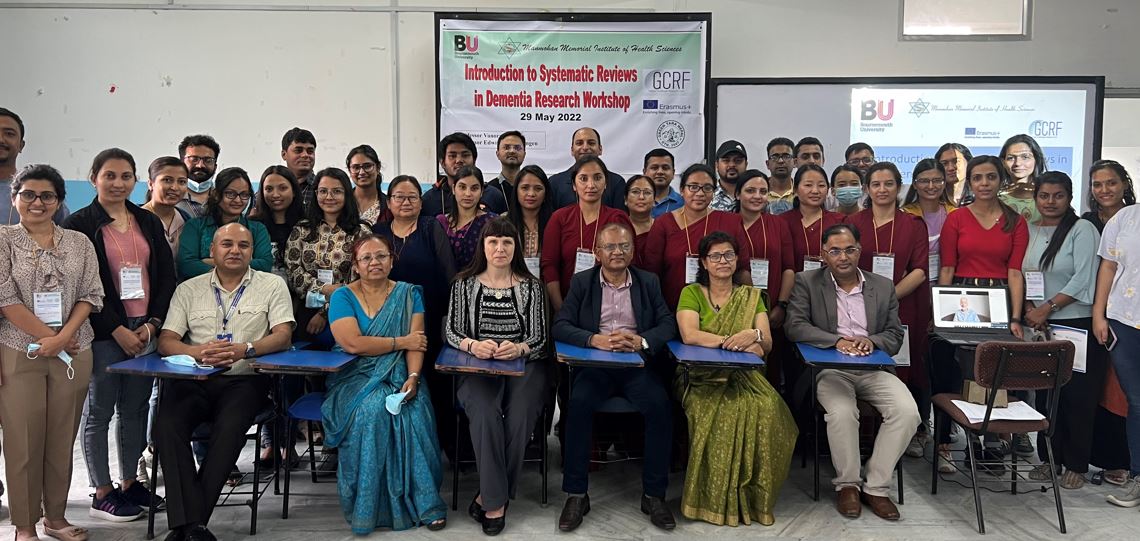
In addition, with extra funding from GCRF (Global Challenges Research Fund), Bournemouth University and MMIHS supported by the local charity Green Tara Nepal planned ran a one-day research workshop in Kathmandu. This GCRF- funded ‘Systematic Review on Dementia Research Workshop’ was very well attended. Although the workshop budgeted for 30 people the attendance register shows that nearly double (n=59) the number of people attended at least part of the workshop. However, running the workshop was not without is problems. Two-days before the workshop Prof. van Teijlingen first had a positive COVID-19 lateral flow test followed by a positive PCR test. This put the burden of running the show very much on Prof. Vanora Hundley with Edwin being called in through Zoom. This is where the potential ‘irony’ title comes in. The irony of doing a workshop by ZOOM in Nepal ….. not from halfway across the globe but from a local hotel 200 meters across the road from MMIHS! The hotel’s internet connection was not as good as most of us have grown used to in Dorset, which added to the difficulty of running the workshop smoothly.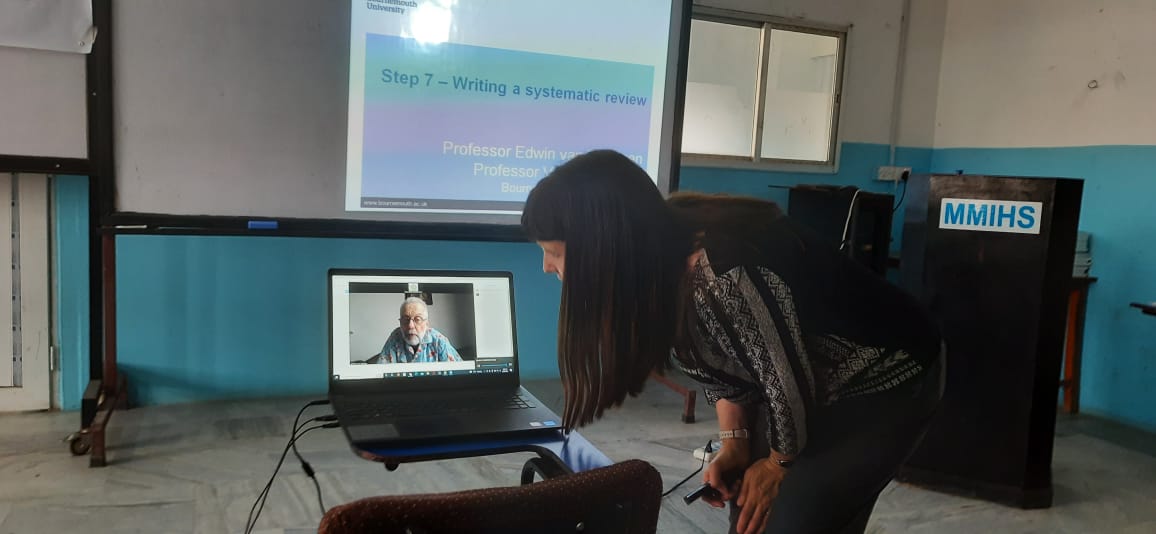
Despite all these challenges, the result was a very successful workshop that will continue to build our collaboration with colleagues in MMIHS and more widely across Nepal.
Finally, to end the story of hiccups, MMIHS forgot to inform the hotel that Edwin would be staying four extra nights. On the day he was originally scheduled to leave Nepal he received a phone call from reception asking what time he was checking out. When he said he thought extra nights had been booked for him, there was no reply. A little later he was told he could get another night, but he would have to move to another floor, and it would be for one night only, since all 91 room of the hotel were booked for the weekend for a big Asian wedding party. Luckily MMIHS found him another hotel a bit more outside the city centre for the remaining three nights.
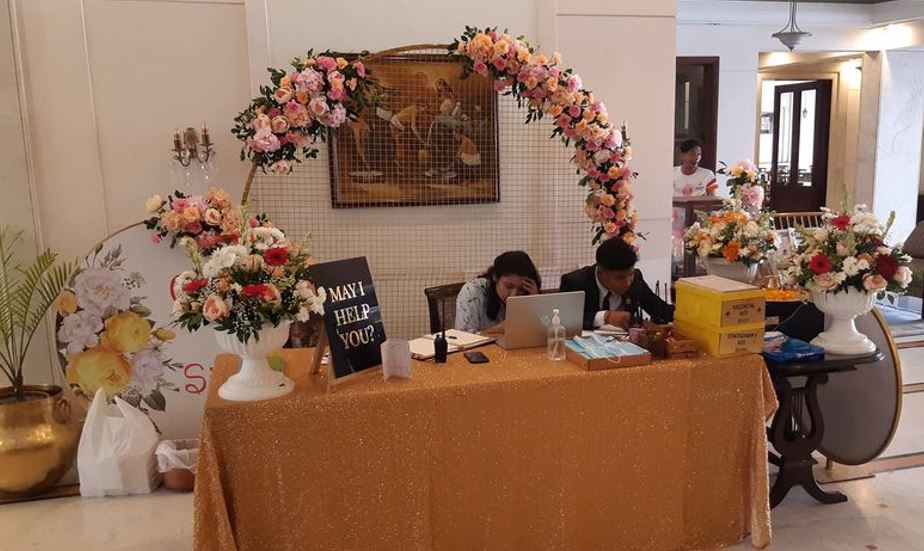 We are incredibly grateful for the support of colleagues and friends in Nepal and at home in the UK, which helped smooth out some of the more interesting challenges.
Lessons learnt:
· Be ready to change and adapt to the needs of the situation.
· Strong relationships will help you deal with the unexpected.
· Keep positive when things get tough.
In the words of Steve Maraboli “Life doesn’t get easier or more forgiving, we get stronger and more resilient.”
Successful GCRF Systematic Reviewing in Dementia Research Workshop in Nepal
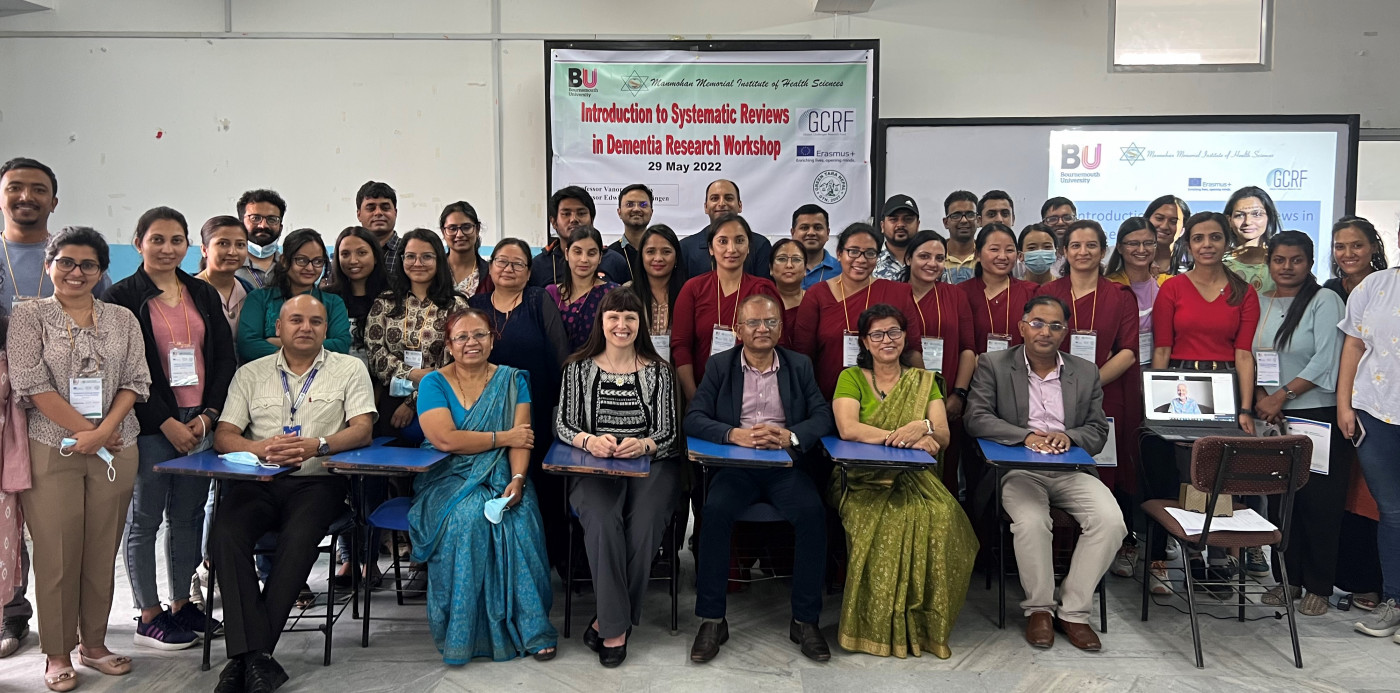 Last Sunday (29th May) Professors Vanora Hundley and Edwin van Teijlingen from the Centre for Midwifery, Maternal & Perinatal Health (CMMPH) run a hugely successful introduction to research workshop in Kathmandu. Their Global Challenges Research Fund (GCRF) funded the Systematic Review on Dementia Research Workshop on Sunday, which was very well attended. They expected (and had budgeted for) 30 people to attend and in the end the audience was closer 50 people
 .
.
The event was organised by our colleagues at Manmohan Memorial Institute of Health Sciences (MMIHS) in Kathmandu and it was supported by the charity Green Tara Nepal. Professors Vanora Hundley and Edwin van Teijlingen are currently in Nepal as part of the BU-MMIHS ERASMUS+ exchange and added this one-day workshop to their schedule. The audience included Master students in Nursing and Public Health, MMIHS lecturers and post-doctoral researchers. This capacity-building workshop offered an introduction to all aspects of a systematic review, from formulating the systematic review research question at the start to the publication of a systematic review paper. The workshop also benefited from a short presentation by CMMPH PhD student Mrs. Sulochana Dhakal-Rai who also happened to be in Nepal as part of the BU-MMIHS student-exchange.
 The planning nearly went wrong as two days before the workshop Prof. van Teijlingen tested positive for COVID-19 on a lateral flow test which was later confirmed by a PCR test. The fact that the event went ahead despite my quarantine in a nearby hotel room was only possible because of Prof. Vanora Hundley hard work on the day. Vanora led the workshop on the whole day whilst Edwin appeared in several sessions via ZOOM. Ironically, sitting only 200 meters away from the university venue in his hotel room. The connection was not always great, it broke up several times during the day, but it worked well enough. The MMIHS colleagues were very thoughtful when it came to the group photo at the end as they included the laptop with his ‘live’ presence on Zoom.
My experience of the Turing student mobility programme in Nepal
I am Yagya Adhikari, PhD student at BU’s Faculty of Health and Social Sciences (FHSS). I am honoured to participate in the Turing Scheme (Traineeship) in Nepal. For me this student mobility programme ran for four weeks. In Kathmandu, I attended the Manmohan Memorial Institute of Health Sciences (MMIHS) sessions. I also presented my proposal and discussed it with both MSc Public Health students and teachers and had the privilege to attend the lectures delivered by MMIHS academics. Furthermore, I shared my UK university experiences with the students and faculties. Some of the MMIHS students and faculties will soon participate in the ERASMUS+ exchange programme at BU.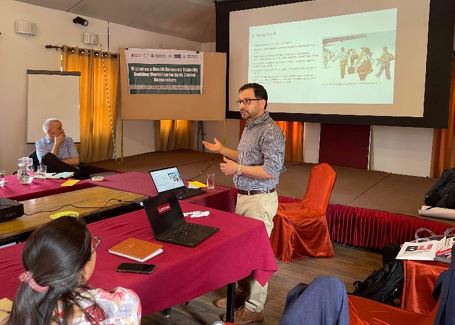
Additionally, I invited to present my research proposal at the “Migration and Health Research Capacity Building Workshop for Early Career Researchers”, organised by BU, the University of Huddersfield, MMIHS and the charity Green Tara Nepal. It provided a forum for discussion and feedback from the participants. Similarly, I took part in the “Academic writing and publishing” book launch workshop at Nobel College, Kathmandu. It was facilitated by Prof. Edwin van Teijlingen and Dr Pramod Regmi both from FHSS.
As my PhD research title is “Parental migration and its impact on health and well-being of left-behind adolescents in Nepal,” I plan to conduct fieldwork next year. Thus, the visit allowed me to familiarise myself with Nepal’s current socio-economic context and understand the ethical procedure prior to data collection and fieldwork.
Networking is another outstanding achievement for me. I interacted with researchers involved in migration and health research in Nepal. One of the cardinal benefits of the tour was the exchange of knowledge and expertise between BU and MMIHS. It was also crucial to strengthen the network amongst public health sector professionals of both nations and establish new connections. The visit helped me understand the recent challenges of conducting research at the field level and gave me the insight to mitigate the issues. In addition, it helped me lay the foundation of my study and proffered me the prerequisite tools to address my research question.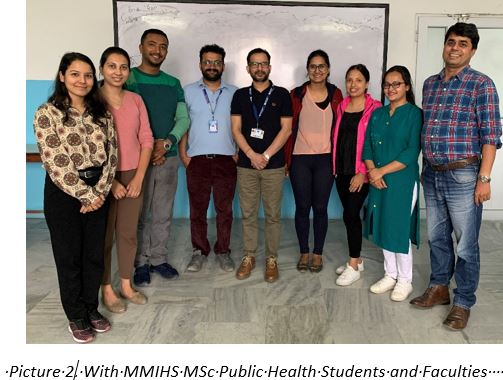
I forged ties with several organisations working in health, migration, and mental health. Some of the key associations we shared our expertise with were Green Tara Trust and Transcultural Psychosocial Organisation Nepal (TPO Nepal). Furthermore, I discussed the proposed research tools for my PhD and the availability of validated questionnaires in the Nepali translated version. It was a win-win visit for both BU and MMIHS Nepal. As a research student, I returned with a rich experience, and I look forward to fostering collaborations in future. Overall, it was a fantastic opportunity to explore and interact with students, academics and researchers internationally.
NIHR Grant Applications Seminar ONLINE – 7th July 2022
Dear colleagues
– Do you have a great idea for research in health, social care or public health?
– Are you planning to submit a grant application to NIHR?
Our popular seminar continues online and will take place on Thursday 7th July 2022 from 10.00am – 12.30pm.
The seminar provides an overview of NIHR funding opportunities and research programme remits, requirements and application processes. We will give you top tips for your application and answer specific questions with experienced RDS South West advisers.
We also have a limited number of 20-minute 1-to-1 appointments available after the seminar should you wish to discuss your proposed study with an RDS adviser.
Find out more and book a place.
Your local branch of the NIHR RDS (Research Design Service) is based within the BU Clinical Research Unit (BUCRU)
We can help with your application. We advise on all aspects of developing an application and can review application drafts as well as put them to a mock funding panel (run by RDS South West) known as Project Review Committee, which is a fantastic opportunity for researchers to obtain a critical review of a proposed grant application before this is sent to a funding body.
Contact us as early as possible to benefit fully from the advice
Feel free to call us on 01202 961939 or send us an email.
BU staff can login below:
Other services







Recent posts
BU research Funding opportunities EU
 Food Price Research Shortlisted for Civil Service Prize
 It’s International Open Access week
 3C Event: Research Culture, Community & Connections – Wednesday 11 November 3-4pm
 ECR Opportunities: New Development Programme, Researcher Grants & Upcoming Events
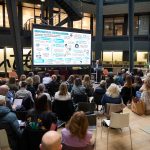 Help us capture BU’s knowledge exchange activity HE-BCI survey 2025–26
 Verbal autopsy paper published two days ago
 Horizon Europe Cluster 3 (Civil Security for Society) 2026 Calls Now Open
 MSCA Doctoral Networks 2026 Call Information Webinar
 ESRC Festival of Social Science 2026: Application Deadline Extended to Thursday 25 June 2026
- Apply now to take part in the 2026 ESRC Festival of Social Science
 Reminder: Register for the ESRC Festival of Social Science 2026 Information Session
 ECR Funding Open Call: Research Culture & Community Grant – Apply now
- MSCA Postdoctoral Fellowships 2025 Call
 ERC Advanced Grant 2025 Webinar
- European Migration Research and Impact – Invitation to a Roundtable Discussion
- MSCA Postdoctoral Fellowships 2025
 Update on UKRO services
 European research project exploring use of ‘virtual twins’ to better manage metabolic associated fatty liver disease
 Research Information Network
- Physical Sciences Case studies: information use and discovery
- Information handling in collaborative research: an exploration of five case studies
- Information literacy monitoring and evaluation
- Data centres: their use, value and impact
- Heading for the open road: costs and benefits of transitions in scholarly communications