Category / REF Subjects
The impact of COVID-19 on workforce stress and resilience – Parliamentary Health and Social Care Committee Publication
The COVID-19 pandemic has created major upheaval across the world, and for frontline practitioners in social work, this led to sudden changes in working practices alongside homeworking. In the summer of 2020, Parliament started to conduct an inquiry exploring workforce burnout and resilience in the NHS and social care as a result of the COVID-19 pandemic. As part of this they put out a call for evidence from interested parties, and were particularly interested into early research findings. Areas of interest to the inquiry included the impact of the COVID-19 pandemic on resilience, levels of workforce stress, and burnout across the NHS and social care sectors and the impacts of workforce burnout on service delivery, staff, patients and service users across the NHS and social care sectors.
At the beginning of the COVID-19 pandemic in March 2020 Professor Lee-Ann Fenge and Emily Rosenorn-Lanng from Bournemouth University developed a collaborative research project with Tilia Lenz from the Pan-Dorset and Wiltshire Teaching partnership (PDWTP) to explore the impact of COVID-19 on practitioners and managers, and to date this has been completed by 146 participants. We submitted evidence to this inquiry based on our preliminary findings, and this has now been published by the Health and Social Care Committee.
This publication recognises the importance of the research undertaken by BU and the PDWTP during COVID-19, and the contribution this makes to understanding how practitioners have responded to the unprecedented challenges created by the pandemic.
Midwifery education publication published today
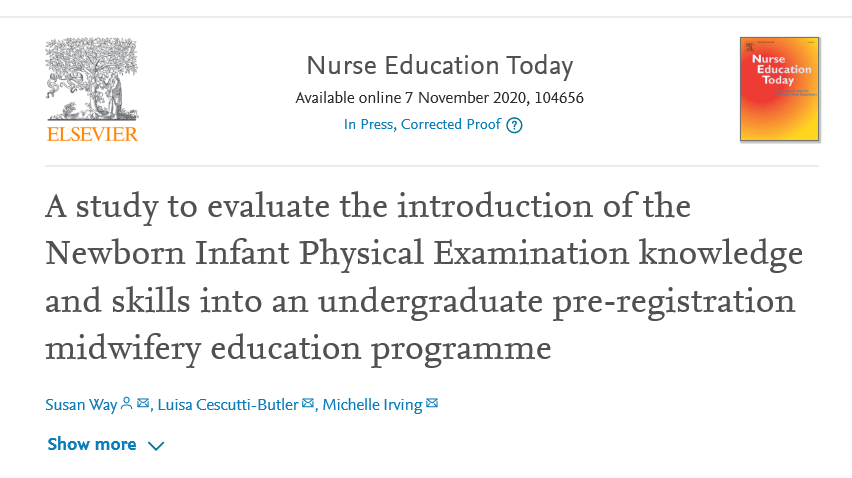 Congratulations to Prof. Sue Way, Dr. Luisa Cescutti-Butler and Dr. Michelle Irving on the publication today of their latest article ‘A study to evaluate the introduction of the Newborn Infant Physical Examination knowledge and skills into an undergraduate pre-registration midwifery education programme’ [1]. This paper published in Nurse Education Today uses the principles of FUSION, bring together Education (undergraduate midwifery education), Practice (examination of the newborn) and Research (evaluation study). This paper adds to the growing list of publication on aspects of midwifery education by academics in the Centre for Midwifery, Maternal & Perintal Health (CMMPH).
Congratulations!
Prof. Edwin van Teijlingen
CMMPH
Reference:
- Way, S., Cescutti-Butler, L., Irving, M. (2020) A study to evaluate the introduction of the Newborn Infant Physical Examination knowledge and skills into an undergraduate pre-registration midwifery education programme, Nurse Education Today, https://doi.org/10.1016/j.nedt.2020.104656.
Community Hospitals: An international perspective
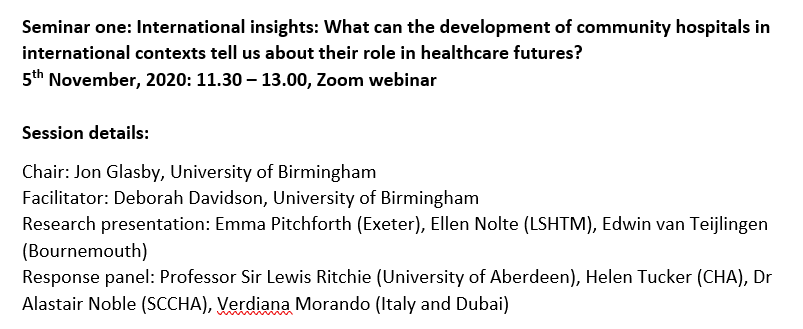
 BU Visiting Faculty Dr. Emma Pitchforth (Senior Lecturer in Primary Care, University of Exeter) spoke this week at International insights: What can the development of community hospitals in international contexts tell us about their role in healthcare futures?, the first of three UK Community Hospital online seminars. Emma presented our NIHR study on Community Hospitals [1-3].
 Community hospitals are a crucial but often neglected part of the health care systems in the UK. Community Hospitals are often very popular with local communities but they often face political challenges. COVID-19 has prompted us to make dramatic changes to way we think about and organise health care. Community hospitals have made a significant contribution to the health and wellbeing during the pandemic. The flexibility, resilience and strong community engagement typical of many community hospitals is being brought to the fore. At this critical time, questions are being asked about the future role of community hospitals and what lessons we can learn from other countries.
 The notion of a Community Hospital in the UK is evolving from the traditional model of a local hospital staffed by general practitioners and nurses and serving mainly rural populations. Along with the diversification of models, there is a renewed policy interest in community hospitals and their potential to deliver integrated care. However, there is a need to better understand the role of different models of community hospitals within the wider health economy and an opportunity to learn from experiences of other countries to inform this potential.
There will be two further webinars at lunch time on the 12th and 19th November. You can register using the following link: https://bham-ac-uk.zoom.us/webinar/register/WN_dX8LwdHxQX2-Mf8nlt8nwg .
Prof. Edwin van Teijlingen
Centre for Midwifery, Maternal & Perinatal Health
References:
- Pitchforth, E., van Teijlingen, E., Nolte, E. (2017) Community hospitals: a traditional solution to help today’s NHS? Health Services Journal (11 July) https://www.hsj.co.uk/community-services/community-hospitals-a-traditional-solution-to-help-todays-nhs/7020019.article#/scientific-summary
- Pitchforth, E., Nolte, E., Corbett, J., Miani., C, Winpenny., E, van Teijlingen, E., Elmore, N,, King, S,, Ball, S,, Miler, J,, Ling, T. (2017) Community hospitals and their services in the NHS: identifying transferable learning from international developments – scoping review, systematic review, country reports and case studies Health Services & Delivery Research 5(19): 1-248.
- Wimpenny, E.M., Corbett, J., Miami, C., King, S., Pitchforth, E., Ling, T., van Teijlingen, E. Nolte, E. (2016) Community hospitals in selected high income countries: a scoping review of approaches and models. International Journal of Integrated Care 16(4): 13 http://dx.doi.org/10.5334/ijic.2463
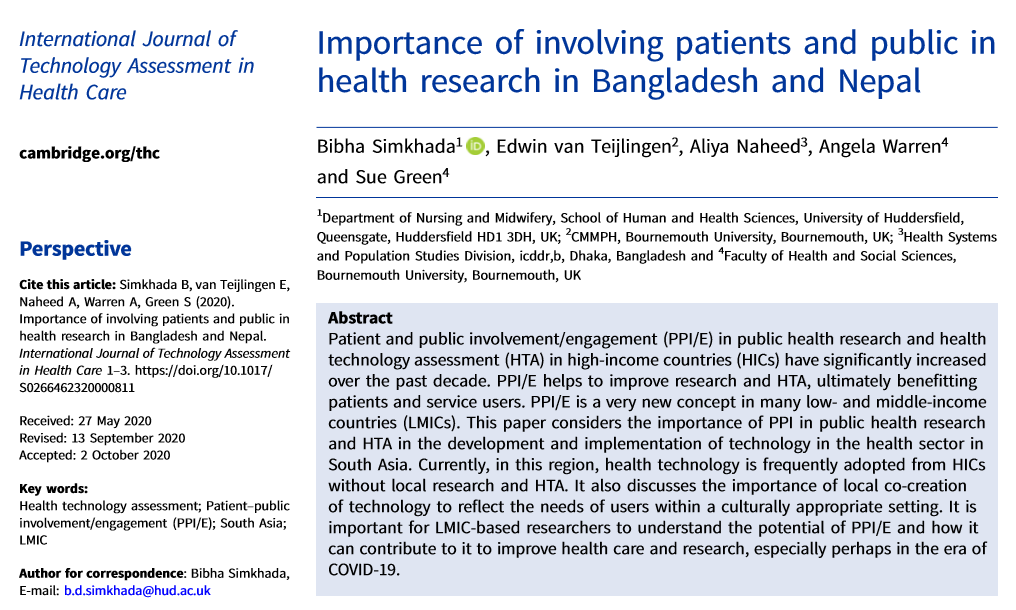 Today saw the publication of a new paper ‘Importance of involving patients and public in Health Technology Assessment (HTA) and health research in South Asia’ co-authored by the BU Public Involvement in Education and Research (PIER) Partnership [1]. This paper is co-written with Dr. Bibha Simkhada, until recently Lecturer in Nursing in N4LTH Centre (Nursing for Long-Term Health) and now Senior Lecturer in Nursing at the University of Huddersfield, Dr. Aliya Naheed at icddr,b in Bangladesh, Angela Warren based at PIER, Dr. Sue Green (Principal Academic) and Prof. Edwin van Teilingen. The paper appears in the International Journal of Technology Assessment in Health Care, which is published by Cambridge University Press.

The authors highlights that Patient and Public Involvement/Engagement (PPI/E) in public health research and Health Technology Assessment (HTA) in has significantly increased over past decade in countries such as the UK. PPI/E helps improve health research and hence benefits patients and service users. For example, organisations like BU’s PIER bring a unique patients and (potential) users’ perspective of these services, which enables FHSS to enhance the education the future workforce in health and social care as well as research in this area.
However, PPI/E is still very new concept in many LMICs (Low- and Middle-Income Countries). This paper considers the importance of PPI in public health research and HTA in the development and implementation of technology in the health sector in South Asia. Currently, in this region, health technology is frequently adopted from HICs without local research and HTA. It also discusses the importance of local co-creation of technology to reflect the needs of users within a culturally appropriate setting. It is important for LMIC-based researchers to understand the potential of PPI/E and how it can contribute to it to improve health care and research, especially perhaps in the era of COVID-19.
Reference:
- Simkhada, B., van Teijlingen, E., Naheed, A., Warren A., Green, S. (2020) Importance of involving patients and public in Health Technology Assessment (HTA) and health research in South Asia. International Journal of Technology Assessment in Health Care [Online First 5 November, pp. 1-3].
Symposium: Coronavirus, Statistical Chaos and the News
Fifteen senior and award-winning British science, health and data journalists will gather with leading statisticians, health scientists and media scholars to examine challenges and approaches to news communication of Covid-19 data and statistics at a free BU-hosted online symposium on 4 December 2020.
The one-day event – an initiative of BU’s emerging Science, Health and Data Communication Research Group, in conjunction with the Royal Statistical Society and the Association of British Science Writers – aims to provide a “waypoint” for the participating journalists and academics to reflect on their experience, share their expertise and exchange ideas around issues and challenges in dealing with the science and politics behind Covid-19 facts and figures.

At the centre of the day will be what journalists have done and how they have performed in navigating, handling and communicating the constantly changing and rather chaotic flow of Covid-19 data and statistics, which have become a daily occupation of public and private thought during the pandemic.
The symposium is geared to stimulate rigorous interaction between speakers as well as between speakers and audiences in order to draw some preliminary lessons for the near and far future. The day will cover the following questions:
- What are the major challenges to news reporting of the influx of Covid-19 data and statistics?
- To what extent does news reporting of Covid-19 data and statistics change hearts, alter minds and/or mobilise people into proper pandemic actions?
- What methods, techniques and platforms do journalists use to obtain, unpack, portray and deliver Covid-19 data and statistics to help people make sense of the pandemic?
- How well have journalists performed in questioning and scrutinising Covid-19 data and statistics to debunk statistical “lies and damn lies” spread by vested interests?
- How effectively have scientists, science institutions and other sources of Covid-19 statistics collaborated with journalists – and vice versa – in conveying them to the public?
The event will take place on Zoom. Interested parties can find the detailed programme, including the full list of speakers, and register for free on Eventbrite.
For further information, please contact An Nguyen at anguyen@bournemouth.ac.uk.
Bournemouth University Social Entrepreneurs Forum Celebrates Global Entrepreneurship Week 2020
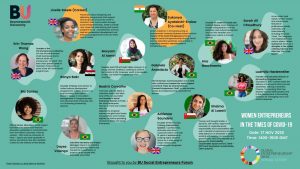
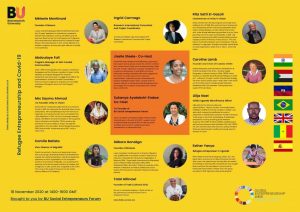
BU Social Entrepreneurs Forum BUSEF is proud to present Global Entrepreneurship Week 2020 with not one but two stellar events!
Last year we celebrated the very first Global Entrepreneurship Week at BU with two mega events on campus and although this year the world is different but what’s stopping us from celebrating and raising the bar even higher?
It is a proud moment for us to introduce this year’s events- Women Entrepreneurs in The Times of Covid-19 supported by the Women’s Academic Network at BU on the 17th of November 1400-1600 GMT (online) and Refugee Entrepreneurs and Covid-19 18 November 1400-1600 Online.
These events are aligned with the purpose of BU Social Entrepreneurs Forum in supporting the BU2025 commitment to UN SDGs and creating Fusion-led activities supporting research and student learning and experience.
BUSEF, created in partnership with the Association of Sustainability Practitioners, Dorset and The Rotary Club at Poole Bay is a collaborative, inclusive forum to support the knowledge exchange between academia and the developing landscape of socially focused businesses in the region. In the past one year BUSEF has facilitated a number of student-led projects across BU, organised a number of free skills-based workshops, showcased GEW 2019 and is continuing to support local businesses through online workshops and events.
Discussion on Gender-based Violence in Tourism – Links to Zoom presentations
A month ago, Dr Paola Vizcaino (Bournemouth University), along with co-editors Dr Heather Jeffrey (Middlesex University – Dubai) and Dr Claudia Eger (Copenhagen Business School) welcomed attendees to the virtual launch of the edited collection Tourism and Gender-Based Violence: Challenging Inequalities (CABI – find the book here). Nearly 30 academics, students and general public joined the discussion on the multiple and interconnected forms of gender-based violence against women and girls in tourism production and consumption. Please find below the links to the Zoom presentations by the book editors, chapter contributors and grassroots organisations.
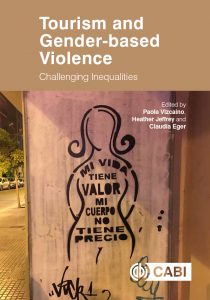
Tourism and Gender-based Violence, Challenging Inequalities. Edited by Paola Vizcaino, Heather Jeffrey, Claudia Eger
Tourism and Gender-Based Violence Book Launch 30th Sept. 2020, Introduction by Dr Paola Vizcaino – https://youtu.be/P_eRv-adlpI
The relevance of the book and the need to continue examining GBV in tourism research by Dr Stroma Cole – https://youtu.be/8ZCV0h0ev6s
Chapter discussion: Critical debates on Gender-based Violence by Dr Claudia Eger – https://youtu.be/8ewG4Y_YyQE
Chapter discussion: Trafficking in human beings in the tourism industry by Dr Tenia Kyriazi – https://youtu.be/e4zNSHoidWo
Chapter discussion: The double-bind of a female traveller in Morocco by Dr Siân Stephens – https://youtu.be/Brf4XkBQB1k
Chapter discussion: Embodying Gender and Risk: Mountain Bike Tourism in Mexico by Dr Isis Arlene Díaz-Carrión – https://youtu.be/7o20Wsl5Cv4
Profiles of grassroots organisations working to tackle GBV in tourism and beyond by Sara Ali Abdelghani – https://youtu.be/r_U9eOD5OvM
Las Kellys representing hotel workers in Spain, presentation by Myriam Barros (in Spanish with English translation) – https://youtu.be/MBBDSPT879Q
Tourism and Gender-Based Violence – Q&A segment – https://youtu.be/BJc4ATDBO7Y
Closing remarks by Dr Heather Jeffrey – https://youtu.be/VBo2Gyrsb3s
Apply for an Award Lectureship from the British Science Association
Are you, or do you know, an exceptional early career researcher?
Every year the British Science Association asks for applications for the seven Award Lectureships available to early career academics who are skilled at engaging people with their research. These Award Lectures aim to promote open and informed discussion of science and related disciplines. Awards are available in seven different areas:
- Social sciences
- Engineering, technology and industry
- Environmental sciences
- Agricultural, biological and medical sciences
- Physical sciences and mathematics
- Digital innovation
- Science and the arts
More information, including the application process can be found here:
https://www.britishscienceassociation.org/award-lectures
or you can contact Hannah at hannah.lawrence@britishscienceassociation.org with any questions.
The selected lecturers receive an all-expenses paid trip to the British Science Festival where they will present their lecture, as well as public speaking coaching and a £250 honorarium. There may also be other opportunities to present the Award Lecture at other science festivals in the UK.
The deadline for applications is 17.00 3 December 2020.
Steady stream of Nepal migration papers
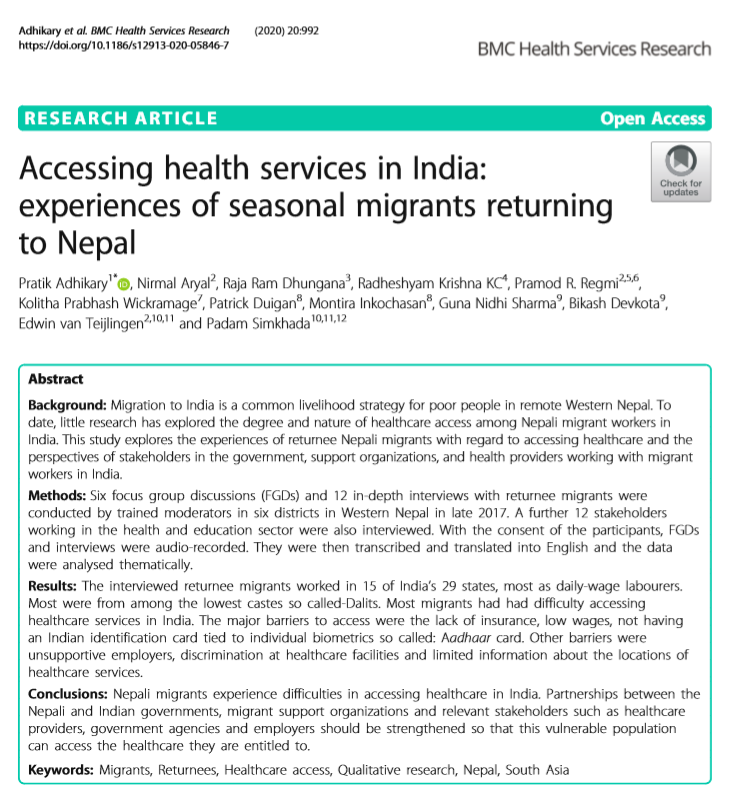
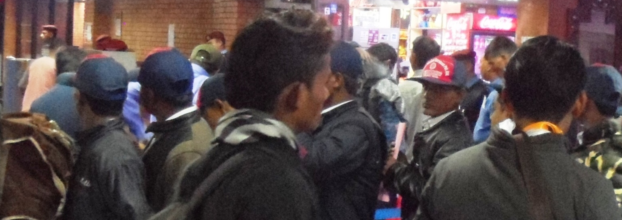
Today we added to our growing pool of publications on aspects of labour migration in Nepal. The Open Access journal BMC Health Services Research published our paper ‘Accessing health services in India: experiences of seasonal migrants returning to Nepal’ [1]. The paper explores the experiences of returnee Nepali migrants with regard to accessing healthcare and the perspectives of stakeholders in the government, support organizations, and health providers working with migrant workers in India. The paper concludes that Nepali migrants experience difficulties in accessing healthcare in India. Hence the authors recommend partnerships between the Nepali and Indian governments, migrant support organizations and relevant stakeholders such as healthcare providers, government agencies and employers should be strengthened so that this vulnerable population can access the healthcare to which they are entitled.
Three of the authors are based at BU (Dr. Nirmal Aryal, Dr. Pramod Regmi & Prof. Edwin van Teijlingen), whilst Dr. Pratik Adhikary is a BU PhD graduate and Prof. Padam Simkhada, from the University of Huddersfield, is BU Visiting Faculty.This qualitative paper is part of a larger International Organization for Migration research project on ‘Health vulnerabilities of the cross-border migrants from Nepal’ [2].
 The authors to acknowledge the continuous support from Green Tara Nepal (GTN) during the field work. This Open Access paper from this FHSS team of researchers on migration and health research related to Nepal is the 19th paper in total on the topic [3-19].
References:
- Adhikary, P., Aryal, N., Dhungana, R.R., KC, R.K., Regmi, P.R., Wickramage, K.P., Duigan, P., Inkochasan, M., Sharma, G.N., Devkota, B., van Teijlingen, E., Simkhada, P. (2020) Accessing health services in India: experiences of seasonal migrants returning to Nepal. BMC Health Services Research 20, 992. https://doi.org/10.1186/s12913-020-05846-7
- IOM [International Organization for Migration]. (2019) Health vulnerabilities of cross-border migrants from Nepal. Kathmandu: International Organization for Migration.
- Aryal, N., Regmi, P.R., van Teijlingen, E., Trenoweth, S., Adhikary, P., Simkhada, P. (2020) The Impact of Spousal Migration on the Mental Health of Nepali Women: A Cross-Sectional Study, International Journal of Environmental Research & Public Health 17(4), 1292; https://doi.org/10.3390/ijerph1704129
- Regmi, P., Aryal, N., van Teijlingen, E., Adhikary, P. (2020) Nepali migrant workers and the need for pre-departure training on mental health: a qualitative study, Journal of Immigrant & Minority Health 22, 973–981.
- Adhikary, P. van Teijlingen, E. (2020) Support networks in the Middle East & Malaysia: A qualitative study of Nepali returnee migrants’ experiences, International Journal of Occupational Safety & Health (IJOSH), 9(2): 31-35.
- Simkhada, B., Sah, R.K., Mercel-Sanca, A., van Teijlingen, E., Bhurtyal, Y.M., Regmi, P. (2020) Health and Wellbeing of the Nepali population in the UK: Perceptions and experiences of health and social care utilisation, Journal of Immigrant & Minority Health (accepted).
- Regmi, P., van Teijlingen, E., Mahato, P., Aryal, N., Jadhav, N., Simkhada, P., Syed Zahiruddin, Q., Gaidhane, A., (2019) The health of Nepali migrants in India: A qualitative study of lifestyles and risks, Journal of Environmental Research & Public Health 16(19), 3655; doi:10.3390/ijerph16193655.
- Dhungana, R.R., Aryal, N, Adhikary, P., KC, R., Regmi, P.R., Devkota, B., Sharma, G.N., Wickramage, K., van Teijlingen, E., Simkhada, P. (2019) Psychological morbidity in Nepali cross-border migrants in India: A community-based cross-sectional, BMC Public Health 19:1534 https://bmcpublichealth.biomedcentral.com/articles/10.1186/s12889-019-7881-z
- Aryal, N., Regmi, P.R., van Teijlingen, E., Simkhada, P., Mahato, P. (2019) Adolescents left behind by migrant workers: a call for community-based mental health interventions in Nepal. WHO South East Asia Journal of Public Health 8(1): 38-41.
- Aryal, N., Regmi, P.R., Faller, E.M,, van Teijlingen, E., Khoon, C.C., Pereira, A., Simkhada, P. (2019) ‘Sudden cardiac death and kidney health related problems among Nepali migrant workers in Malaysia’ Nepal Journal of Epidemiology 9(3): 755-758. https://www.nepjol.info/index.php/NJE/article/view/25805
- Adhikary P, van Teijlingen E., Keen S. (2019) Workplace accidents among Nepali male workers in the Middle East and Malaysia: A qualitative study, Journal of Immigrant & Minority Health 21(5): 1115–1122. https://link.springer.com/article/10.1007/s10903-018-0801-y
- Simkhada, P.P., van Teijlingen, E.R., Gurung, M., Wasti, S. (2018) A survey of health problems of Nepalese female migrants workers in the Middle-East & Malaysia, BMC International Health & Human Rights 18(4): 1-7. http://rdcu.be/E3Ro
- Adhikary P, Sheppard, Z., Keen S., van Teijlingen E. (2018) Health and well-being of Nepalese migrant workers abroad, International Journal of Migration, Health & Social Care 14(1): 96-105. https://doi.org/10.1108/IJMHSC-12-2015-0052
- Adhikary, P, Sheppard, Z., Keen, S., van Teijlingen, E. (2017) Risky work: accidents among Nepalese migrant workers in Malaysia, Qatar & Saudi Arabia, Health Prospect 16(2): 3-10.
- Simkhada, P.P., Regmi, P.R., van Teijlingen, E., Aryal, N. (2017) Identifying the gaps in Nepalese migrant workers’ health and well-being: A review of the literature, Journal of Travel Medicine 24 (4): 1-9.
- Aryal, N., Regmi, P.R., van Teijlingen, E., Simkhada, P., Adhikary, P., Bhatta, Y.K.D., Mann, S. (2016) Injury and Mortality in Young Nepalese Migrant Workers: A Call for Public Health Action. Asian-Pacific Journal of Public Health 28(8): 703-705.
- Sapkota, T., Simkhada, P., van Teijlingen, E. (2014) Nepalese health workers’ migration to United Kingdom: A qualitative study. Health Science Journal 8(1):57-74.
- Adhikary P, Keen S and van Teijlingen E (2011). Health Issues among Nepalese migrant workers in the Middle East. Health Science Journal.5 (3):169-i75 DOI: 2-s2.0-79960420128.
- Adhikary, P., Simkhada, P.P., van Teijlingen E., Raja, AE. (2008) Health & Lifestyle of Nepalese Migrants in the UK, BMC International Health & Human Rights 8(6). Web address: www.biomedcentral.com/1472-698X/8/6
Interdisciplinary Neuroscience Research Centre informal event
We would like to invite you to the informal online opening event of BU’s Interdisciplinary Neuroscience Research Centre on Monday 2 November from 10am – 12pm, in Zoom.
The centre is designed to foster collaborative research in applied, translational and theoretical neuroscience within the university and with our external partners to enable us to bid for external funding. We also seek to promote education in neurosciences in graduate and post-graduate programs. The centre offers a range of experimental and theoretical expertise and we are interested in collaborating with internal and external colleagues.
During the event we will provide a very brief overview of the techniques, recording modalities and facilities that we have available. Then we would welcome discussion around potential collaborations and projects.
Add this event to your diary and join us on Zoom.
Meeting ID: 885 0146 7009
Passcode: BE@hTx^1
Thank you very much and we are looking forward to seeing you there.
If you have any queries please do not hesitate to contact any of us (Ellen Seiss, eseiss@bournemouth.ac.uk Emili Balaguer-Ballester eb-ballester@bournemouth.ac.uk or Peter Abaraci Hills phills@bournemouth.ac.uk).
Art? In corporate governance?
Philosophy of Management seems to think so. Donald Nordberg’s somewhat unconventional paper on the subject has just been accepted at the journal.
- Nordberg, D. (2020). Art in corporate governance: A Deweyan perspective on board experience. Philosophy of Management, doi: 10.1007/s40926-020-00152-y.
It uses the pragmatist philosopher John Dewey’s 1934 treatise on aesthetics to examine the motivation of company directors, reinterpreting empirical studies and examining the lived experience of the author. It also raises the question of what ugly corporate governance might consist in.
Its starting point is the artwork displayed on the walls of two boardrooms, one a FTSE100 corporation, the other a social care charity…
BU Fusion Strategy in Europe
Dr John Oliver formed part of an expert panel for a European Media Management Association webinar on ‘Overcoming challenges for bridging theory and practice’. The webinar was well attended by academics from across the UK, Europe, US, Qatar,Australia and provided an opportunity to discuss the opportunities and challenges for academics to create actionable knowledge and impact in the media industries.
Dr Oliver argued that BU was well placed to advance knowledge and create social and economic impact through its Fusion Strategy. He discussed his external engagement experiences, REF2021 Impact Case Study and his recent publication on creating actionable knowledge and impact (Oliver, J.J., 2020. Managing Media Firms: case studies of practice-led research, actionable knowledge and instrumental impact. In U. Rohn, & T. Evens (Eds.), Media Management Matters, 59-74. London: Taylor & Francis).
For more information on the European Media Management Association webinar series, please go to: https://www.media-management.eu/news/
Insensitive question?
Last week I sent a reminder email to a health journal in Nepal enquiring about the progress of our submitted manuscript, assuming it had got stuck somewhere in the peer review process. The reply threw me a little and made me realise that some people’s situation is far and far worse than we think. The Nepali editor’s email went:
Dear Professor Edwin
Thank you for your email.
I will update the progress as early as possible.
Stay Safe.
PS: 25% of the medical personnel in the hospital where I am working is infected with COVID-19.
Hope for the positive news.
 I immediately replied and told him not to worry and take as long as necessary. It also made me realise that we don’t always put ourselves in the editor’s shoes, even though I am a journal editor myself.
Food for thought!
Prof. Edwin van Teijlingen
CMMPH
The PhD examiner
Being asked to examine a PhD thesis is a honour for most academics. As an examiner you always learn something new. If not about the topic itself, you may learn different ways of applying a research method or new theoretical explanations or even new ideas for supervising your own PhD students. It is a joy to have an in-depth scientific discussion with a dedicated and motivated candidate. Usually the candidate is a little nervous, especially at the start of the viva, and I see it as one of my tasks as an examiner to help the candidate to relax a little.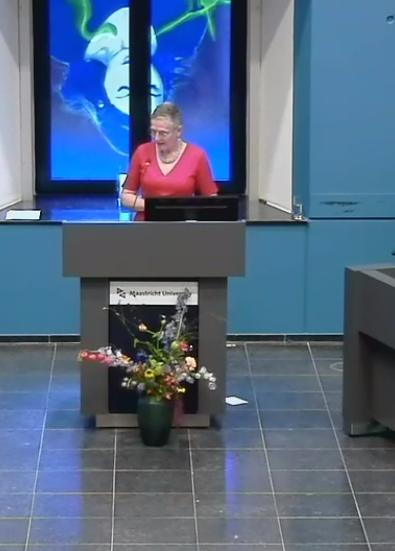
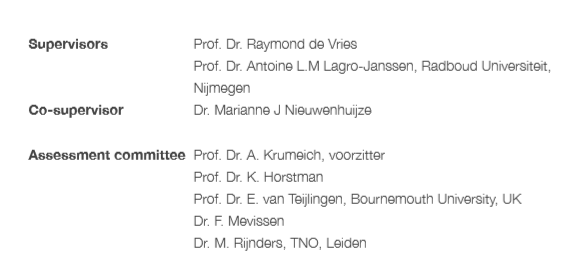 Today I had the pleasure of being one of the examiners for a PhD at the University of Maastricht (the Netherlands). The PhD candidate (now Dr.) Franka Cadée was a little nervous according to her supervisors, although it did not show during the viva.
Interestingly, enough I also felt nervous! Before today I had examined 50th PhD thesis in seven different countries. However, I probably had not felt this nervous since my own viva nearly three decades ago. Why was I nervous? First, although I am Dutch and I have studied in the Netherlands and the UK, I had never attended a PhD examination in the Netherlands. And PhD examinations really do differ between the UK and most northern European countries, especially the public defence of the thesis by the candidate in front of examiners, colleagues, friends and family. Secondly, the candidate today is the president of the ICM (the International Confederation of Midwives). Of course, this does not make any difference in the examination process, this candidate was treated the same as any other student would have been. Thirdly, and most importantly, the ICM had globally advertised the public defence of Dr. Cadée’s thesis to midwives, maternity policy-makers, member of International Non-Governmental Organisations and maternity care providers and invited ‘everybody’ to watch on ZOOM.
I really think it was the latter that made me more nervous than the much more private UK PhD viva with perhaps five or six people in a small class room, or, these days, on ZOOM.
Finally, my congratulations to Dr. Franka Cadée on the successful defence of her thesis Twinning, a promising dynamic process to strengthen the agency of midwives.
Professor Edwin van Teijlingen
Centre for Midwifery, Maternal & Perinatal Health (CMMPH)
OAPEN Open Access Books Toolkit Launched
The OAPEN Foundation (Online Library and Publication Platform) has launched a new open access (OA) books toolkit for researchers and academic book authors. The toolkit is a free-to-access, stakeholder-agnostic resource that aims to help authors better understand OA for books, increase trust in OA book publishing, provide reliable and easy-to-find answers to questions from authors, and to provide guidance on the process of publishing an OA book.
The toolkit was created in collaboration with Springer Nature and The University of Glasgow and has been written by a global and diverse group of stakeholders from the academic community and scholarly communications organisations.
You can access the toolkit here: www.oabooks-toolkit.org
To learn more about the toolkit or get involved, please contact Tom Mosterd, Community Manager at OAPEN: t.mosterd@oapen.org. You can also sign up to the toolkit newsletter: http://eepurl.com/g5fuFr.
NIHR Grant Applications Seminar ONLINE

Dear colleagues
– Do you have a great idea for research in health, social care or public health?
– Are you planning to submit a grant application to NIHR?
Our popular seminar has now moved online and will take place on Tuesday 24th November 2020 from 10.00am – 12.30pm.
The seminar provides an overview of NIHR funding opportunities and research programme remits, requirements and application processes. We will give you top tips for your application and answer specific questions with experienced RDS South West advisers.
Find out more and book a place.
Your local branch of the NIHR RDS (Research Design Service) is based within the BU Clinical Research Unit (BUCRU)
We can help with your application. We advise on all aspects of developing an application and can review application drafts as well as put them to a mock funding panel (run by RDS South West) known as Project Review Committee, which is a fantastic opportunity for researchers to obtain a critical review of a proposed grant application before this is sent to a funding body.
Come as early as possible to benefit fully from the advice
Feel free to call us on 01202 961939 or send us an email.
COVID-19 affects research into other diseases
A systematic review published late last week assesses the impact of the COVID-19 pandemic on on-going and new clinical trials and research on a range of diseases [1]. The COVID-19 pandemic has resulted in a series of public health policies, including lock down, that have crippled the healthcare systems of many countries. These measures hugely impact on study participants, care providers, researchers, trial sponsors, and research organizations conducting clinical trials. This pandemic has a substantial impact on the trial sites as they experience difficulty in the continuation of trial activities which eventually hampers the progress of the trial and delays study timelines. Most sites are struggling due to delayed subject enrolment, shortfalls in monitoring, and risks of compromised data integrity, and this situation also has a negative impact on the start of future. Researchers are also concerned regarding the delay or cancellations of trials in the pandemic, which will have financial consequences for research organizations/human resources.
 According to one survey, about two-thirds of the respondents have stopped or will soon halt subject enrolment in ongoing clinical trials, one-third halted randomization, and fifty percent of respondents are delaying or planning to delay the studies. Adopting new approaches and understanding the key risk indicators will help managers support trial sites with flexibility and ingenuity. For instance, switching patient site visits to new-trial virtualization, and telemedicine to interact with patients will help manage current clinical trials also beneficial for the post-pandemic era.
Reference:
- Sathian B, Asim M, Banerjee I, Pizarro AB, Roy B, van Teijlingen ER, Borges do Nascimento IJ, Alhamad HK. Impact of COVID-19 on clinical trials and clinical research: A systematic review. Nepal J Epidemiol. 2020;10(3); 878-887
BU staff can login below:
Other services







Recent posts
BU research Funding opportunities EU
 BU Annual Research Conference: Poster Exhibition Call for Applications
 Vitae Three Minute Thesis (3MT®) Competition: Applications Now Open
- Applications are now open for 2026 ESRC Postdoctoral Fellowships
 3C Online Social: Thursday 26 March 1–2pm – Research Culture, Community & Can you Guess Who?
 Four BU students at national midwifery conference
 INRC book roundtable/presentation by Drs Jonathan Cole and Catherine Talbot, Wednesday 22/04/2026, 13:00h, P426
 ECR Funding Open Call: Research Culture & Community Grant – Apply now
- FLF UKRI round 11- internal launch and timelines
 ECR Funding Open Call: Research Culture & Community Grant – Application Deadline Friday 12 December
- ECR Funding Open Call: Research Culture & Community Grant – Apply Now
 MSCA Postdoctoral Fellowships 2025 Call
 ERC Advanced Grant 2025 Webinar
- MSCA Postdoctoral Fellowships 2025 Call
- ERC Advanced Grant 2025 Webinar
- European Migration Research and Impact – Invitation to a Roundtable Discussion
- MSCA Postdoctoral Fellowships 2025
 Update on UKRO services
 European research project exploring use of ‘virtual twins’ to better manage metabolic associated fatty liver disease
 Research Information Network
- Physical Sciences Case studies: information use and discovery
- Information handling in collaborative research: an exploration of five case studies
- Information literacy monitoring and evaluation
- Data centres: their use, value and impact
- Heading for the open road: costs and benefits of transitions in scholarly communications