Category / Business and economic sustainability

Sustainability Symposium

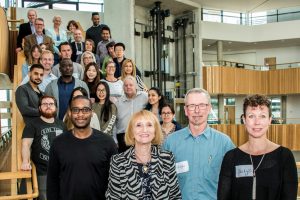
The Faculty of Management held a “Sustainability Symposium” yesterday as one response to the challenges facing businesses today. Organised by Dr Karen Thompson in collaboration with Professor Janet Dickinson and Gwyn Jones, a Director of the Association of Sustainability Practitioners, the event brought together over 50 participants, including academics from a range of disciplines, students and external practitioners.
Sustainability is not just about technology, as Professor Janet Dickinson explains:

“The Committee on Climate Change suggest the UK could achieve net zero greenhouse gas emissions by 2050.  Technology is expected to produce 38% of the reduction, societal/behavioural change delivering 9% and the remining 53% coming from a combination of both.”

Clearly, social scientists and business experts will need to work with the technologists to develop solutions and change society if we are to achieve this target.

Nor is sustainability just an issue for future generations.  The impacts of greenhouse gas emissions are here today and, according to the latest models, we only have a very short window of opportunity before the planet reaches a ‘tipping point’ beyond which we will be unable to reverse progress towards an uninhabitable planet.  “Being less unsustainable is not the same as being sustainable” (Hugo Spowers, Founder & CEO of Riversimple).

Sustainability is high on the list of priorities for BU.  Our BU2025 vision includes KPIs for all our research and education to be aligned with one or more of the UN’s 17 Sustainable Development Goals, and a new Strategic Investment Area has recently been launched in ‘Sustainability, Low-Carbon Technology and Materials Science’.
Business is one of the greatest forces on the planet.  Emerging research suggests that companies who proclaim their ‘green’ credentials most loudly often perform the worst, not just in terms of the environment but also in terms of profits and shareholder value over the long term.  Trading-off between the short term and the long term, or between domains, does not produce sustainability for a business.

One of the questions posed by Gwyn Jones was ‘What are we trying to sustain?  He suggested that what we are aiming to sustain is life.  And the question we do not yet have an answer to is ‘How can 10 billion people live in harmony and peace, equitably by 2050?’

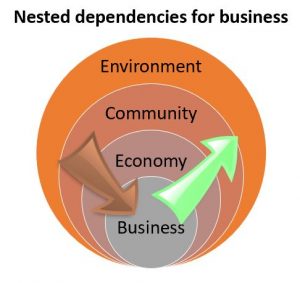
Seeking answers to this question in a business context involves developing our understandings of the dependencies among profit, people and planet.  In other words, every business depends upon a community, and all communities depend on the natural environment.
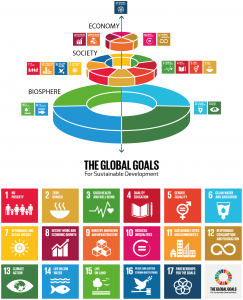
All businesses draw resources from and have impacts, both beneficial and detrimental, on the other domains.  Awareness and understanding of these dependencies will be required if we are to make progress.  The UN’s 17 Sustainable Development Goals can provide a useful framework for analysing impact and are mapped against the biosphere, society and the economy.

Sustainability has profound implications for both education and research.

We explored the question ‘Can sustainability be taught?’ (see a separate post on this).

Research on sustainability is likely to require one or more of the three characteristics identified during the event:

  1. Cross-disciplinary thinking that seeks to understand the complexity of social practices
  2. Fundamental re-thinking of existing models and ways of doing business
  3. Partnerships with practitioners and stakeholders representing the interests of all domains.

Further thoughts on the implications for research are discussed in a separate post (see ‘Sustainability changes everything’).

For further information please contact Dr Karen Thompson or Professor Janet Dickinson, from Faculty of Management.

New publication: Job Satisfaction and Employee Turnover Determinants in High Contact Services: Insights from Employees’ Online Reviews,

NEW PAPER: Stamolampros, P., Korfiatis, N., Chalvatzis, K., Buhalis, D., 2019, Job Satisfaction and Employee Turnover Determinants in High Contact Services: Insights from Employees’ Online Reviews, Tourism Management,  Vol.75, Dec. pp.130-147, https://doi.org/10.1016/j.tourman.2019.04.030

Abstract

We explore a special case of electronic word of mouth that of employees’ online reviews to study the determinants of job satisfaction and employee turnover. We perform our analysis using a novel dataset of 297,933 employee online reviews from 11,975 US tourism and hospitality firms, taking advantage of both the review score and text.

Leadership, good custom uniforms, and cultural values are found to be better predictors of high employee satisfaction, while career progression is critical for employee turnover. One unit increase in the rating for career progression reduces the likelihood of an employee to leave a company by 14.87%.  Additionally, we quantify the effect of job satisfaction on firm profitability, where one unit increase leads to an increase between 1.2 and 1.4 in ROA.

We do not find evidence supporting the reverse relationship, that growth on firm profitability increases job satisfaction. The feedback to management in employee reviews provides specific managerial implications.

Highlights

•We use online reviews to evaluate job satisfaction and employee turnover factors for tourism and hospitality firms.
•297,933 employee review ratings and texts for 11,975 U.S tourism and hospitality firms from Glassdoor are analyzed.
•A recent extension of probabilistic topic modeling the Structural Topic Model (STM) is used for the text analysis.
•A one unit increase of the rating for career opportunities decreases the likelihood of an employee to leave by 14.87%.
•An increase by one star in the overall rating of a company is linked with an increase between 1.2 and 1.4 of ROA.

Creating a long term strategy in an uncertain digital environment

Developing organisational strategy in uncertain competitive conditions can be problematic. Dr John Oliver’s (FMC) research into media management tools and scenario planning provides an insight into the problems faced by firms operating in dynamic markets and has been used to create a number of instrument impacts of international reach and significance.

James Gater,a former partner at Bell Pottinger, one of the world’s leading communication consultancies and now a partner at Special Projects Partners Ltd, commented that “The ideas presented in Dr Oliver’s research into ‘Media Management Tools’ used by business executives and his follow-up research into Scenario Planning was used to good effect. Indeed, we developed a Senior Communicators’ Development Programme in which he personally briefed senior Middle Eastern clients. Of particular note, I personally conducted scenario planning exercises, based directly Dr Oliver’s approach, with a diverse range of clients helping them see how their communications functions may need to adapt to future strategic challenges. These have included several government organisations (in South Africa, Kuwait, Saudi Arabia and the UAE), a political party in Pakistan and an agribusiness in Liberia amongst others”.

Dr Oliver leads the Advances in Media Management research group, a cross faculty cluster that seeks to advance knowledge and create economic and societal impact.

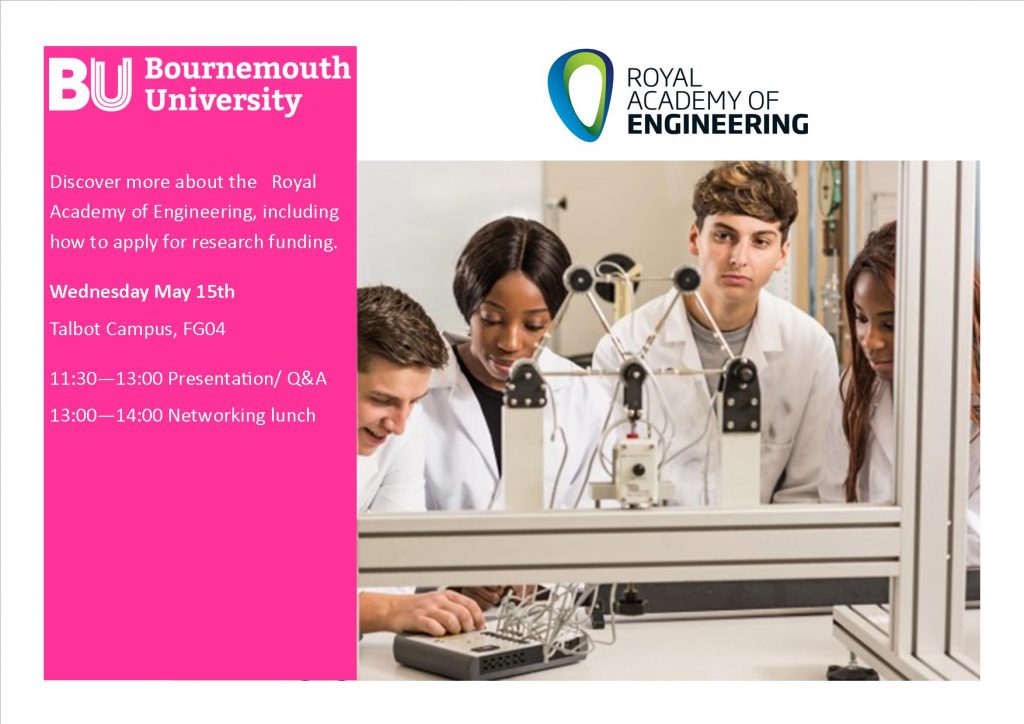
Royal Academy of Engineering to Visit BU

Engineering matters. It underpins our daily lives, drives economic growth, plays a critical role in addressing major societal challenges and helps ensure our readiness for the future, from providing a sustainable supply of food, water and clean energy, to advancing healthcare, and keeping us safe and secure.


As the UK’s national academy for engineering and technology, the Royal Academy of Engineering brings together the most talented and successful engineers – our Fellows – to advance and promote excellence in engineering for the benefit of society.

We are excited that Research Programme Managers from the Royal Academy of Engineering will be visiting BU on Wednesday 15th May to provide an overview of:

  • Who they are
  • Their remit
  • Types of funding offered
  • Their decision-making processes
  • Time frames and planning a Royal Academy of Engineering application.

This will help our academics to learn more about the Royal Academy of Engineering, its remit and the type of funding offered, and will help them determine whether or not the Royal Academy of Engineering is an appropriate funder for their research projects.

To attend the presentation and lunch, please book here.

Please contact Alex Pekalski or Theresa McManus if you have any queries.

As if 15 years of oil price volatility was not enough… energy markets now need to deal with Brexit

The next in our series of Fusion inaugural lectures will take place on Tuesday 26 March in the Executive Business Centre on Lansdowne campus.  Professor George Filis from the Faculty of Management will be speaking.

During the course of this inaugural lecture, Professor George Filis will present recent developments relating to energy markets (with particular focus on the oil market). This will include some of the potential drivers behind the increase in oil price volatility over the last 15 years. Professor Filis will also look at the political economy of the oil market, with particular emphasis on the current status of the “petrodollar system”, the developments in Venezuela and whether Brexit could signal the onset of another turbulent period for the oil market.

Professor George Filis is a specialist in energy and financial economics. Currently, he is working towards the development of new modelling frameworks for forecasting energy prices. In particular, he looks at the predictive information of different asset classes on oil prices and oil price volatility. Professor Filis has also served as a consultant for the US Energy Information Administration and the Bank of Greece.

You can book your free tickets here.

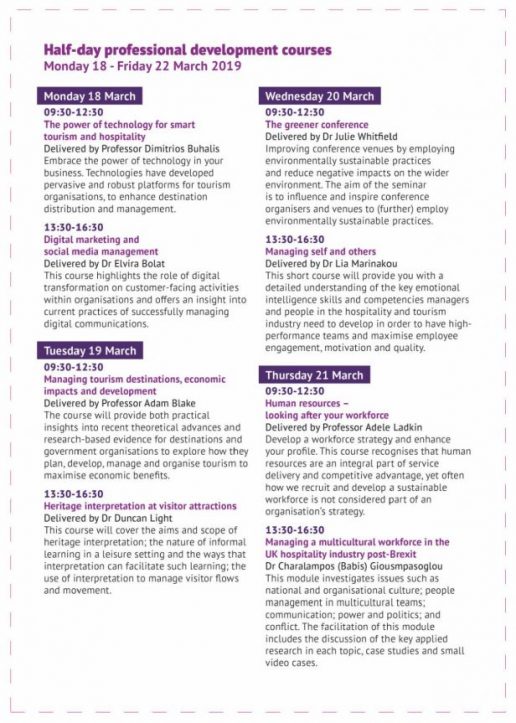
Bournemouth University Professional development courses for tourism & hospitality 

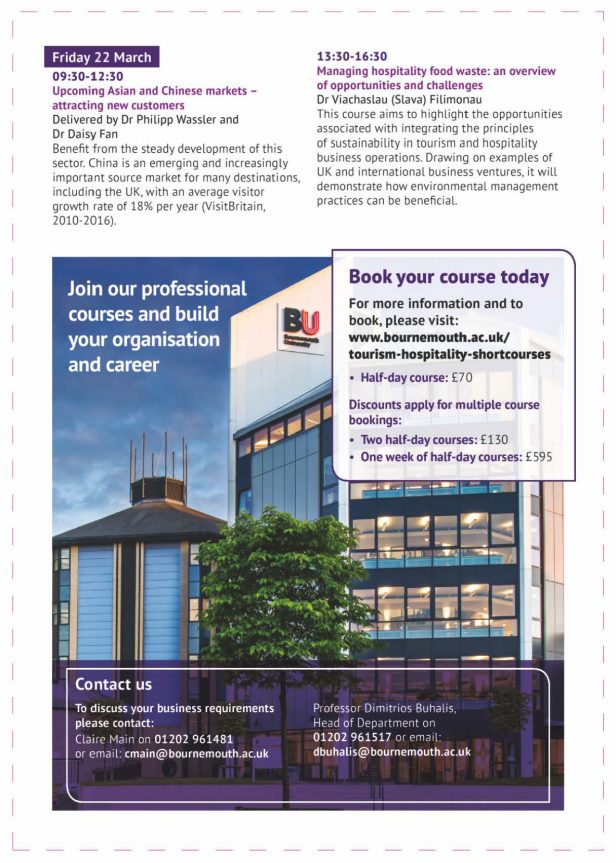
18 March – 22 March  2019 Bournemouth University Professional development courses for tourism & hospitality https://tinyurl.com/BUProfessionalCourses

Join Bournemouth University Department of Tourism and Hospitality to learn how you can develop your potential and competitiveness through managing your staff, developing your product and service, understanding your customers and using digital marketing. You will also have access to our resources and networks to develop your competitiveness. The courses are delivered through interactive workshops and networking with leading academics and students and will support managers to develop contemporary knowledge of critical business aspects that influence their profitability and performance.

Part of our Fusion and BU2025 strategy at Bournemouth University the short courses run from 18 March – 22 March and can be booked individually or as a package at a discounted rate. Our series of half-day courses will be delivered through interactive workshops and networking with leading academics and students. They will support managers, supervisors and their teams in their operational and strategic thinking.

The courses will focus on the following cutting edge areas:

  • Digital marketing and branding
  • Finance & the economy
  • Tourism attractions and heritage
  • Conferences & events
  • Asian markets & culture
  • HR – managing & developing staff
  • Sustainable hospitality

View the full schedule of short courses and click below for more detail about each course.https://tinyurl.com/BUProfessionalCourses


During these courses we share and disseminate our research findings and we develop collaborations and engagement to develop the talent of the future. Please forward this message to your network and encourage them to participate

Bournemouth University Professional development courses for tourism and hospitality 18 March – 22 March  2019

Bournemouth University Professional development courses for tourism & hospitality 18 March – 22 March  2019

Department of Tourism and Hospitality Bournemouth University

Information  https://www.bournemouth.ac.uk/about/our-faculties/faculty-management/our-departments/department-tourism-hospitality/professional-development-courses

Booking https://www.eventbrite.co.uk/e/professional-development-courses-for-tourism-hospitality-professionals-tickets-51803261951?_eboga=1715778101.1516471310

Professional development courses for tourism & hospitality professionals

Our series of half-day courses will be delivered through interactive workshops and networking with leading academics and students. They will support managers, supervisors and their teams in their operational and strategic thinking. Our half-day courses will focus on the following areas:

  • The power of technology Professor Dimitrios Buhalis
  • Digital marketing and social media Dr Elvira Bolat
  • Managing tourism destinations, economic impacts and development Professor Adam Blake
  • Heritage interpretation at visitor attractions Dr Duncan Light
  • The greener conference Dr Julie Whitfield
  • Managing self and others Dr Lia Marinakou
  • Looking after your workforce Professor Adele Ladkin
  • Managing a multicultural workforce Dr Charalampos (Babis) Giousmpasoglou
  • Upcoming Asian and Chinese Markets – Attracting new customers Dr Philipp Wassler and Dr Daisy Fan
  • Managing hospitality food waste Dr Viachaslau Filimonau

View the full schedule of short courses and click below for more detail about each course.
Information  https://www.bournemouth.ac.uk/about/our-faculties/faculty-management/our-departments/department-tourism-hospitality/professional-development-courses

Booking https://www.eventbrite.co.uk/e/professional-development-courses-for-tourism-hospitality-professionals-tickets-51803261951?_eboga=1715778101.1516471310

Please feel free to forward this email to interested parties.

Our Professional development courses for tourism & hospitality professionals are primarily for our partners and help us to develop the competitiveness of the tourism and hospitality industries of the future.  Join us to learn how you can develop your potential and competitiveness through managing your staff, developing your product and service, understanding your customers and using digital marketing. You will also have access to our resources and networks to develop your competitiveness. The courses are delivered through interactive workshops and networking with leading academics and students and will support managers to develop contemporary knowledge of critical business aspects that influence their profitability and performance. We pride ourselves on the cutting edge knowledge and professional excellence we cultivate. The combination of staff expertise and enthusiasm, knowledge excellence and co-creation with industry, generate innovation and best professional practice. We have developed a suite of professional development courses for the tourism and hospitality industry to support managers in their operational and strategic thinking. They will bring you the tools and techniques to help grow your business.

ABOUT BOURNEMOUTH UNIVERSITY DEPARTMENT TOURISM AND HOSPITALITY

The Department of Tourism and Hospitality, Faculty of Management, Bournemouth University is a top university in the world for the study of tourism and hospitality, ranked 8th in the world for hospitality and leisure management according to the QS University Rankings 2018 and 12th in the world for hospitality and tourism management according to the Shanghai Rankings of Academic Subjects 2018 and 3rd in the UK for hospitality, event management and tourism in the Guardian League Table 2019. We are recognised globally as a leading contributor to knowledge creation and dissemination in tourism and hospitality. A team of 29 academic staff and over 1,000 undergraduate, postgraduate and doctoral students make us one of the biggest and most prolific departments in the world. The combination of staff expertise and enthusiasm, knowledge excellence and cocreation with industry, generate innovation and best professional practice. Our approach is about creating value with everyone we work with, locally and globally, and to share the benefits with society.

Look forward to welcome you to our Professional Development courses.

Professor Dimitrios Buhalis
Head of Department Tourism and Hospitality
Bournemouth University

new paper published  Volchek, K., Liu, A., Song, H., & Buhalis, D. (2018) Forecasting tourist arrivals at attractions: Search engine empowered methodologies. 

new paper published  Volchek, K., Liu, A., Song, H., & Buhalis, D. (2018) Forecasting tourist arrivals at attractions: Search engine empowered methodologies. Tourism Economics. https://doi.org/10.1177/1354816618811558

Abstract

Tourist decision to visit attractions is a complex process influenced by multiple factors of individual context. This study investigates how the accuracy of tourism demand forecasting can be improved at the micro level. The number of visits to five London museums is forecast and the predictive powers of Naïve I, seasonal Naïve, seasonal autoregressive moving average, seasonal autoregressive moving average with explanatory variables, SARMAX-mixed frequency data sampling and artificial neural network models are compared. The empirical findings extend understanding of different types of data and forecasting algorithms to the level of specific attractions. Introducing the Google Trends index on pure time-series models enhances the forecasts of the volume of arrivals to attractions. However, none of the applied models outperforms the others in all situations. Different models’ forecasting accuracy varies for short- and long-term demand predictions. The application of higher frequency search query data allows for the generation of weekly predictions, which are essential for attraction- and destination-level planning.

Keywords: artificial intelligence, attractions, forecasting, Google Trends, search engine, tourist demand

The Impact of Digital Strategy and Business Transformation

In April 2017 Dr John Oliver co-hosted a business engagement event on Digital Strategy and Business Transformation with The Hackett Group (London). The Hackett Group are leading management consultants providing expert advice on digital transformation and benchmarking to major corporations and government agencies, including 97% of the Dow Jones Industrials, 89% of the Fortune 100 and 59% of the FTSE 100.

The event formed part of a British Academy/Leverhulme Trust funded research project and was attended by senior business executives from the likes of Ofcom, the Financial Times, Astrazeneca and Bell Pottinger. At the time, the delegates commented that it was an “excellent event” that provided different perspectives on digital transformation and new ideas on how to manage strategic digital transformation within their firms.

After 18 months, a clearer picture has emerged of the impact that the presentation of findings and subsequent discussion has had on business practice. Chris Davenport, a Senior Director at The Hackett Group, recently commented that “the event influenced our strategic approach to the development of a new Digital Strategy and Analytics service for our clients. This new consultancy service has been now been launched and several of our FTSE100 clients (among others Tesco, John Lewis and Unilever) have gained insight from this. Some of these clients have already decided to invest millions of pounds into resources creating many new jobs in Digital services and Analytics departments in their firms and we expect many more to follow”.

The research findings have been published in several practice management journals, whilst the academic papers are in the final stages of peer review.

EU FIRST Project

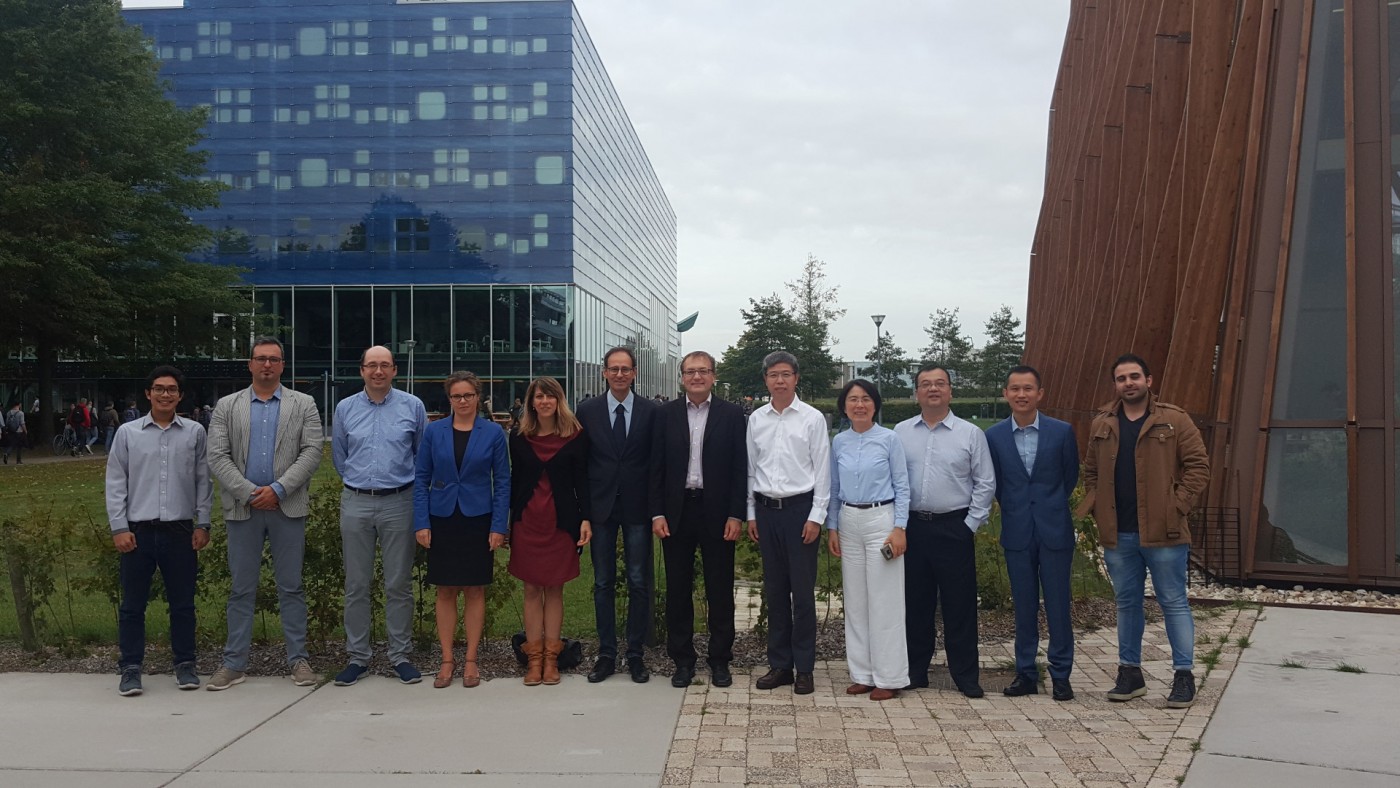
A Bournemouth University team from the Faculty of Science and Technology visited University of Groningen for FIRST mid-term review. It was a very productive meeting with a lot of effective outcomes for research and knowledge exchange. Dr. Lai Xu and Dr. Paul de Vrieze are FIRST coordinators representing Bournemouth University and the team is pleased to announce that FIRST will continue to move towards a factory of the future for European Union.

If you want to know more about the project and get involved, please contact Dr. Lai Xu or Dr. Paul de Vrieze. You can also follow our social medial links on Facebook, Twitter, Instagram and YouTube Channel.

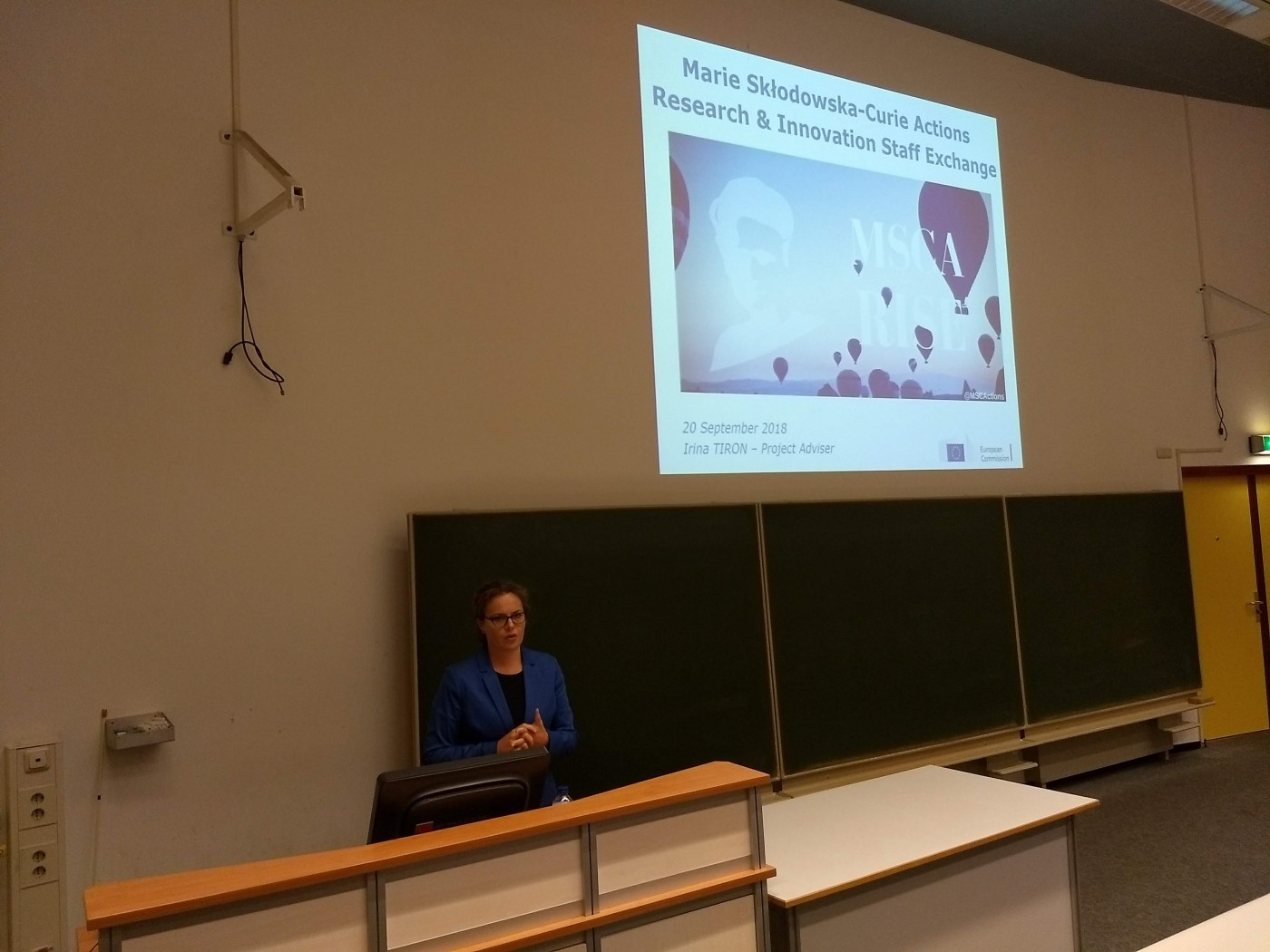
During the mid-term review meeting, the FIRST EU project advisor Irina Elena Tiron giving a talk on RISE projects. A useful instrument for researchers in EU (and beyond).