Category / Digital and technological futures

Looking through the lens of Covid-19 at student risk management practice in HE

Earlier this year the International Journal for Creative Media Research (IJCMR) published a journal article by Annie East, Deputy Head of Media Production Department at BU, on ways students make meaning of the risk assessment process on their undergraduate filmmaking degree. Based on Annie’s doctoral pilot study findings, this article, whilst written in a pre-covid19 environment, has 5 areas for consideration of health and safety going forward in a Covid-19 student fieldwork context. Below Annie considers how we conceive health, safety and risk before outlining 5 points.

What is safe? The social construction of safety

Safety is a subjective, constructed and socially derived notion. The Health And Safety Executive literature does not define what safety is, leaving companies and organisations to interpret or translate how that applies to their practices. Similarly risks are ‘selected’ and ‘risk is only what people choose to say it is.’ As for health, we follow current advice in how to understand what is ‘good health’.

To give more clarity we could consider the terms ‘health’ and ‘safety’ from within the industrial context in which they are being used. Since my research is about filmmaking (in an HE context), when we refer to safety at work we can consider a film set in a studio; a lighting electrician may fall off a ladder that isn’t secure and this is a result of non-safety, or ‘unsafe-ness’. When we talk about health we can view the same studio where a set designer is carrying heavy props and as a result of that act, potentially, over time, this will create health problems, linked to heavy lifting, for that person. Safety is therefore constructed by us with an immediacy, whether perceived as safe or unsafe, and health is constructed as more removed from the act, alluding to future constructs of ailment/s within the body (or mind).

So with a socially constructed definition of health and safety the linked article can be read, taking into account the added consideration of working practice and Covid19 outlined in 5 points below.

1. VR Elicitation

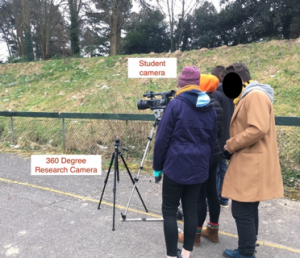
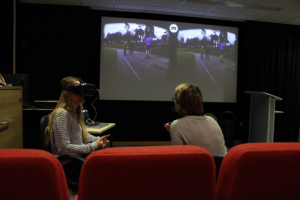
In the article I propose a new research method; VR elicitation. A two-tier practice of placing a 360-degree camera into fieldwork (in this case a student film shoot) and then viewing it back as a way of deepening reflective and reflexive practice for both educator and student through an immersive environment. In response to innovation around education during Covid-19, VR elicitation could be utilised to enhance, learning for students who may not be able to engage as fully with fieldwork. This would be through remote learning ‘in the round’ with peers and educators taking advantage of the immersive environment. Working with apps that can download onto smartphones and be slotted into a £30 VR visor.

Image 1: Student film shoot

Image 2: Re-immersion back into film shoot; VR elicitation

2. The paradox within HE

The article highlights the paradoxical nature of working in a tripartite environment; education that teaches industry practice whilst complying with HE rules. With the extra layer of Covid-19 risk management incorporated into our health and safety practices, it is worth fully understanding the paradox presented within the article.

3. Risk as imagined, risk as performed

Following David Borys, I conceived the risk assessment in two steps; risk as imagined (the writing of a risk assessment) and risk as performed (the performance of the risk assessment in action). The literature acknowledges a lack of emphasis on risk as performed in scholarly research discoveries or, if it does, it discovers performance as being different to that as imagined.

4. Working beyond bureaucracy in risk management

The article posits holistic ways to approach risk management that involves engaging HE students more thoroughly. Moving us away from purely bureaucratic tick box exercises of writing a risk assessment towards a shared ownership of risk management strategy or otherwise referred to as ‘institutional magic’ by Patrick Brown. This holism is essential now that we are dealing with an invisible risk.

5. VR elicitation study findings

The pilot study teases out some of the ways students inherently keep themselves safe and are examples of where the imagined is very different to the performance. This reminds us of the importance of developing shared ownership of managing risk rather than staying purely with top-down implementation that is tied to institutional and legal power structures.

Moving forward it will be interesting to see if the increased scrutiny on Covid-19 health & safety risk management within HE results in safer student practice on a film location (or other generic fieldwork) or whether increased scrutiny on Covid-19 results in a lowering of the other health & safety practice principles.

Full linked article here.

Contact: Annie East, Deputy Head Media Production Department, Faculty of Media and Communication. aeast@bournemouth.ac.uk

Doctorate via Centre of Excellence for Media Practice (CEMP).


NERC Workshop: Identifying Challenges for a Sustainable Digital Society

Deadline for Expressions of Interest: 14 May 2020 at 16:00

The EPSRC Digital Economy Theme welcomes Expressions of Interest for a one-day virtual workshop to explore how research can tackle the challenges in establishing a Sustainable Digital Society.

It is intended that the outputs of the workshop will be used to scope a Digital Economy Theme call to be funded by EPSRC for up to £5m.

The virtual workshop will be held on Thursday 11 June 2020.

For more information, see the NERC website.

Donning the ‘Slow Professor’

Congratulations to the Bournemouth authors who published the paper ‘Donning the ‘Slow Professor’: A Feminist Action Research Project’ earlier this month [1].  This paper was published in the journal Radical Teacher.  The paper argues that the corporatisation of Higher Education has introduced new performance measurements as well as an acceleration of academic tasks creating working environments characterised by speed, pressure and stress. This paper discusses findings from a qualitative, feminist participatory action research (PAR) study undertaken by an interdisciplinary team of women academics at a modern, corporate university in England. The study illuminates how corporatized HE erodes faculty autonomy, degrades learning environments, damages professional satisfaction and health. Strategies for resistance and liberation developed through the PAR process are discussed.

The writing collective for this paper comprised: Sara Ashencaen Crabtree, Ann Hemingway, Sue Sudbury, Anne Quinney, Maggie Hutchings, Luciana Esteves, Shelley Thompson, Helen Jacey, Anita Diaz, Peri Bradley, Jenny Hall, Michele Board, Anna Feigenbaum, Lorraine Brown, Vanessa Heaslip,  and Liz Norton.

Reference: Ashencaen Crabtree, S., Hemingway, A., Sudbury, S., Quinney, A., Hutchings, M., Esteves, L., Thompson, S., Jacey, H., Diaz, A., Bradley, P., Hall, J., Board, M., Feigenbaum, A., Brown, L., Heaslip, V., Norton, L. (2020) Donning the ‘Slow Professor’: A Feminist Action Research Project , Radical Teacher, Vol. 116

Corrosion Condition Monitoring

Collaborative research with The Tank Museum in terms of experimental investigations to evaluate and analyse corrosion induced damage to high value assets led to further collaborations with NASA Materials & Corrosion Control Branch and BAE Systems. The experimental research provided valuable data to develop precision based mathematical models in collaboration with Defence Science & Technology Laboratory (DSTL) Ministry of Defence (MOD) to predict and prognose fracture, electrochemical and coating failures in military vehicles. Further work was conducted to develop in-situ and remote sensing, prediction and prognosis models incorporating advanced sensing techniques to predict and prognose corrosion, coating and fracture led failures.

Subject of this study

Subject of this study

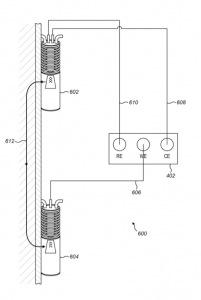
In a separate research additional work has led to state-of-the-art novel sensor design and has been recently patented (GB2018/053368). A framework of remote sensing techniques have been developed and has been adopted by Analatom Inc. USA which are successfully applied in several key installations in the US.

Telescopic Electrochemical Cell (TEC) for Non-Destructive Corrosion Testing of Coated Substrate. Patent number GB2018/053368

Since 2009 a suite of numerical models – and published algorithms and methodologies that have enabled other researchers to reproduce the methods – have been developed at NanoCorr, Energy & Modelling (NCEM) Research Group (previously SDRC[1]) to simulate corrosion failures in large complex engineering structures and to predict averaged material properties, typically measured in laboratory experiments, such as hardness and corrosion resistance.

Experimental work at NCEM was started in 2009 with a focus on corrosion issues and expanded to multidisciplinary research with new grants from several key stakeholders into wear-corrosion, nanocoating failure, fracture mechanics, in-situ and remote sensing techniques. This research was led and conducted by Professor Zulfiqar A Khan and his team including Dr Adil Saeed, Dr Mian Hammad Nazir, Dr Jawwad Latif and several other PGRs and Post Docs.

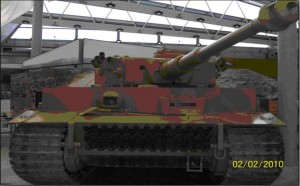
At the start of project, research was conducted to analyse corrosion and tribological failures in The Tank Museum Bovington military tanks. Based on collected data, (3.5 years of live data, over 153k data points) numerical models were developed for simulating corrosion failures in nonconductive polymeric coatings applied to large engineering structures such as automotive and aerospace applications. These models represented the failing structure as bending cantilever beam subjected to mechanical and/or thermal loading which produces both residual and diffusion-induced stresses in beam. These numerical models were later extended to include nano-composite metal and sea water resistant coatings.

These structures are affected by corrosion

This numerical modelling technology developed at NCEM was combined with remote sensing techniques, which enabled predictions in static structures and high value mobile assets substituting conventional methods which require expensive & time consuming experimental setup and laborious while often unreliable visual inspection. The technology allowed faster structural analyses with greater reliability and precision compared to experiments in turn saving money, labour and time. Further developments included the performance enhancement of coatings under extreme temperatures and pressures. Recent plans are to extend the model capabilities to simulate the effects of deep zone residual stresses on corrosion failures.

Coating delamination issues due to corrosion

This research has developed state of the art cells fabricated by using a special magnetic aluminium compound, which is highly electrically conductive and resistant to corrosion. The research has commissioned for deploying this novel sensing technology for micro-defects detection, corrosion rate measurement and condition assessment of defective coatings. This technology has been successfully tested and commissioned in automotive, hazardous compartments with polymeric coatings and bridges to assess their coating condition in terms of their structural integrity. Post design testing involved the installation of these cells, running diagnostics, data acquisition, and macro-graphs to predict structural defects and the resulting corrosion rate. Taking above research further, an NDT apparatus for use in sensing the electromechanical state of an object was invented to monitor the health/condition of coatings.

Further details can be found in [1, 2, and 3]. If you have interest in the above subjects or have questions and would like to discuss then contact Professor Zulfiqar A Khan.

[1] Sustainable Design Research Centre

New publication by NCCA academics and students in the top journal

The SIAM Journal on Imaging Sciences (“SIIMSa broad authoritative source for fundamental results in imaging sciences, with a unique combination of mathematics and applications”), an influential Q1-journal with a significant Impact Factor and SJR indicator, has just published the paper “Automatically Controlled Morphing of 2D Shapes with Textures” authored by NCCA academics and students. This multidisciplinary paper proposes a novel theoretical and practical framework resulting in a suite of mathematically substantiated techniques important in the context of 2D imagery, artistic design, computer animation, and emerging streaming and interactive applications.

The paper has a rather long and non-trivial history related to the fusion of academic and student research. Initially, NCCA UG student Felix Marrington-Reeve (“Computer Visualisation and Animation” course, Level 6) undertook his R&D project within the “Innovations” unit and got some interesting results. The 8-page paper written on the basis of his project and co-authored with his supervisors Dr Valery Adzhiev and Prof Alexander Pasko, was, however, rejected in 2017 by two international conferences (they were prepared to accept a short version but the authors thought the work deserved a better fate).

After Felix’s graduation (he started working in a leading production company Framestore) Dr Oleg Fryazinov and PhD student Alexander Tereshin joined the project team. A lot of additional theoretical and practical work had been done, and in February 2019 the radically modified and extended 30-page version was submitted to SIIMS. After two-stage rigorous peer-reviewing process, in October 2019 the paper was accepted by this prestigious journal.

References:

  • Tereshin, A., Adzhiev, V., Fryazinov, O., Marrington-Reeve, F., Pasko, A. (2020). “Automatically Controlled Morphing of 2D Shapes with Textures”, The SIAM Journal on Imaging Sciences, Vol. 13, No. 1, pp. 78-107. DOI: 10.1137/19M1241581
  • Full text of the paper: http://eprints.bournemouth.ac.uk/33366/

International Centre for Tourism and Hospitality Research

ICTHR has recently been re-approved for another three years. If your research is in (or partly overlapping with) tourism or hospitality or related subjects such as events and leisure, join with other researchers in this centre.

What does membership involve?

  • addition of your details to the ICTHR website,
  • addition to the ICTHR email list, giving you news and updates from the centre, for example on meetings, seminars and workshops.

What does it give you?

  • collaboration across BU with other tourism and hospitality researchers,
  • workshops and seminars relevant to your research,
  • use of the centre membership, e.g. on grant applications as appropriate.

Simply email Adam Blake to be included.

MHRA webinar regarding new regulations on Medical Devices – 6 Feb 2020

*Unfortunately this webinar is being postponed

On 6 Feb MHRA are running a webinar about changes to the UK law for medical devices which will affect the NHS/University.

The changes will apply from 26th May 2020 and introduce a number of changes for Healthcare Institutions, including for clinical trials for medical devices, reprocessing single use devices and storing device identifier information.

If you are involved in developing a clinical trial for a device, manufacture, reprocess or regularly use medical devices, they encourage you to attend the webinar.

This is your opportunity to see what changes are being made and better understand how it will impact on you.

The meeting will be held on: Feb 6, 2020 12:00 PM

You will need to register in advance for this meeting at the following link: https://mhra.zoom.us/meeting/register/v5wqc-ChrDkrj8YZBNePipahj_S_yXcWng Instructions on how to register can be found here.

After registering, you will receive a confirmation email containing information about joining the meeting.

If you have any further questions about this webinar please reply to Devices.Consultation@MHRA.gov.uk


Don’t forget your local branch of the NIHR RDS (Research Design Service) is based within the BU Clinical Research Unit (BUCRU) on the 5th floor of Royal London House.

Feel free to pop in and see us in person, call us on 61939 or send us an email.

Staff Survey – An investigation into cyber crime threats against Universities

Staff Survey – An investigation into cybercrime threats against Universities

Hello all, as part of my MSc in Cybercrime Investigation studies, I am conducting a staff survey regarding the perceptions of cybercrime amongst Bournemouth University staff.

Participation in the survey is voluntary. If you would like to take part in the survey, it will take around 15 minutes to complete. To be eligible, participants must be current Bournemouth University staff members. Your survey responses will be submitted anonymously.

You do not need to be an expert in cybercrime/cyber security to complete the survey. More information can be found on the survey, or by contacting Catherine Charles (Assistant TEL Developer, Centre for Fusion Learning Innovation & Excellence) – ccharles@bournemouth.ac.uk, 01202 961303.

Thank you,

The link to the survey is accessible here:

https://uclan.eu.qualtrics.com/jfe/form/SV_8nLLvIOdStkdLc9

Staff Survey – An investigation into cybercrime threats against Universities

Staff Survey – An investigation into cybercrime threats against Universities

Hello all, as part of my MSc in Cybercrime Investigation studies, I am conducting a staff survey regarding the perceptions of cybercrime amongst Bournemouth University staff.

Participation in the survey is voluntary. If you would like to take part in the survey, it will take around 15 minutes to complete. To be eligible, participants must be current Bournemouth University staff members. Your survey responses will be submitted anonymously.

You do not need to be an expert in cybercrime/cyber security to complete the survey. More information can be found on the survey, or by contacting Catherine Charles (Assistant TEL Developer, Centre for Fusion Learning Innovation & Excellence) – ccharles@bournemouth.ac.uk, 01202 961303.

Thank you,

The link to the survey is accessible here:

https://uclan.eu.qualtrics.com/jfe/form/SV_8nLLvIOdStkdLc9

A research seminar session ‘A Story of Blockchain Impact in Asia’ 😇 is on the way! 19th December 2019, 11:30-12:30. Venue: EB602

We will have a seminar session with the guest lecturer, Professor Nariaki Ikematsu (Consultant, National Institute of Information and Communications Technology; NICT). This session is the third ‘spin-out’ event from DEEP TRANSFORMATIONS AND THE FUTURE OF ORGANIZATIONS (6-7 December 2019). This research seminar is conducted as a Skype video conference.

Professor Ikematsu will present a contemporary topic of blockchain impact in the Asian countries, Thailand and Vietnam. He will talk about some cases including the business practices of ‘PIZZA 4P’S Makes the World Smile for Peace through “Edutainment”’ referring to the key factors ‘local consumption’ and ‘innovative supply chain management’. https://www.earthackers.com/pizza-4ps-makes-the-world-smile-for-peace-through-edutainment/ (Accessed 12 December 2019).

This seminar is held in line with the suggestions from a Key Note Speech made by Professor Sangeeta Khorana at the conference, DEEP TRANSFORMATIONS AND THE FUTURE OF ORGANIZATIONS on the 6th December in Tunis.

This session will provide unique topics in line with the UN Sustainable Development Goals (SDGs), such as ‘Goal 9: Industry, Innovation and Infrastructure’ and ’Goal 17: Partnerships for the Goals’.

This session also aligns with BU2025 strategic investment areas (SIAs), Simulation & Visualisation and Assistive Technology.

The BU ECRs, PhD researchers, and MSc students are welcome to this session.

The session will be facilitated by Dr Hiroko Oe and an ECR, Ediz Akchay. Mr. Gideon Adu-Gyamfi (MSc International Management) will also contribute as a discussant.

*For more details, please email to hoe@brounemouth.ac.uk