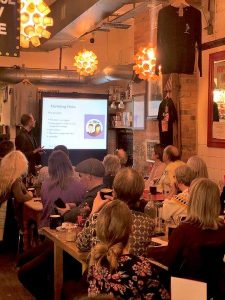
Yesterday CoPMRE welcomed 30 colleagues to our Visiting Faculty bi-annual event showcasing the exciting medical developments at BU from the new Bournemouth Gateway Building to the Institute of Medical Imaging and Visualisation. The key priorities to support delivery of BU2025 were presented by Dr Clare Wedderburn, Interim Head of Department of Medicine & Public Health presented. Juan Campos-Perez, Clinical Research Co-ordinator, BUCRU spoke about Biobanks which were highlighted in Professor Emma King’s research presentation on immunotherapy. Professor Jeffrey Wale, Lecturer in Law encouraged innovative medical cross faculty collaboration demonstrated by his recent research collaboration with Professor Sam Rowlands, Visiting Professor resulting in four co-authored papers. The main focus of the meeting centred around Visiting Faculty engagement in research and education to help us achieve our aims. The audience reported that they were ‘very excited’ about these new developments at BU and were keen to support this vision.
Tagged / BU research
Photo of the week: ‘Through different eyes’
Telling a story of research through photography
The ‘photo of the week’ is a weekly series featuring photographs taken by BU academics and students for our Research Photography Competition which took place earlier this year.
These provide a snapshot into some of the incredible research taking place across the BU community.
This week’s photo of the week was taken by Chantel Cox and is titled;
‘Through different eyes’
‘My research is looking at how our identities are affected as we get older and how older people with frailty manage these changes. This image is of a great grandfather and great grandson looking out to sea in Poole. This is where my research is being carried out but it made me think how although they are both looking at the same scene they are looking at it through totally different eyes. This is the same as we get older and look at all aspects of the world’
If you have any questions about the Photo of the Week series or the Research Photography Competition please email research@bournemouth.ac.uk
CMMPH represented at The European Midwives Association (EMA) conference
EMA held its 6th triennial education conference in Malmo, Sweden from the 28-29 November 2019. Dr. Luisa Cescutti-Butler and Professor Sue Way had three abstracts accepted, two of which highlighted units of learning in our midwifery undergraduate programme (Evaluating the student experience of introducing newborn infant physical theory into a pre-registration midwifery programme in the UK and An evaluation of the student experience of peer facilitated learning) and a further one which was focused on a national collaborative project on grading practice (Developing a set of key principles to achieve consistency in assessing pre-registration midwifery competency in practice in the UK). The opening keynote speaker at the EMA Conference was Fran McConville – Midwifery Expert at WHO. Fran presented on ‘Strengthening Quality Midwifery Education for Universal Health Coverage 2030’. Our takeaway message from her presentation was the following important statement: “When midwives are educated to international standards, and midwifery includes the provision of family planning……more than 80% of all maternal deaths, stillbirths and neonatal deaths could be averted”.
On the social side we were privileged to a hear a woman from the Sammi tribe in Sweden sing three traditional songs and a tradition adopted from Syracuse in Sicily which was the ‘Santa Lucia’ group of singers celebrating the start of Christmas who sang Xmas Carols in Swedish. We were also able to network with some significant and contemporary midwifery leaders such as Gill Walton (CEO of the Royal College of Midwives), Fran McConville (WHO) and Grace Thomas, Reader and Lead Midwife for Education (Cardiff University).

Talk/session with the Wessex Clinical Research Network Study Support Service
The National Institute for Health Research (NIHR) is the nation’s largest funder of health and care research – the NIHR oversee 15 Clinical Research Networks (CRN) and these CRNs work alongside NHS Trusts, primary care providers and Universities. Each CRN has a dedicated Study Support Service.
The NIHR have a portfolio of research studies that are eligible for consideration for support from the CRN in England. Portfolio status is usually vital to participating NHS Trusts when considering undertaking a proposed study.
Information on the NIHR portfolio is present on the research blog, but at this session our local CRN’s Study Support team will provide you with an opportunity to hear about and discuss the network and the service, and how it could benefit you.
This session is aimed at those planning on conducting clinical research.
It is also designed to raise awareness at BU about the benefits and importance of the NIHR portfolio, so if you’re just interested in learning more, please book on.
The session will take place next week on Tuesday 10th December at 2:30pm until 4:00pm on Lansdowne Campus.
To register your interest or if you have any queries, please get in touch with Research Ethics.
Checklist now available to support researchers undertaking clinical research
Suzy Wignall (Clinical Governance Advisor – Research Development & Support) and Juan Campos-Perez (Clinical Research Coordinator – Bournemouth University Clinical Research Unit) have compiled a checklist (PDF and word formats) that can be used to support researchers through the process of applying for and conducting clinical research.
The document contains links to various documents and further resources to guide researchers through areas such as applying for external approvals, running the study and closing the study. The checklist clearly sets out what tasks are required, the support/resources available to complete this tasks, a space to write your own notes/how this task was resolved and the date it was completed. Using this document will help you ensure that all the required tasks are completed during your research journey.
The document is also here on the Clinical Governance blog.
Remember – support and guidance is on offer at BU if you are thinking of conducting clinical research, whether in the NHS, private healthcare or social care – contact details for Suzy and Juan are on the checklist, and you can also take a look at the Clinical Governance blog for resources and updates.
New UK Standards for Public Involvement
Involving the public in your study is important, especially at the research design stage. This is called ‘Public Involvement’ (also known as ‘PPI’ [Patient and Public Involvement]). Public involvement in research means research that is done ‘with’ or ‘by’ the public, not ‘to’, ‘about’ or ‘for’ them.
By seeking the opinions and recommendations of the public, it is a great way to ensure that your study is designed and set-up in a way that will be relevant to participants, and of good quality.
This can also help to avoid any setbacks once the project is underway.
The new UK Standards for Public Involvement have now been released and were developed over three years by a country-wide partnership between the National Institute for Health Research (NIHR), Chief Scientist Office (CSO) Scotland, Health
and Care Research Wales, and the Public Health Agency Northern Ireland
They describe what good public involvement looks like and encourage approaches and behaviours that are the hallmark of good public involvement such as flexibility, sharing and learning and respect for each other.
You can see the six UK standards and supporting materials, as well as further details about the partnership, project and the piloting of the new standards, here.
Further guidance is available via the Clinical Governance section of the Research blog and via the Health Research Authority and NIHR pages.
Update on Leverhulme Trust Visit
On Weds 20th November, BU were delighted to welcome Dr Tracey Henshaw, Assistant Director of Leverhulme Trust to speak about the funding opportunities available from Leverhulme. Tracey provided an overview of who the Leverhulme Trust are, what they will (and won’t!) fund, their funding programmes, and what they are looking for in funding applications including useful hints and tips for their main programmes.
You can now view the slides via Brightspace here.
Introduction to Good Clinical Practice – Wednesday 15th January
Are you interested in running your own research project within the NHS? Good Clinical Practice, or ‘GCP’, is a requirement for those wishing to work on clinical research projects in a healthcare setting.
GCP is the international ethical, scientific and practical standard to which all clinical research is conducted. By undertaking GCP, you’re able to demonstrate the rights, safety and well-being of your research participants are protected, and that the data collected are reliable.
The next GCP full day session is scheduled for Wednesday 15th January at Bournemouth University –08:45am – 4:30pm.
The day will comprise of the following sessions:
- Introduction to research and the GCP standards;
- Preparing to deliver your study;
- Identifying and recruiting participants – eligibility and informed consent;
- Data collection and ongoing study delivery;
- Safety reporting;
- Study closure.
If you’re interested in booking a place, please contact Research Ethics.
Remember that support is on offer at BU if you are thinking of introducing your research ideas into the NHS – email the Research Ethics mailbox, and take a look at the Clinical Governance blog.
Checklist now available to support researchers undertaking clinical research
Suzy Wignall (Clinical Governance Advisor – Research Development & Support) and Juan Campos-Perez (Clinical Research Coordinator – Bournemouth University Clinical Research Unit) have compiled a checklist (PDF and word formats) that can be used to support researchers through the process of applying for and conducting clinical research.
The document contains links to various documents and further resources to guide researchers through areas such as applying for external approvals, running the study and closing the study. The checklist clearly sets out what tasks are required, the support/resources available to complete this tasks, a space to write your own notes/how this task was resolved and the date it was completed. Using this document will help you ensure that all the required tasks are completed during your research journey.
The document is also here on the Clinical Governance blog.
Remember – support and guidance is on offer at BU if you are thinking of conducting clinical research, whether in the NHS, private healthcare or social care – contact details for Suzy and Juan are on the checklist, and you can also take a look at the Clinical Governance blog for resources and updates.
Update on International Funding – UKRO Visit
RDS hosted the annual UK Research Office visit to BU on 18th November 2018. The event was well attended and wide-ranging. Topics included overview of the impact of Brexit on EU research funding and a review of hints and tips for being successful at securing international funding. The session was delivered by Dr Andreas Kontogeorgos, BU European Advisor at the UK Research Office.
All staff interested in EU funding were also able to express their concerns related to Brexit and discuss the EU funding related questions they were concerned about.
Presentation slides are available on Brightspace.
If you wish to further discuss issues related to Brexit or remaining H2020 funding opportunities, please contact Research Facilitator – International Ainar Blaudums.
UKRO is the European office of the UK Research Councils. It delivers a subscription-based advisory service for UK research organisations and provides National Contact Point services on behalf of the UK Government. UKRO’s mission is to maximise UK engagement in EU-funded research and innovation. As part of UKRO services, BU members of staff may sign up to receive personalised email alerts – feel free to subscribe on UKRO portal.
RKEDF – Research Training in December
We have some great events coming up over the next month to support you in your research activities.
December
| Tuesday 3rd December | RKEDF: NHS site set-up or research and overview of approval process |
| Wednesday 4th December | RKEDF: Environment Narrative Writing Day |
| Friday 6th December | RKEDF: Impact Planning Session |
| Tuesday 10th December | RKEDF: Inspirational Impact Journey – FMC |
| Tuesday 10th December | RKEDF: Writing Academy |
| Wednesday 11th December | RKEDF: Working with Industry |
| Thursday 19th December | RKEDF: Preparing Practice-Based Research Outputs for Assessment |
You can see all the Organisational Development and RKEDF events in one place on the handy calendar of events.
Please note that all sessions are now targeted, so look closely at the event page to ensure that the event is suitable for you. In addition, most RKEDF events now require the approval of your Head of Department (or other nominated approver). Please follow the instructions given on the event page and the template email for you to initiate the booking request.
If you have any queries, please get in touch!
ESRC Festival of Social Science – Part 4
We’re continuing our look back at the ESRC Festival of Social Science, you can catch up on our coverage so far on the Research Blog.
Friday night featured two concurrent events. Professor Edwin van Teijlingen visited Poole Hospital to consider ‘How We Think about Pregnancy and Childbirth’, comparing different perspectives on pregnancy – from the social model of pregnancy, which accepts childbirth as a normal event in a woman’s life to the medical model, which portrays childbirth as potentially dangerous to health.
Dr Alison Taylor discussed infant feeding and shared research in the form of video diaries from first-time breastfeeding mothers.
At South Coast Roast café, we explored the idea of ‘Influencers for good’; can social media influencers be more than their media image as drivers of overspending, overconsumption and low self-confidence?
A team of BU academics (Dr Elvira Bolat, Dr Parisa Gilani, Samreen Ashraf & Dr Nasiru Taura) covered every angle, including the trust-relationship between influencers and us, how influencers make us feel and a positive vision for the future, where influencers are an ethical economic force for good.
Guest speaker Sarah Ali Choudhury shared the story of her rise to fame, while talent agent Laura Edwards showed us the other side of the influencer industry.
This series will conclude with Part 5 tomorrow.
RKEDF – Clinical Research Documentation and Filing
On Tuesday 5th November, Research Development & Support are running a 2 hour workshop on clinical research documentation and filing.
This workshop is designed to share best practice in ensuring that records are completed, stored and shared appropriately, in accordance with the ‘ALCOAC’ general principle, and Good Clinical Practice standards.
The workshop will cover the ‘essential documents’ to be kept during the research project, as well as what to do once the study has ended. Also covered will be how to ensure compliance when storing data on paper and electronically and requirements for source data.
By the end of this workshop you will have an understanding about:
- The ‘ALCOAC’ general principle and how it applies to your research
- What to keep in your study file
- How to maintain good and compliant research records, throughout the life-cycle of the study
- Requirements for once the study has ended
If you’re interested in attending then reserve your place via Organisational Development.
How to turn your Research into Impact
Amanda Lazar and Brian McNulty are running an Impact Planning Session on Friday 6th December for anyone engaged in research – from ECRs to Professors.
If you have some research that you think has the potential to make a positive change in the world, then bring it along.
We will discuss how to effectively disseminate your research, plan your impact pathway and how to evidence the impact of your research, as well as how to work towards an Impact Case Study for the REF.
By the end of the session you will have the outline of an impact pathway and will know how to access BU resources to help turn your research into impact.
Click here to book yourself onto the workshop.
Good Clinical Practice Refresher – Wednesday 4th December
Are you currently undertaking research within the NHS, and your Good Clinical Practice (GCP) training is due to expire? Or has it expired recently?
GCP certification lasts for two years, so if your training is due to expire, has expired, or you want to validate your learning, then take advantage of the upcoming refresher half day session, taking place at Poole Hospital on Wednesday 4th December, 9:00am – 12:30pm.
Spaces are still remaining, so if you’d like to enrol, get in touch with Research Ethics.
Cafe Scientifique Tuesday 3 December: The secret information hidden in your hair
Café Scientifique takes place on the first Tuesday evening of the month at Café Boscanova
Enjoy listening to a short talk from our guest speaker before engaging in debate and discussion around that topic.
We’ll be joined by Dr Richard Paul on Tuesday 3 December 7:30-9pm (doors open at 6:30pm) No need to book, make sure you get there early though as seats fill up fast!
The secret information hidden in your hair
As we go about our daily lives, our hair is recording evidence of what we consume and of the environments we are exposed to. It can record how much you drink, whether you smoke or take drugs, or live or work in an environment where drug abuse is prevalent. Join us to learn about the technology used to analyse hair and how it can be used in criminal cases to investigate drug facilitated crime, monitor alcohol consumption, and assess the exposure of prison guards to new psychoactive substances in UK prisons.
If you have any questions please do get in touch
Find out more about Café Scientifique and sign up to our mailing list to hear about other research events: www.bournemouth.ac.uk/cafe-sci

ESRC Festival of Social Science – Part 3
We’re continuing our look back at the ESRC Festival of Social Science, you can catch up on our coverage so far on the Research Blog.
‘Stress and Wellbeing in the Workplace’ followed on Wednesday, with Professor Lee-Ann Fenge introducing the topic of how researching sensitive topics can have an emotional impact on academics and practitioners, mainly in social work but with wide-reaching relevance.
Tilia Lenz, Stevie Corbin-Clarke and Emily Rosenorn-Lanng then led a series of workshops teaching techniques to de-stress, including origami, meditation and yoga.
Dr Jeff Bray delivered a ‘Rainbow of Vegetable Literacy’ at a local primary school, with Natalia Lavrushkina, Dr Fiona Cownie and Professor Katherine Appleton. Designed to increase children’s familiarity with vegetables, and encourage them to eat more vegetables, the event featured a quiz, tasting vegetables cooked in a variety of ways, and planting a broad bean seed in the school ‘allotment’.
Find out more about this project in a post by one of the organisers.
Members of the Global Festival of Learning team reprised activities last run in Vietnam, this time training teachers, tutors and others who work with young adults in a series a workshops aimed at ‘Preparing Generation Z for the Global Workplace’.
Dr Debbie Sadd, Rebecca Hindley and Dr Milena Bobeva provided a grounding in workshops including ‘Stranded on a Mountain’, Belbin personality assessments and interactive quiz technology, designed to develop teamwork skills and awareness.
This series will continue with Part 4 tomorrow.
Talk/session with the Wessex Clinical Research Network Study Support Service
The National Institute for Health Research (NIHR) is the nation’s largest funder of health and care research – the NIHR oversee 15 Clinical Research Networks (CRN) and these CRNs work alongside NHS Trusts, primary care providers and Universities. Each CRN has a dedicated Study Support Service.
The NIHR have a portfolio of research studies that are eligible for consideration for support from the CRN in England. Portfolio status is usually vital to participating NHS Trusts when considering undertaking a proposed study.
Information on the NIHR portfolio is present on the research blog, but at this session our local CRN’s Study Support team will provide you with an opportunity to hear about and discuss the network and the service, and how it could benefit you.
This session is aimed at those planning on conducting clinical research.
It is also designed to raise awareness at BU about the benefits and importance of the NIHR portfolio, so if you’re just interested in learning more, please book on.
The session will take place on Tuesday 10th December at 2:3opm until 4:00pm on Lansdowne Campus.
To register your interest or if you have any queries, please get in touch with Research Ethics.


New Nepal scoping review on maternal & neonatal health
Fourth INRC Symposium: From Clinical Applications to Neuro-Inspired Computation
Writing policy briefs
Upholding Excellence: The Concordat to Support Research Integrity
ECR Funding Open Call: Research Culture & Community Grant – Application Deadline Friday 12 December
MSCA Postdoctoral Fellowships 2025 Call
ERC Advanced Grant 2025 Webinar
Horizon Europe Work Programme 2025 Published
Horizon Europe 2025 Work Programme pre-Published
Update on UKRO services
European research project exploring use of ‘virtual twins’ to better manage metabolic associated fatty liver disease