Category / Psychology

What makes a Bournemouth University publication?

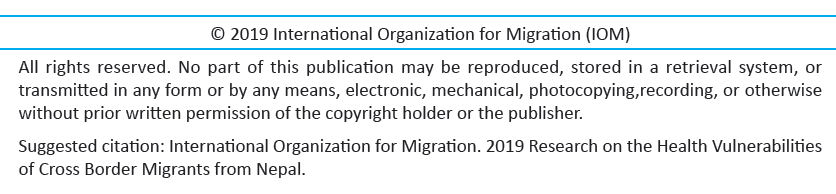
Last week the IOM (International Organization for Migration) in Nepal, the UN Migration Agency published a new report online: Research on the Health Vulnerabilities of the Cross-Border Migrants from Nepal.  This report mentioned the input and advice of Bournemouth University (BU) staff, including Dr. Nirmal Aryal, who worked on the report prior to his appointment at BU and who is listed as Co-Investigator, furthermore listed as Resource Persons are: Dr. Pramod Regmi and Prof. Edwin van Teijlingen.  Working with the charity Green Tara Nepal (GTN) on this study has been good for IOM and BU.  All of use have worked on the report in different kind of ways and to different degrees.  The publication suggested a corporate authorship as ‘International Organization for Migration’, which is great for the status of the report as it is a UN agency.  We feel part of this as BU academics and feel we are part of the team despite this not being a BU publication!



Professor Edwin van Teijlingen

CMMPH


Reference:

International Organization for Migration (2019) Research on the Health Vulnerabilities of the Cross-Border Migrants from Nepal, Kathmandu, Nepal: International Organization for Migration.  Available at : https://nepal.iom.int/sites/default/files/publication/Research_on_The_Health_Vulnerabilities_of_The_Cross_Border_Migrants_from_Nepal_0.pdf


NIHR Invention for Innovation (i4i) Programme – Product Development Awards – Live FAQ sessions

The NIHR Invention for Innovation (i4i) Programme is holding live FAQ sessions for applicants to its Product Development Awards 19 funding call (launched on 30 October 2019).
The FAQ webinars will be interactive, and participants will have the opportunity to submit written questions that will be responded to during the session. The questions and responses will be made available to all participants during the session, and a summary will be made available on the NIHR website afterwards.
Two sessions will be held to give all potential applicants the opportunity to participate. You can access the webinars here.
  • 11 November 2019 at 2pm
  • 15 November 2019 at 11am

Please note the links won’t be active until just before the starting time.

Your local branch of the NIHR RDS (Research Design Service) is based within the BU Clinical Research Unit (BUCRU) on the 5th floor of Royal London House.

We can help with your application. We advise on all aspects of developing an application and can review application drafts as well as put them to a mock funding panel (run by RDS South West) known as Project Review Committee, which is a fantastic opportunity for researchers to obtain a critical review of a proposed grant application before this is sent to a funding body.

Come as early as possible to benefit fully from the advice

Feel free to pop in and see us in person, call us on 61939 or send us an email.

More pilots please!

“More pilots please!” is not a call from British Airways, Ryanair or the Royal Air Force.  No, it a reminder to students to do more piloting in their postgraduate research projects.  Between us we have read many (draft) theses and examined over 60 PhD theses external to Bournemouth University, and it is clear to us that many students do not do enough pre-testing or piloting of their research instruments.  Perhaps they did some piloting or feasibility work for their projects but don’t write enough about it.  Or they present some feasibility or piloting in their thesis but haven’t added references to methodological texts.

The term ‘pilot studies’ refers to mini versions of a full-scale study (also called ‘feasibility’ studies), as well as the specific pre-testing of a particular research instruments such as data collection tools (i.e. questionnaire or semi-structured interview schedule). Pilot studies are key to good study design [1-6].  Conducting a pilot study does not guarantee success in the main study, but it does increase the likelihood of success. Pilot studies have several of important functions in research design and can provide valuable insights to the researcher on both tools and research processes.  We think it is telling that our most cited paper on Google Scholar is not one of our papers reporting research findings but a methods paper highlighting the importance of pilot studies [2].


Professors Vanora Hundley & Edwin van Teijlingen

CMMPH


References:

  1. van Teijlingen E, Rennie, AM., Hundley, V, Graham, W. (2001) The importance of conducting & reporting pilot studies: example of Scottish Births Survey, Journal of Advanced Nursing, 34: 289-95.
  2. van Teijlingen E, Hundley, V. (2001) The importance of pilot studies, Social Research Update Issue 35, (Editor N. Gilbert), Guildford: University of Surrey. Web:  http://www.soc.surrey.ac.uk/sru/SRU35.html
  3. van Teijlingen E, Hundley, V.(2002) ‘The importance of pilot studies’ Nursing Standard 16(40): 33-36. Web: www.nursing-standard.co.uk/archives/vol16-40/pdfs/vol16w40p3336.pdf

  4. Hundley, V., van Teijlingen E, (2002) The role of pilot studies in midwifery research RCM Midwives Journal 5(11): 372-74.
  5. van Teijlingen E, Hundley, V. (2003) Pilot study, In: Lewis-Beck, M., Bryman, A. & Liao, T. (eds.) Encyclopaedia of Social Science Research Methods, Vol. 2, Orego, Sage: 823-24.
  6. van Teijlingen E, Hundley, V. (2005) Pilot studies in family planning & reproductive health care, Journal of Family Planning & Reproductive Health Care 31(3): 219-21.


BUCRU (Bournemouth University Clinical Research Unit) – Newsletter

Please see the latest newsletter from the Bournemouth University Clinical Research Unit (BUCRU). We hope you find it interesting.  This is our ‘last’ newsletter and covers content from last year, we are shortly introducing new quarterly ‘BUCRU Bulletins’ with more recent content to be disseminated digitally.

BUCRU supports researchers to improve the quality, quantity, and efficiency of research locally by supporting grant applications and providing on-going support in funded projects, as well as developing our own programme of research.  2018 was an exciting year for BUCRU including being awarded a further 5 years of funding from National Institute for Health Research (NIHR) to continue our work as the RDS (Research Design Service) South West.  We’ve also submitted 14 grant applications, have 23 peer-reviewed publications and over £800,000 in grant involvement.

You can find out more within the newsletter, including news from our colleagues in the Centre of Postgraduate Medical Research and Education or visit: www.bournemouth.ac.uk/bucru

And don’t forget, your local branch of the NIHR RDS (Research Design Service) is based within the BU Clinical Research Unit (BUCRU) on the 5th floor of Royal London House. Feel free to pop in and see us, call us on 61939 or send us an email.

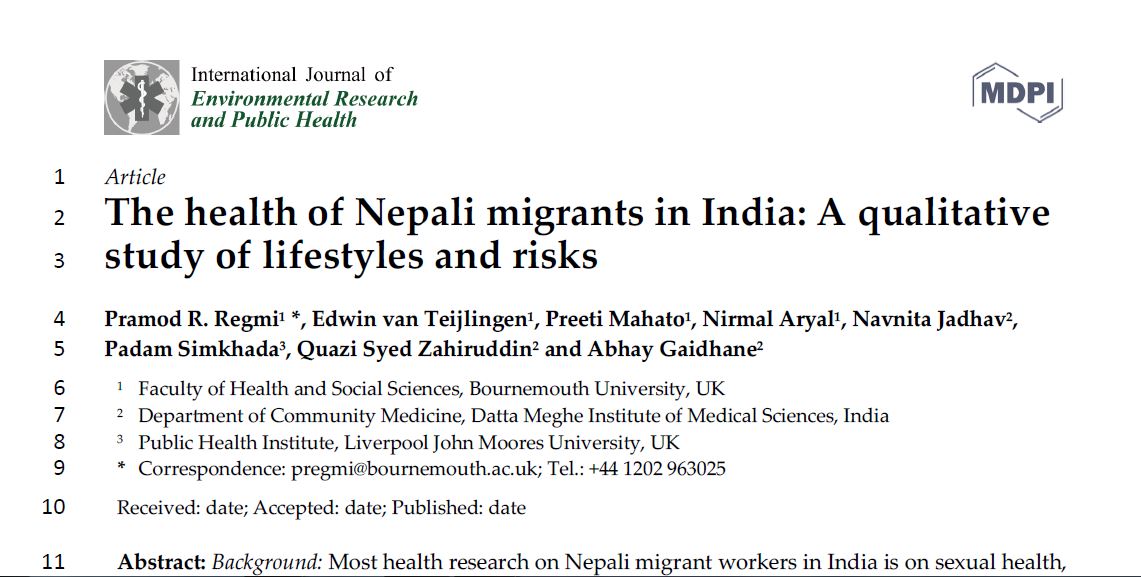
New BU paper: Health of Nepali migrants in India

Today the International Journal of Environmental Research and Public Health accepted our paper ‘The health of Nepali migrants in India: A qualitative study of lifestyles and risks’ [1].  The research in this paper was funded through Connect India is Bournemouth University’s Hub of Practice for the Indian subcontinent.  It brought together a community of researchers, educators, practitioners and students, both at Bournemouth University and across the Indian subcontinent.

The lead author, Dr. Pramod Regmi, is lecturer in International Health in the Department of Nursing & Clinical Science.  His co-authors are based in the UK, Nepal and India.  BU authors are: Pramod Regmi, Edwin van Teijlingen, Preeti Mahato and Nirmal Aryal as well as BU Visiting Faculty Prof. Padam Simkhada.  The  International Journal of Environmental Research and Public Health is an interdisciplinary Open Access journal, hence when published this paper will be freely available to readers across the globe, including India and Nepal.

Reference:

  1. Regmi, P., van Teijlingen, E., Mahato, P., Aryal, N., Jadhav, N., Simkhada, P., Syed Zahiruddin, Q., Gaidhane, A., (2019) The health of Nepali migrants in India: A qualitative study of lifestyles and risks Journal of Environmental Research & Public Health (forthcoming)


Successful Introduction to Research Day at BU

Yesterday Dorset Healthcare University NHS Foundation Trust held an away day for its clinical staff to learn more about health research.  The event was hosted by the Faculty of Health & Social Sciences on its Lansdowne Campus.  The organiser, Dr. Ciarán Newell, a Consultant Nurse Eating Disorders as well as Dorset Healthcare’s Facilitator for Research and Development organised the event to increase research collaborations between Dorset Healthcare and Bournemouth University. 

Our guests were offered a very varied programme with many FHSS staff (as well as one of our Psychology colleagues) presenting their own research or research-related services available at the university.  We hope this event will lead to further fruitful collaborations between the NHS and the university in the near future.

TIME SESSION FACILITATOR
9.30am Welcome Dr. Ciarán Newell
9.40am What research means to me: Patient Research Ambassador (PRA) Anna Glanville-Hearson
10.10am Health & Social Care Research at BU: overview

·        Strategic Investment Areas

·        Departments / Research Centres

Prof. Edwin van Teijlingen
10.30am Research at Dorset HealthCare University NHS Trust: an overview Dr Paul Walters   Clinical Lead, R&D
10.50am Research Design Service & BU Research Support Prof. Peter Thomas
11.00am COFFEE BREAK
11.15am Mixed-methods & qualitative research Prof. Edwin van Teijlingen
11.30am What Bournemouth University Library can offer Caspian Dugdale
11.50am Postgraduate Studies at BU Dr. Sharon Docherty
12.20am Research into health of BAME communities Dr. Bibha Simkhada
12.30pm LUNCH
1.30pm Trust Research & Development team: how can we help you with your research? Dr. Ciarán Newell, Facilitator, R&D

Irene Bishton, Lead Research Nurse

2.15pm

2.25pm

2.35pm

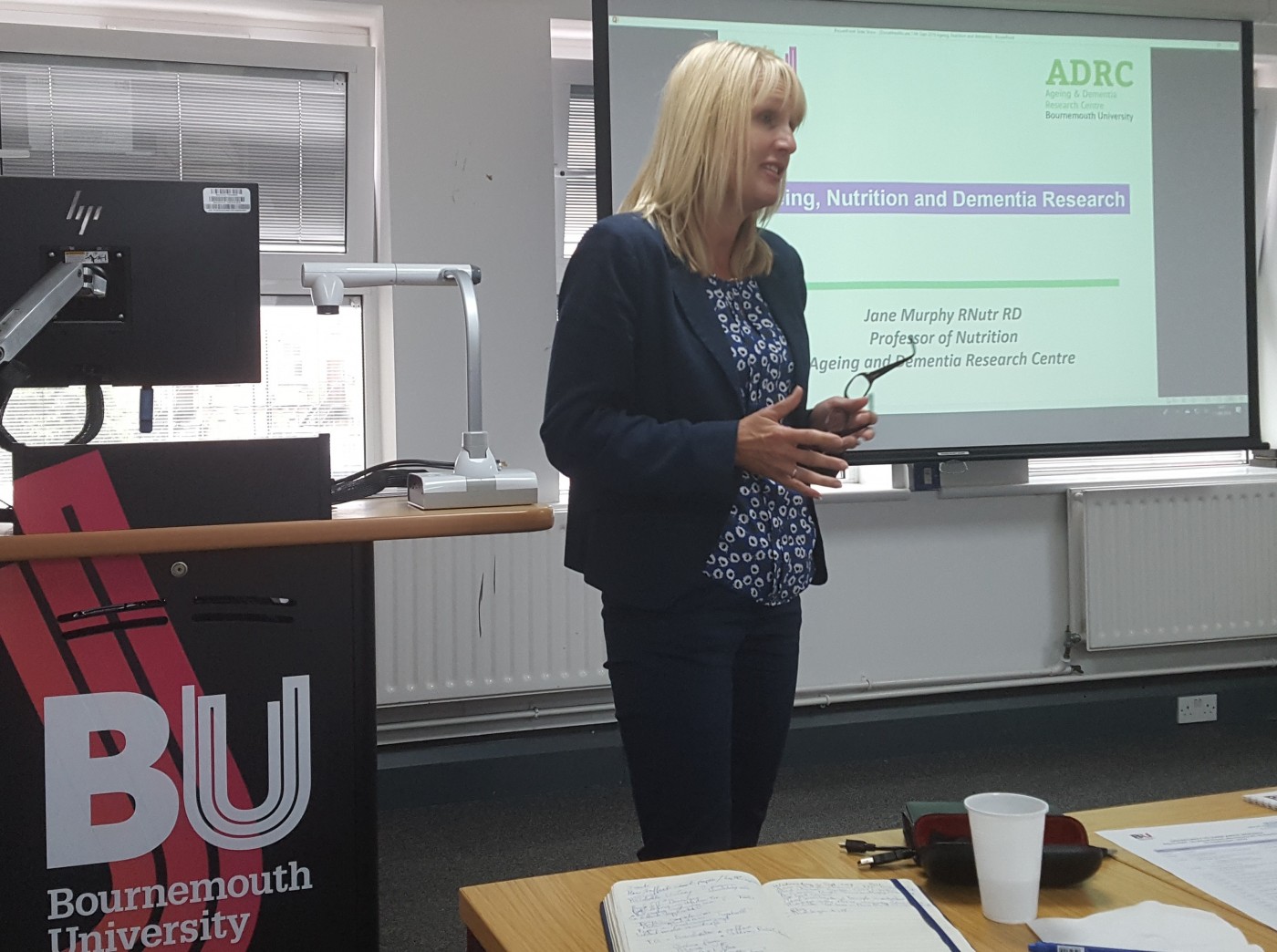
Research into: Nutrition/Dementia/Ageing

Pain research

Smoking cessation & baby dolls

Prof. Jane Murphy

Dr. Carol Clark

Dr. Humaira Hussain

2.45pm TEA BREAK
3.00pm Clinical Academic Support (links to Wessex) Prof Vanora Hundley
3.15pm Academic Writing & Publishing Prof Edwin van Teijlingen
4.15pm Psychology: Mental health research Dr. Andy Mayers
4.30pm Close – Questions & Answers Prof. Edwin van Teijlingen / All


Prof. Edwin van Teijlingen

Centre for Midwifery, Maternal & Perinatal Health (CMMPH)

NIHR RDS Grant Applications – seminar & support event, Truro, Cornwall – 8th October 2019

Are you planning to submit a grant application to NIHR?

We are holding a one-day event at the Knowledge Spa, Truro, Cornwall on Tuesday 8 October that is aimed at helping you to improve your chances of success..

The morning seminar session is open to anyone to come and hear RDS advisers give presentations on what makes a good grant proposal. Topics covered will include:

  • what does the NIHR look for?
  • the application as a marketing document: selling the topic, selling the method, and selling the team
  • the team
  • clarity of description and explanation
  • feasibility issues
  • identifying and avoiding potential pitfalls.

The afternoon support session of one-to-one appointments is for those who would like to discuss their own proposal with an RDS adviser.

This event is FREE and refreshments and lunch will be provided. Places are limited and will be allocated on a ‘first come, first served’ basis. In order to secure your place please register using our online form by 1pm, 25 September 2019Find out more.

And don’t forget, your local branch of the NIHR RDS (Research Design Service) is based within the BU Clinical Research Unit (BUCRU) on the 5th floor of Royal London House. Feel free to pop in and see us, call us on 61939 or send us an email.

Congratulations on academic paper by BU PhD student Orlanda Harvey

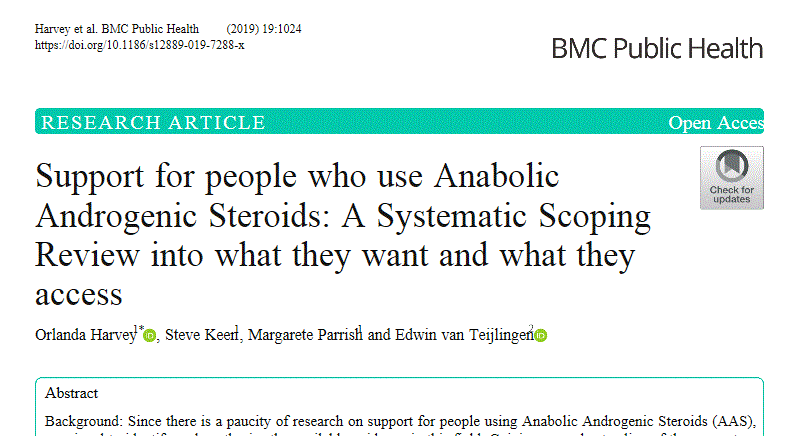
Congratulations to Orlanda Harvey, PhD student in the Faculty of Health & Social Sciences on her PhD publication “Support for people who use Anabolic Androgenic Steroids: A Systematic Scoping Review into what they want and what they access” in the Open Access journal BMC Public Health [1].  Since there is a paucity of research on support for people using Anabolic Androgenic Steroids (AAS), this article searched and synthesised the available evidence in this field. Gaining an understanding of the support both accessed and wanted by recreational AAS users will be of use to professionals who provide services to intravenous substance users and also to those working in the fields of public health and social care, with the aim to increase engagement of those using AAS.

This systematic scoping review identified 23 papers and one report for review, which indicated that AAS users access a range of sources of information on: how to inject, substance effectiveness, dosages and side effects, suggesting this is the type of information users want. AAS users sought support from a range of sources including medical professionals, needle and syringe programmes, friends, dealers, and via the internet, suggesting that, different sources were used dependent on the information or support sought.

The authors argue that AAS users tended to prefer peer advice and support over that of professionals , and access information online/specialist fora, reflecting the stigma that is experienced by AAS  users. These tendencies can act as barriers to accessing services provided by professionals.  The paper concludes that support needs to be specific and targeted towards AAS users. Sensitivity to their perceptions of their drug-use and the associated stigma of being classified in the same sub-set as other illicit drug users is relevant to facilitating successful engagement.


Reference: 

  1. Harvey, O., Keen, S., Parrish, M., van Teijlingen, E. (2019) Support for people who use Anabolic Androgenic Steroids: A Systematic Literature Review into what they want and what they access. BMS Public Health 19: 1024      https://rdcu.be/bMFon


EDULEARN held in the beautiful city of Palma (on Love Island!): Assoc Prof Jacqui Taylor presents paper and poster


I recently presented a paper and poster at the EDULEARN19 Conference. The paper reported a study which measured different elements of psychological literacy in students across five different disciplines. Sarah Coady, a voluntary Psychology Research Assistant, helped me with some of the data analysis and for this work she won a BU co-creation Award in May. Also, I presented a poster with the title ‘Psychological literacy for all’, to show how psychological literacy is relevant for students of all disciplines. Both papers are published by IATED in the Proceedings of the 11th International Conference on Education and New Learning Technologies.

Congratulations to PhD student Alice Ladur

FHSS PhD student Alice Ladur has been awarded a small but very competitive grant by FfWG, the Funds for Women Graduates.  FfWG is the trading name of the BFWG Charitable Foundation and the BFWG (British Federation of Women Graduates), which is affiliated to the International Federation of University Women.

Alice is based in the Centre for Midwifery, Maternal & Perinatal Health (CMMPH).  Her PhD research in Uganda is supervised by Prof. Vanora Hundley and Prof. Edwin van Teijlingen. Her thesis research has already resulted in an academic paper published in the international journal BMC Pregnancy & Childbirth, which Open Access.

Breastfeeding paper published today

The journal Women and Birth (by Elsevier) published the latest academic paper by Dr. Alison Taylor today.  Alison’s paper ‘The therapeutic role of video diaries: A qualitative study involving breastfeeding mothers’ had been online as a pre-publication for a while but today in appeared officially in print [1].  Alison is a Senior Lecturer in Midwifery in the Centre for Midwifery, Maternal & Perinatal Health (CMMPH) and this scientific paper is part of her completed PhD research project. 


The paper is based on a large number of video clips recorded by new mothers.  The total recording time exceeded 43 hours. This paper focuses on one theme, the therapeutic role of the camcorder in qualitative research. Four subthemes are discussed highlighting the therapeutic impact of talking to the camcorder: personifying the camcorder; using the camcorder as a confidante; a sounding board; and a mirror and motivator.  Dr. Taylor and colleagues conclude that frequent opportunities to relieve tension by talking to “someone” without interruption, judgement or advice can be therapeutic. Further research needs to explore how the video diary method can be integrated into standard postnatal care to provide benefits for a wider population.

This is the second paper originating from Alison’s PhD research, the first one appeared in Midwifery (also published by Elsevier) [2].   Dr. Taylor’s PhD thesis was supervised by Prof. Emerita Jo Alexander, Prof. Edwin van Teijlingen (in CMMPH) and Prof. Kath Ryan at the University of Reading.

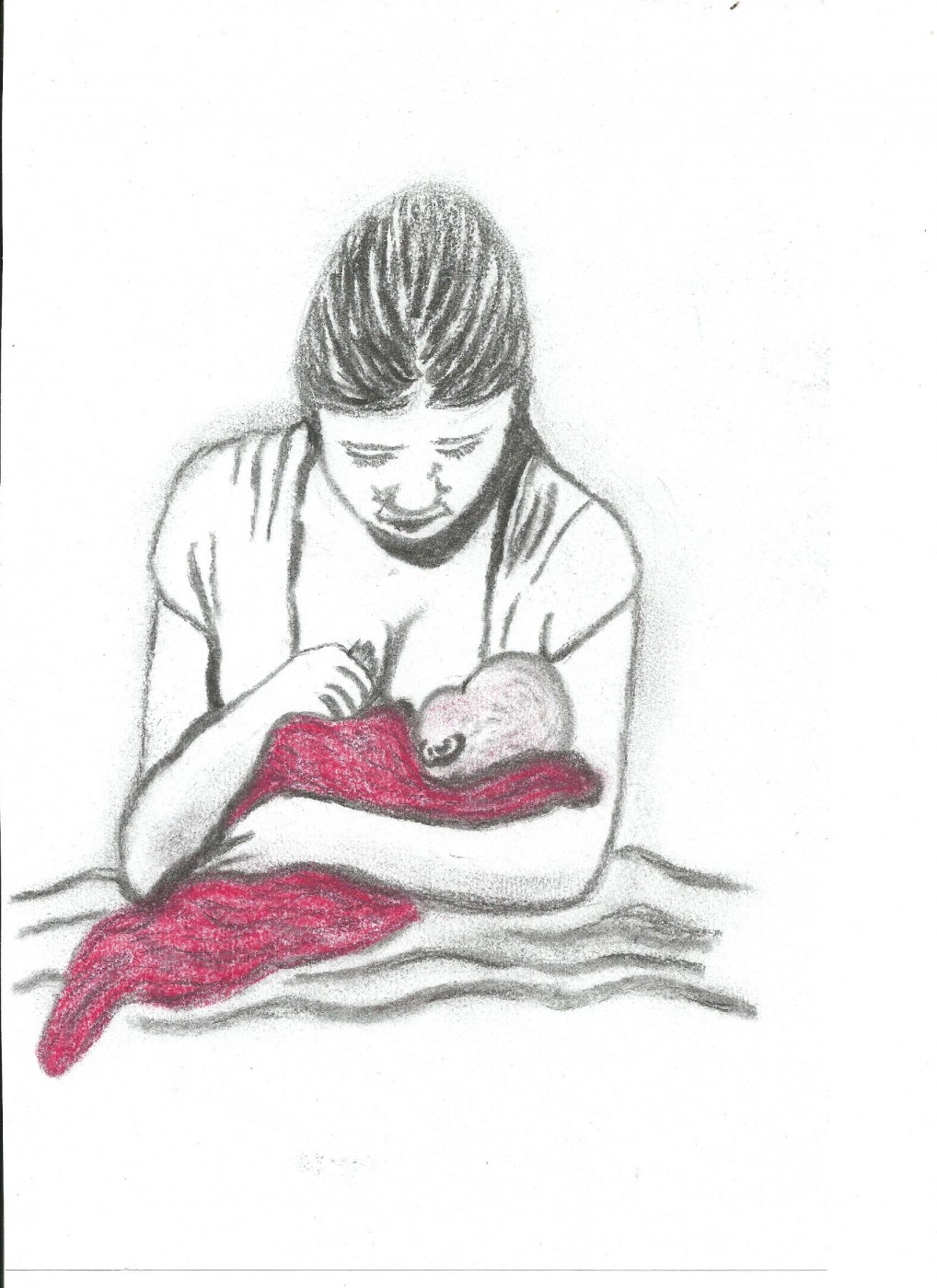
[Drawing of Breastfeeding Woman by Allison Churchill.]


REFERENCES:

  1. Taylor AM, van Teijlingen E., Alexander J, Ryan K. (2019) The therapeutic role of video diaries: A qualitative study involving breastfeeding mothers, Women & Birth 32(3):276-83. https://www.sciencedirect.com/science/article/pii/S1871519218300064
  2. Taylor A, van Teijlingen E, Ryan K, Alexander J (2019) ‘Scrutinised, judged & sabotaged’: A qualitative video diary study of first-time breastfeeding mothers, Midwifery 75: 16-23.