Category / Open Access

International Open Access Week: Open Access – facilitating global development

In our final blog post to mark International Open Access Week, Professor Edwin van Teijlingen, Chair of BU’s REF Outputs Sub-Committee, writes about the role of open access research in supporting the REF and facilitating global development…

The REF (Research Excellence Framework) is the periodical (every seven years or so) assessment of the quality of research in the UK at universities and research institutes.

Every university prepares a submission comprising its best publications, evidence of impact in wider society, and a description of its research environment.  The next REF – 2029 – will be in just over four years’ time.

The relevance of open access to the REF is that it is a requirement that academics at UK universities and research institutes make their publications in papers open access. This means making publications available to any reader without them having to pay a fee.

The underlying argument is that publicly funded research, be it funded by charities or by the government, should be freely available for all to read, i.e. for the greater good!

One important side effect of the REF’s push for open access is that people who would otherwise not have access can see and use the research.

The three main groups in my view are those not based at universities with subscriptions to loads of scientific journals:

(1) practitioners, in our field health and social care staff who are not working in universities;

(2) members of the public interested in their own conditions and relevant care;

(3) those involved in patient pressure groups and charities; and

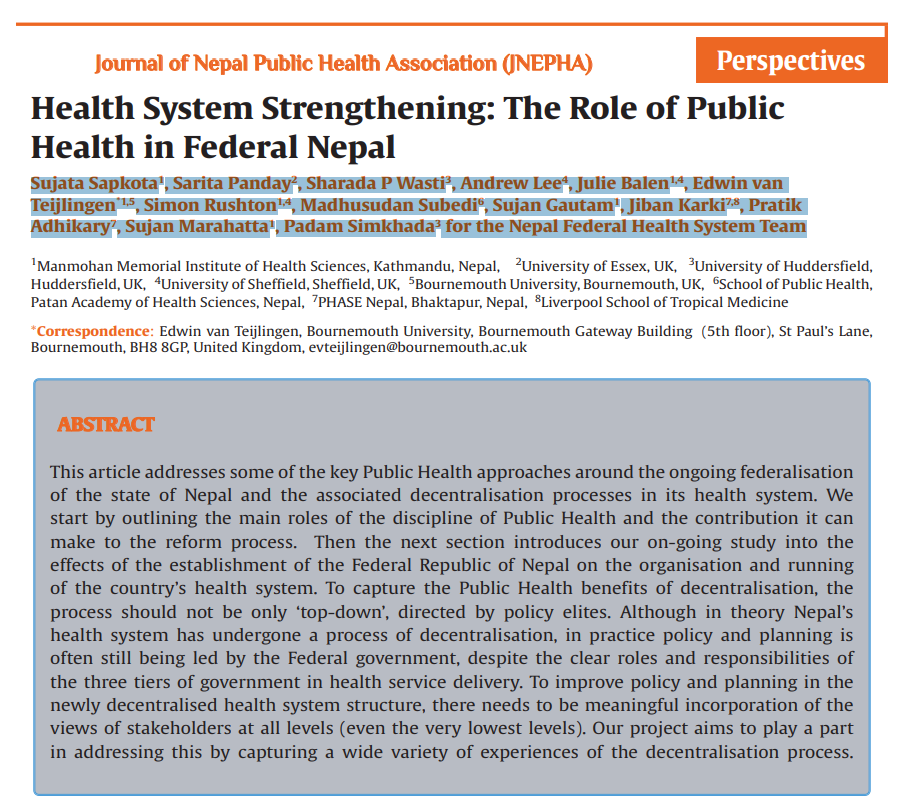
(4) students and academics in low-income countries, such as Nepal and Bangladesh.

These groups are now getting access to up-to-date research findings that otherwise would be hidden behind a paywall.

The latter is of key importance, as Bournemouth University colleagues work in many low-income countries.

For me personally, I have been teaching sessions in Nepal on research methods for nearly two decades and I have noticed the enormous improvement in access to up-to-date research publications amongst students during this period, since some many more international publications are now freely available in Nepal.

It is gratifying to know that Bournemouth University academics, together with colleagues all over the world, are contributing to global development through open access publishing.

Prof. Edwin van Teijlingen

Chair of Bournemouth University REF Outputs Sub-Committee

Visiting Faculty, Centre for Disability Studies, Mahatma Gandhi University, Kerala, India
Honorary Professor, School of Health Sciences, University of Nottingham, UK.
Visiting Professor, Nobel College, affiliated with Pokhara University, Nepal.
Visiting Professor. Manmohan Memorial Inst Health Sci affiliated with Tribhuvan University, Nepal


MaGMap: Mass Grave Mapping

Mapping projects related to mass atrocities and human rights violations are prevalent across the globe. Despite their often well-intentioned origins, there has been minimal practical research and subsequent output focused on what constitutes effective mapping. Furthermore, there is a lack of guidance on how to balance the pursuit of justice with the need to protect victims and affected communities. This raised an essential question: where, when and under what circumstances should mapping of mass graves be avoided or kept secret so that protection is not jeopardised?


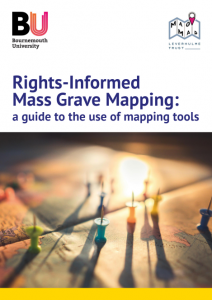
In 2022, Professor Melanie Klinkner and Dr Ellie Smith secured Leverhulme funding to address this critical question. As of August 30th, 2024, the project’s output has been completed and is now available as an open-access resource for global use. The output is accessible both online and in a physical format, consisting of a comprehensive workbook accompanied by a set of removable tools designed to guide practitioners through the mapping process. These tools include:


  • Mapping Process Flowchart: The flowchart illustrates the life cycle of a mass grave, highlighting the key stages and considerations at each step, all guided by the protection of rights.


  • Mapping Decision Tree: Accompanying the flowchart, the decision tree highlights concerns and necessary actions that must be addressed before progressing with mapping at each stage.


  • Risk Register: This element assists in decision-making processes by enabling logging and evaluations of risks and subsequent mitigation strategies.


Upon completion of the research Dr Ellie Smith outlines that:

“Mapping mass graves in an open-source format has the potential to provide longer-term protection of the site, as well as a means of countering revisionism, but is not without risks. The aim of our MaGMap tools is to enable anyone involved in mass grave mapping to do so in a way that is safe for survivors, witnesses and the families of victims, and preserves the integrity of the site as a crime scene”.


For Professor Melanie Klinkner the finalisation of these resources means that:

“Theoretical, transferable foundations have been laid to inform continued research and current mapping of atrocity practices. In fact, much of what we have learned during the course of the project now guides our own approach to building a regularised global mass grave map. This is significant: it will enable us to fully appraise the scale and magnitude of mass graves across the world in a rights-compliant and safe manner”.


Dr Ellie Smith will be presenting the findings of MaGMap this week at the European Society of International Law Conference in Lithuania.


New Nature paper by IMSET researchers

An internationally significant and ground-breaking paper has appeared in the journal Nature, led by Dr Phil Riris of the Institute for the Modelling of Socio-Environmental Transitions.

The work investigates 30,000 years of population resilience, with contributions from collaborating scholars from 14 institutions in 7 countries. The paper marks a watershed in our understanding of how people in the past adapted to, and overcame, disturbances. It is available in open access.

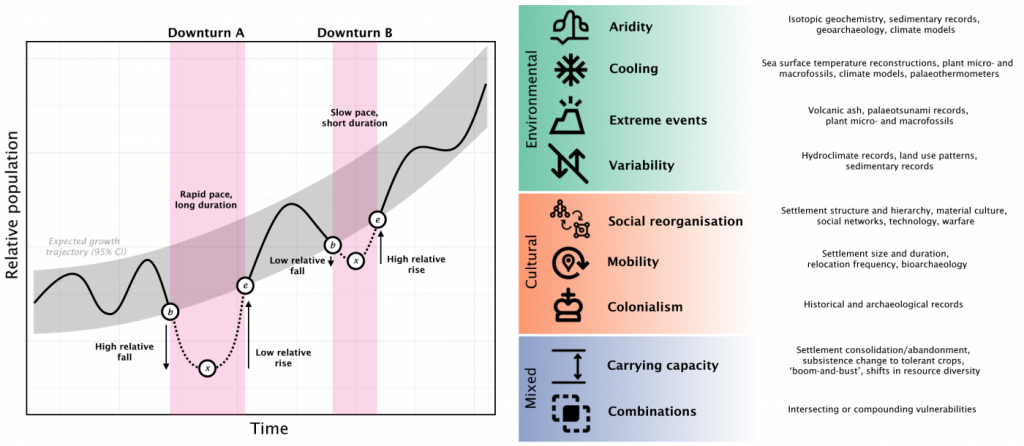
A schematic diagram of disturbances and population responses

Left: A sketch of an archaeological population time series with downturns and metrics obtained during the analysis. Right: Example types and groups of disturbances noted in the literature.

The key finding of the paper is that land use – the kinds of subsistence practices, mobility regimes, and extent of infrastructure investments – enhanced both how often a population experienced downturns and their ability to recover from them. In particular, agricultural and agropastoral societies in prehistory were especially likely to suffer demographic busts. However, they also displayed an improved ability over time to “bounce back”.

This result has wide-ranging implications for the development of sustainable land use practices, as traditional lifeways may have intrinsic rates of failure “baked into” their function and operation. The paper speculates that, similar to resilient ecosystems or ecological communities, such localised, small-scale, or short-term failures in human socio-environmental systems may contribute to building improved long-term resilience for the system as a whole.

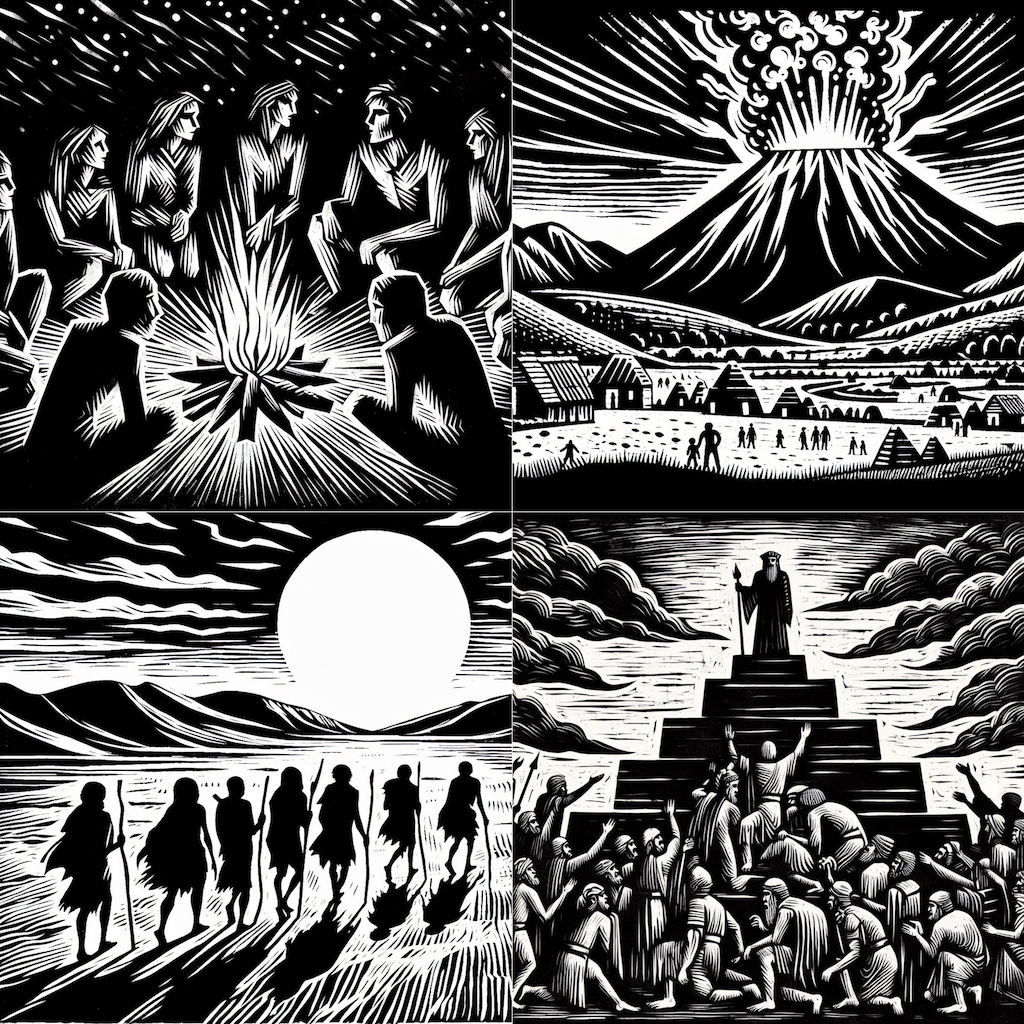
Artistic impression of some of the types of disturbances experienced by ancient societies.

Importantly, these patterns only reveal themselves in the macro-scale comparison of independent case studies, and take multiple decades or even centuries to unfold. Archaeology is the only field able to tackle these timescales systematically, and underscores the value and contribution of the historical sciences to resilience-building and sustainability challenges in the present.

URL: https://www.nature.com/articles/s41586-024-07354-8

The research was funded by the Arts and Humanities Research Council (AH/X002217/1).


Article Processing Charges

Keywords: APC, Open access, REF, Repositories, Journals, Outputs.

APC and subscription-based models have their specific yet intersecting merits. Here in the UK, several aspects of publications have been repositioned during the last REF2021 census period. Lord Stern review led to several key changes, especially in terms of reporting research. Although the costs of APCs are high, HEIs have ringfenced QR funding to support outputs in quartile two and above through an internal review process. Similarly, publishers have institutional partnerships where partial or full waivers are offered. Several reputable publishers have introduced incentives to waive or partially waive APCs, for example, by contributing to the review process, participating as editors, and recommending high-quality manuscripts in terms of originality, significance, and academic depth.

APC route, for example, Creative Commons CC BY, offers many benefits to researchers, academics, and especially early career researchers in terms of flexibility of literature use as compared to traditional publication processes, such as the complexity and costs associated with permission to use or reuse infographics, including authors’ own results and images where copyright transfer has occurred. On the other hand, APCs provide an opportunity for wider availability of research to be read, used, and applied within research contexts where funding for subscription-based models is not generous or sometimes limited. Making preprint peer-reviewed and accepted author version manuscripts available on institutional repositories is a better alternative to APCs.

Traditional and legacy practices could benefit from dialogue and consideration; publishers’ subscription models could be diversified for greater inclusivity by offering variations in subscription fees based on certain metrics such as a country’s GDP or RPI. Revenues generated from both subscription and APCs should be more transparent, with figures available to public and open to stakeholders feedback. Profits should be reinvested in discounted subscription fees for HEIs, funding research through RC UK initiatives and similar programmes, and supporting early and mid-career researchers.

Another aspect which is not usually discussed is that traditionally, journals editorial teams, especially editors and chief editors, serve in their roles for prolonged periods. Although unintended, this inadvertently limits opportunities for diversity, inclusion, and equal opportunities for a diverse community of researchers worldwide. New thinking is needed to change the structure of publishers’ journal editorial teams to meet twenty-first-century needs. Some initial measures could include: (i) open calls for expressions of interest in editorial team roles, including editors and chief editors, (ii) transparent recruitment based on person specifications, and (iii) a maximum two-year tenure in the role. Subscription fees and APC revenue, combined with alternative grants from research councils and charities, could be used to incentivise engagement with the publishing process, from editorial board participation to contributing to the review process.

Zulfiqar A Khan
Professor of Design, Engineering & Computing
NanoCorr, Energy & Modelling (NCEM) Research Group Lead
Email: zkhan@bournemouth.ac.uk

Editorial accepted by Frontiers in Public Health

As part of the special issue in Frontiers in Public Health on ‘Evidence-based approaches in Aging and Public Health’ the guest editors included 15 academic papers.  These 15 contributions to the Special Issue were introduced in placed in perspective in our editorial ‘Editorial: Evidence-based approaches in Aging and Public Health[1] which was accepted for publication two days ago.   The guest editors included two Visiting Faculty to FHSS: Prof. Padam Simkhada and Dr. Brijesh Sathian.


Prof. Edwin van Teijlingen

Centre for Midwifery & Women’s Health (CMWH)

Reference:

  1. Sathian, B., van Teijlingen, E., Simkhada, P., Kabir, R., Al Hamad, H. (2024) Editorial: Evidence-based approaches in Aging and Public Health, Frontier in Public Health 12 2024 https://doi.org/10.3389/fpubh.2024.1391432

Femoral arterial waveform- is it a reliable technique to measure HRV? A New Publication from an MSPH Researcher

This week PlOS One published a journal article titled: Reliability of carotid-femoral arterial waveforms for the derivation of ultra-short term heart rate variability in injured British servicemen: An inter-rater reliability study.


This article has been authored by a third-year PhD student – Rabeea Maqsood- and co-authored by her supervisors at Bournemouth University (Prof. Ahmed Khattab and Prof. Christopher Boos) and collaborator at the Defence Medical Rehabilitation Centre (Prof. Alexander N Bennett).


In this paper, Rabeea et al. explored the reliability of carotid-femoral arterial waveforms to measurement HRV. The findings suggest that femoral waveforms offer great reliability to measure HRV- this is especially important in events where access to ECG is limited e.g. military triage.

The full article can be read open access at: https://journals.plos.org/plosone/article?id=10.1371/journal.pone.0290618


Physical function- an important mediator of HRV-combat trauma relationship: latest research from an MSPH researcher

Rabeea is a 3rd year PhD student whose research explores the complex relationship between HRV and combat injury in British military veterans and personnel, in collaboration with the ADVANCE study, UK.

As a part of her PhD, this paper investigated the mediating effect of mental and physical health factors in the ADVANCE military cohort. Of all factors, physical function (the 6-minute walk test) was found to be a significant mediator of the HRV-combat injury relationship via the structural equation modelling approach.  The article is published in Military Medicine and can be read open access here:

The co-authors on this paper (in no specific order) are Rabeea’ supervisors: Prof. Ahmed Khattab (MSPH, BU), Prof. Christopher Boos (Department of Cardiology, UHD) and collaborators from the ADVANCE study: Prof. Alex N Bennett (DMRC, Stanford Hall), Prof. Nicola Dear (King’s College London), Prof. Anthony Bull (Imperial College London), Prof. Paul Cullinan (Imperial College London) and Miss Susie Schofield (Imperial College London) and Prof. Carol Clark from Bournemouth University.

A New Publication by MSPH researcher on Combat Trauma and Heart Rate Variability in a UK Military Cohort

Rabeea Maqsood is a 2nd year PhD student based in the department of Medical Sciences and Public Health. As a part of her PhD, Rabeea’s original research has been published in BMJ Military Health. Read it #OpenAccess here:

https://militaryhealth.bmj.com/content/early/2023/03/28/military-2022-002316.citation-tools

This is the first study- to the authors’ knowledge- to have comprehensively explored the association between combat trauma (status, severity and mechanism) and ultra-short term HRV in a large sample of 862 participants.
 The co-authors on this paper (in no specific order) are Rabeea’ supervisors: Prof. Ahmed Khattab (MSPH, BU), Prof. Christopher Boos (Department of Cardiology, UHD) and collaborators from the ADVANCE study: Prof. Alex N Bennett (DMRC, Stanford Hall), Prof. Nicola Dear (King’s College London), Prof. Anthony Bull (Imperial College London), Prof. Paul Cullinan (Imperial College London) and Miss Susie Schofield (Imperial College London).

Association between Traumatic Injuries and Heart Rate Variability- Systematic Review Published in PloS One by an MSPH PhD Student

Rabeea is a 2nd year PhD student who is based in the Department of Medical Sciences and Public Health. As a part of her PhD, her systematic review on the association between traumatic Injuries and HRV has recently been published as an open access research in PloS One.

It is the first systematic review to provide evidence on the relationship between non-acute traumatic injuries and Heart Rate Variability  (RMSSD, SDNN and LF/HF) ratio. This also highlights paucity of evidence and calls for further research in the field, especially in the Military research- the focus of Rabeea’s PhD.

The co-authors on this paper are Rabeea’ supervisors: Prof. Ahmed Khattab (MSPH, BU), Prof. Christopher Boos (Department of Cardiology, UHD), and Prof. Alex N Bennett (DMRC, Stanford Hall).

NEW Jisc Transformative Journals Guide

Cambridge University Press Elsevier logoSAGE Logo

Jisc have recently published a guide for researchers on publishing in transformative journals. All peer-reviewed research articles (including reviews and conference papers) submitted after 1 April 2022 acknowledging funding from UKRI or one of its constituent councils must be published open access immediately, without embargo, under a CC-BY licence (or other licence permitted by UKRI).

Similar policies have been adopted by other funders such as the Wellcome Trust and NIHR, with further details on their websites. Jisc’s guide can be found here, and should prove useful when wishing to make your research openly available.

Transformative journals are subscription/hybrid journals that commit to transitioning to full open access journals. Jisc-approved transformative journals can be checked on Sherpa, with other useful resources below:

  • Use the Journal Checker Tool to find out whether a title is a transformative journal or compliant via another route. Remember that if you’re funded by UKRI and intend to use UKRI open access funds for an article processing charge in a transformative journal, you’ll need to ensure that the journal is listed as Jisc-approved on Sherpa.
  • Think. Check. Submit. helps researchers to identify trusted journals.
  • Sherpa lists funder policies from over 150 funders around the world.

You can read up on the transformative deals BU holds with a number of publishers such as Elsevier, Wiley and Taylor & Francis.

If you have any queries, please contact Open Access.

BURO and Open Access Week

When a publication is submitted to BURO and made available Open Access, it opens part of our university free of charge to anyone who may be interested and benefit from the work of our researchers. As we mark Open for Climate Justice week, the availability of so much of our research into the environment and climate change is a reminder that out library is not just a physical space, but also a digital one which can be entered from anywhere in the world.  

Recent articles on BURO on the environment range from post-COVID green recovery plans; the role of international tourist arrivals on pollutant emissions, and how the restoration of agricultural land can aid economic development.  

As well as the published output, there are huge potential benefits to making the research data available too. BORDaR is BU’s interdisciplinary research data repository, hosting important work on the environment such as this dataset on microplastic patterns in urban streams 

There are of course many areas where BU research is making a major impact, but with the urgency of our climate crisis we can see how Open Access extends the influence of BU’s researchers in areas of the greatest political, ecological and social changes in our world.