/ Full archive
Sarah Morton, PhD student short listed for Nursing Times Award.
Congratulations to Sarah Moreton, PhD student at Bournemouth University, who was nominated and shortlisted for her research into the challenges faced by the nursing workforce in implementing the COVID-19 vaccination programme during the pandemic. A great achievement Sarah – very well done.
The awards bring together the nursing community to celebrate the brightest talent in the profession and to recognise innovation, inclusivity, and patient-centred care. The event aims to honour individuals who go above and beyond to inspire excellence across the nursing and midwifery community, contributing to the advancement of patient care and the healthcare profession as a whole.
The awards showcase innovation, perseverance, and outstanding contributions across 25 categories, spanning a diverse range of nursing specialties—including mental health, community care, inclusivity, and sustainability in nursing and midwifery.
Insight Dementia educational resource: now available!
We are delighted to share with you the new Insight Dementia resource.
Developed in collaboration with students, staff, healthcare professionals, carers and individuals living with dementia, this resource has been designed as an educational tool for hospital staff and is full of useful information, advice and exercises to aid reflection and learning on how to best care for people living with dementia.
https://issuu.com/bournemouthuniversity/docs/insight_dementia_going_into_hospital_staff_resou
Fullscreen
NIHR Global Health Research Academy 2025
The 2025 NIHR Global Health Research Academy Member event will take place on Tuesday 13th and Wednesday 14th May. The NIHR recognizes that career progression is a common challenge for early-career researchers. This year the event’s theme is ‘Empowering Early-Career Researchers: Navigating Careers in Global Health’. This two-day online event aims to equip participants from across the globe with the skills and knowledge to navigate and build a career in global health research.
Bournemouth University staff and students participating in the NIHR Research and Innovation for Global Health Transformation Call 4: Drowning Prevention for newly mobile infants under 2 years in Bangladesh programme have been invited. This NIHR-funded project is called Sonamoni and BU’s student Md. Shafkat Hossain, whose PhD assessed the work in Bangladesh, is one the participants, as is our colleague from Bangladesh Notan Dutta. In the afternoon BU’s Edwin van Teijlingen who will be chairing a session on ‘Funding & Grant Writing’.
Sonamoni is being coordinated by Bournemouth University in collaboration with the Centre for Injury Prevention and Research (CIPRB) in Bangladesh as well as the University of the West of England, Bristol, the University of Southampton, Design Without Borders (DWB) in Uganda, and the Royal National Lifeboat Institution (RNLI). This project, with Prof. Dr. Aminur Rahman (at CIPRB) as Bangladesh lead, includes the above mentioned BU-based PhD project. The interdisciplinary team at Bournemouth University covers three faculties through: Dr. Mavis Bengtsson, Dr. Kyungjoo Cha, Dr. Mehdi Chowdhury, Dr. Yong Hun Lim, Mr. John Powell, and Prof. Edwin van Teijlingen.
Take part in the 2025 ESRC Festival of Social Science: Application Deadline Extended to Friday 23 May 2025
Up to £1,000 per event available to engage the public with your research in a national prestigious festival

The 23rd annual ESRC Festival of Social Science (FoSS) takes place Saturday 18 October – Saturday 8 November 2025, with the theme of ‘Our Working Lives’.
About the Festival of Social Science
The festival is an annual UK-wide celebration of research and knowledge about people and society, organised and funded by the Economic and Social Research Council (ESRC). It provides a platform for researchers from UK universities to engage the public in a wide range of topics, from health and wellbeing to crime, equality, education, and identity, through engaging events such as exhibitions, lectures, panel debates, performances, and workshops.
The festival is free to attend, with most events open to everyone, though some may target specific groups. It offers researchers a unique opportunity to take their work beyond the university, connect with diverse audiences, and present their research in creative and accessible ways. Funding of up to £1,000 per event is available.
What are the festival aims?
- Encourage, support & create opportunities for social science researchers to engage with the public and young people
- Promote & increase awareness of the social sciences and ESRC-funded research, & the contribution social science makes to the UK
- Enable the public to engage with social science research
- Engage with teachers and young people and raise their awareness of the social sciences
Training to run a great event
The national FoSS team is coordinating public engagement training with Engagement Trainer and Consultant Jamie Gallagher in June (repeated in September). Attendance at these sessions is mandatory for all event leads to attend and further details will be shared upon successful application.
Applications will be assessed on these 5 key areas
Motivation for taking part – Show you have thought carefully about why you are applying e.g. to pilot an idea, reach a new audience, or develop public engagement skills, and what you hope to gain.
Target audience identified – Events must be aimed at a non-academic audience. Clearly define who your audience is (e.g. a specific public group, community, or professional sector). If you are proposing an event for professionals, businesses, policymakers, or third sector organisations, please note that ESRC rules only permit up to 20% of our events to be targeted at these groups. As we often receive many proposals in this category, selecting one of these audiences may reduce your chances of taking part.
Audience motivation – Show why your chosen audience would be interested in your activity, and how and when they might engage.
Content & format – Demonstrate initial ideas for what the activity will involve, why the format suits the goal (e.g. in-person, online), and considerations for timing and location.
Appropriate costing – Budget should be realistic, clear, and fit the scale and type of activity.
How to apply
We are particularly keen to receive applications from PGRs and early to mid-career researchers and encourage groups/teams to apply. If you have a supervisor, they will need to endorse your application by emailing publicengagement@bournemouth.ac.uk.
If you are considering applying, we strongly encourage you to get in touch with us directly as early as possible.
Apply to take part by completing the online application form.
Deadline for applications EXTENDED to: 5pm FRIDAY 23 May 2025
You can view the slides from the Information Session here. If you weren’t able to attend, or if you would like to revisit what was covered, you can also watch the session here.
Please read before applying
Before submitting your application, please make sure you meet both the ESRC eligibility criteria and our key requirements. This is essential for your proposal to be considered. Applications that reference academic or undergraduate audiences, or propose campus-based venues, will not be eligible. This opportunity is focused on public engagement beyond academic settings.
Festival Event Leader Pack this practical guide supports researchers in planning and delivering events for the festival. It covers the festival’s aims, event criteria, useful planning tips, audience engagement, and evaluation. It also details the funding, training, and promotional support available from the ESRC, making it a key resource for aligning events with the festival’s goals.
Contact us
Please contact the Public Engagement Team to discuss your application publicengagement@bournemouth.ac.uk
SERVED research project: Supporting Evidence-based Research for Veterans Experiencing Dementia
Dementia is a condition which is increasing amongst the general population, and furthermore, military veterans may experience increased exposure to risk factors for developing dementia, including military-related trauma, traumatic brain injury, and post-traumatic stress disorder. Despite growing dementia prevalence, significant barriers remain to accessing specialised care meeting veterans’ needs.


Alzheimer’s Awareness Week – join us in BGB on Tuesday 20th May
Join us in learning more about Alzheimer’s and Dementia!
📣📣 Calling all Early Career Researchers (ECRs) at the postdoctoral level! 📣📣
Help us understand the precarious nature of fixed-term contracts.
The Action Research on Research Culture (ARRC) project at the University of Cambridge is conducting an online Discrete Choice Experiment to examine how postdocs and ECRs make career choices. The results from this survey will inform policy recommendations aimed at improving research careers.
With only 10-15 minutes of your time, you can contribute to the conversation about contract precarity in the academic sector and help the understanding of the situation among funders and universities. As a token of our appreciation, we will donate £2 to a charity of your choice for completion of our survey!
You can find the survey here:
https://redcap.link/ECR_job_pref
For further information about our project, please visit our website or email us at arrcproject@admin.cam.ac.uk.
BA ECRN: Impact and Engagement Workshop
5th June 2025, Impact & Engagement Workshop in Bath, including AHRC & British Academy
Doubletree by Hilton Hotel, Bath, 1000-1600 (optional to 1700)
The impact and public engagement agenda in the UK and internationally are rapidly changing the nature of academic work across disciplines and affecting the shape of academic careers and post-doctoral research opportunities more widely.
It is important to understand how the opportunities and requirements produced by this shift can help Early Career Researchers strengthen their research portfolios, networks, and ultimately help secure an interesting and meaningful research career.
Join us for a day of workshopping, discussions and networking where we’ll benefit from the insights of experts and peers on impact and public engagement in humanities and social sciences research.
We will be guided towards fruitful ways of (re)imagining our research, extending its reach, building academic and non-academic collaborations, and strengthening our standing in the national and international research space.
Book your place here: https://www.tickettailor.com/events/earlycareerresearchernetwork/1676717
Tentative agenda:
| 09:15-10:00 | Registration and Networking |
|
10:00 – 10:05
10:05 – 10:15
|
Welcome – Bath Spa University
Aims for today & framework |
| 10:15 – 10.45
|
Temperature check
Interactive check-in – how is everyone feeling about their professional identity, current and future career? – what are the issues of concern? – what is going well? |
|
10.45 – 12.00
|
Building professional integrity through impact and engagement in a dynamic research environment and shifting culture (tentative title) – Tracey Stead, Leadership Development Consultant, Facilitator & Coach |
| 12.00 – 13:00 | Lunch |
| 13:00 – 14:30 | Public Engagement: an overview of the PE landscape with a presentation of case studies demonstrating the value and impact of PE (tentative title) – Mike Collins, Head of Public Engagement, Arts and Humanities Research Council |
| 14:30 – 14:35
|
Comfort Break |
| 14:35 – 15:30
|
Public engagement and impact: what does it mean for your career going forward?– a set of facilitated interactive sessions tbc |
| 15:30 – 16:00 | Temperature re-check and moving forward
Check back to points raised at the start of day Plan: where to go from here? |
| 16:00 – 17:00 | Afternoon Tea and Networking (optional) |
CWLTH Research Seminar
The next Centre for Wellbeing and Long-Term Health (CWLTH) Research Seminar will be at 13:30-14:30 on Wednesday 4th June in BG-108. Kelsie Fletcher (Lecturer in Nursing at the University of the Sunshine Coast and PhD student at BU) will be speaking about her doctoral research on ‘Becoming leaders of change: adaptive moral navigation and the challenges of international disaster management‘. Kelsie will be submitting her doctoral thesis later this year. Everyone is welcome to join us to learn more about Kelsie’s research.
For more information about the CWLTH please contact cwlth@bournemouth.ac.uk.
Nanocoatings to Bionanocomposites: Sustainable Solutions
Coating Innovation for Tough Environments
At Bournemouth University, Professor Zulfiqar Khan and his team at the NanoCorr, Energy & Modelling (NCEM) research group have long been developing innovative nanocoating technologies. These ultra-thin coatings are designed to protect materials from damage caused by high temperatures, pressure, corrosion, and wear.
Their work is especially relevant to industries like energy, transport, and manufacturing—where equipment is pushed to the limit every day. By improving the durability and energy efficiency of such systems, these coatings can reduce costs and environmental impact.
A recent publication by the team, featured on PubMed Central (https://pmc.ncbi.nlm.nih.gov/articles/PMC9788522/), explores how carefully designed nanocomposite coatings can provide long-term protection while remaining environmentally responsible. The research highlights the team’s expertise in tribology (the science of wear and friction), materials science, and surface engineering.
A New Frontier: Fighting Superbugs with Nanoscience
This strong foundation in coatings and materials research has supported Professor Zulfiqar Khan and his team in addressing one of the biggest global health challenges of our time: antibiotic resistance.
In a separate study published on PubMed (https://pubmed.ncbi.nlm.nih.gov/34771863/), the team introduced a novel copper oxide (CuO) bionanocomposite that shows powerful antibacterial properties. What makes this research stand out is its simple, green production method—using CuO nanoparticles derived from bitter melon (Momordica charantia), combined with natural egg yolk phospholipids and glycerol.
This eco-friendly approach avoids the need for toxic chemicals or expensive metals like silver. The result is a stable, affordable, and highly effective material that can kill drug-resistant bacteria, including E. coli and S. aureus, at very low doses (minimum inhibitory concentration of just 62.5 µg/mL).
Recognised on a Global Stage
The fact that this work is published on PubMed—a leading platform hosted by the US National Library of Medicine—shows the international relevance and scientific quality of the research. Only peer-reviewed studies of high standard are included on PubMed, meaning this work by Professor Zulfiqar Khan and his team has been recognised as a significant contribution to global health.
Their findings come at a time when antimicrobial resistance is a growing threat. According to the World Health Organization (WHO), it’s one of the top 10 public health risks facing humanity.
What’s Next?
This research opens the door to real-world applications—such as antimicrobial coatings for medical devices, tools for agriculture, or water purification systems. However, further work is needed to identify some of the unknown compounds in the material and to confirm long-term safety in living systems.
From Machines to Medicine
Whether protecting a turbine from corrosion or tackling bacteria that no longer respond to antibiotics, the work of Professor Zulfiqar Khan and his team combines advanced engineering with environmental and public health awareness. Their approach shows how expertise in nanocoatings and materials science can be applied to solve very different—but equally important—global challenges.
Take part in the 2025 ESRC Festival of Social Science – Deadline for applications: Thursday 15 May 2025
Up to £1,000 per event available to engage the public with your research in a national prestigious festival

The 23rd annual ESRC Festival of Social Science (FoSS) takes place Saturday 18 October – Saturday 8 November 2025, with the theme of ‘Our Working Lives’.
About the Festival of Social Science
The festival is an annual UK-wide celebration of research and knowledge about people and society, organised and funded by the Economic and Social Research Council (ESRC). It provides a platform for researchers from UK universities to engage the public in a wide range of topics, from health and wellbeing to crime, equality, education, and identity, through engaging events such as exhibitions, lectures, panel debates, performances, and workshops.
The festival is free to attend, with most events open to everyone, though some may target specific groups. It offers researchers a unique opportunity to take their work beyond the university, connect with diverse audiences, and present their research in creative and accessible ways. Funding of up to £1,000 per event is available.
What are the festival aims?
- Encourage, support & create opportunities for social science researchers to engage with the public and young people
- Promote & increase awareness of the social sciences and ESRC-funded research, & the contribution social science makes to the UK
- Enable the public to engage with social science research
- Engage with teachers and young people and raise their awareness of the social sciences
Training to run a great event
The national FoSS team is coordinating public engagement training with Engagement Trainer and Consultant Jamie Gallagher in June (repeated in September). Attendance at these sessions is mandatory for all event leads to attend and further details will be shared upon successful application.
To help you develop your application, you can sign up to attend the Introduction to Festival of Social Science 2025 webinar on Thursday 8 May, 12pm via Teams.
Applications will be assessed on these 5 key areas
Motivation for taking part – Show you have thought carefully about why you are applying e.g. to pilot an idea, reach a new audience, or develop public engagement skills, and what you hope to gain.
Target audience identified – Events must be aimed at a non-academic audience. Clearly define who your audience is (e.g. a specific public group, community, or professional sector). If you are proposing an event for professionals, businesses, policymakers, or third sector organisations, please note that ESRC rules only permit up to 20% of our events to be targeted at these groups. As we often receive many proposals in this category, selecting one of these audiences may reduce your chances of taking part.
Audience motivation – Show why your chosen audience would be interested in your activity, and how and when they might engage.
Content & format – Demonstrate initial ideas for what the activity will involve, why the format suits the goal (e.g. in-person, online), and considerations for timing and location.
Appropriate costing – Budget should be realistic, clear, and fit the scale and type of activity.
How to apply
We are particularly keen to receive applications from PGRs and early to mid-career researchers and encourage groups/teams to apply. If you have a supervisor, they will need to endorse your application by emailing publicengagement@bournemouth.ac.uk.
If you are considering applying, we strongly encourage you to get in touch with us directly as early as possible.
Apply to take part by completing the online application form.
Deadline for applications: 11:59pm, Thursday 15 May 2025
You can view the slides from the Information Session here. If you weren’t able to attend, or if you would like to revisit what was covered, you can also watch the session here.
Please read before applying
Before submitting your application, please make sure you meet both the ESRC eligibility criteria and our key requirements. This is essential for your proposal to be considered. Applications that reference academic or undergraduate audiences, or propose campus-based venues, will not be eligible. This opportunity is focused on public engagement beyond academic settings.
Festival Event Leader Pack this practical guide supports researchers in planning and delivering events for the festival. It covers the festival’s aims, event criteria, useful planning tips, audience engagement, and evaluation. It also details the funding, training, and promotional support available from the ESRC, making it a key resource for aligning events with the festival’s goals.
Contact us
Please contact the Public Engagement Team to discuss your application publicengagement@bournemouth.ac.uk
AI learning to read emotions from motion….
This is Dr Roya Haratian participating in data collection to help develop AI which can read emotions from motion!
This is our Higher Education Innovation Fund (HEIF) project HORSENSE VR. We are developing a game which enables participants to play with horses in a virtual environment to develop calmness and reduce anxiety.
We are working with external partners – our team is Dr Roya Haratian, Prof Fred Charles, Prof Ann Hemingway, Dr Xun He, Harriet Laurie MBE (The HorseCourse) Liucheng Guo (Tg0), Paul Brown.
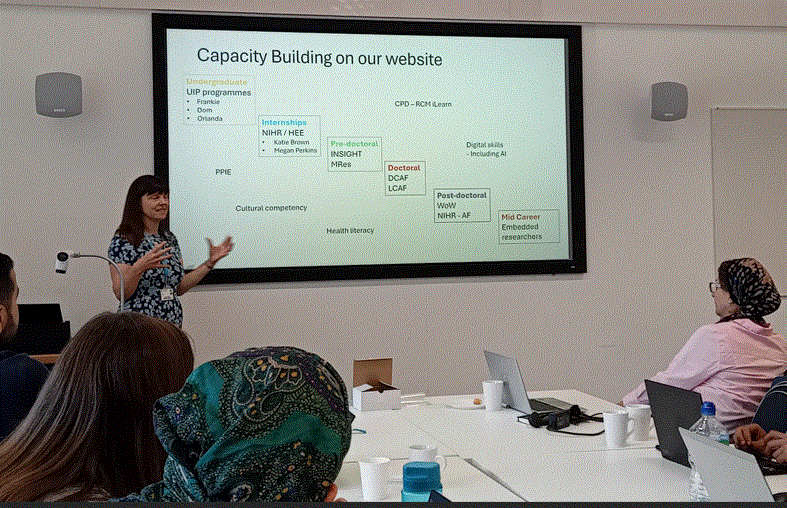
Building Research Capacity: The key role of PhD students
Postgraduate students, especially PhD students dramatically expand a university’s research capacity. They contribute significantly to data collection, analysis, the day-to-day management of research projects, and publications that might otherwise be impossible to sustain. Postgraduate students are central to progressive research-active communities. PhD student also frequently serve as mentors to undergraduate researchers or Masters’ students, creating a cascade of learning that benefits all participants.
Beyond individual projects, postgraduate students help build research infrastructure through their contributions to lab management, protocol development, the exchange of innovative ideas, and so on. These contributions create lasting benefits to staff as well as higher education institutions. Academic communities with PhD students often promote collaboration, provide emotional and intellectual support, and create spaces where ideas can be tested and analyses refined before wider dissemination.
This expanded capacity allows universities to pursue more ambitious research agendas and respond to complex challenges requiring multidisciplinary approaches. The postgraduate journey requires carefully planned mentorship, giving students increasing autonomy, and ownership of their scholarly contribution. This apprenticeship model has proven remarkably effective in preparing the next generation of academics for centuries.
This blog was created as part of the Professional Discourse in the Age of AI: an interactive writing workshop facilitated by Prof. Debbie Holley and Prof. Carol Clark in the Faculty of Health & Social Sciences at Bournemouth University. Since last week’s workshop was on the topic, we have used the help of AI in the writing of this BU Research Blog!
Dr. Kathryn Collins, Prof. Vanora Hundley & Prof. Edwin van Teijlingen
Action for Children to present at Community Voices Webinar Wednesday May 14th 12-1pm
The May Community Voices Webinar will welcome Lynn and Maddy from Dorset Action for Children – to shine a light on the services they provide and specifically Dorset Nightstop – providing young homeless people aged 16-25 with shelter through a network of vetted volunteer host families.
https://service.actionforchildren.org.uk/dorset-services/dorset-nightstop/
Action for Children is a UK-based children’s charity that provides practical and emotional care and support to vulnerable children and young people.
The charity has a wide range of services for parents and families, including parenting support, childcare, fostering, residential care and policy and research.
They also ensure children’s voices are heard and campaign for improvements in their lives.
In Dorset, Action for Children runs two services. A Parenting Support Service providing individual/group programmes and webinars for parents/caregivers struggling with their children’s challenging behaviour.
Also Dorset Nightstop that provides young homeless people aged 16-25 with shelter through a network of vetted volunteer host families.
Lynn and Maddy will be talking more about the work of Action for Children with particular reference to Dorset Nightstop.
Community voices is a collaboration between BU PIER partnership and Centre for Seldom Heard Voices to provide a platform and a voice to local community activists.
Please do join us for this webinar….
Bournemouth University eHealth paper cited 40 times!
Yesterday, ResearchGate alerted us that the paper ‘Midwives’ views towards women using mHealth and eHealth to self-monitor their pregnancy: A systematic review of the literature’ [1] had reached 40 citations! This paper has four Bournemouth University (BU) authors and one author, Prof. Gary Smith, who was FHSS Visiting Professor at the time of publication. This literature review, published in 2020, sought midwives’ perspectives on women self-monitoring their pregnancy using eHealth and mHealth.
The paper fund that midwives generally held ambivalent views towards the use of eHealth and mHealth technologies in antenatal care. They acknowledged the potential benefits of such technologies, such as their ability to modernise antenatal care and to help women make more informed decisions about their pregnancy. However, midwives were quick to point out the risks and limitations of these, such as the accuracy of conveyed information, and negative impacts on the patient-professional relationship.
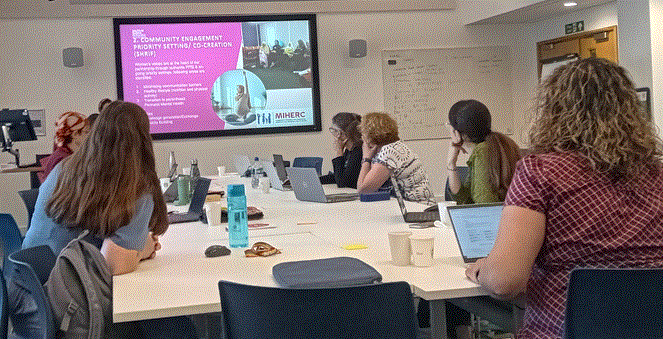
This paper will contribute to our recently awarded NIHR funding to tackle inequalities in UK maternal healthcare as part of the NIHR Challenge Call: Maternity Disparities Consortium. Profs Vanora Hundley and Edwin van Teijlingen from the Centre for Midwifery and Women’s Health, and Prof. Huseyin Dogan and Dr. Deniz Cetinkaya from the Department of Computing and Informatics collaborate in MIHERC (Maternal & Infant Health Equity Research Centre). MIHERC is led by Prof. Hora Soltani at Sheffield Hallam University, and it is a partnership with Bournemouth University, the City of Doncaster Council and South Yorkshire Digital Health Hub as well as several charities and voluntary organisations. Prof. Dogan has recently been appointed the co-lead for the “Digital, data, monitoring, evaluation and implementation science” work stream of the NIHR Maternity Disparities consortium.
Reference:
- Vickery, M., van Teijlingen, E., Hundley, V., Smith, G. B., Way, S., Westwood, G. (2020). Midwives’ views towards women using mHealth and eHealth to self-monitor their pregnancy: A systematic review of the literature. European Journal of Midwifery, 4(Sept.), 1-11. https://doi.org/10.18332/ejm/126625
Trans+ Research Conference on Lansdowne Campus!
Join our Trans+ Research Conference, an exciting day dedicated to advancing research and understanding of trans+ experiences.
📅 15 May 2025 | 📍 Bournemouth University, Lansdowne Campus and Online
🔗Register online here https://www.ticketsource.co.uk/beyond-reflections/trans-research-conference/2025-05-15/09:00/t-vvammmg
GSW Food Security Academic Summit
The Great South West launched its Food Security Position paper in Westminster late last year highlighting the significant contribution this region makes to the UK’s food supply. The launch event drew together policy makers from both the Commons and the Lords, leading industry and academia. The event highlighted the key food security challenges and the critical role that the South West region holds in securing our national food supply. Bournemouth University was represented by Professor Jeff Bray.
Universities across the Great South West region are researching different aspects of Food Security. To develop greater awareness of the region’s research interests and capabilities, an academic Food Security Summit is being convened in June. This event will bring the region’s universities together, showcase respective expertise and enable academic network building thereby stimulating greater collaboration. Themes to be discussed include agri-tech developments, localised supply chains, consumer decision making & economic approaches. A regional academic network will be developed and annual meetings established, reflecting the trajectory and importance of the topic.
This timely and much-needed initiative is led by Jeff Bray from BU and supported by colleagues from all Faculties. If you have a research interest in Food Security and would like to be included in these discussions, then please e-mail Jeff with a brief outline of your research focus by 15th May.


Fourth INRC Symposium: From Clinical Applications to Neuro-Inspired Computation
Writing policy briefs
Upholding Excellence: The Concordat to Support Research Integrity
Today’s Documentation Will Serve Tomorrow’s Justice
ECR Funding Open Call: Research Culture & Community Grant – Application Deadline Friday 12 December

MSCA Postdoctoral Fellowships 2025 Call

ERC Advanced Grant 2025 Webinar
Horizon Europe Work Programme 2025 Published
Horizon Europe 2025 Work Programme pre-Published
Update on UKRO services
European research project exploring use of ‘virtual twins’ to better manage metabolic associated fatty liver disease