Using drama and storytelling in dementia care: Kick-off meeting for ERASMUS+ 2018 funded project
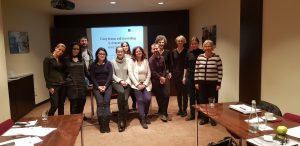
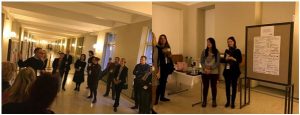
Last week, Dr Ben Hicks, I and the European partners from Greece, Romania, Bulgaria and Ireland began the ERASMUS+ 2018 funded project, exploring drama and storytelling in dementia care. The kick-off meeting was held in Bucharest, Romania, where all partners met to discuss the implementation of the project and establish targets for the next two years.
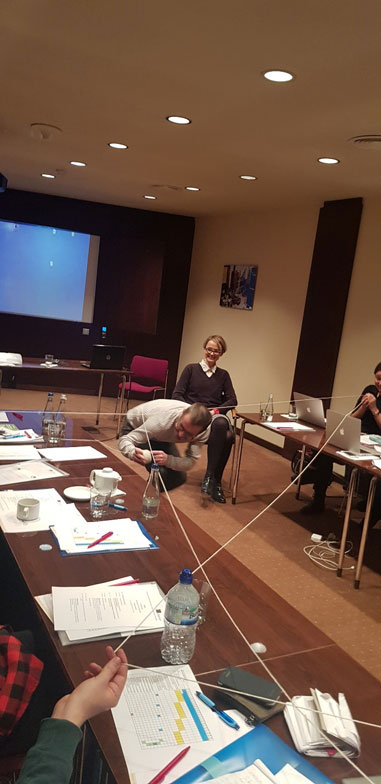
The morning session began with a discussion regarding the process of producing a booklet “Life in a story: creative arts and storytelling use for Alzheimer’s Disease patients and carers”. This will be based on a systematic review, conducted by Bournemouth University, and interviews with professionals who use drama and storytelling as a mean to engage people with dementia. In the afternoon, representatives from The Gaiety School of Acting, Ireland, introduced us to the use of theatre and storytelling. This was by far the most creative and interesting moment from the meeting, as we passed a ball of string amongst ourselves whilst regaling the proudest moment in our life.
The ball of string went around the table and everyone got a chance to tell their story. At the end, we could tangibly see that although we were all individuals, we each had similar stories that bound us together. The partners from Gaiety School of Acting will be creating a training programme using similar methods that focus of theatre and storytelling to train health and social care professionals to better understand, engage and support people living with dementia and their care partners.
As the meeting progressed, we also discussed the preparation of a toolkit for family carers to improve communication with people with dementia as well as the policy recommendations required for creating dementia friendly communities and institutions through the use of creative arts.
The meeting went well, and clear targets and future plans were established for the project. Moving forward, Bournemouth University will now begin conducting a systematic review of the area as well as interviews with dementia practitioners. This phase of the research will conclude in April 2019 and will inform the development of a ‘Train-the-Trainer booklet that will supplement the future drama and storytelling workshops (Phase 2).
My first international meeting as a research assistant exceeded my expectations. We received a very warm welcome, tackled the workload with a lot of heated discussions and achieved positive outcomes from the meeting. It was interesting to learn about cross cultural differences in dementia care and the benefits that the creative arts can offer people with dementia and their care partners. However, it was also upsetting to listen to project partners sharing their experiences of battling their Governments to provide even the most minimal of financial support for those living with dementia. Hopefully, this ERASMUS+ 2018 project will not only bring more dementia awareness across European countries, but also enable a wide variety of people to use drama and storytelling in dementia care to improve understanding of dementia and enhance the support provided to those living with the condition. I really look forward to the practical part of this project, when we receive the training from Gaiety School of Acting.
Blog written by Irma Konovalova (Research Assistant in the ADRC).
 usiness Collaboration organised by the University of Helsinki from the 7th to 9th November, 2018.


 On the third day to Christmas, my RKEO friend gave to me, 3 more months in the EU.


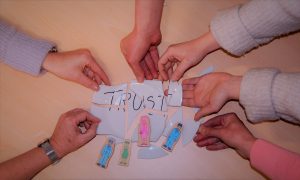 Sustainability and consumer trust go hand-in-hand. Organisations need to understand what drives trust and how to build trust if they are to achieve sustainability. This was the message that Associate Professor Julie Robson delivered as part of her keynote presentation at the LIGUE (Laboratoire Interdisciplinaire en Gestion Université-Entreprise) in Carthage Tunisia.
 Theresa provides support to the University-wide Research and Knowledge Exchange Development Framework, (RKEDF), which incorporates a suite of pathways providing developmental support to academics at every stage of their careers.
 Apologies that this is a brutalisation of the Christmas song, but we wanted to share with you 12 useful bits of information in the days leading up to the Christmas break (yeh, 12 working days to go!). Here comes the first one!
 The Times Higher Education (THE) have
 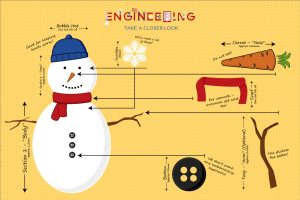 In support of the 2018 Year of Engineering, a year-long government led (Department of Transport) campaign to celebrate UK engineering and increase awareness and understand what engineers do, EPSRC have created a ‘fun’







 ESRC Festival of Social Science 2026: Application Deadline Extended to Thursday 25 June 2026
 First publication for two CMWH PhD students
 Opportunities to support our REF preparations
 SPROUT Returns: Designing Sustainability in Research Practice – Wednesday 20 May 12-2pm
 Innovative Approaches to Doctoral Supervision: Selected Case Studies
 Reminder: Register for the ESRC Festival of Social Science 2026 Information Session
 ECR Funding Open Call: Research Culture & Community Grant – Apply now
 ECR Funding Open Call: Research Culture & Community Grant – Application Deadline Friday 12 December
 MSCA Postdoctoral Fellowships 2025 Call
 ERC Advanced Grant 2025 Webinar
 Update on UKRO services
 European research project exploring use of ‘virtual twins’ to better manage metabolic associated fatty liver disease