 In the latest Athena SWAN update you can read the news and events relating to gender equality, as well as why Athena SWAN is important to everyone at BU. The leading story is the Department of Media Production’s Bronze SWAN Award.
/ Full archive
Nepal paper by Lesley Milne (CMMPH)
Congratulations to Lesley Milne, senior lecturer in midwifery, on the acceptance of her latest paper on maternity care in Nepal. This new paper ‘Gender inequali ties and childbearing: A qualitative study of two maternity units in Nepal’ will appear soon in the Open Access publication: Journal of Asian Midwives [1]. This is the second publication from a qualitative research study undertaken in two birthing facilities in Kathmandu Valley to examine barriers to women accessing these services from the perspective of hospital staff [2].
The study received financial support from Wellbeing of Women and the RCM (Royal College of Midwives) as Lesley won their first International Fellowship Award. The study was a collaboration led by Lesley in the Centre for Midwifery, Maternal & Perinatal Health (CMMPH) with two of FHSS’s Visiting Faculty, namely Prof. Padam Simkhada who is based at Liverpool John Moores University and Jillian Ireland, Professional Midwifery Advocate based at Poole NHS Hospitals Foundation Trust.

Well done!
Profs. Vanora Hundley & Edwin van Teijlingen
References
- Milne, L., Ireland, J., van Teijlingen, E., Hundley, V., Simkhada, P.P. (2018) Gender inequalities and childbearing: A qualitative study of two maternity units in Nepal, Journal of Asian Midwives (accepted).
- Milne, L., van Teijlingen, E., Hundley, V., Simkhada, P., Ireland, J. (2015) Staff perspectives of barriers to women accessing birthing services in Nepal: A qualitative study BMC Pregnancy & Childbirth 15:142 www.biomedcentral.com/1471-2393/15/142 .
Café Scientifique: Facing our Future Self


Think about your future ageing or old age.
What thoughts and feelings come to mind?
At the recent October Cafe Scientifique event, Dr Curie Scott from the Centre for Excellence in Learning asked a packed audience at Café Boscanova in Boscombe, Bournemouth these questions.
Ageing populations
As a trained medical doctor and educator of health professional students, Curie became aware of the impact of ageing populations. In 2017, global population trends reversed: there are now more people over 65 years old than under five years old (United Nations, 2013). Nearly one in five people currently alive in the UK will get to their hundredth birthday (Department for Work and Pensions, 2011).
We are ageing. But we remain uncomfortable about talking about it.
Using drawing to discuss ageing
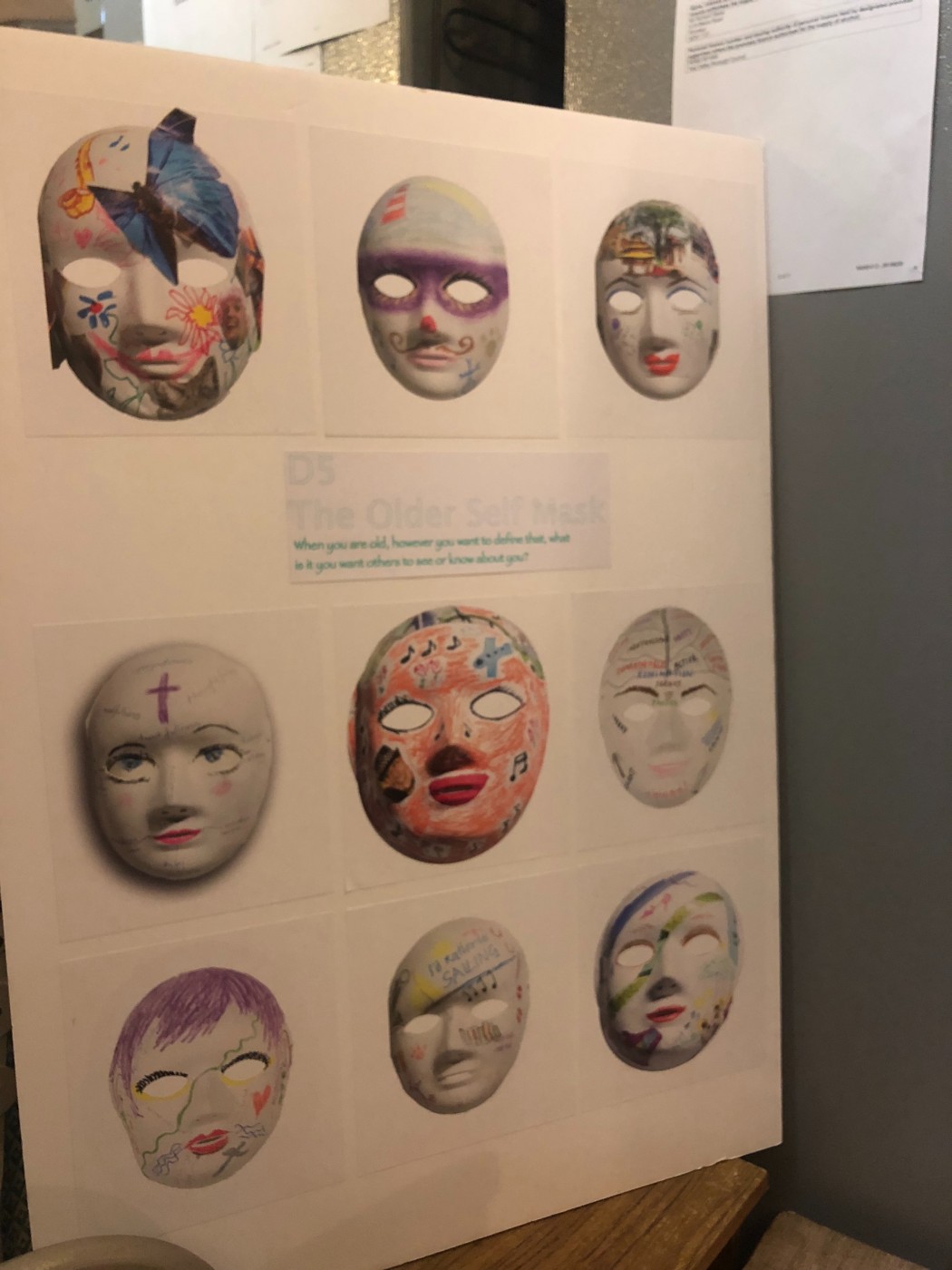
For her research, she was interested in whether drawing might help us talk about our future. She invited health professional students and people over 60 to a specially designed Drawing Programme to think about their future ageing. This was a four week expressive mark-making workshop-based programme. Examples of drawings were on display at the cafe. Of the five drawings linked to ageing, the masks (below) were the final drawing as it was the most personal.
Challenging the accepted Cultural ‘truths’ about ageing
It is clear that ‘older people’ are an ‘othered’ group. That is, we want to separate ourselves from being labelled ‘old’. The Drawing Programme facilitated openness and a willingness to consider the myriad ‘what-ifs’ of ageing. Participants noted ‘truths’ or ‘assumptions’ of ageing which they had absorbed from their surrounding Culture ageing. These were predominantly negative:
- Ageing is relative, dependent on one’s age
- Ageing is about decline with core and peripheral losses
- With ageing, one is concealed and outcast from society
- With increasing age, one is less valued
- Ageing as a discussion topic is taboo
- Ageing is ugly and is especially harsh to women
These myths echoed responses by those at Café Scientifique. Comments about the future included concerns about ill health, dependency, and loneliness. Positive aspects were about greater confidence, time to enjoy leisurely pursuits and have more time with family and friends.
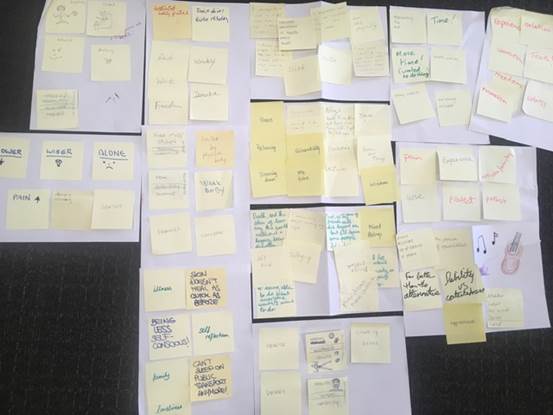
Returning to the research, over the three month study period, participants interrogated their assumptions. They disentangled from dominant negative threads and chose new ways of being. They described some powerful shifts in thinking and behaviour. They shared a stronger internal sense of agency and choice – not that ageing would just ‘happen’ but that we all have choices we can make for and about our future ageing.
At the deepest level of consideration, participants could visualise themselves, and indeed accept, that they were likely to become old. They took control of the time they had left. At 73 years old, Veronica (not her real name) declared that the study propelled her into fulfilling her lifelong dream of playing the saxophone. With a strong family history of deaths in their sixties, Eva (not her real name) responded by changing her health behaviour and asking for health screening tests.
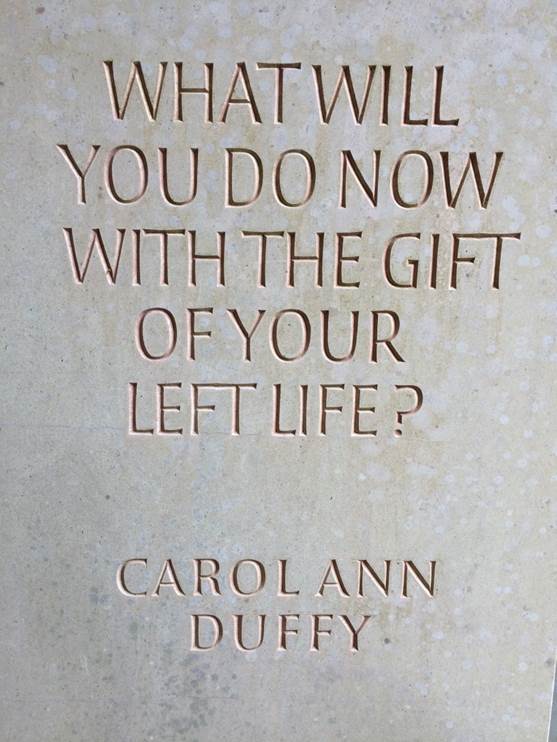
Drawing helped adults to think, explore, and articulate on the emotive topic of their future ageing. Curie ended with a line from the poem ‘Snow’ by poet laureate Carol Ann Dufffy which is carved on a stone in Durlston Country Park.
If you are interested in knowing more about the drawing workshops or perceptions of ageing, contact me at cscott@bournemouth.ac.uk
The next Cafe Scientifique by Xun He is on next week, Tues 6th Nov, on “Working together: When your mind is in my mind”
References
Department for Work and Pensions, 2011. Number of Future Centenarians by Age Group [online] Available at: https://assets.publishing.service.gov.uk/government/uploads/system/uploads/attachment_data/file/223173/centenarians_by_age_groups.pdf
United Nations, 2013. World Population Prospects: The 2012 Revision. United Nations Population Division of the Department of Economic and Social Affairs. Available at: https://population.un.org/wpp/Publications/Files/WPP2012_HIGHLIGHTS.pdf
Doctoral College Santander Mobility Awards | Soheon Kim Awardee Report

Research Professional – all you need to know
 Every BU academic has a Research Professional account which delivers weekly emails detailing funding opportunities in their broad subject area. To really make the most of your Research Professional account, you should tailor it further by establishing additional alerts based on your specific area of expertise. The Funding Development Team Officers can assist you with this, if required.
Research Professional have created several guides to help introduce users to ResearchProfessional. These can be downloaded here.
Quick Start Guide: Explains to users their first steps with the website, from creating an account to searching for content and setting up email alerts, all in the space of a single page.
User Guide: More detailed information covering all the key aspects of using ResearchProfessional.
Administrator Guide: A detailed description of the administrator functionality.
In addition to the above, there are a set of 2-3 minute videos online, designed to take a user through all the key features of ResearchProfessional. To access the videos, please use the following link: http://www.youtube.com/researchprofessional
Research Professional are running a series of online training broadcasts aimed at introducing users to the basics of creating and configuring their accounts on ResearchProfessional. They are holding monthly sessions, covering everything you need to get started with ResearchProfessional. The broadcast sessions will run for no more than 60 minutes, with the opportunity to ask questions via text chat. Each session will cover:
-
Self registration and logging in
-
Building searches
-
Setting personalised alerts
-
Saving and bookmarking items
-
Subscribing to news alerts
-
Configuring your personal profile
Each session will run between 10.00am and 11.00am (UK) on the fourth Tuesday of each month. You can register here for your preferred date:
These are free and comprehensive training sessions and so this is a good opportunity to get to grips with how Research Professional can work for you.
Have you noticed the pink box on the BU Research Blog homepage?
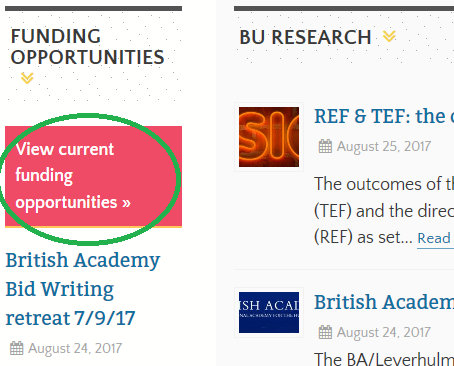 By clicking on this box, on the left of the Research Blog home page just under the text ‘Funding Opportunities‘, you access a Research Professional real-time search of the calls announced by the Major UK Funders. Use this feature to stay up to date with funding calls. Please note that you will have to be on campus or connecting to your desktop via our VPN to fully access this service.
Fake e-cigarette liquid is putting vapers at risk – here’s how we can tackle the fraud

Sulaf Assi, Bournemouth University
Over 35m people worldwide now use e-cigarettes, according to one estimate. In the US, this includes 4.5% of the adult population. But the rise in vaping has led to a trade in fake e-liquids – the mix of water, glycerol, propylene glycol, flavours and (usually) nicotine used to create the vapour of e-cigarettes.
Fake e-liquids are those that contain ingredients or incorrect concentrations of them that do not match those on the label. In particular, fakes often contain less or more nicotine than their labels claim, or impurities such as other drugs. The problem is that there is no current way to be sure exactly what is in an e-liquid, and no official certification scheme to guarantee that a label claim is accurate.
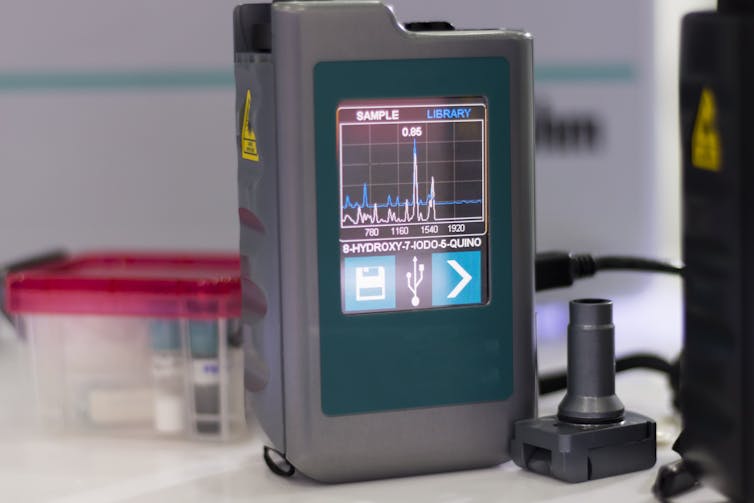
However, my colleagues and I are working on a way to use handheld scanning technology to spot fake e-liquids. This system could help to catch fraudsters because it does not just prove an e-liquid does not match its labelling but also provides a chemical “fingerprint” that can be linked back to its creators.
The internet has made it much easier for fraudsters to sell fake goods, and e-liquids are no exception. The problem is still new enough that we do not have good data on how common it is, but anecdotal evidence suggests many vapers are aware of the issue.
Nicotine e-liquids typically contain concentrations of between 0.1% and 2% of the drug, depending on the strength the vaper prefers. Current EU law means higher concentrations of nicotine than this are illegal. And manufacturers are required to declare any ingredient that accounts for more than 0.1% of its content.
Buying a fake e-liquid is not just annoying, it is potentially dangerous. It is rare for someone to consume so much nicotine that it becomes toxic, but it can happen. High doses of nicotine can result in unwanted stimulant effects such as hypertension (high blood pressure), tachycardia (unusually high heart rate), tremors and even seizures. Impurities in nicotine can also affect the body but this is difficult to predict and depends on what the impurity is and its concentration.
Mr.1/Shutterstock
Having a portable technology that can authenticate products would help law enforcement officers identify fake e-liquids, catch the criminals supplying them and so prevent the health problems they cause. So we have tailored portable scanning technology already used to detect other counterfeit products including medicine and food, by creating a library of chemical signatures for e-liquids and the software to compare them to the scan results.
The technology works by firing near-infrared light at a sample. Different ingredients will reflect or absorb the light by different amounts. So measuring this reflection gives a spectrum that acts like a fingerprint, which we can use to identify the liquid’s physical and chemical properties. Our algorithms can then interpret this fingerprint and compare it to our library of other spectra to assess how likely it is that the liquid contains what the label says it does.
Using this kind of portable spectroscopic technology saves on the cost, labour and time of taking a sample into the laboratory, preparing and measuring it and then processing the data. Instead, our system can scan a sample and tell users how close a match it is to entries from the library – and so how much nicotine and other ingredients it contains – without the need for them to have specialist training. Collecting a signature takes a few seconds and the results are ready within a couple of minutes. The equipment is also stable in hot and cold climates and can be used in the field for long periods of time.
As portable versions of these instruments are already available for detecting fake drugs and tobacco, it would be easy to adapt them for law enforcement agents. All you need to do is develop the right library of chemical signatures to detect a variety of fake e-liquids, as we have started doing. Then the police can start cracking down on this potentially dangerous trade.
Sulaf Assi, Senior lecturer in forensic sciences, Bournemouth University
This article is republished from The Conversation under a Creative Commons license. Read the original article.
IRAS training, 06/11/2018 – CANCELLED
Unfortunately due to low numbers the above training is now cancelled.
Keep an eye on the blog for future dates and please email Research Ethics if you require any guidance on making an application via IRAS.
Will you take part in AcWriMo – Academic Writing Week?
We have received this announcement from CREST (Consortium for Research Excellence Support and Training):
 CREST is delighted to be participating in this year’s Academic Writing Month, or #AcWriMo. AcWriMo was created in 2011 by Charlotte Frost, founder of PhD2Published. It is a month long festival of writing hoping to create some good writing habits or help you get some writing done.
The CREST team has developed a set of activities to support you and encourage you with your writing. We will be holding online twitter conversations throughout November, suitable for researchers at any career stage. We will be available online between 8am and 10am on Tuesday, Wednesday and Thursday each week for writing together sessions on Twitter and Slack.
How to take a part
- Sign up to CREST AcWriMo 2018 to get updates
- Follow @crestuk on Twitter and join in discussion. Remember to use #CRESTAcWriMo and #AcWriMo2018 in your posts
- Join us on Slack every Tuesday, Wednesday and Thursday between 8 and 10 am.
- Post to CREST AcWriMo 2018 Wall. We are asking all interested in taking part to publicly announce their intention to write. In this way you are more likely not to give up as it creates a feeling of taking a part in a ‘real and not online event’.
- Track your Progress
What to do
- Make a plan and research your topic in advance
- Book some time in your diary for writing
- Set yourself a daily goal (can be anything, we are suggesting 300-500 words or more), start writing and document your progress
- Update your column in the CREST AcWriMo 2018 Progress sheet as often as you can (we suggest writing daily and updating daily)
- Tweet us some photos of how is your writing going, how is your desk looking or of the view from your writing space. Don’t forget to include #acwrimo2018 #CRESTAcWriMo
- There is a writing retreat in November 2018 but this is only open to those from CREST member institutions (BU is not a member)
Looking forward to writing with you!
Your CREST team,
Tijana, Rachel and Matthew
Good Clinical Practice refresher – Monday 12th November
Are you currently undertaking research within the NHS and your Good Clinical Practice (GCP) training is due to expire? Or has it expired recently?
GCP certification lasts for two years, so if your training is due to expire, has expired, or you want to validate your learning, then take advantage of the upcoming refresher half day session, taking place at Poole Hospital on Monday 12th November, 9am – 12:30pm.
Spaces are still remaining, so if you’d like to enrol, get in touch with Research Ethics or the Wessex Clinical Research Network.
Dr Debbie Sadd – Virgin Start Up Mentor
Virgin StartUp is a not-for-profit organisation, started by Sir Richard Branson, that helps entrepreneurs in England with the funding, resources and advice they’ll need to make their business idea a reality. Their main focus is to help entrepreneurs get the support they need to turn their great idea in to a successful and sustainable business. Anyone 18 or over and a British citizen or legal UK resident who wants to start or expand a new business that’s less than a year old in England may be eligible for a start-up loan.

In each area that they are based Virgin Start Up look for suitable people to become mentors and Debbie was approached to become the first female mentor for Bournemouth and surrounding areas. The mentor’s role is to act a a sounding block to help develop the entrepreneur’s confidence, knowledge and skills. Mentors are not there to tell what to do or even how to do it, but to help them make the right decisions themselves.

As part of her role Debbie also attends the Screw It, Just do it Virgin Start Up talks in Bournemouth https://www.startupu.co.uk/new-events/2018/11/29/the-real-ted-talk-2 the next one of which will be Ray Kelvin the founder of Ted Baker. Other recent talks have been from Candy Kittens (co owned by Jamie Laing), Conker Gin, Jimmy’s Iced Coffee. If anyone is interested in knowing more please email dsadd@bournemouth.ac.uk
Have you been involved with an event designed for the external community?
Then we want to hear from you!
The University is currently compiling the data for the annual Higher Education – Business & Community Interaction survey (HE-BCI) due to be submitted to HESA shortly. Data returned is used to calculate our HEIF grant.
We are asked to submit details of social, cultural and community events designed for the external community (to include both free and chargeable events) which took place between 1 August 2017 and 31 July 2018.

Event types that should be returned include, but are not limited to:
- public lectures
- performance arts (dance, drama, music, etc)
- exhibitions
- museum education
- events for schools and community groups
- business breakfasts
We cannot return events such as open days, Student Union activity, commercial conferences, etc.
All events that we ran as part of the Festival of Learning, ESRC Festival of Social Science and Cafe Scientifique series are likely to be eligible for inclusion and we will collate this information on your behalf centrally.
If you have been involved with any other event which could be returned, please could you email your contact as soon as possible (see below) and confirm: the event name and date, whether it was free or chargeable, the estimated number of attendees, and an estimate of how much academic time was spent preparing for (but not delivering) the event:
- SciTech – Norman Stock
- FoM – Rob Hydon
- HSS – Deirdre Sparrowhawk
- FMC – Laura Hampshaw
- Professional Service – Julie Northam (RKEO)
The data returned is used by Research England to allocate the HEIF funding so it is important that we return as accurate a picture as possible.
Forthcoming RKEDF events
 We have some great events coming up over the next few weeks to help support you in your research activity within the Research and Knowledge Exchange Development Framework (RKEDF)
We have also grouped the RKEDF events around your needs, so if, for example, you are an Early Career Researcher or need to know about external funding, you can click on the link to find all the RKEDF sessions that may assist you. You can also find related events by using the link on each session’s page.
November
December
| Wednesday 5th December | RKEDF: Writing Academy – Day 1 of 3 |
| Monday 10th December | RKEDF: Technical Bid Writing Workshop |
| Wednesday 12th December | RKEDF: Main Panel D UOA 27 – Improving the Quality Score of Your Output |
| Wednesday 12th December | RKEDF: Main Panel D UOA 32 – Improving the Quality Score of Your Output |
| Wednesday 12th December | RKEDF: Main Panel D UOA 34 – Improving the Quality Score of Your Output |
| Wednesday 12th December | RKEDF: Main Panel D – Improving the Quality Score of Your Output |
| Friday 14th December | RKEDF: Impact Case Study Writing Retreat |
| Monday 17th December | RKEDF: Main Panel A – Developing Impact Case Studies for your REF Panel: the good, bad and ugly |
| Tuesday 18th December | RKEDF: Main Panel B – Developing Impact Case Studies for your REF Panel: the good, bad and ugly |
The above list does not include events where attendance requires faculty nominations / applications or are part of the Early Career Researcher Network schedule for 18/19.
You can see all the Organisational Development and RKEDF events in one place on the handy calendar of events.
Please note that all sessions are now targeted, so look closely at the event page to ensure that the event is suitable for you. In addition, RKEDF events now require the approval of your Head of Department (or other nominated approver). Please follow the instructions given on the event page and the template email for you to initiate the booking request.
If you have any queries, please get in touch!
BU Academic Research presented at prestigious ACE sponsored Conference

Dr Nigel Williams, Department of Leadership, Strategy & Organisation
Dr Nicole Ferdinand, Department of Events and Leisure and Dr Nigel Williams, Department of Leadership, Strategy and Oraganisation presented their research on the Notting Hill Carnival at the prestigious ACE sponsored 7th Biennial Steelpan Conference: Steelpan, Calypso and Mas. This year’s theme was Empowering the Youth to lead the UK transformation of Carnival Arts: Celebrating Windrush 70. Among the attendees were keynote presenter Dr John Cowley, one of the most well-known authorities on Caribbean Carnival traditions, Mr Matthew Phillip, Executive Director Notting Hill Carnival Ltd and His Excellency Orville London, High Commissioner for Trinidad and Tobago, United Kingdom.

Dr Nicole Ferdinand, Department of Events and Leisure, with fellow presenter Ray Mahabir, Director, Sunshine International Arts
Dr Ferdinand and Dr Williams presented a paper entitled Evolution of Notting Hill Carnival: from a Community Festival to a Global Phenomenon. It focused the role of politics and power in transforming the Notting Hill Carnival. Other papers presented in their session were:
- Insights into Artistic Design: Techniques for Street Carnivals – presented by Ray Mahabir
- Moko Jumbies: Dionysian Explosions as Tradition, Myth & Mayhem – presented by Ansel Wong
- Participation versus Performance: Who’s to Judge – presented by Katie Segal
- Talk and Drums: The Role of Orality in British Caribbean Carnival and Steelpan – presented by Tola Dabiri
- Know de Gayelle: Using the Art and Practice of Stick fighting to Realise Cultural Transformation in Youths – The Bois Academy – presented by Dr Susan Burke
Do you need help with your research application?
 If you need help with your research application and can meet certain criteria, then you may be eligible to receive support from one of our External Application Reviewers (EARs).
With a new and simplified process, you can request this when you submit your Intention to Bid form, and you meet at least one of the following conditions:
- The application is to a prestigious funder (UK research councils, Wellcome Trust, Leverhulme Trust, British Academy, Royal Society, NIHR and EU Horizon 2020)
- The application is to a strategically important funding call, including those in the BU2025 Strategic Investment Areas
- NERC Standard Grants
- One-off calls for multi-million pound bids (such as AHRC’s Creative Clusters Programme and Research England’s E3 call)
- The applicant is a member of the BU Research Council Development Scheme and is applying to a UK Research Council call
- The applicant is an ECR and is applying to a prestigious funder
Your Research Facilitator will then be in contact to discuss your needs. Approval will need to be given both by RKEO and your department before an EAR is appointed to support you.
If you do not meet the above conditions, help may still be available in certain circumstances. Additionally, certain calls may be eligible for external support from other sources. – please discuss these with your Research Facilitator.
Please note that this is an application reviewing service; the EARs will not write your bid for you.
Training opportunity – completing and submitting your IRAS application
Are you currently in the process of designing, setting up or planning your research study, and would like to extend your project into the NHS?
Yes? Then you may want to take advantage of this training opportunity.
Oliver Hopper (Research & Development Coordinator, Royal Bournemouth and Christchurch Hospital) and Suzy Wignall (Clinical Governance Advisor, R&KEO) will be running a training session on how to use, and complete your own application within the IRAS system.
IRAS (Integrated Research Application System) is the system used to gain approvals from the NHS Research Ethics Committee and Health Research Authority, before rolling out your study to NHS Trusts. To support this, the session will include the background to research ethics and the approvals required for NHS research.
The session will also be interactive, and so as participants, you will have the opportunity to go through the form itself and complete the sections, with guidance on what the reviewers are expecting to see in your answers, and tips on how to best use the system.
The training will take place in Studland House – Lansdowne Campus, room 117 on Tuesday 6th November, at 13:00pm – 16:00pm.
There are 12 spaces available, so get in touch with Research Ethics if you would like to register your interest and book a place.
Doctoral College Santander Mobility Awards | Preeti Mahato Awardee Report

EoIs invited for BU Ethics Panel Chairs and Deputy Chairs
 Expressions of interest are invited for the Chairs and Deputy Chairs of the Social Science and Humanities Ethics Panel and the Science, Technology and Health Ethics Panel. These prestigious and honorary roles work across the university to champion the highest ethical standards in research undertaken by staff and students.
This document provides further information about the roles and the application process.
Expressions of interest, consisting of a CV and brief statement outlining suitability for the chair/deputy chair role, should be submitted to RKEO (researchethics@bournemouth.ac.uk) by 5pm on Friday 9 November 2018.
For an informal discussion about the roles please contact one of the current Chairs:
- Dr Sean Beer, Chair of the Social Science and Humanities Ethics Panel
- Prof Holger Schutkowski, Chair of the Science, Technology and Health Ethics Panel
If you have any questions regarding the process, please email Sarah Bell/Suzy Wignall using the researchethics@bournemouth.ac.uk email address.
‘Communicating Empathy in a Post-Brexit Landscape’. Sat, 10 Nov, 2-4pm
Professor Iain MacRury, Visiting Professor and psychotherapist Brett Kahr and I are hosting an event at the EBC in Bournemouth, 2-4pm Saturday 10 November.
We will be sharing psychosocial perspectives on the meanings of empathy and the potential for its development in a polarised Brexit landscape.
Tickets are free, but limited and so book your place soon. Further details can be found on the link below.
We hope to see you there!
Candida Yates
Prof of Culture and Communication, FMC
https://www.eventbrite.co.uk/e/communicating-empathy-in-a-post-brexit-landscape-tickets-51241331201
BU staff can login below:
Other services







Recent posts
BU research Funding opportunities EU
 ESRC Festival of Social Science 2026: An Opportunity to Engage New Audiences
 New HIV paper by BU PhD student
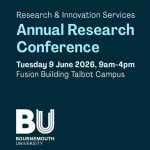 BU Annual Research Conference: Poster Exhibition Call for Applications
 Vitae Three Minute Thesis (3MT®) Competition: Applications Now Open
- Applications are now open for 2026 ESRC Postdoctoral Fellowships
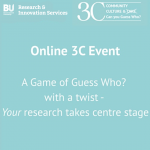 3C Online Social: Thursday 26 March 1–2pm – Research Culture, Community & Can you Guess Who?
 ECR Funding Open Call: Research Culture & Community Grant – Apply now
- FLF UKRI round 11- internal launch and timelines
 ECR Funding Open Call: Research Culture & Community Grant – Application Deadline Friday 12 December
- ECR Funding Open Call: Research Culture & Community Grant – Apply Now
 MSCA Postdoctoral Fellowships 2025 Call
 ERC Advanced Grant 2025 Webinar
- MSCA Postdoctoral Fellowships 2025 Call
- ERC Advanced Grant 2025 Webinar
- European Migration Research and Impact – Invitation to a Roundtable Discussion
- MSCA Postdoctoral Fellowships 2025
 Update on UKRO services
 European research project exploring use of ‘virtual twins’ to better manage metabolic associated fatty liver disease
 Research Information Network
- Physical Sciences Case studies: information use and discovery
- Information handling in collaborative research: an exploration of five case studies
- Information literacy monitoring and evaluation
- Data centres: their use, value and impact
- Heading for the open road: costs and benefits of transitions in scholarly communications