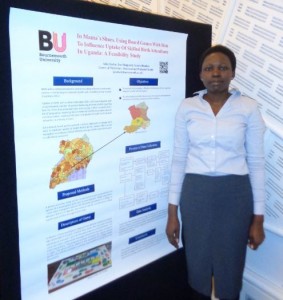
Research from Bournemouth University was showcased at the Global Women`s (GLOW) conference organised by University of Manchester on 24th November 2016. The GLOW annual conference is designed to provide a platform for academics, policy makers and researchers involved in international maternal, child and reproductive health to share their experiences, build collaborations and inspire upcoming researchers to make a difference.
Under the theme `innovations to accelerate saving lives at birth` researchers were given the opportunity to share their ideas and novelties on improving newborn, child and maternal health. A key message echoed by speakers at the conference was on improving quality of maternity services at health facilities with a call to ensure interventions translate into saving lives along the continuum of care.
PhD student, Alice Ladur presented a poster In mama` shoes. Using board games with men to influence uptake of skilled birth attendants in Uganda. This research is about using educational board games as a means to engage with men to address barriers that hinder pregnant women from accessing skilled care at birth a key factor contributing to high maternal deaths in low income countries. Alice`s PhD project is supervised by Dr Zoe Sheppard and Professor Vanora Hundley.
Key highlights for me from the GLOW conference was receiving feedback on the game that will be tested next year in Uganda and a call for excellence as articulately stated by one of the keynote speakers ` let us all do our part in saving lives at birth and do it well`. It is possible to improve health outcomes for pregnant mothers and babies in resource constrained settings.
If you are interested in finding out more about this research, please contact me at aladur@bournemouth.ac.uk
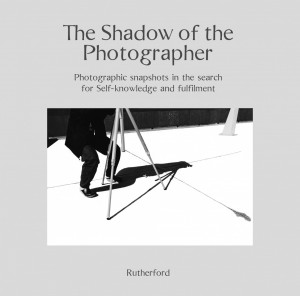 In addition to our snapshots of friends and family, holidays and special events, many of us also make photographs of things… just because we liked the way something looked, but often without knowing why our attention had been attracted to a particular scene. For example, we might photograph two children playing in a park, an old house, or a bicycle lying in the grass – but we don’t know those children, or the people who lived in that house, and that’s not our bicycle. It was suggested that, when we are prompted to record a scene with which we have no conscious or logical connection, it may be that we have intuitively recognised a personally relevant metaphor in the arrangement of elements – and one to which our subconscious is now trying to bring to our attention.
 Would you like to bring cutting edge science to a wider audience at the British Science Festival?
 Bournemouth University researchers
 Plans for a new round of Doctoral Training Partnerships (DTPs) have been
  Don’t miss our drop-in sessions where we can offer you support in planning your event for Festival of Learning 2017.
 Did you know that more people play disability football than rugby league in the UK?
 As part of the Research and Knowledge Exchange Development Framework, RKEO are holding a workshop for academics to learn more about funding opportunities from Innovate UK. This workshop will be led by our local Innovate UK KTP Adviser and the will be talking about various Innovate UK funding opportunities. There will also be a drop-in session for one-to-one advice.







 REF mock exercise 2026 – nominate your research outputs on BRIAN
 ESRC Festival of Social Science 2026: Application Deadline Extended to Thursday 25 June 2026
 First publication for two CMWH PhD students
 SPROUT Returns: Designing Sustainability in Research Practice – Wednesday 20 May 12-2pm
 Reminder: Register for the ESRC Festival of Social Science 2026 Information Session
 ECR Funding Open Call: Research Culture & Community Grant – Apply now
 ECR Funding Open Call: Research Culture & Community Grant – Application Deadline Friday 12 December
 MSCA Postdoctoral Fellowships 2025 Call
 ERC Advanced Grant 2025 Webinar
 Update on UKRO services
 European research project exploring use of ‘virtual twins’ to better manage metabolic associated fatty liver disease