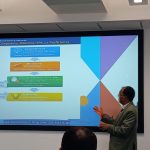
Yesterday CoPMRE welcomed 30 colleagues to our Visiting Faculty bi-annual event showcasing the exciting medical developments at BU from the new Bournemouth Gateway Building to the Institute of Medical Imaging and Visualisation. The key priorities to support delivery of BU2025 were presented by Dr Clare Wedderburn, Interim Head of Department of Medicine & Public Health presented. Juan Campos-Perez, Clinical Research Co-ordinator, BUCRU spoke about Biobanks which were highlighted in Professor Emma King’s research presentation on immunotherapy. Professor Jeffrey Wale, Lecturer in Law encouraged innovative medical cross faculty collaboration demonstrated by his recent research collaboration with Professor Sam Rowlands, Visiting Professor resulting in four co-authored papers. The main focus of the meeting centred around Visiting Faculty engagement in research and education to help us achieve our aims. The audience reported that they were ‘very excited’ about these new developments at BU and were keen to support this vision.
Category / REF Subjects
Prof. Dinusha Mendis Hosts Final Workshop of the 3D Printing – IP Project at the European Commission
On 14th October 2019, Prof. Dinusha Mendis hosted the final workshop of the European Commission funded project, ‘The Intellectual Property Implications of the Development of Industrial 3D Printing’ in Brussels.
The project aims to formulate a clear picture of the Intellectual Property (IP) framework that could enhance the competitiveness of the Additive Manufacturing (AM) sector in Europe. As such, the workshop was attended by academics, practitioners, businesses and policy makers thereby bringing together key stakeholders in the field of 3D printing and IP laws.
The workshop commenced with a welcome from Amaryllis Verhoeven, Head of the Intellectual Property Unit at the European Commission. Thereafter, Dinusha Mendis (Project Lead) presented the main results, which was complemented by presentations from invited speakers and a panel discussion consisting of members of the project team and industry partners.
Ben Redwood (Hubs), Phil Reeves (Reeves Insight Ltd) and Phill Dickens (Added Scientific Ltd) considered the future of manufacturing and its different applications and uses for industry as well as consumers.
Thereafter, various issues from the Study were explored in a panel discussion. Panelists consisting of Lieven Claerhout / Bram Smits (Materialise NV), Ann Marie Shillito (Anarkik3D), and members of the project team (see below), considered IP issues in light of the views from industry, obtained as part of the Study. In bringing the workshop to its conclusion, Jean-Francois Romainville (IDEA Consult) spoke about next steps, in taking this project and other similar projects forward. Virginie Fossoul, (Legal and Policy Officer, European Commission), closed the workshop with some concluding remarks.
The presentations as well as the panel discussion can be accessed/watched here:
https://webcast.ec.europa.eu/workshop-on-3d-printing#
The project which was awarded to Bournemouth University in 2018, by the European Commission’s Directorate-General for Internal Market, Industry, Entrepreneurship and SMEs has been led by Prof. Dinusha Mendis (Principal Investigator) from the Department of Humanities and Law at Bournemouth University.
The Co-Investigators of this project include Dr. Julie Robson (Bournemouth University, UK), Dr. Rosa Ballardini (University of Lapland, Finland), Prof. Dr. Jan Nordemann (Boehmert & Boehmert, Germany), Prof. Phill Dickens (Added Scientific Ltd, UK), Dr. Maria del Carmen Calatrava-Moreno, Mr. Alfred Radauer (Technopolis Group, Austria) and Hans Brorsen (Germany).
The final project report is due for publication in early 2020.
CMMPH represented at The European Midwives Association (EMA) conference
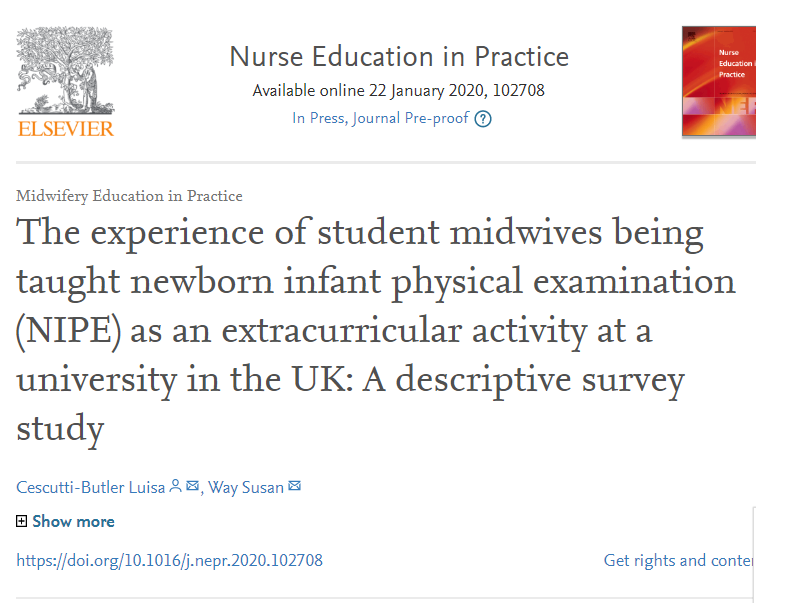
EMA held its 6th triennial education conference in Malmo, Sweden from the 28-29 November 2019. Dr. Luisa Cescutti-Butler and Professor Sue Way had three abstracts accepted, two of which highlighted units of learning in our midwifery undergraduate programme (Evaluating the student experience of introducing newborn infant physical theory into a pre-registration midwifery programme in the UK and An evaluation of the student experience of peer facilitated learning) and a further one which was focused on a national collaborative project on grading practice (Developing a set of key principles to achieve consistency in assessing pre-registration midwifery competency in practice in the UK). The opening keynote speaker at the EMA Conference was Fran McConville – Midwifery Expert at WHO. Fran presented on ‘Strengthening Quality Midwifery Education for Universal Health Coverage 2030’. Our takeaway message from her presentation was the following important statement: “When midwives are educated to international standards, and midwifery includes the provision of family planning……more than 80% of all maternal deaths, stillbirths and neonatal deaths could be averted”.
On the social side we were privileged to a hear a woman from the Sammi tribe in Sweden sing three traditional songs and a tradition adopted from Syracuse in Sicily which was the ‘Santa Lucia’ group of singers celebrating the start of Christmas who sang Xmas Carols in Swedish. We were also able to network with some significant and contemporary midwifery leaders such as Gill Walton (CEO of the Royal College of Midwives), Fran McConville (WHO) and Grace Thomas, Reader and Lead Midwife for Education (Cardiff University).

BU scholars’ paper, ‘Mirror, Mirror’, reflects well in Leadership
The journal Leadership has published the paper “Mirror, Mirror on the Wall: Shifting Leader-Follower Power Dynamics in a Social Media Context“.
Congratulations to the Faculty of Management team: Parisa Gilani (Department of People & Organisations), Elvira Bolat (Marketing, Strategy & Innovation), and Donald Nordberg (Accounting, Finance & Economics), as well as alumna Claudia Wilkin.
It’s a case of staff-student co-creation that also integrates themes across the business and management disciplines.
How to turn your Research into Impact
Amanda Lazar and Brian McNulty are running an Impact Planning Session on Friday 6th December for anyone engaged in research – from ECRs to Professors.
If you have some research that you think has the potential to make a positive change in the world, then bring it along.
We will discuss how to effectively disseminate your research, plan your impact pathway and how to evidence the impact of your research, as well as how to work towards an Impact Case Study for the REF.
By the end of the session you will have the outline of an impact pathway and will know how to access BU resources to help turn your research into impact.
Click here to book yourself onto the workshop.
Discussion Forum is on the Way! 😇Collaboration for mobilising new and emerging ICTs for sustainable development! – 11th December 2019 From 14:00 –16:00 at EB602
This discussion forum is the second ‘spin-out’ event following the Conference ‘Deep Transformations and the Future of Organisations’ (6-7 December, in Tunis). It would be a great opportunity to share the research outcomes of BU and ITU (International Telecommunication Union, one of the specialised organisations under the UN), inviting Dr Bruce Gracie, a chairman of the Telecommunication Standardisation Advisory Group (TSAG) of ITU.
As a kick-off speech, Bruce will talk about the current requirements of the telecommunication standardisations in the global context, focusing on five key themes; AI, IoT, 5G, Big Data, and OTTs.
From BU, Dr Marios Angelopoulos (Sci-Tech) will discuss the recent his achievement in the Study Group 20 of ITU-T, focusing on the impact of ICT (ITU Recommendation) in the area of the Internet of Things (IoT). Specifically, focusing on the reference model of IoT-related crowdsourced systems for an emerging networking paradigm.
Marios’s talk will be followed by Dr Hiroko Oe (FoM) , who used to be a deputy head of the delegation of Japan to the ITU, will explain the pathway how the ITU has been contributing to the development of seamless world based on the ICT, specifically focusing on the preparation tasks towards the World Telecommunication Policy Forum (WTPF-21).
BU is an academic member of the ITU, with only five UK universities; Anglia Ruskin University, Birkbeck College University of London, CISD-SOAS, University of London, Royal Holloway, University of London, and the University of Bristol. Marios and Hiroko have been working as a team with dedicated support from Dr Angelos Stefanidis, Head of Department Computing & Informatics. The research team is aiming to contribute to the policy coordination and also cooperating with the Department for Digital, Culture, Media & Sport (DCMS) to develop actionable impacts for the ICT sector globally.
This Discussion Forum will be carried out by a Skype conference method. Dr Hiroko Oe will act as a facilitator for this Forum and Dr Yan Liang (FoM) will perform as a discussant for this event who liaises with her research interest in digital marketing and digital retailing.
This Discussion Forum will provide unique and interesting views from the ICT standardisation perspectives, including key topics of the UN SDGs (e.g., Goal 9 ‘Industry, innovation and infrastructure’, Goal 11 ‘Sustainable cities and communities’, and Goal 17 ‘Partnerships for the goals’). The theme of this Forum is also in line with the SIAs of ‘Animation, Simulation & Visualisation’ and ‘ Assistive Technology’.
BU ECRs and the PG students will be invited to the Forum, too.
For more details, please email to hoe@brounemouth.ac.uk
The Road to Research Impact Starts Here
The UK Government’s Industrial Strategy ‘Building a Britain fit for the Future’ (2017) places an increased emphasis on the academic community to produce research that has impact in the form of societal and economic contribution. This impact can be achieved in many ways, for example, by creating and sharing new knowledge that results in the type of innovation that leads to market growth, improved corporate performance, jobs, new products and services.
My British Academy funded research into chronic corporate under performance has yielded some interesting findings, based on a unique methodological approach that draws on research from the field of epigenetics. I recently presented the findings to the Global Crisis Team at Edelman, a world leading consultancy for crisis management. As a result, we are now developing a number of workshops for their international senior executives.
A key factor in delivering research impact is to develop relationships and networks (1) with professional practitioners and to disseminate research in a user-friendly way. In this case, a short paper entitled “Culture also eats innovation for breakfast!” was published in Strategic Direction (2). This is a zero star rated journal that has an international readership of management consultants and business people which enabled Edelman to understand the idea in a non-academic way.
BUs Academic Career Framework informs staff that they should be disseminating professional practice outputs – and yet not many do. So, if you want to start on the road toward research impact, then think about the professional outlets that can help you disseminate your research and build a professional practice network.
1. Oliver, J.J. (2017). Developing a distinctive digital profile and network. In: Kurcirkova, N., and Quinlan,O. (eds). The Digitally Agile Researcher, Open University Press, Chapter 8, pp.80-87
2. Oliver, J.J. (2019). Culture also eats innovation for breakfast! Strategic Direction, Vol. 35 No. 12, pp. 1-3.
BU professor visiting University of West Bohemia
The University of West Bohemia in Pilsen (Plzeň in the Czech Republic) invited Bournemouth University’s Professor Edwin van Teijlingen for an academic exchange visit with BU Visiting Faculty Ms Jillian Ireland (Professional Midwifery Advocate at Poole Maternity Hospital) . Yesterday he presented a session about academic publishing to staff and students in the health faculty. This afternoon his audience comprised sociology students in a session on ‘The medical/social model of childbirth’. The two guests from Dorset were also shown round the obstetric wards of the two main maternity hospitals in the city of Pilsen. The international visit was funded by the European Union!

Ms Ireland has shared two presentations with student midwives and staff sharing the development of maternity services in partnership with families in Dorset using the ‘Maternity Matters’ website (developed as early adopters of ‘Better Births’ – Improving outcomes of maternity services in England – A five year forward view for maternity care). A particular focus on birth trauma was complemented with discussion of care and self-care of midwives. 
Contemporary Issues in Fertility Control
On the 13 November 2019, BU hosted a one day interdisciplinary conference addressing a range of perspectives and concerns relating to human fertility control. The event was opened with a keynote presentation from Clare Murphy, Director of External Affairs at the British Pregnancy Advisory Service on ‘Compelling choices: decision-making around contraception in the UK today’. This was followed by a series of contributions – including presentations from charitable, medical and academic stakeholders – with coverage of emergency and long-acting reversible contribution; population control through nudging behaviours; recognition of a legal right to family planning and discussion of abortion care and regulation. The conference was organised by Jeffrey Wale, Senior Lecturer in the Department of Humanities and Law and was funded by an ACORN award aimed at supporting Early Career Researchers. One of the central aims of the event was to start up conversations, generate new links and to establish a network of interested parties.
Growing wealth of migration publications at Bournemouth University
Yesterday saw the latest publication based on Bournemouth University (BU) migration research. The international journal BMC Public Health published our quantitative paper ‘Psychological morbidity in Nepali cross-border migrants in India: a community based cross-sectional study’ [1]. This scientific article highlights that since Nepali migrants can freely cross the border with India and hence work and stay there, they are largely undocumented. The majority of these Nepali migrant workers is involved in semi-skilled or unskilled jobs with limited labour rights and social security, which predisposes them to psychological distress. The paper assessed the prevalence of and factors associated with psychological morbidity among Nepali migrants upon their return from India.
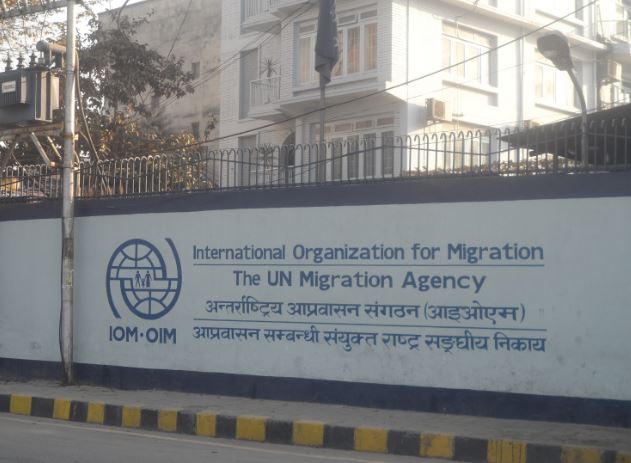
Just a few days ago the UN Migration Agency in Nepal IOM (International Organization for Migration) published ‘Research on the Health Vulnerabilities of the Cross-Border Migrants from Nepal‘, an online report to which BU academics (Aryal, Regmi & van Teijlingen) had contributed [2]. Just recently we had published the qualitative sister paper on Nepali migrants working and living in India. [3]. Whilst Dr. Nirmal Aryal was the lead author on a paper highlighting the need for more research specifically focusing on adolescents left behind by migrant workers [4]. Earlier this year BU PhD graduate Dr. Pratik Adhikary published his latest paper from his thesis, the paper is called ‘Workplace accidents among Nepali male workers in the Middle East and Malaysia: A qualitative study’ and was published in the Journal of Immigrant & Minority Health [5].
Last year was also a very good year for BU migration research, including a systematic review on sex trafficking (perhaps the worst kind of migrant workers) [6], an earlier research paper by Dr. Adhikary with his PhD supervisors [7], and one paper on Nepali female migrants workers in the Middle-East & Malaysia [8]. Earlier BU academics published on general health issues and accidents among Nepali migrant workers in Malaysia, Qatar & Saudi Arabia [9-10], Nepali migrants in the UK [11-12] , other papers included: a call for action on Public Health [13]; a systematic review [14]; a paper on migrant workers’ spouses [15]; migrant health workers in the UK [16-17]; migration and tourism industry [18-20]; migrants and space in Italy [21-22]; an anthropological perspective on migration [23]; a media studies’ perspective [24]; and archaeological perspective [25]; and a socio-economic perspective [26]. No doubt there are several other publications I have forgotten or I am simply unaware missed in this list.
Prof. Edwin van Teijlingen
Centre for Midwifery, Maternal & Perinatal Health
References:
- Dhungana, R.R., Aryal, N, Adhikary, P., KC, R., Regmi, P.R., et al. (2019) Psychological morbidity in Nepali cross-border migrants in India: A community-based cross-sectional, BMC Public Health 19:1534
- International Organization for Migration (2019) Research on the Health Vulnerabilities of the Cross-Border Migrants from Nepal, Kathmandu, Nepal: International Organization for Migration.
- Regmi, P., van Teijlingen, E., Mahato, P., Aryal, N., Jadhav, N., Simkhada, P., Syed Zahiruddin, Q., Gaidhane, A., (2019) The health of Nepali migrants in India: A qualitative study of lifestyles and risks, Journal of Environmental Research & Public Health 16(19), 3655; doi:10.3390/ijerph16193655.
- Aryal, N., Regmi, P.R., van Teijlingen, E., Simkhada, P., Mahat, P. (2019) Adolescents left behind by migrant workers: a call for community-based mental health interventions in Nepal. WHO South East Asia Journal of Public Health 8(1): 38-41.
- Adhikary P, van Teijlingen E., Keen S. (2019) Workplace accidents among Nepali male workers in the Middle East and Malaysia: A qualitative study, Journal of Immigrant & Minority Health 21(5): 1115–1122. https://link.springer.com/article/10.1007/s10903-018-0801-y
- Simkhada, P., van Teijlingen, E., Sharma, A., Bissell, P., Poobalan, A., Wasti, S.P. (2018) Health consequences of sex trafficking: A systematic review, Journal of Manmohan Memorial Institute of Health Sciences, 4(1): 130-149.
- Adhikary P, Sheppard, Z., Keen S., van Teijlingen E. (2018) Health and well-being of Nepalese migrant workers abroad, International Journal of Migration, Health & Social Care 14(1): 96-105. https://doi.org/10.1108/IJMHSC-12-2015-0052
- Simkhada, P.P., van Teijlingen, E.R., Gurung, M., Wasti, S. (2018) A survey of health problems of Nepalese female migrants workers in the Middle-East & Malaysia, BMC International Health & Human Rights 18(4): 1-7. http://rdcu.be/E3Ro
- Adhikary, P, Sheppard, Z., Keen, S., van Teijlingen, E. (2017) Risky work: accidents among Nepalese migrant workers in Malaysia, Qatar & Saudi Arabia, Health Prospect 16(2): 3-10.
- Adhikary P., Keen S., van Teijlingen E (2011) Health Issues among Nepalese migrant workers in Middle East. Health Science Journal 5: 169-75. www.hsj.gr/volume5/issue3/532.pdf
- Adhikary, P., Simkhada, P.P., van Teijlingen E., Raja, AE. (2008) Health & Lifestyle of Nepalese Migrants in the UK BMC International Health & Human Rights 8(6). Web address: www.biomedcentral.com/1472-698X/8/6
- van Teijlingen E, Simkhada, P., Adhikary, P. (2009) Alcohol use among the Nepalese in the UK BMJ Rapid Response: www.bmj.com/cgi/eletters/339/oct20_1/b4028#223451
- Aryal, N., Regmi, PR., van Teijlingen, E., Simkhada, P., Adhikary, P., Bhatta, YKD., Mann, S. (2016) Injury and Mortality in Young Nepalese Migrant Workers: A Call for Public Health Action. Asian-Pacific Journal of Public Health 28(8): 703-705.
- Simkhada, PP., Regmi, PR., van Teijlingen, E., Aryal, N. (2017) Identifying the gaps in Nepalese migrant workers’ health & well-being: A review of the literature, Journal of Travel Medicine 24 (4): 1-9.
- Aryal, N., Regmi, PR., van Teijlingen, E., Dhungel, D., Ghale, G., Bhatta, GK. (2016) Knowing is not enough: Migrant workers’ spouses vulnerability to HIV SAARC Journal of Tuberculosis, Lung Diseases & HIV/AIDS 8(1):9-15.
- Scammell, J., 2016. Nurse migration and the EU: how are UK nurses prepared? British Journal of Nursing, 25 (13), p. 764.
- Sapkota, T., Simkhada, P., van Teijlingen, E. (2014) Nepalese health workers’ migration to United Kingdom: A qualitative study. Health Science Journal 8(1):57-74.
- Janta, H., Ladkin, A., Brown, L., Lugosi, P., 2011. Employment experiences of Polish migrant workers in the UK hospitality sector. Tourism Management, 32 (5): 1006-1019.
- Dwyer, L., Seetaram, N., Forsyth, P., Brian, K. (2014) Is the Migration-Tourism Relationship only about VFR? Annals of Tourism Research, 46: 130-143.
- Filimonau, V., Mika, M. (2017) Return labour migration: an exploratory study of Polish migrant workers from the UK hospitality industry. Current Issues in Tourism, 1-22.
- De Martini Ugolotti, N., 2016. ‘If I climb a wall of ten meters’: capoeira, parkour and the politics of public space among (post)migrant youth in Turin, Italy. Patterns of Prejudice, 50 (2), 188-206.
- De Martini Ugolotti, N., 2015. Climbing walls, making bridges: children of immigrants’ identity negotiations through capoeira and parkour in Turin. Leisure Studies, 34 (1), 19-33.
- Mai, N., Schwandner-Sievers, S. (2003) Albanian migration and new transnationalisms, Journal of Ethnic & Migration Studies 29(6): 939-948.
- Marino, S., Dawes, S., 2016. Fortress Europe: Media, Migration and Borders. Networking Knowledge, 9 (4).
- Parker Pearson, M., Richards, C., Allen, M., Payne, A. & Welham, K. (2004) The Stonehenge Riverside project Research design and initial results Journal of Nordic Archaeological Science 14: 45–60.
- Chowdhury, M., 2014. Migration, Human Capital Formation and the Beneficial Brain Drain Hypothesis: A Note. Migration & Development, 3 (2), 174-180.
Call for EoIs: Impact Champion for UOA 18 to drive REF 2021 preparations
BU is preparing submissions for units of assessment (UOAs) for REF 2021. Each UoA has a UoA Leader, supported by an Impact Champion and Outputs Champion. The roles are recruited through an open and transparent process, which gives all academic staff the opportunity to put themselves forward for UOA roles.
We are currently seeking an expression of interest (EoI) from academic staff interested in supporting impact development for UoA 18 Law.
Impact Champions play a key role in shaping the impact element of their UoA’s submission. They work closely with their Faculty’s Impact Officer and Impact Post-Doctoral Researcher, where relevant.
Key responsibilities of the Impact Champion role include:
- Review the development of impact case studies being prepared within the UOA
- Provide guidance on how impact case studies can be accelerated and evidenced
- Advise colleagues on the REF impact guidelines
- Review impact strategies related to the UOA and assess progress made against them
- Review and implement recommendations from external research users to strengthen research impact
- Ensure that colleagues are updating institutional systems for impact tracking
- Promote relevant training and development opportunities
- Review impact arising from major programmes of research and knowledge exchange to make recommendations as to how these can contribute to impact case studies
- Advise on the use of appropriate metrics specific to the subject area
- To undertake any other duties as requested by the relevant Deputy Dean for Research and Professional Practice (DDRPP) and/or Unit of Assessment leader.
The full role description can be found here – Impact Champion Role Descriptor.
Application process:
To apply for the role, please submit a short statement (suggested length 300 words) explaining your interest in the role and what you could bring to it. This should be sent by email to Professor Dinusha Mendis by Friday 22nd November 2019. The EoIs will be reviewed by the UoA Leader and Output Champion.
The selection criteria used at EoI are outlined below. Each criterion carries a total possible score of 5. The role will be offered to the highest scoring applicant. The UoA Leader or current Impact Champion will provide feedback to all applicants.
- Knowledge of the REF and research impact (scored out of 5): Applicants should have the appropriate level of skill and knowledge to help them support the development of impact in their UoA. It is expected that Impact Champions will predominantly be practising researchers and will have a breadth of understanding of research across their Faculty. They are also expected to have an understanding of the REF assessment process and of research impact.
- Experience of external engagement and / or impact development (scored out of 5): Impact Champions are expected to be able to provide advice and direction to colleagues who want to develop their research impact. Experience of engaging with external organisations or developing your own research impact would be of benefit in this role.
- Commitment, motivation and enthusiasm (scored out of 5): Being an Impact Champion is a big commitment and the role has the scope to help shape impact development at BU. Applicants need to be committed to the role, as well as showing the enthusiasm and motivation needed to support their UoA.
Call for EoIs: Output Champion for UOA 20 to drive REF 2021 preparations
BU is preparing submissions for units of assessment (UOAs) for REF 2021. Each UoA has a UoA Leader, supported by an Impact Champion and Outputs Champion. The roles are recruited through an open and transparent process, which gives all academic staff the opportunity to put themselves forward for UOA roles.
We are currently seeking an expression of interest (EoI) from academic staff interested in supporting output development for UoA20 Social Work & Social Policy.
Output Champions play a key role in shaping the output element of their UoA’s submission. Key responsibilities of the Output Champion role include:
- Support the development of research outputs being prepared within the UOA
- Provide guidance on how research outputs can be produced and published
- Advise colleagues on the REF output guidelines specifically those in relation to assessment, open access and research metrics
- Review output strategies related to the UOA and assess progress made against them
- Ensure that colleagues are updating institutional systems such as BRIAN and BURO
- Promote Open Access publication and use of the Open Access Publication Fund as appropriate
- Promote relevant training and development opportunities
- Review outputs arising from major programmes of research and knowledge exchange to make recommendations as to how these can contribute to the UoAs output profile
- Work with Post-Doctoral Research Fellows on REF Output related activity as appropriate.
The full role description can be found here.
Application process:
To apply for the role, please submit a short statement (suggested length 300 words) explaining your interest in the role and what you could bring to it. This should be sent by email to Professor Jonathan Parker by Friday 22nd November. The EoIs will be reviewed by the UoA Leader and Impact Champion.
The selection criteria used at EoI are outlined below. Each criterion carries a total possible score of 5. The role will be offered to the highest scoring applicant. The UoA Leader will provide feedback to all applicants.
- Knowledge of the REF (scored out of 5): Applicants should have the appropriate level of skill and knowledge to help them support the development of outputs in their UoA. It is expected that Output Champions will predominantly be practising researchers and will have a breadth of understanding of research across their Faculty. They are also expected to have an understanding of the REF assessment process and of research outputs and open access.
- Experience of output development (scored out of 5): Output Champions are expected to be able to provide advice and direction to colleagues who want to develop their research outputs.
- Commitment, motivation and enthusiasm (scored out of 5): Being an Output Champion is a big commitment and the role has the scope to help shape output development at BU. Applicants need to be committed to the role, as well as showing the enthusiasm and motivation needed to support their UoA.
Call for EoIs: Output Champion for UOA 17 to drive REF 2021 preparations
BU is preparing submissions for units of assessment (UOAs) for REF 2021. Each UoA has a UoA Leader, supported by an Impact Champion and Outputs Champion. The roles are recruited through an open and transparent process, which gives all academic staff the opportunity to put themselves forward for UOA roles.
We are currently seeking an expression of interest (EoI) from academic staff interested in supporting output development for UoA17 Business & Management, alongside the existing Output Champion George Filis.
Output Champions play a key role in shaping the output element of their UoA’s submission. Key responsibilities of the Output Champion role include:
- Support the development of research outputs being prepared within the UOA
- Provide guidance on how research outputs can be produced and published
- Advise colleagues on the REF output guidelines specifically those in relation to assessment, open access and research metrics
- Review output strategies related to the UOA and assess progress made against them
- Ensure that colleagues are updating institutional systems such as BRIAN and BURO
- Promote Open Access publication and use of the Open Access Publication Fund as appropriate
- Promote relevant training and development opportunities
- Review outputs arising from major programmes of research and knowledge exchange to make recommendations as to how these can contribute to the UoAs output profile
- Work with Post-Doctoral Research Fellows on REF Output related activity as appropriate.
The full role description can be found here.
Application process:
To apply for the role, please submit a short statement (suggested length 300 words) explaining your interest in the role and what you could bring to it. This should be sent by email to Professor Chris Chapleo by Friday 22nd November. The EoIs will be reviewed by the UoA Leader and existing Output Champion.
The selection criteria used at EoI are outlined below. Each criterion carries a total possible score of 5. The role will be offered to the highest scoring applicant. The UoA Leader or current Output Champion will provide feedback to all applicants.
- Knowledge of the REF (scored out of 5): Applicants should have the appropriate level of skill and knowledge to help them support the development of outputs in their UoA. It is expected that Output Champions will predominantly be practising researchers and will have a breadth of understanding of research across their Faculty. They are also expected to have an understanding of the REF assessment process and of research outputs and open access.
- Experience of output development (scored out of 5): Output Champions are expected to be able to provide advice and direction to colleagues who want to develop their research outputs.
- Commitment, motivation and enthusiasm (scored out of 5): Being an Output Champion is a big commitment and the role has the scope to help shape output development at BU. Applicants need to be committed to the role, as well as showing the enthusiasm and motivation needed to support their UoA.
Ways of Seeing Sport Coaching Violence – a unique interactive installation
On Monday 4th November 2019, as part of the ESRC festival of social science, Dr Emma Kavanagh and Dr Adi Adams (Faculty of Management) alongside final year sport student Terri Harvey, curated and hosted an arts based installation to showcase their research on inter-personal violence in sport. The event adopted an innovative, immersive, sensory art-based method not traditionally utilised in sport coach education (but widely used in other ‘caring’ professions) to bring their research knowledge to life and allow coaches and other practitioners to engage with data in a dynamic manner. This was achieved through re-presenting research data collected by the BU academics in audio and visual forms.
Abuse, intimidation and violence in sport and coaching remains a significant global problem. In 2017 the British Government published the Duty of Care in Sport Review, sharing the findings of a critical inquiry into the culture and climate of elite sport in the United Kingdom. High performance sport came under significant scrutiny linked to a number of high profile accounts in the media that raised serious questions concerning the safety of elite sporting spaces and the threats they can pose to athlete welfare. Allegations of bullying, racial, sexual and gender abuse alongside other forms of discrimination have been made across Olympic and Paralympic sports. This ESRC event provided an opportunity to engage practitioners in debates surrounding the safety of sporting spaces as a way of promoting the duty of care in practice.
The event brought to life qualitative social science research data, currently available to academics through peer-reviewed journal articles through the production of an immersive arts-based installation. The data was used to enable those who attended to see/hear/feel and confront the contemporary issue of inter-personal violence in the world of sport coaching, from the perspective of ‘others’. The event aimed to bring sport coaches (and other practitioners) together around a shared concern/problem in the sport industry, with the aim of inspiring awareness, understanding, empathy, care and practical solutions to reducing interpersonal-violence. An arts and media-based approach is often adopted in the education of other ‘caring’ professions engaged in complex, difficult, ‘social’ and emotional work (e.g. nurses, medical practitioners, social workers, palliative care workers), yet has gained limited application in the sporting profession.
The event attracted significant attention from external practitioners, students and local organisations. Participants moved around and shared the immersive space with others, experiencing the ‘felt difficulty’ (Trevelyan et al., 2014) of ‘what it feels like’ to experience violence and intimidation as a participant in sport. It is anticipated that experiencing this ‘felt difficulty’, provoked by engaging with material that is ‘perplexing’ or ‘disorientating’ has the potential to provide a platform for coaches to reflect authentically on and transform their own practice. The impact of attending the installation is currently the topic of Terri’s dissertation and the team are excited to understand more about how participants experienced the event.
The event would not have been a success without the support of the ESRC team and, in particular, Adam Morris who helped drive the installation forward. In addition, thanks goes to the sport students who volunteered on the evening and actively engaged in the project through ‘becoming voices’. All of these people shared one passion; making sport a safer space for all those who participate in it.
What makes a Bournemouth University publication?
Last week the IOM (Int
ernational Organization for Migration) in Nepal, the UN Migration Agency published a new report online: Research on the Health Vulnerabilities of the Cross-Border Migrants from Nepal. This report mentioned the input and advice of Bournemouth University (BU) staff, including Dr. Nirmal Aryal, who worked on the report prior to his appointment at BU and who is listed as Co-Investigator, furthermore listed as Resource Persons are: Dr. Pramod Regmi and Prof. Edwin van Teijlingen. Working with the charity Green Tara Nepal (GTN) on this study has been good for IOM and BU. All of use have worked on the report in different kind of ways and to different degrees. The publication suggested a corporate authorship as ‘International Organization for Migration’, which is great for the status of the report as it is a UN agency. We feel part of this as BU academics and feel we are part of the team despite this not being a BU publication!
Professor Edwin van Teijlingen
CMMPH
Reference:
International Organization for Migration (2019) Research on the Health Vulnerabilities of the Cross-Border Migrants from Nepal, Kathmandu, Nepal: International Organization for Migration. Available at : https://nepal.iom.int/sites/default/files/publication/Research_on_The_Health_Vulnerabilities_of_The_Cross_Border_Migrants_from_Nepal_0.pdf
NIHR Invention for Innovation (i4i) Programme – Product Development Awards – Live FAQ sessions
- 11 November 2019 at 2pm
- 15 November 2019 at 11am
Please note the links won’t be active until just before the starting time.
Your local branch of the NIHR RDS (Research Design Service) is based within the BU Clinical Research Unit (BUCRU) on the 5th floor of Royal London House.
We can help with your application. We advise on all aspects of developing an application and can review application drafts as well as put them to a mock funding panel (run by RDS South West) known as Project Review Committee, which is a fantastic opportunity for researchers to obtain a critical review of a proposed grant application before this is sent to a funding body.
Come as early as possible to benefit fully from the advice
Feel free to pop in and see us in person, call us on 61939 or send us an email.
Helping Nurses Stay Infographic
Bournemouth University (Principal investigator- Janet Scammell) and Royal Bournemouth and Christchurch Hospitals NHS Foundation Trust (RBCH) recently collaborated on a Burdett Trust for Nursing funded research project (Making TRACS to improve nurse retention) on improving nurse retention. One of the main findings of this collaborative research project was what helps keep nurses in the workplace. The main factors that impact on nurse retention are Transition periods in one’s life, Resilience to cope with stressful situations, Authentic leadership as role models, Commitment of the organisation, and Support of a nurse’s health and wellbeing. Using these main concepts, we developed an infographic to present the findings of our research to enable an improvement in nurse retention.
Here is a glimpse, but you can click on the link below for the full pdf!
Helping nurses stay_BU.RBCH.TRACS2019
Dr Emily Arden-Close from Psychology presents to Santander about problem gamblers
On 16th October, Dr Emily Arden-Close, Senior Lecturer in Psychology, presented to Santander Group about how they can help problem gamblers. This was based on research she had conducted exploring ex-problem and social gamblers’ experiences of gambling and perceptions of EROGamb, technology developed by the Responsible Online Gambling Research Team for managing responsible online gambling.
The presentation generated a lot of discussion, and is expected to lead Santander Group taking an active role in developing policy to enable early identification of problem gamblers.


Dr. Chloe Casey on Sky News
Final Bournemouth University publication of 2025
On Christmas Day in the Morning…
New Nepal scoping review on maternal & neonatal health
ECR Funding Open Call: Research Culture & Community Grant – Application Deadline Friday 12 December

MSCA Postdoctoral Fellowships 2025 Call

ERC Advanced Grant 2025 Webinar
Horizon Europe Work Programme 2025 Published
Horizon Europe 2025 Work Programme pre-Published
Update on UKRO services
European research project exploring use of ‘virtual twins’ to better manage metabolic associated fatty liver disease