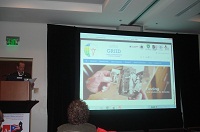
Bournemouth University Dementia Institute (BUDI) held its third open meeting at the university on 14th May, with this year’s theme being dementia friendly environments. The day was well attended by practitioners, family carers, the general public and people with dementia. It started with a lovely buffet lunch sponsored by Alzheimer Research UK, providing an opportunity for delegates to network and to browse the information stands hosted by themselves and BUDI Ph.D. students. The open meeting was formally opened by Professor Gail Thomas who praised the innovative work being carried out by the BUDI team. Delegates then heard presentations from Dr Fiona Kelly on dementia friendly design, Dr Jan Wiener on the use of eye tracking technology to explore navigation skills and difficulties, Kathrin Büter on using computer technology to support dementia friendly design in hospitals. This session closed with a presentation by architect Niall McLaughlin on his work with communities and older people to design care homes that meet everyone’s needs and are inspirational, therapeutic spaces. The final part of the day involved a question and answer session where delegates and presenters discussed some of the issues raised during the day including how to ensure that the concept of good design filters down to those commissioning, designing and using buildings that people with dementia also use. This successful event is sure to have got people thinking and sharing some of what they heard and we look forward to holding similar events in the future.
Category / Technology & Design
SciTech postgraduate conference and poster presentation
Yesterday the postgraduate researchers in the Faculty of Science and Technology (SciTech) held their annual showcase of their research projects. For the applied sciences students this took the form of 15 minutes presentations and the design, engineering and computing students presented posters.
Former PhD student Kathryn Ross opened the presentations in the Lawrence Lecture Theatre and likened the process of studying for a doctorate to taking part in a 100 mile walk. Kathryn was an inspiration to her peers, showing how hard work and persistence can get results. Her own PhD project investigating the effects of sea-level rise on the avocet population in Poole Harbour yielded new and interesting findings about the birds’ diet.
The subsequent presentations were outstanding, covering a wide variety of topics including how parasites impact eco-systems, volunteer engagement, the process of ageing fish and the spread of the domestic chicken through Europe.
The posters were equally impressive, featuring rescue robots, intelligent call routing and lie detector technology among others.
The work of the Bournemouth University Dementia Institute (BUDI) postgraduate researchers was strongly represented, including a remarkable project looking at adapted home environments for people living with dementia.
It was wonderful to see the amazing research being carried out by BU’s postgraduate community, with the support of their dedicated supervisors. I have no doubt many of them will make valuable contributions to their field in the future.
And to any postgraduate researchers reading this… If you would like to share your research more widely via the BU website or other channels, please do email me. I’d love to help you with that. Additionally, if you are interested in taking part in any public engagement activity, we have some great opportunities including a tent at Camp Bestival. If you like to find out more please email our Public Engagement Manager Barry Squires.
Facebook User Interface to suit Saudi Arabian culture
We would like to invite you to the next research seminar of the Creative Technology Research Centre that will be delivered by Hana Almakky.
Title: Facebook User Interface to suit Saudi Arabian culture
Time: 2:00PM-3:00PM
Date: Wednesday 28th May 2014
Room: P302 (Poole House, Talbot Campus)
Abstract: Social media has continued growing in Saudi Arabia. Millions of businesses and trades are now using social media for entertainment, advertisement and promoting themselves internationally. Social networking sites, like Facebook, Twitter, YouTube etc., have gained huge popularity at personal as well as professional scale. Therefore, work is being done to evolve the modes of communication over these platforms, extensively. My research explores the effect of Saudi cultures on the design of social media site of Facebook. The expected outcome of this research will be a theoretical framework that guides the design of a user interface for Facebook to meet the Saudi’s expectations.
We hope to see you there,
Dr. David John
Dragons’ Den: Pitch to the Editors
Do you have a science news story worthy of appearing in Nature, The Times or Research Fortnight?
Organisers of the UK Conference of Science Journalists are running a ‘Dragons’ Den: Pitch to the Editors’ session, open to students, recent graduates or scientists with a great story.
This is your chance to stand up in front of top journalists and ‘sell’ your story idea. It can be about any aspect of science, as long as it is suitable for Nature, the Times or Research Fortnight. (Do make sure you research the publications before submitting)!
Successful applicants will pitch their story idea to Helen Pearson (Nature), Ehsan Masood (Research Fortnight) and Hannah Devlin (The Times) in front of a live audience at the conference on Wednesday 18th June in London.
For more information and details of how to apply, visit http://www.ukcsj.org/dragons-den.html. Applications are open until 23rd May.
If you would like to discuss your pitch, email Sally Gates (Research Communications Manager).
Understanding Crowdsourcing and CCTV surveillance
Staff, students and members of the public are invited to join us for the next Cyber Security Seminar…
‘Understanding Crowdsourcing and CCTV surveillance’
Tuesday, 27th May
Coyne Lecture Theatre
4pm – 5pm
Closed Circuit Television (CCTV) has many different uses but is often considered an archetypal surveillance technology. These infrastructures generate large amounts of data; so much so that the technique of crowdsourcing has recently been applied to the problem of searching for abnormalities in live surveillance video; the premise being that many inexpert watchers are cheaper but as efficient as a small number of experienced security experts. However, the merits of crowdsourcing watchers of surveillance video are largely unknown.
In this talk Dr. Paul Dunphy will describe exemplar infrastructures of this type, and two user studies that assess the performance of the watchers of CCTV video online. The results prompt a discussion regarding the effectiveness of using crowdsourcing in such contexts, and the role such infrastructures can play in society.
Speaker Bio: Paul is a postdoctoral researcher in the Culture Lab at Newcastle University. He is interested in multi-disciplinary approaches to understand and design security and privacy technologies.
If you would like to join us for this presentation, please book your place via Eventbrite.
Puerto Rico welcomes a new BUDI

Every year the prestigious Alzheimer’s Disease International conference welcomes practitioners, academics, people living with dementia, medical professionals and clinicians from all over the world to share their latest knowledge, experience and research about dementia careThis year I was lucky enough to attend and represent BUDI at the 29th International Conference of Alzheimer’s Disease International Dementia: Working Together for a Global Solution, hosted in San Juan on the beautiful island of Puerto Rico.
Three abstracts were accepted to be orally presented, so this was a great opportunity to showcase some of BUDI’s innovative research projects to world leading dementia specialists. The three presented projects were the Technology Club (Dementia Care and Technology), Tales of the Sea (Empowering people with dementia) and (Dont) Mention Dementia (Voices of people with dementia and their families).
All three presentations were well received and stimulated discussion and many questions. The feedback I received after my presentations and during the conference was that BUDI’s projects were seen as innovative, creative and great examples of how to engage people with dementia in research and how people with dementia should be at the core of all research.
Above and beyond presenting, I had the opportunity to catch up with Peter, an Australian colleague (who I have been working on the international GRIID research project with for around two years and have never met!) Peter presented the GRIID project (Gateway to Rural International Initiatives in Dementia) at this conference. After his presentation we were able to meet and come up with some really innovative ideas to take the GRIID project to the next level.
To top off a very successful conference, I won a huge kangaroo courtesy of the Australian Alzheimer’s Association. He was unfortunately a bit too big to fit into my case so he to travelled home with another colleague…I wonder if I will ever get him back as he was very cute!
Since returning home I have started to get in touch with some of the many contacts I made at this conference and look forward to potential international collaborations. This conference highlights all the good work currently being undertaken but also emphasises the amount of work we still need to do. I invite you to check out the below clip of Richard Taylor PhD, who presented numerous times at the conference. Richard is extremely funny and has a great approach and attitude to life. It is very thought provoking as he shares his thoughts about living with dementia. http://www.youtube.com/watch?v=lHQfc3KJ9qE.
Clare Cutler, BUDI Project Manager
Latest CEMP Research Bulletin
Here is the updated CEMP Research / Innovation bulletin for May / June 2014. CEMP bulletin May June 2014
Please contact Julian or Richard in CEMP if you are interested in any of the funding opportunities here, or have other ideas for collaborative projects with CEMP.
Fusion – Establishment of research collaboration, student and staff exchanges with the University of KwaZulu-Natal, South Africa
My application to the Fusion Investment Fund (FIF) has been successful. The funds will be used to establish research collaboration, student and staff exchanges with the University of KwaZulu-Natal (UKZN), South Africa. I will be travelling to the UKZN during Easter this month for an exploratory visit. While at UKZN, I will present a paper to the School of Accounting, Economics and Finance. This will be followed by a series of meetings with students and staff. On my return, I will apply to Bournemouth University to put in place the three relationships.
A successful establishment of the three aforesaid relationships will have many enormous benefits to the students and staff of BU and UKZN. For example, students should benefit culturally in terms of spending sometime in South Africa and UK respectively due to differences in the two countries’ cultures. In addition to cultural awareness, the staff exchange will benefit the staff involved through observing how lecturers in a different country deliver lectures. Apart from co-authoring academic journal articles, research collaboration between BU and UKZN staff should be beneficial where the research call (e.g. Horizon 2020) requires that researchers from Europe collaborate with a partner from South Africa.
At an institution level, the relationships should help BU in two main ways. Firstly, student exchange should increase awareness of BU in Africa which may translate into increase in percentage of African students enrolled at BU. Increasing the percentage of students from Africa is important for BU because currently less than 4% of our students are from Africa compared to 8% UK universities average. Secondly, the increase in student population from Africa will also help BU achieve the strategic plan objective of increasing overseas students’ recruitment by 15% by 2015.
UKNZ is the third largest university in South Africa and a very good university and also shares great similarities in university teaching, research and enterprise activities with those of the Business School, School of Tourism, Design, Engineering and Computing, School of Health and Social Care. Further information about the university can be found on: http://www.ukzn.ac.za/.
Dr Ven Tauringana, Associate Professor of Accounting – The Business School
Sustainable Design Research Centre New Experimental Resources for Research & Education
Sustainable Design Research Centre
Faculty of Science & Technology
Newly Added and Commissioned Experimental Resources for Research & Education
The following new equipment have been recently added to the lab resources for both research & education. Two
PhD research projects in Renewable Technology (Heat Transfer and Thermodynamic Expansion) and one Research Assistant within SDRC are fully funded by industrial partner FES Ltd [Dr Zulfiqar Khan, PI]. This research informs education within the Design & Engineering Framework, MEng Programme, through Level I Thermo-fluids & Heat Transfer (20 Credit) unit led by Dr Zulfiqar Khan.
These equipment are significant addition for enhancing students’ experience and providing a vehicle for realising BU Fusion initiative.
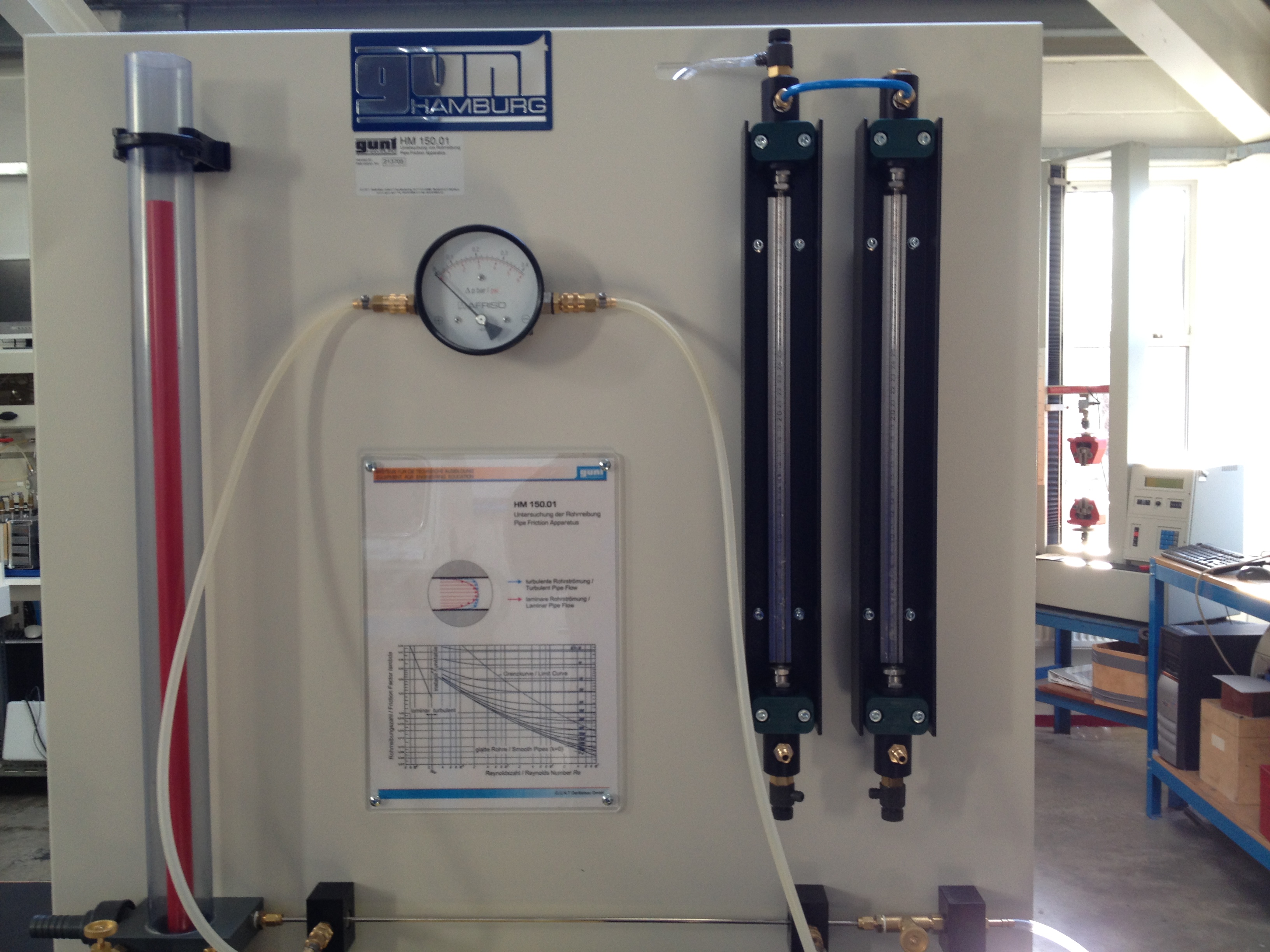
PIPE FRICTION APPARATUS
The experimentation stand can be used to investigate pipe frictional losses with laminar and turbulent flows. The pipe section is a brass pipe with an internal diameter of 3 mm. The distance between the pressure measuring fittings and thus the length of the experimental pipe section is 400 mm.
The pressure losses for laminar flow are measured using a water manometer. The static pressure difference is displayed. A head tank is available to create a laminar flow and ensures a constant water inlet pressure in the pipe section at a constant water level.
For turbulent flow, the pressure difference is measured using a dial manometer. The head tank is not used to create a turbulent flow. The water is fed directly into the pipe section from the water supply via a bypass. The flow is adjusted using shut-off valves at the beginning and end of the pipe. The water supply is provided either by the Basic Hydraulics Module or from the mains supply in the laboratory.
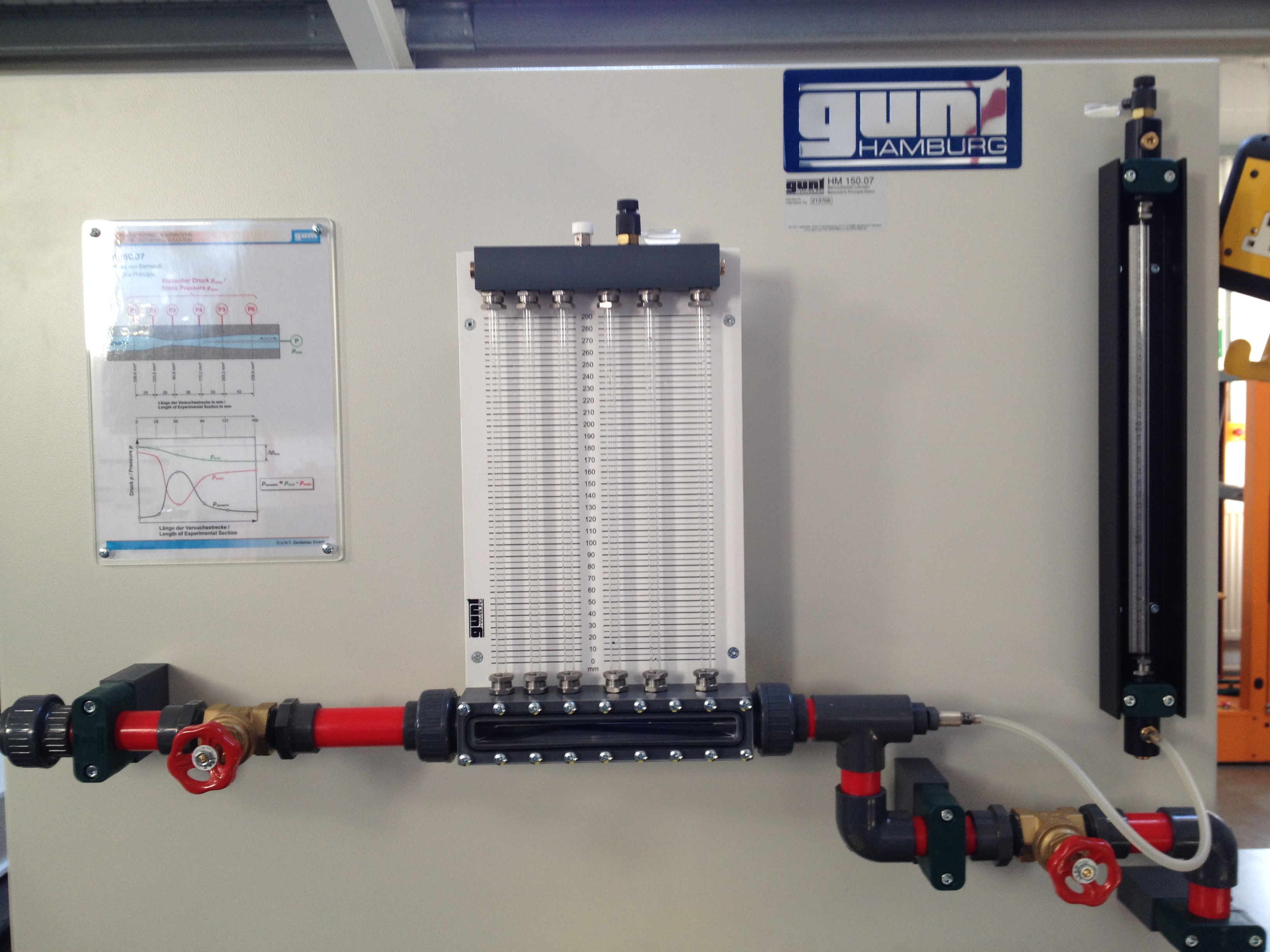
BERNOULLI’S PRINCIPLE DEMONSTRATOR
The equipment is used to investigate Bernoulli’s law. The measurement object is a Venturi nozzle with six pressure measurement points. The six static pressures are displayed on a board with six water pressure gauges. The overall pressure can also be measured at various locations in the Venturi nozzle and indicated on a second water pressure gauge. Measurement is by way of a probe which can be moved axially with respect to the Venturi nozzle. The probe is sealed by way of a compression gland. Water is supplied either from the Fluid Mechanics Basic Module or from the laboratory mains.
The equipment enables a closed water circuit to be constructed.
Possible experiments:
- Demonstration of Bernoulli’s law
- Pressure measurements along Venturi nozzle
- Determination of flow rate factor K
[The above information are provided by GUNT Publication-no.: 917.000 01 A 150 12 (A) Experiment instructions HM 150.01 Pipe Friction Apparatus & Experiment Instructions HM 150.07 Bernoulli’s Principle Demonstrator].
If you have interest in Renewable Technology research & education and would like to find more about the activities within the Sustainable Design Research Centre, then please contact.
Dr Zulfiqar Khan (Associate Professor)
Director SDRC
BU Researchers launch a new online copyright resource at the AHRC Creative Economy Showcase London

Following the internal launch at BU on the 14th February 2014, BU Researchers at the Centre for Intellectual Property Policy and Management (CIPPM) launched the Copyrightuser.org at The Arts and Humanities Research Council (AHRC) Creative Economy Showcase.
The event was held at Kings Place, London, on Wednesday 12th March 2014. The Showcase demonstrated the outputs and innovations of AHRC investments in the Creative Economy through presentations, workshops and exhibitions. The sectors exhibited on the day, included fashion, design, video games, architecture, broadcasting, archives, digital technologies and dance.
Amongst the various funded initiatives showcased on the day, Copyrightuser.org held a prominent exhibition stand and exhibited the website which was complemented by large posters, bookmarks and myth/reality cards (illustrated below) which explained the most common myths about copyright.
This high-profile event was attended by over 450 delegates and included policy-makers, business leaders in the creative industries, knowledge exchange practitioners, directors of research in universities, senior representatives from partner organisations in the Creative Economy, other strategic funding agencies in the sector, representatives from the AHRC’s investments in the Creative Economy and other stakeholders.
Keynote speakers included amongst others Sebastian Conran (Designer), the Hon David Willetts (Minister of State for Universities and Science), Ed Vaizey MP (Minister for Culture, Communications and Creative Industries) and Professor Rick Rylance (CEO, AHRC).
Highlights from the day can be streamed here.
Copyrightuser.org was funded by the BU Fusion Investment Fund in 2012 and was developed by the Business School’s Centre for Intellectual Property Policy and Management (CIPPM) in collaboration with Centre for Excellence in Media Practice (CEMP). Following the success of the Fusion Funded project, the CIPPM-led team went on to secure RCUK funding provided by CREATe in August 2013 to extend the scope of the project. Phase II of the copyrightuser.org is now underway.
The launched online resource aims to make UK copyright law accessible to creators and members of the public. This 1-minute video captures the concept behind the Copyrightuser.org project.
Using quantitative and qualitative methods the site aims to provide answers to the most pressing concerns that creators and the public have about copyright law. To achieve these aims, interviews with creators where conducted and a video for each creative sector was produced demonstrating their thoughts and questions about copyright, see the musicians video here for example. Secondly, 200 frequently asked questions posted by users online were sourced, analysed and coded down to the 20 most common.
The Copyrightuser.org has so far been received very well as evidenced by the positive feedback from various organisations, individuals, legal professionals and the creative industries.
During the launch, the website received 232 visits; and has now received over 1,558 visits to date.
Please also visit our twitter page – @copyrightuser to keep up with the Copyrightuser.org developments.
The copyrightuser.org team consists of:
Dr. Dinusha Mendis (Principal Investigator & Co-Director CIPPM)
Mr. Bartolomeo Meletti (Lead Multimedia Producer and CIPPM Research Assistant)
Ms. Hayleigh Bosher (PhD Candidate (Copyright) and CIPPM Research Assistant)
Professor Martin Kretschmer (Principal Investigator & Director CREATe)
Dr. Kris Erickson (Co-Investigator, CREATe).
The team is further assisted by a Production Team consisting of Marco Bagni (Art Direction, Design and Animation), Sar:co (Music and SoundFX), Davide Bonazzi (Illustrations) amongst others and an Editorial Board consisting of Professor Maurizio Borghi (Director, CIPPM); Professor Ruth Towse (Co-Director, CIPPM); and Professor Ronan Deazley (Professor of Copyright Law, University of Glasgow) amongst others.

Dash7 for remote patient monitoring via mobile phone
We would like to invite you to the next research seminar of the Creative Technology Research Centre that will be delivered by Andrew Yearp.
Title
Dash7 for remote patient monitoring via mobile phone
Time: 2:00PM-3:00PM
Date: Wednesday 26th March 2014
Room: P302 (Poole House, Talbot Campus)
Abstract: Wireless Remote patient monitoring systems provide an improved environment for hospital patients while expanding the range physiological information available to medical personnel. With these developments patients are now free from wires, but are still contained within the range of the wireless monitoring system. This seminar explores the application of Dash7 and mobile phone technologies in patient monitoring, particularly in hospital wards. The functionality of a prototype system which has been developed so far will be demonstrated during this seminar.
We hope to see you there,
Dr. David John
Significant Professional Practice Role and Contributions
Dr Zulfiqar Khan, Director Sustainable Design Research Centre has been appointed as Industrial Advisor (voluntary role) by the Institution of Mechanical Engineers (IMechE). The role of Industrial Advisor (IA) is to evaluate membership applications where candidates are usually not required to attend a membership interview. IA also evaluates Fellowship applications of the Institution. IA provides an evaluative report to the IMechE Professional Review Committee (PRC). IAs are appointed by the IMechE to provide expert guidance to the Institution staff, the Professional Review Committee and where necessary, other committees who are involved in the membership application process.
“The Industrial Advisor’s prime responsibility is to undertake an initial peer assessment of applications in a variety of situations where an interview is not normally required:
- Applications for transfer of Member to Fellow
- Applications from existing CEng, IEng or EngTech registrants
- Applications via a Mutual Recognition Agreement (MRA)
- Applications via the European Mobility Directive (EMD)
Industrial Advisors will normally assess applicants from their indicated areas of expertise.”
If you are interested to know more about the IMechE, its membership/registration please click on the link or contact
Dr Zulfiqar Khan (Associate Professor)
Director Sustainable Design Research Centre
Faculty of Science & Technology
Website & BRIAN Training Sessions
Due to popular demand we are hosting training sessions for the new research webpages together with BRIAN training.
These sessions are open to all BU academic staff, post graduate research students and those supporting researchers in their communications activity.
During the session you will learn the following:
Research Webpages
- Why BU has new research webpages
- How you can upload content to the website
- How the site can be used most effectively to maximise exposure of BU research.

BRIAN
- What is BRIAN and why is it important
- How to set up and maintain your BRIAN profile
- How to ensure your details are correct
- How to request a photo is uploaded
- How BRIAN links to your external staff profile
To book on one of the following sessions please use the links below…
Thursday 27th March 2pm in P421 Poole House, Talbot Campus
Thursday 17th April 2pm in P421 Poole House, Talbot Campus
We hope to follow these with a session at the Lansdowne Campus (room pending). If you would be interested in a Lansdowne session or you have any queries, please email Shelly Maskell on smaskell@bournemouth.ac.uk
FUSION within Sustainable Design Research Centre (SDRC) – Faculty of Science & Technology
“At the heart of the BU2018 strategy is the powerful fusion of research, education and professional practice, creating a unique academic experience where the sum is greater than the component parts”.
SDRC has been actively engaged with the BU Fusion initiative through various methods i.e. Fusion fund, Festival of Learning, Fusion conferences, international collaborations, chairing international conferences, keynote & invited guest speaking, journal reviews & editorship, funding councils review panels, visiting professors from international HE, engaging with regional industry & community stakeholders and research informed education.
Some examples of research informed education & linkages between the two academic activities are provided briefly.
Design Engineering Level – C
Unit: Design Methods & Projects (40 credit)
Dr Zulfiqar Khan is leading this significant unit within the Design & Engineering framework in the Faculty of Science & Technology. This unit has four projects. Final project (project 4, 50% of the course work) is linked to The Tank Museum. An educational trip to the museum is part of the course work, an additional visit (complimentary free entry for the day), which involves access/study to/in archives and study of engineering systems & components within design & engineering context. This project is linked to the PhD research projects with the Tank Museum [Zulfiqar Khan lead] and current collaborative research project with the Defence Science & Technology Laboratory (DSTL) Ministry of Defence [Zulfiqar Khan lead]. Topics in these projects are related to the Sustainable Design Research Centre areas of Corrosion, Contact Mechanics and Tribology.
Design Engineering Level – H
Unit: Advanced Technology & innovation (40 credit)
Dr Zulfiqar Khan is leading this core unit within the Design & Engineering framework in the Faculty of Science & Technology. The students submit a research paper (50% of the coursework) in the second semester. Students have the opportunity to get involved with the existing PhD programmes within SDRC [mainly led by Zulfiqar Khan] or engage in new mini research projects. Students are involved with the Sustainable Design Research Centre research themes in Renewable Technology, Corrosion, Tribology & Sustainable Design. Students published 2 x journal and 1 x Conference papers in AY 2012-13. Students have published 1 x journal paper this year. 2 x journal & 1 x conference papers are submitted in AY 2013-14 and are currently under review.
Design Engineering Level – I & H
Unit: Design Projects (40 credit) and Final Design Projects (60 credit)
Zulfiqar is QS for level I and supervised the following level H projects. Students in both levels were involved in the Sustainable Design Research Centre Renewable Technology theme in collaboration with community led Poole Tidal Energy Partnership [ZK one of the founding directors] projects in Tidal Energy. Final year projects in Tidal Turbine and Heat Pump were showcased in the BU Festival of Design & innovation (FoDI) 2011-2012. Level I students were set projects to design non-rotating tidal turbines and students presented their work to the community stakeholders in renewable technology.
Product Design Level – H
Unit: Design Projects 3 (60 Credits)
A retro-fitted horizontal axis wind turbine (HAWT) was designed & a functional prototype was developed by a final year student [ZK supervised]. Student participated and presented his work in the BU Renewable Technology Public Engagement (Question Time) Event as part of the BU Festival of Learning 2013 organised by SDRC [ZK and Mark Hadfield].
MEng Level – I
Unit: Thermo-fluids & Heat Transfer (20 credit)
Zulfiqar Khan contributed to the development of this unit and has been leading as unit leader. Two research projects in Solar-thermal technologies (thermal conductivity and thermal expansion) are fully funded by Energy Company [ZK lead] within Sustainable Design Research Centre. This research is supported by off campus experimental and simulation labs at the industrial unit [ZK lead]. A lab has been developed at BU to fully link the newly developed unit through its fundamentals to the current researches in thermo-fluids, heat transfer (thermal conductivity, thermal convection) and fluids (Bernoulli’s, Frictional flow, Fluid properties) linking research in Solar-Thermal technologies. MEng level I students have been performing experiments in fluid properties and heat transfer which are directly linked with the researches within SDRC.
Students’ lead published papers
- Nugent, M., Khan, Z. (2014). The effects of corrosion rate and manufacturing in the prevention of stress corrosion cracking on structural members of steel bridges. The Journal of Corrosion Science and Engineering JCSE, 17(16). Retrieved from http://www.jcse.org/
- Wilton-Smith, K., Khan, Z., Saeed, A., & Hadfield, M. (2013). Accelerated Corrosion tests of Waste-gated Turbocharger’s Adjustable and Fixed End Links. In 11th International Conference on Surface Effects and Contact Mechanics. Siena, Italy: Wessex Institute of Technology, UK. Retrieved from http://www.wessex.ac.uk/13-conferences/contact-and-surface-2013.html
- Dobson, P., & Khan, Z. (2013). Design considerations for carbon steel pipes materials’ selection applied in fossil powered plants subjected to wet-steam flow accelerated- corrosion review paper. Journal of Corrosion Science and Engineering, 16, 1-13. Retrieved from http://www.scopus.com/source/sourceInfo.url?sourceId=12326&origin=recordpage
- Denham, L., & Khan, Z. (2013). The prevention of corrosion and corrosion
stress cracking on structural members of
fixed deep sea oil rigs. The Journal of Corrosion Science and Engineering, 16, 1-13. Retrieved from http://www.jcse.org/
If you have interests in BU Fusion, Research informed education and or SDRC research activities and would like further information then please contact
Dr Zulfiqar Khan (Associate Professor)
Director SDRC
CEMP Bulletin for March / April
Here is the updated CEMP Research / Innovation bulletin for March / April 2014. CEMP bulletin March | April 2014
Please contact Julian or Richard in CEMP if you are interested in any of the funding opportunities here, or have other ideas for collaborative projects with CEMP.
2014 sees a surge in engagement with eBU
Through immediate internal publication and open peer review, eBU is ideally placed to support the developmental needs of authors at any career stage, and I’m pleased to say that, so far, the 2014 issue has seen a levels of engagement from across the career spectrum. eBU has had two working paper submissions so far in 2014 (and there are plenty more in the archived 2013 issue!).
Firstly, under the Lifelong Health and Wellbeing theme, Sheetal Sharma (HSC) and colleagues submitted a paper titled Eliciting Nepali women’s views on childbirth and the newborn. A full text file of this paper has been openly reviewed and can be viewed here – http://ebu/index.php/ebu/article/view/17. I understand Sheetal has just submitted this paper to an external journal, so best of luck and we await with great excitement to hear the outcome!
Secondly, under the Education, Learning and Practice theme, Jonathan Williams (again HSC) has submitted a paper titled Is student knowledge of anatomy affected by a Problem-Based Learning approach? A full text file of this paper can be read here – http://ebu/index.php/ebu/article/view/24.
eBU was also delighted to be able to support outputs from the 2014 PGR conference, and a number of PGRs have decided to use eBU to showcase their work. Why not take a look at the following abstracts and posters:
Business, Entrepreneurship and Economic Growth
Alice Bonasio – PGR Conf 2014 Abstract: Customer Engagement Through Crowd-Funding and Social Media: http://ebu/index.php/ebu/article/view/21
Lifelong Health and Wellbeing
Ben Hicks – PGR Conf 2014 Abstract: Using commercial computer game technology to benefit men with dementia residing in rural areas of Dorset: http://ebu/index.php/ebu/article/view/19
Sheetal Sharma – PGR Conf 2014 Abstract: Pregnant and ‘dirty’ for 40 days: A qualitative study of childbirth practice, beliefs and myths in Nepal: http://ebu/index.php/ebu/article/view/20
Jonny Branney – PGR Conf 2014 Abstract: Is spinal manipulation associated with changes in cervical inter-vertebral motion?: http://ebu/index.php/ebu/article/view/23
Research Methods and Practice
Jenny Roddis – PGR Conf 2014 Poster: Experience of interviewing: face-to-face vs. telephone: http://ebu/index.php/ebu/article/view/22
Technology & Design
Manuel Salvador – PGR Conf 2014 Poster: Automating Data Pre-processing for Online and Dynamic Processes in the Chemical Industry: http://ebu/index.php/ebu/article/view/18
Bournemouth European Network in Cyber Security (BENICS)
In recent years, the field of Cybersecurity has attracted researchers and practitioners from academic fields ranging from Computer Science and Design, through to Psychology and Business Studies. To date, however, these communities have not been influenced by each other. Their research are disseminated in a variety of workshops and conferences across these fields. As a result, there is a misunderstanding of the role these different fields play in improving cybersecurity. For example, some researchers describe people are “the weakest link” and encourage designers to build systems that “Homer Simpson” can use safely. Unfortunately, treating users as a problem limits opportunities for innovation when people are engaged as part of a solution. Similarly, treating practitioners like cartoon characters disenfranchises the very people that a design is meant to support. Bournemouth University is one of the few institutions in the world with interests across the disciplines contributing to Cybersecurity, a small enough size for academics across these disciplines to engage with each other, and the vision necessary to fuel this engagement. To take advantage of the opportunities afforded to Bournemouth, an interdisciplinary seminar series in cybersecurity was launched in September 2013. The seminar series has attracted both staff and students from across the university, together with practitioners from local industry with interests in cybersecurity. So far, this has led to connections forming across the Faculty of Science & Technology, and the Media and Business schools. Resulting collaborations with our seminar speakers have also led to prospective KTP and Horizon 2020 proposals, and invitations to deliver guest lectures at other universities.
To build on this momentum in interdisciplinary cybersecurity activity at Bournemouth, we have created the Bournemouth European Network for Interdisciplinary Cyber Security (BENICS): a FUSION funded SMN activity. Over the coming year, BENICS will bring five invited European cybersecurity academics to Bournemouth to engage in short (one-week), focused collaborative visits. These visits will introduce invited academics to Bournemouth’s cybersecurity capabilities, allow them to share their interests with us as part of the cybersecurity seminar series, and engage in short and focused proposal building, research, or teaching resource creation activities.
Following each visit, Bournemouth and the visiting academic will engage in pump-priming activities; these will refine deliverables produced to sustain the momentum created during the visit. These deliverables will form the basis of a joint publication at an agreed international conference or journal.
Watch this space for more information about these visits, and please get in touch if you’re interested in engaging with BENICS and our cybersecurity research in general.
Sustainable Design Research Centre – Faculty of Science & Technology Research Seminar
Date: 02/04/2014
Time: 12:00 – 12:30
Venue: PG 22
Title: Renewable energy goes global – what is wrong with the wind turbines?
Abstract:
As a fast growing renewable energy source, wind turbines have undergone significant development over the past thirty years providing a suitable portion of renewable energy in many countries. However, the world’s demand for wind energy supply will continue to increase in the next five to ten years. To increase the production efficiency, wind turbine manufacturers have been focusing on the increase of output power from individual turbines. Larger and heavier gearboxes are being put up ‘in the air’ (on the top of high towers), which has unfortunately been accompanied by an escalation of tribological issues related to wear and lubrication in the drivetrain systems. The unsatisfactory performance and reliability of wind turbines are threatening the sustainability of wind energy globally. Wind turbine failure, white structure flaking (WSF), has been found to limit the lives of a large number of wind turbine gearboxes from the design life of over 20 years to as short as 6 months to 2 years and the premature failure has a huge impact on the reliability of wind turbines and the cost of wind energy due to its frequent occurrences and high cost involved (at £300k per gearbox replacement). This talk presents the research on WSF at University of Southampton.
Brief bio:
Dr Ling Wang is a lecturer in condition monitoring of tribological systems at the national Centre for Advanced Tribology at Southampton (nCATS), Engineering Sciences Academic Unit, Faculty of Engineering and the Environment since 2007. She has published over 80 peer reviewed papers and conducted collaborative research projects with a wide range of industrial partners including Rolls-Royce plc. GE Aviation, Vestas Wind Systems, Shell Global Solutions, Afton Chemical Corporation, BP and Agusta Westland.
These seminars are organised by the University Sustainable Design Research Centre in the Faculty of Science & Technology to provide a platform for disseminating latest research activities and results. These seminars are good opportunity of networking for both BU staff and students.
If you would like further information on research activities in corrosion, corrosion simulation and corrosion monitoring please visit SDRC webpage. For any specific inquiries please contact
Dr Zulfiqar Khan (Associate Professor)
Director Sustainable Design Research Centre


NIHR Insight South West Central Conference 2026 at Bournemouth University
BU PhD student presented at World Safety Conference in South Africa
National Research Supervision Recognition: Apply Now & Join the Supporting Workshop on 16 September
3C Event: ECR Network Café – Wednesday 16 September 2-3pm
BU geography student’s undergraduate dissertation published in international journal
Horizon Europe Cluster 3 (Civil Security for Society) 2026 Calls Now Open

MSCA Doctoral Networks 2026 Call Information Webinar

ESRC Festival of Social Science 2026: Application Deadline Extended to Thursday 25 June 2026

Reminder: Register for the ESRC Festival of Social Science 2026 Information Session

ECR Funding Open Call: Research Culture & Community Grant – Apply now

ERC Advanced Grant 2025 Webinar
Update on UKRO services
European research project exploring use of ‘virtual twins’ to better manage metabolic associated fatty liver disease