Tagged / collaborative research

Breastfeeding paper published today

The journal Women and Birth (by Elsevier) published the latest academic paper by Dr. Alison Taylor today.  Alison’s paper ‘The therapeutic role of video diaries: A qualitative study involving breastfeeding mothers’ had been online as a pre-publication for a while but today in appeared officially in print [1].  Alison is a Senior Lecturer in Midwifery in the Centre for Midwifery, Maternal & Perinatal Health (CMMPH) and this scientific paper is part of her completed PhD research project. 


The paper is based on a large number of video clips recorded by new mothers.  The total recording time exceeded 43 hours. This paper focuses on one theme, the therapeutic role of the camcorder in qualitative research. Four subthemes are discussed highlighting the therapeutic impact of talking to the camcorder: personifying the camcorder; using the camcorder as a confidante; a sounding board; and a mirror and motivator.  Dr. Taylor and colleagues conclude that frequent opportunities to relieve tension by talking to “someone” without interruption, judgement or advice can be therapeutic. Further research needs to explore how the video diary method can be integrated into standard postnatal care to provide benefits for a wider population.

This is the second paper originating from Alison’s PhD research, the first one appeared in Midwifery (also published by Elsevier) [2].   Dr. Taylor’s PhD thesis was supervised by Prof. Emerita Jo Alexander, Prof. Edwin van Teijlingen (in CMMPH) and Prof. Kath Ryan at the University of Reading.

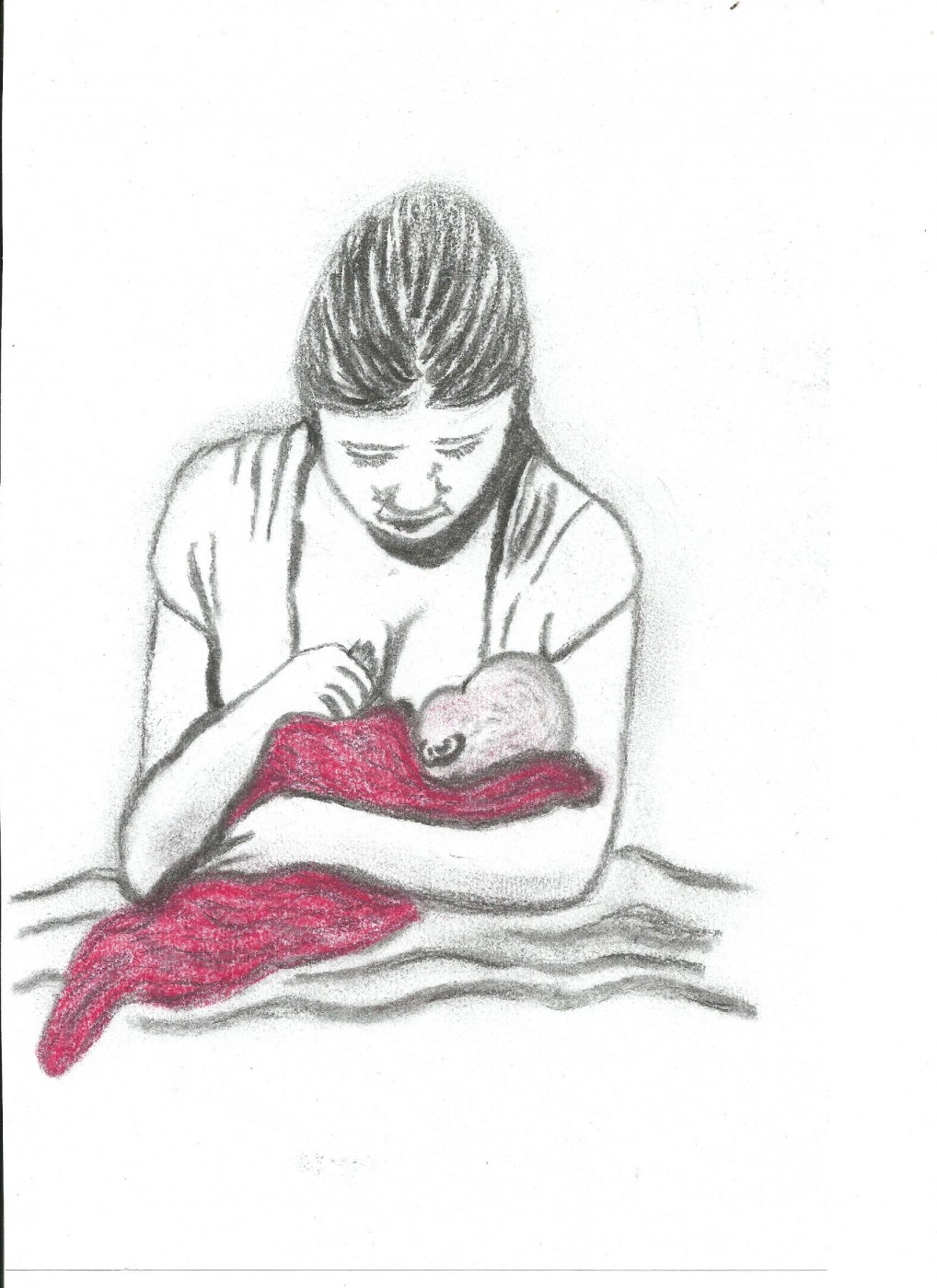
[Drawing of Breastfeeding Woman by Allison Churchill.]


REFERENCES:

  1. Taylor AM, van Teijlingen E., Alexander J, Ryan K. (2019) The therapeutic role of video diaries: A qualitative study involving breastfeeding mothers, Women & Birth 32(3):276-83. https://www.sciencedirect.com/science/article/pii/S1871519218300064
  2. Taylor A, van Teijlingen E, Ryan K, Alexander J (2019) ‘Scrutinised, judged & sabotaged’: A qualitative video diary study of first-time breastfeeding mothers, Midwifery 75: 16-23.

Applications Open! Re-commissioning the Research Centres

Following a recent review by the Research Performance Management Committee (RPMC) applications are now open for the establishment of new Research Centres.  This process is open to all groups of academic staff, each led by a member of the Professoriate, to put forward proposed Research Centres.  Applications can be from established Research Centres, new groupings or new amalgamations of groupings (old and/or new).  The new Research Centres will be launched in September when existing Research Centres will cease to exist unless they have applied under this process (except where exempt).*

Research Centres are the public face of BU’s research. They bring together individuals and research teams from across the University to form collaborative and interdisciplinary groupings which, through the development and delivery of world-leading research, strengthen and underpin the delivery of the BU2025 vision.  They offer an opportunity for the Professoriate to engage in leadership of research that can contribute significantly to the aims of BU2025 – see leadership role descriptor – and provide a genuine platform for innovation and the achievement of critical mass.

Research Centres provide opportunities for staff at all levels to become members, benefitting from dynamic, creative relationships which cut across the perceived boundaries of discipline, Department and/or Faculty.  Research Centres provide members with the opportunity to be a part of an interdisciplinary research community, which enables individuals to join and establish interdisciplinary relationships and networks which can facilitate and strengthen their own research.

The Process

Applications (see pages 6 – 9) are to be completed and submitted to the Faculty Research and Professional Practice Committee (FRPPC) for approval.  As part of the application process Research Development and Support (RDS) will provide a data set of the KPI’s relating to the proposed membership for the past year.  This means that there are two deadlines – the first being to allow time for the data set to be prepared and the second for final submission to FRPPC.  Arrangements and the dates for submission vary between Faculties and are shown in the table below:

Faculty D/L for proposed

membership list

D/L for completed

application to FRPPC

D/L for approval by Faculty
FMC 5th July 2019

A Faculty meeting on 5th July 2019 will discuss and finalise Research Centre compositions. Proposed Centres and membership lists should be brought to this meeting.

14th July 2019

Details of submitting completed applications to be decided at this meeting but the deadline is 14th July and will be submitted for FRPPC via DDRPP (ethorsen@bournemouth.ac.uk)

18th July 2019
FHSS 14th June 2019

Proposed membership lists to be sent directly to Project Delivery Manager (plynch@bournemouth.ac.uk) by 14th June who will provide data set by 21st June

5th July 2019

Deadline for submission of completed applications to DDRPP (vhundley@bournemouth.ac.uk)

21st July 2019
FoM 28th June 2019

Completed applications (including membership lists) to be sent directly to Project Delivery Manager (plynch@bournemouth.ac.uk) by 28th June 2019.

28th June 2019

Same as deadline for membership list. Project Delivery Manager will forward to DDRPP (msilk@bournemouth.ac.uk)

19th July 2019
FST 21st June 2019, 5 pm

Completed applications (including membership lists) to be sent to DDRPP tzhang@bournemouth.ac.uk

21st June 2019

Same as deadline for membership list.

4th July 2019

For an overview of the approval process please see this flowchart.

If you have any questions please contact me, (plynch@bournemouth.ac.uk EXT 68265), or the DDRPP for your Faculty.

*Institutes will be exempt from this process and addressed later.  The following entities are exempt from this process for the reasons stated: NCPQSW and NCCA as they are externally recognised national centres; DMC, CoPMRE, Centre for GP Practice, Centre for Digital Entertainment and BUCRU as their purpose and remit exceeds the scope of the Research Centres policy and therefore the re-commissioning process

NIHR Clinical Research Network Portfolio

The National Institute for Health Research (NIHR) is one of the largest funders of clinical research in Europe and have a number of funding streams that you can apply for in order to conduct health-related research. The NIHR then has a number of Clinical Research Networks or ‘CRNs’ that are spread out to each region of England. The local CRN is Wessex, based in Hedge End, Southampton.

The ‘Portfolio’

At the heart of CRN activities is the NIHR CRN Portfolio of studies. This consists of high-quality clinical research studies that are eligible for consideration for support from the CRN in England. Adoption onto the portfolio has a number of benefits for researchers, such as help in identifying potential research sites, access to patients and the public to carry out ‘PPI‘ and advice on recruitment strategy at any point during the study. The CRN offers support to researchers via their Study Support Service and likewise via each portfolio manager and their team. You can see a breakdown of each portfolio here on the Wessex CRN page.

The Portfolio and the NHS

Portfolio adoption is usually vital to participating NHS Trusts when considering the research studies they wish to undertake, as they are reimbursed for the resource given to conduct the study (e.g. research nurse support, data manager time). As a result, it is strongly advised that external funding is considered for BU clinical research projects – the amount of funding doesn’t have to be substantial.

Each CRN is given a budget for the financial year by the NIHR, which is then distributed to sites based on their recruitment figures.

Requirements

In order to be eligible for portfolio adoption, there are three criteria a study must meet:

  • The study must be ‘research’ (this is stipulated, as often what’s classed as research outside the NHS setting, is sometimes a service evaluation, quality improvement etc. within the NHS – see this table);
  • Have appropriate ethical approval; and Health Research Authority (HRA) Approval where required;
  • Have full research funding – this has to have been awarded via open competition and by the NIHR, other areas of central Government, or an NIHR non-commercial partner (for which there is a list). If the study has received support from multiple funders, then it will be still considered automatically eligible, if one of the funding streams is the NIHR, an area of central Government or a non-commercial partner.

You can read more about study eligibility here, including research funded by overseas partners.

The Portfolio and BU

The source of research funding is the principal determinant of eligibility for NIHR CRN support and so it is encouraged that researchers seek external funding where possible and appropriate, from the NIHR, another area of central Government or one of their non-commercial partners. The amount of funding doesn’t need to substantial in order to be eligible.

For any queries to do with the portfolio or for guidance regarding implementing your research in a healthcare setting, take a look at the Clinical Governance blog. You can also get in touch with BU’s Research Ethics team with any queries.

Setting up NHS / HSC research in the UK– changes from TODAY

The new ‘UK Local Information Pack‘  has been introduced today, 5th June to support the set-up of NHS / HSC research in the UK.

The ‘UK Local Information Pack’ is the set of documents that NHS / HSC organisations use to formally start preparing to deliver the study. You can find more information here, including what comprises the pack. All researchers wishing to set-up their study at an NHS/HSC site from today, 5th June, need to be aware of this change.

The Organisation Information Document

Researchers and research teams may be aware of a document called the ‘Statement of Activities’ – this is essentially a document that allows the sponsor to make clear to the research site, what activities will be undertaken locally. The document can also act as the agreement between the sponsor and site.

From today the Statement of Activities has been replaced by a document called the ‘Organisation Information Document‘. For non-commercially sponsored studies, that are not clinical trials or clinical investigations, the ‘Organisation Information Document’ should be used as the agreement between sponsor and participating NHS / HSC organisation.

A new delegation log template

Another feature of the new UK Local Information Pack is the inclusion of a delegation log template, which is intended to be used at participating NHS / HSC organisations. This will allow NHS/HSC organisations to locally record who will be working on the study and who is authorised to undertake study tasks. The delegation log can be found here and should be used for studies submitted for approvals from today.

Schedule of Events or Schedule and Events Cost Attribution Tool (SoECAT)

For non-commercially sponsored studies studies an IRAS Schedule of Events or a SoECAT will be a part of the IRAS Form submission and is used in the UK Local Information Pack as a way of providing clarity to participating NHS / HSC organisations on the cost attributions associated with a study.

Further help and guidance

Guidance on the use of the new UK Local Information Pack has now been published in the Site Specific page of IRAS Help to help applicants get ready for the change.

If you are making an IRAS Form submission or planning to set up research in an NHS / HSC organisation from today, 5th June 2019 please read the transition guidance so that you prepare the correct materials.

If you have any queries regarding any of the information provided above, or would like some guidance with regard to implementing your research in a healthcare setting – please get in touch with BU’s Research Ethics team.

You can also take a look at the Clinical Governance blog for documents, links and training opportunities.

NIHR Research Participant Experience Survey 2018/19 – final report

You may have seen the blog post back in April regarding the results from a recent patient research experience survey, conducted by National Institute for Health Research (NIHR) Clinical Research Network (CRN) Wessex.

The survey results showed that across the 10 NHS organisations in Wessex, from the 400 responses received, 96% of participants had a good experience of taking part in research. It also showed that 98% of research participants surveyed had all the information that they needed in relation to the study.

The NIHR have released a recent report that shares the results of the Research Participant Experience Survey 2018-19, which was also conducted across the other 14 Clinical Research Network areas in England. You can take a look at the report here.

Setting up NHS / HSC research in the UK– upcoming changes

The UK Local Information Pack

A ‘UK Local Information Pack‘ will be introduced on the 5 June 2019 to support the set-up of NHS / HSC research in the UK.

The ‘UK Local Information Pack’ is the set of documents that NHS / HSC organisations use to formally start preparing to deliver the study. You can find more information here, including what comprises the pack. All researchers wishing to set-up their study at an NHS/HSC site from 5 June, will need to be aware of this change.

The Organisation Information Document

Researchers and research teams may be aware of a document called the ‘Statement of Activities’ – this is essentially a document that allows the sponsor to make clear to the research site, what activities will be undertaken locally. The document can also act as the agreement between the sponsor and site. Researchers setting up their study before 5 June should continue to use this document.

From 5 June the Statement of Activities will be replaced by a document called the ‘Organisation Information Document‘. For non-commercially sponsored studies, that are not clinical trials or clinical investigations, the ‘Organisation Information Document’ should be used as the agreement between sponsor and participating NHS / HSC organisation.

A new delegation log template

Another feature of the UK Local Information Pack is the inclusion of a delegation log template, which is intended to be used at participating NHS / HSC organisations. This will allow NHS/HSC organisations to locally record who will be working on the study and who is authorised to undertake study tasks.

Schedule of Events or Schedule and Events Cost Attribution Tool (SoECAT)

For non-commercially sponsored studies studies an IRAS Schedule of Events or a SoECAT will be a part of the IRAS Form submission and is used in the UK Local Information Pack as a way of providing clarity to participating NHS / HSC organisations on the cost attributions associated with a study.

Further help and guidance

Guidance on the use of the UK Local Information Pack has now been published in the Site Specific page of IRAS Help to help applicants get ready for the change.

If you are making an IRAS Form submission or planning to set up research in an NHS / HSC organisation from 5 June 2019 please read the transition guidance so that you prepare the correct materials.

If you have any queries regarding any of the information provided above, or would like some guidance with regard to implementing your research in a healthcare setting – please get in touch with BU’s Research Ethics team.

You can also take a look at the Clinical Governance blog for documents, links and training opportunities.

Paper in top 30 most cited Journal Advanced Nursing articles

BU’s Dr. Bibha Simkhada’s paper ‘Factors affecting the utilisation of antenatal care in developing countries: a systematic review of the literature’ [1] is currently the 27th most cited paper in the Journal of Advanced Nursing.  This is great achievement considering that the journal has published nearly ten thousand articles since its inception (to be precise 9,847).  The Journal of Advanced Nursing (published by Wiley) is one of the prestigious journals in the nursing field.  This extremely well-cited paper was part of Bibha’s Ph.D. study at the University of Aberdeen.  Dr. Bibha Simkhada is Lecturer in Adult Nursing in the  Department of Nursing and Clinical Sciences.  One of her co-authors also works at BU, Prof. Edwin van Teijlingen and a second co-author, Prof. Padam Simkhada from Liverpool John Moores University is Visiting Professor in the Faculty of Health & Social Sciences.  The third co-author Dr. Maureen Porter retired a few years ago.


Reference:

  1. Simkhada, B., van Teijlingen E., Porter, M., Simkhada, P. (2008) Factors affecting the utilisation of antenatal care in developing countries: a systematic review of the literature, Journal of Advanced Nursing 61(3): 244-260.

Future frameworks for international collaboration on research and innovation – Call for evidence

Overview

The Secretary of State for Business, Energy and Industrial Strategy and the Minister of State for Universities, Science, Research and Innovation have commissioned Professor Sir Adrian Smith to provide independent advice on the design of future UK funding schemes for international collaboration, innovation and curiosity-driven blue-skies research. There is a written call for evidence to inform this advice, and BU is preparing an institutional response to this call.


Further information can be found in the call for evidence document, and associated Terms of Reference.


How to contribute

If you would like your feedback to be included in the institutional response, please complete the feedback form and send to Lisa Andrews, RDS Research Facilitator by Wednesday 15th May.

Top ten cited paper in MIDWIFERY

Looking at the SCOPUS data for 5 May 2019 on the International Day of the Midwife showed that the theoretical paper ‘Risk, Theory, Social & Medical Models: critical analysis of the concept of risk in maternity care’ [1] is in the top ten mosted quoted articles in Midwifery.  Now in its 35th year, Midwifery is an international  journal published by Elsevier.  Since its inception in 1985 it has published 2,626 papers, and our paper ”Risk, Theory, Social & Medical Models’ has now been cited by 108 papers, making it the eighth most cited article.

Professor Edwin van Teijlingen

Centre for Midwifery, Maternal & Perinatal Health (CMMPH)


Reference:

  1. MacKenzie Bryers H., van Teijlingen, E. (2010) Risk, Theory, Social & Medical Models: critical analysis of the concept of risk in maternity care, Midwifery 26(5): 488-496.

HRA Research Transparency Strategy Group minutes available

The Health Research Authority (HRA) has formed the Research Transparency Strategy Group in response to the House of Commons Science and Technology Committee Report on clinical trials transparency.

You can read more about the first meeting of the expert group, including the minutes by clicking here

In relation to this, the HRA’s Director of Policy, Juliet Tizzard has released a blog post entitled What’s the point of research transparency? You can read the post here.

BU has access to the ClinicalTrials.gov system so get in touch if you would like access. This is a great opportunity to register your study and study results in the public domain. On ClinicalTrials.gov, it is free to do so.
Despite the name, the system may be used for other clinical research projects.

Introduction to Good Clinical Practice – 15th May 2019

Are you interested in running your own research project within the NHS? Good Clinical Practice, or ‘GCP’, is a requirement for those wishing to work on clinical research projects in a healthcare setting.

GCP is the international ethical, scientific and practical standard to which all clinical research is conducted. By undertaking GCP, you’re able to demonstrate the rights, safety and wellbeing of your research participants are protected, and that the data collected are reliable.

The next GCP full day session is scheduled for Wednesday 15th May, at Bournemouth University, Lansdowne Campus (Bournemouth House) – 8:45am – 4:30pm.

The day will comprise of the following sessions:

  • Introduction to research and the GCP standards;
  • Preparing to deliver your study;
  • Identifying and recruiting participants – eligibility and informed consent;
  • Data collection and ongoing study delivery;
  • Safety reporting;
  • Study closure.

If you’re interested in booking a place, please contact Research Ethics.

Remember that support is on offer at BU if you are thinking of introducing your research ideas into the NHS – email the Research Ethics mailbox, and take a look at the Clinical Governance blog.