Things have really stepped up a gear in terms of SWAN activity across BU as we strive collectively towards better gender equality and fairer, more open employment practices that will benefit everyone. You can read the latest newsletter here
/ Full archive
Knowledge Frontiers – Security Symposium Call

The Canadian Institute for Advanced Research (CIFAR) and the British Academy are inviting applications for early career researchers in the humanities and social sciences to attend a research collaboration symposium on the broad theme of ‘security’.
This will explore varied understandings and experiences of security, and how security can be and has been conceptualised, represented, lived and addressed. The symposium aims to encourage international engagement and collaboration between early career researchers from Canada and the UK from a broad range of disciplines, encouraging the exchange of ideas across both disciplinary and national boundaries. The event will take place in Montebello, Quebec, Canada from 08/12/20 – 10/12/20 .
Deadline for applications Wednesday 6 May 2020 at 17.00.
For details on how to apply please see here.
If you have any queries, please contact RDS on RKEDF@bournemouth.ac.uk
Doctoral College Newsletter | March 2020

The Doctoral College Newsletter provides termly information and updates to all those involved with postgraduate research at BU. The latest edition is now available to download here. Click on the web-links provided to learn more about the news, events and opportunities that may interest you.
If you would like to make a contribution to future newsletters, please contact the Doctoral College.
Doctoral Students: Cumberland Lodge Scholarships

The two-year Cumberland Lodge Scholarship programme offers doctoral students based at UK universities the opportunity to set themselves apart, by deepening their understanding of pressing social issues and developing new skills in communication, public engagement and interdisciplinary working.
Cumberland Lodge are now recruiting for a new cohort of Scholars for 2020-22. To apply, please complete the application form, which is available to download from this webpage, and return it to Sarah Galvin, Programme Administrator: sgalvin@cumberlandlodge.ac.uk.
Applications will be accepted from Monday 2 March to Tuesday 31 March 2020 (midnight).
Best of luck to any BU PGRs applying.
Research Training Events at BU in the Next 2 Weeks

Monday 9th March RKEDF: Global Visiting Fellowship – Drop in sessions
12:30 – 13:30 Talbot Campus
For those who are thinking of nominating an applicant for the GVF fund, to come along with their idea and seek advice on the joint application process from panel members.
Wednesday 11th March RKEDF: Getting started in public engagement with research
10:00 – 12:00 Lansdowne Campus
An intensive introductory session covering why Public Engagement is important, what it can do for your research, how to identify audiences and target their needs, designing public engagement activity and the logistics of public engagement – from securing funding through planning, developing skills and the support offered at BU. Also the evaluation of engagement activity.
Friday 6th March RKEDF: Research Outputs – Writing Day
Dedicated time and space, free from everyday distractions with a collaborative focus on productive writing with other BU authors.
FULLY BOOKED
Next dates: 14th May and 14th July
If you have any queries, please contact mailto:RKEDF@bournemouth.ac.uk?subject=Research Event Query.
Pre-Call Announcement – GCRF Partnerships
The Arts and Humanities Research Council (AHRC), working in collaboration with other Research Councils within UKRI, is planning to announce a new funding call in early 2020 for Partnership Development awards under the Global Challenges Research Fund’s Collective Programme. This call will support the development of equitable partnerships and an interdisciplinary community to explore the intersections between conflict and fragility (SDG 16: Peace, Justice and Strong Institutions & GCRF Conflict portfolio) and wider development challenges (and other SDGs and GCRF portfolios) such as health, environmental resilience, sustainable cities and food systems, as well as cross-cutting development issues such as gender, inequalities, poverty reduction and sustainable livelihoods.
The call will launch in early March 2020 with a closing date in late spring 2020 and projects expected to start from autumn 2020. Approximately 20 awards of varying sizes up to £200,000 (fEC) and between 12 and 24 months duration will be supported.
Further details can be found in this Pre-Call Announcement Document (PDF, 172KB)
Timescale
| Call opens | February/March 2020 |
| Call Close | May 2020 |
| Panel | July 2020 |
| Expected grant start dates | September/October 2020 |
If you require further information, please don’t hesitate to contact Alex Pekalski. She’s happy to have a chat with prospective applicants.
Good public involvement in research – the perspective of a patient advocate
To mark World Cancer Day, patient advocate Richard Stephens has shared his experience about the importance of incorporating good public involvement in cancer research.
The blog post has been published on the Health Research Authority (HRA) website here and details Richard’s journey first as a clinical trial participant to his role as a patient advocate. He has worked on patient advisory groups and various committees to help improve the information given to participants so they can fully understand the implications of their involvement in clinical research.
‘My first trial involved testing a new chemotherapy drug against standard treatment. I asked to be “randomised” to the new drug. I hadn’t understood what was meant by ‘randomised’ trial. My consultant told me later that she thought I had been joking when I’d asked for the new drug. But the randomisation did put me on it anyway, which was what I thought I’d consented to….
My own misunderstanding made me wonder why patients weren’t involved in writing the information that would be given to other patients.‘
There is guidance published on ‘PPI’ (Patient and Public Involvement) here on the Clinical Governance blog which incorporates guidance available from the HRA website and the National Institute for Health Research’s site.
Conducting PPI is a good way to seek the opinions and recommendations of the public, and can help to ensure that your study is designed and set-up in a way that will be relevant to participants, and of good quality. PPI can also help to avoid any setbacks once the project is underway.
‘Every year more patients are taking part in clinical trials. Evidence shows that cancer patients who take part in clinical research are more likely to report higher levels of satisfaction with their overall care, and are more likely to have better outcomes in research-rich hospitals, even if they don’t take part in trials themselves.
Research participation is good for patients, patient involvement is good for research, and good research produces better treatments and care for all of us.’
Remember that support is on offer at BU if you are thinking of introducing your research ideas into the NHS – email the Research Ethics mailbox, and take a look at the Clinical Governance blog.
Research Professional – all you need to know
 Every BU academic has a Research Professional account which delivers weekly emails detailing funding opportunities in their broad subject area. To really make the most of your Research Professional account, you should tailor it further by establishing additional alerts based on your specific area of expertise. The Funding Development Team Officers can assist you with this, if required.
Research Professional have created several guides to help introduce users to Research Professional. These can be downloaded here.
Quick Start Guide: Explains to users their first steps with the website, from creating an account to searching for content and setting up email alerts, all in the space of a single page.
User Guide: More detailed information covering all the key aspects of using Research Professional.
Administrator Guide: A detailed description of the administrator functionality.
In addition to the above, there are a set of 2-3 minute videos online, designed to take a user through all the key features of Research Professional. To access the videos, please use the following link: http://www.youtube.com/researchprofessional
Research Professional are running a series of online training broadcasts aimed at introducing users to the basics of creating and configuring their accounts on Research Professional. They are holding monthly sessions, covering everything you need to get started with Research Professional. The broadcast sessions will run for no more than 60 minutes, with the opportunity to ask questions via text chat. Each session will cover:
-
Self registration and logging in
-
Building searches
-
Setting personalised alerts
-
Saving and bookmarking items
-
Subscribing to news alerts
-
Configuring your personal profile
Each session will run between 10.00am and 11.00am (UK) on the fourth Tuesday of each month. You can register here for your preferred date:
These are free and comprehensive training sessions and so this is a good opportunity to get to grips with how Research Professional can work for you.
Have you noticed the pink box on the BU Research Blog homepage?
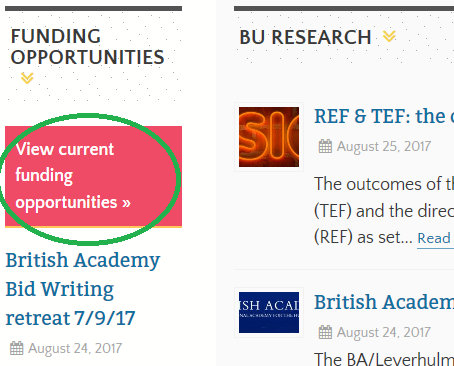 By clicking on this box, on the left of the Research Blog home page just under the text ‘Funding Opportunities‘, you access a Research Professional real-time search of the calls announced by the Major UK Funders. Use this feature to stay up to date with funding calls. Please note that you will have to be on campus or connecting to your desktop via our VPN to fully access this service.
HE policy update for the w/e 28th February 2020
Welcome back to your policy update. We bring you the key news from the last two weeks including the new universities minister, rumours of student number control return, and we explore what the new points-based immigration system means for students and staff members.
Admissions in the spotlight
The anticipated OfS consultation on admissions has gone live with a press fanfare: consultation page. There are 87 questions and the deadline is 5pm in 21st May. The overarching premise is that the admissions process does not always work in the interests of students, who may not always choose between and select the providers and courses best suited to them.
There are 4 new principles proposed.
The consultation lists 10 “issues” plus the overarching one:
- Advertised entry requirements v actual entry requirements
- The use and accuracy of predicted grades in undergraduate admissions
- The use of assessment methods, including personal statements and references, auditions, portfolios, admissions tests and interviews
- The role of contextual offers and contextual admissions
- The use of unconditional offers and “attainment offers”
- The use of offer incentives, inducements and false marketing claims
- Applications which are made later in the admissions cycle, including the use of the UCAS clearing system
- The transparency of the admissions process
- Applicants’ experience of the admissions process
- Stakeholders’ perceptions of the extent to which the English higher education (see principle 5 above)
The options for change include a number of tweaks to the existing system (such as doing away with personal statements, removing predicted grades, getting rid of incentives, reforming clearing (by making suppliers hold places back for clearing) or a post-qualification offers system or post-results applications (timing issues will loom large with this one) or what we have now, which is post-results confirmation).
BU is preparing an institutional response, so contact policy@bournemouth.ac.uk if you want to be involved.
These are not new debates. If you are interested, you can read the 2004 Schwarz report that set the fair admissions principles currently in force. It is interesting to note the similarities and the differences between these and what is being proposed by the OfS:
| Schwarz principle | Proposed OfS principle |
| Principle 1: A fair admissions system should be transparent | Principle 1 – Applicants, their advisers and higher education providers should find that the admissions system is transparent and that they have access to full information, presented in such a way that enables applicants to make effective choices |
| Principle 2: A fair admissions system should enable institutions to select students who are able to complete the course as judged by their achievements and their potential | Overarching principle: All students, whatever their background, should be able to choose between and select courses and providers matched to their needs, achievements and potential. |
| Principle 3: A fair admissions system should strive to use assessment methods that are reliable and valid | Principle 2 – Applicants should be given the opportunity to demonstrate their achievement and potential with clear evidence and should know how this evidence will be used by higher education providers to select students
Principle 3 – Applicants should be assessed using methods that are reliable, fair and inclusive |
| Principle 4: A fair admissions system should seek to minimise barriers for applicants | See OfS Principle 3 above. |
| Principle 5: A fair admissions system should be professional in every respect and underpinned by appropriate institutional structures and processes | Principle 4 – Applicants, their advisers and higher education providers should experience a system that is professional in every respect and underpinned by appropriate institutional structures and processes. |
| Principle 5. The public should have confidence in the admissions system |
It is interesting to notice in principle 2, the switch of focus from institutions selecting those able to complete the course to students making that choice themselves and the new OfS principle 5 reflects the times we live in. This was not seen as something that needed to be addressed in 2004, or at least if it was, it was covered by the professionalism principle (5). Of course, public confidence is a complex thing to achieve, and is also difficult to measure. `
It is worth reading the Wonkhe article by David Kernohan:
- …the OfS does not have the power to require or demand changes to admissions processes to individual institutions. Neither does it have any powers with respect to UCAS. UCAS is not a “designated admissions body” – it is an independent charitable body (with a commercial arm) that exists primarily because of a historic expression of will by sector representative bodies. OfS don’t have any agreements or concordats with UCAS and do not sit on the board of UCAS.
- Of course, there are some regulatory powers in the mix that relate to admissions. The use of “conditional unconditional” offers has been framed as “pressure selling” and so relates to its powers to require providers to have regard for advice on consumer law. Similarly, OfS could (and do) argue that B2 of the regulatory framework (“the provider must support all students, from admission through to completion, with the support that they need to succeed in and benefit from higher education”) would mean they can become concerned if students are recruited to courses they can’t cope with. But generally, this is an area that’s off-limits – HERA gives the education secretary the power to give guidance to OfS to which it must have regard in performing its functions, but the guidance “must not relate” to the criteria for the admission of students or how they are applied…
- …It has taken positions on aspects of the current system – the rise of unconditional offer making is considered harmful, but it is keen to see contextual offer making used. It has, as admissions teams will remember, already taken action as a regulator on both of these themes – the former employing a naming-and-shaming approach followed by a letter requesting an explanation, the latter featuring in many of the (extensively negotiated) access and participation plans.
David also points out, in relation to the issues (although we would point out that there is an opportunity to raise other issues in the consultation):
- [the 10 issues] are the matters under discussion – so if you wanted to think about the cost of applications via UCAS (for providers and students) say, you’d be out of luck. More explicitly out of scope are issues around available advice and guidance (so, no complaints about Discover Uni here please), student contracts and consumer protection, partnership arrangements, and the efficacy of assessment methods as predictors of future success….
- What I think we are seeing here is evidence that this is in part a review of the wider perception of admissions, rather than the way the system actually works. If we were doing that, we could look at drop-out rates by course and identify where admissions methods were having an impact. Research already exists that shows that – for instance – unconditional offers do not necessarily have an impact on student success. There’s not enough good research in this area, we should be looking for more of it.
And in the meantime, the Universities UK Fair Admissions Review with Savanta Comres have polled almost 1500 British adults who applied to university or college in the UK between 2015-19. The poll was one element of the UUK Admissions review which is still ongoing, the Advisory Group is due to publish recommendations late spring 2020. Survey results are:
- 70% of applicants consider the application process fair. One in ten (12%) say it is unfair. Of unfair responders – the most common reasons were because the career advice they were given wasn’t very helpful (34%) or because the application process was too long (29%).
- 79% of applicants say they felt supported by the universities/colleges they applied to during the application process. One in five (19%) say they felt unsupported.
- 64% agree that the application process works well as it is or that it is fine to apply with predicted grades. However, 28% disagree. Yet…
- 56% agree that universities/colleges should only make offers after people have received their academic results.
The full results tables can be downloaded here.
The Guardian published an article on the poll findings. And there was an opinion piece from UUK President Professor Julia Buckingham covering the need for universities, colleges, schools, employers and the government to work together to provide better careers advice and support where it is deemed by applicants to be lacking.
Quality, controls and funding
And the admissions debate is not the only lively topic of debate we will need to look at this spring. In advance of any government announcement on the TEF review, and in anticipation of where the government might go with the review of post-18 education and funding (which will not be tackled in the upcoming budget),
HESA data has shown an increase in students dropping out in the first 50 days. Wonkhe quote Nicola Dandridge:
- 8 per cent of students in the UK did not continue their studies in 2017-18, 0.3 per cent up on the previous year.
- This appears to be a UK wide pattern, with the increase smallest in Scotland and the percentages smaller for the year in England and Wales.
- The OfS’ Nicola Dandridge said: “An increase in the proportion of students dropping out is a concern. Rates vary significantly between different higher education providers, and a number of providers will need to think seriously about what they can do to reduce these rates”
Wonkhe have published a long read – Are student number controls coming back to English HE?
A year ago when the Augar report hadn’t come out, we looked at options on fees and suggested that there might be a headline fee cut with top ups linked to access metrics and a range of outcomes, at subject level. It would be fiendishly complicated but given the pronouncements on quality and outcomes, you can now imagine a system where there is:
- an enhanced teaching grant at subject level linked to access and participation
- more teaching grant linked to new TEF metrics at subject level
- graduate salary outcomes (but adjusted to geographical factors i.e. local earnings)
- a sort of learning gain proxy, i.e. some measure of outcomes adjusted for entry tariff and WP context
- quality more generally – i.e. NSS, continuation etc.
- And possibly additional funding for other factors too, like enhanced funding for subjects perceived to be highly desirable – so as now, additional teaching grant for medicine but also for nursing (unless they make that apprenticeship only), and rather than all the current high cost science subjects, restrict it to potentially “strategic” areas like data science, cyber security, AI, or whatever the industrial strategy priorities are
And on the TEF: The OfS have published their board papers. Wonkhe have a tongue in cheek whizz through on the content. Here are the papers in full. And for a more useful half way house on detail read Research Professional, which has this on the TEF
- As higher education awaits the outcome of Shirley Pearce’s review of the TEF—which is up there with the government’s response to Augar in the policy heel-dragging stakes—the future of the framework is somewhat up in the air, but the OfS minutes give us some indication of its direction of travel.
- It is arguably theapproved minutes of the preceding board meeting in November, also published on Friday, that are the most revealing. They tell us that three different models of subject-level TEF ratings have been trialled but that the methodology “does not yet enable robust and credible ratings to be produced at subject level”.
- This is pretty damning given that the subject-level TEF has been piloted since the 2017-18 academic year and that education secretary Gavin Williamson considers it a priority that the first full subject-level TEF should run next year. …Williamson will not wish to see his authority undermined by having his directions to the regulator disregarded for a second time. He will be doubly keen to ensure the subject-level TEF proceeds as planned—but how can that happen if there is no methodology deemed robust enough?
- …“The timeline for the exercise is determined by the need to create metrics, some of which are based on data that is not yet available, to recruit and train panellists and assessors, and to enable moderation of assessments,” the OfS minutes state. It sounds like time is of the essence if the regulator is to settle on a sufficiently rigorous subject-level TEF methodology by 2021.
- Playbook reported last weekon a Universities UK plan to develop its own “framework” designed to give government and universities “greater insights into the impact of a specific course on students, society and the economy”. As we said at the time, it sounded suspiciously like some kind of TEF and could include metrics looking at the proportion of graduates from a course working in essential public services, the number working in regions with relatively lower growth and the number who end up running their own business.
- If question marks remain over the official subject-level TEF’s metrics, could UUK be waiting on the sidelines with an oven-ready alternative?
If RP are correct, this will join admissions as an area where UUK are running their own effort in parallel to the OfS. UUK may believe it is important to develop counter-proposals and at least on admissions they have consulted the sector before publishing a position, but it does all feel rather duplicative.
The RP report from last week is interesting:
- Buckingham told the Advance HE conference that UUK was working on “a framework, with a package of measures of value, giving government and universities greater insights into the impact of a specific course on students, society and the economy”. This sounds like a set of course-level metrics, almost like some kind of teaching excellence framework.
- The framework could include “the proportion of graduates from a course working in essential public services, how many are working in regions with relatively lower growth and addressing skills shortages, or how likely they are to be business owners. It should also include the wider benefits to individuals’ life satisfaction, contributions to the community and their personal health.” Quite how all those measures would be assessed is not clear.
- In effect, UUK has said: ‘I see your subject-level Teaching Excellence Framework, and I raise you.’ Buckingham called it a “bold new approach from government and universities”, which is one way of putting it. However, UUK’s approach to threats from government is always to be seen to be doing something before something is done to universities by politicians.
And in this context, the OfS Insight brief on the NSS is interesting reading:
- As Figure 3 shows, while most providers have an overall satisfaction of more than 81 per cent, over a hundred providers have overall satisfaction of 80 per cent and under. There is a 13 percentage point difference between the providers in the bottom 10 per cent and those in the top 90 per cent.7 This highlights wide variations, with a number of providers producing extremely satisfied students and others falling short.
- One problem is that the NSS results have been employed somewhat outside of their original remit, often standing in as a barometer of ‘student experience’ in general (as seen use in their use in league tables). Much academic study of the survey has looked at the differences in satisfaction between courses. For example, some arts courses (and as a result many art colleges overall) receive lower satisfaction than other courses. However, such comparison is not especially useful for their prospective students, who will be more likely to want to compare the same courses at different providers than to make distinctions between different subjects.
- Instead of looking at raw differences, it is more informative to compare the overall scores with a benchmark. For the 2018 and 2019 surveys, we have run new experimental analysis to create new benchmarks based on five of the six factors which are most closely correlated with different responses to the NSS. For age, for example, the benchmark is based on the sex, ethnicity, disability status, subject classification and mode of study of respondents. This means that if the agreement rate for an age group is different from the benchmark, this is unlikely to result from any of the other characteristics included: for instance, we can ignore the fact that older students are more likely to study part-time. The difference may instead be due to the age of the students, or to a further unknown factor (such as older students being more likely to study at a specific provider).
- Creating a sense of ‘belonging’ has long been seen as important for retaining and ensuring a high-quality experience for all students, but especially part-time ones.33 What these responses to the NSS demonstrate is that providers need to work harder to understand the particular needs of part-time students, and respond perceptibly to their feedback. By focusing on the unique needs of part-time students, universities and colleges could also help other groups who may feel at the margins of their learning community, such as mature students and commuter students.
- A 2019 survey of 67 providers showed that only 53.3 per cent compared their NSS results for disabled and non-disabled students. The characteristics analysis shows the shortcomings of this approach, as it points to specific concerns about courses that disabled students hold. Such comparison could, if supplemented by relevant text comments, help universities and colleges to respond more effectively to these marginalised students.
- As shown in a previous Insight brief, while disabled students have comparable outcomes to non-disabled students, their experience while at college or university can often be worse. Through the Disabled Students’ Commission, the OfS is bringing together a range of experts and educators, including a student representative, to highlight the barriers which remain and explore ways to dismantle them.
- The survey has also failed, thus far, to include the views of those students who do not complete their courses. An all-years survey might allow greater understanding of why students drop out, and potentially see students benefit from improvements introduced by providers in response to the survey. This change will ensure the continued relevance and usefulness of the NSS in the 2020s.
Parliamentary News
The DfE Ministerial responsibilities have been confirmed:
- Education Secretary Gavin Williamson will continue to have overall responsibility for the Department for Education.
- Nick Gibb will continue as Minister of State for School Standards.
- Michelle Donelan has been appointed as Minister of State for Universities (but without the science role and the BEIS report line). Chemistry World have a good article exploring the splitting of the Universities and Science Minister role. Amanda Solloway within BEIS takes on the Science role. More on this below.
- Vicky Ford has been appointed as Parliamentary Under Secretary of State for Children and Families.
- Gillian Keegan has been appointed as the Parliamentary Under Secretary of State for Apprenticeships and Skills.
- Baroness Berridge has been appointed as Parliamentary Under Secretary of State for the School System.
Nick Hillman (Director, HEPI) speaks to Chemistry World on the split between Universities and Science roles:
- “We are finally getting two people in charge. This was always likely to happen eventually, but it might not be an improvement. A single minister can at least bridge gaps between departments in a way two ministers cannot. Now, the strengthened Number 10 might step in more often.” Hillman illustrates his point using the Augar report’s recommendation for lower tuition as an example. “Chris Skidmore could consider the impact across both teaching and research as the minister in charge of all higher education policy. Now, Donelan has an interest in fee levels but not in research funding. Similarly, Solloway will have a majority interest in postgraduate research, but less sway over policy on taught postgraduate courses.”
Daniel Rathbone (Assistant Director, Campaign for Science and Engineering) also speaks to Chemistry World and is also cautious about what the separation of the ministerial profiles for science and universities might mean for research. “The way R&D in universities is funded is complex. At CaSE, we have long warned that any policy changes on university funding must be closely scrutinised in order that they have no unintended consequences that lead to a reduction in the funding available for R&D. This will be doubly important now that the ministerial link between science and universities has been removed.”
Meanwhile Chris Skidmore is in favour of the split. He writes for The Times in Sacked, promoted, shunted, returned, sacked: that’s life as a minister. Chris sees the splitting of the brief into two roles as “a strong sign of the vital importance of both these briefs being given the full attention they deserve”. He also covers his hopes for the future of the HE sector in the article.
In an interesting development, Wonkhe report:
- Gavin Williamson has appointed Iain Mansfield as a special adviser on post-18 education and skills. Iain – who will vacate his role as head of education, skills, science and innovation at Policy Exchange – previously served as special adviser to former universities and science minister Jo Johnson, and before that he was a senior civil servant at DfE, where he led on the development of the TEF. A former Wonkhe contributing editor, Iain has strong views on student numbers, free speech and academic freedom, access and regulation.
Given his track record, the appointment is probably not a surprise, but the fact that Iain will report to the Secretary of State for Education rather than the Universities Minister is telling – the focus on post-18 education and skills for this government is much wider than the universities brief, which we already knew.
The Universities Minister, Michelle Donelan, responded to her first parliamentary questions covering the use of non-disclosure agreements within universities, the number of European students currently in the UK on the Erasmus+ scheme. Social care minister Helen Whately answered a written question on the number of student midwives in each academic year since 2014/15. Schools minister Nick Gibb answered a question on the use of technology in educational environments. Kevin Foster MP answered a written question on a possible extension for the visas of Chinese students affected by the coronavirus outbreak.
And there were multiple questions on supporting private HE providers to attract students, improve their viability and the diversity of courses they offer; and on whether their ineligibility for student loans affects these concerns. Finally it was asked what steps are being taken to promote apprenticeships as an alternative to university and what estimates have been calculated relating to changes in overseas enrolments resulting from the points-based immigration system
Finally Research Professional has an interview with Shadow HE Minister Emma Hardy. She supports Labour’s manifesto aims for the National Education Service, abolishing tuition fees and a graduate tax. On the rumours of the return of student number capping Emma says:
- I think the cap is going to come back anyway…regardless of whether there are changes to tuition fees…Conversations, things we are hearing—I would expect the government to be looking at some kind of cap, yes.
Research Professional report that she points to recent news coverage suggesting that in some universities, students are unable to fit in the lecture hall because there are not enough seats, instead having to watch a livestream of the lecture. Emma asks: What kind of quality university experience are they having if you can’t even all fit into a lecture theatre?
Emma was asked if she would be in favour of reintroducing a cap. She responded: The government would have to do some kind of equalities impact assessment…that’s what I’d be asking them to do. She goes on to express concern that the return of a cap could mean that fewer disadvantaged students are able to study for a degree.
Emma also believes Universities should do more to promote their value, particularly within the local context: I think they need to make the case for why we should value and love our universities. Universities need to be selling what they offer to the wider economy more, and talking about more of the benefits—that they’re world-class institutions, that they contribute so much to the local economy, that they employ local people. They don’t talk about any of this and therefore they’re seen as being remote at times. Given that mention of ‘world class’ and community integration are two of the most common themes within universities strategic plans it is a little concerning that Emma doesn’t feel universities are covering this enough!
Emma goes on:
- They need to do more to talk about why they matter. Otherwise, it is too easy to attack them…If you are seen as a remote, elite institution then you are going to be attacked by a populist government. But if you are seen as something vital and important to the local economy, and loved by that local population, you are much more able to defend yourself against attacks.
- The Universities Minister, Michelle Donelan, responded to her first parliamentary questions covering the use of non-disclosure agreements within universities, the number of European students currently in the UK on the Erasmus+ scheme. Social care minister Helen Whately answered a written question on the number of student midwives in each academic year since 2014/15. Schools minister Nick Gibb answered a question on the use of technology in educational environments. Kevin Foster MP answered a written question on a possible extension for the visas of Chinese students affected by the coronavirus outbreak.
- And there were multiple questions on supporting private HE providers to attract students, improve their viability and the diversity of courses they offer; and on whether their ineligibility for student loans affects these concerns.
- Finally it was asked what steps are being taken to promote apprenticeships as an alternative to university and what estimates have been calculated relating to changes in overseas enrolments resulting from the points-based immigration system
Immigration & International Students
The Government has published more information on the new points-based immigration system that will be introduced from 1 January 2021. The public facing announcements reiterate messaging urging EU citizens currently living in the UK to apply to the EU Settlement Scheme and promises the continuation of their rights and status to live in the UK.
UUK issued a briefing delving into the deeper detail of the new points-based system. We don’t have all the information yet, this is the first step in the border and immigration changes which will span several years and be implemented across multiple parliamentary legislative changes. The Immigration Bill will be introduced to Parliament shortly and secondary legislation in autumn 2020 will extend the detail and implementation. The points-based system is expected to increase in sophistication as it becomes established across years.
The basics
The government will legislate to remove free movement and replace it with a points-based immigration system for skilled workers, students, and other specialist work routes. EU and non-EU citizens will be treated the same. There is no unskilled labour or temporary worker immigration route (at least not yet, some sectors – such as seasonal farm labour – already have concessions, others will fiercely lobby for an exception to the rules). The Government believes the points-based system will reduce levels of migration whilst prioritising immigration from individuals with the highest skills and in the employment gap areas so that the system supports the British economy where it is most needed.
To successfully enter and work in the UK immigrants will need to have a job offer at the appropriate skill threshold and speak English, migrants will either need to earn above the minimum salary threshold, have a relevant PhD, or work in an occupation designated as being in shortage. They will also need to earn no less than £20,480.
Key points on the proposals for high skilled workers:
- The general salary threshold is lower at £25,600, although migrants will still need to be paid the higher of the general threshold or an occupation-specific salary threshold (‘going rate’).
- this is in line with the MAC’s recommendations.
- The skills threshold will be lowered to RQF3 (A-level equivalent).
- All applicants will need to have a job offer at the required skill threshold and speak sufficient English.
- Points will be assigned for specific skills, qualifications, salaries or professions
- They will then gain enough points to be eligible by earning more than the salary threshold. If they do not, they can ‘trade’ this by either having a relevant PhD or working in a shortage occupation.
- There will be no cap on the number of skilled workers and the resident labour market test will be abolished.
- The salary threshold for new entrants will be set at 30% lower than the usual rate.
- There will be no regional variation in the system, including in the devolved nations.
- There will be no pro-rating of salary thresholds for part time work.
- The shortage occupation list will be updated, and then kept under regular review by the MAC.
- Settlement rules will continue to operate as now and extended to apply to EU citizens arriving from January 2021.
- Skilled workers can be accompanied by their dependents.
- The shortage occupations and qualifications will be published ‘in due course’.
- Factors anticipated to be included in the later iteration sophistication of the immigration system are a greater range of qualifications, experience studying in the UK, or age.
- All individuals coming to the UK for work or study (with the exception of some short-term visitors) will need a visa and will be required to pay a fee for themselves and each of their dependents.
- The government will continue to levy the Immigration Skills Surcharge on employers and the Immigration Health Surcharge on the same basis as now.
- The Government estimates that 70% of the existing EU workforce would not meet the requirements of the skilled worker route, which will help to bring overall numbers down in future.
- EU citizens and other non-visa nationals will not require a visa to enter the UK when visiting the UK for up to 6 months. However, the use of national identity cards will be phased out for travel to the UK and the Home Office will set out future plans at a later date.
On Tuesday the Lords held a debate on the new immigration system; you can read what they think here.
Students
Students, both EU and non-EU, will be covered by the new points-based system with a view to ensuring that the “brightest minds from around the globe” have access to the UK’s world-class universities. They will need to:
- demonstrate they have an offer from an approved educational institution;
- speak English;
- be able to support themselves during their studies in the UK.
The policy will operate essentially as it does for non-EU students now, requirements around evidencing English language ability will remain unchanged.
The Graduate Immigration Route will enable international students to remain in the UK for two years after completing their studies. To access students must have completed a degree at undergraduate (or above) level at a HE Provider with a track record of compliance and who have a valid Tier 4 visa at the time of application. This new route will be launched in summer 2021 with students graduating immediately able to apply for this immigration route.
Global Talent Visa (previously the Tier 1 (Exceptional Talent) visa)
The Global Talent visa, for highly skilled workers without a job offer, will be extended to EU citizens from January 2021. This scheme has recently been expanded to be more accessible to those with STEM backgrounds and is now open for applications from non-EU citizens.
The government intends to open key routes from the autumn of this year, so that migrants can apply ahead of the system taking effect in January 2021.
Of particular interest to HE is the new fast-track scheme arranged by UK Research and Innovation (UKRI) for world-leading scientists, top researchers and mathematicians to come to the UK. The Global Talent visa will continue to be open to talented applicants within the digital technology and arts and culture sectors. Under the reformed Global Talent visa route, there will now be no cap on the number of people able to come to the UK, demonstrating the UK government’s commitment to supporting top talent from around the world.
Sector Response
UUK have welcomed the employer led approach to immigration (i.e. the job offer from the HE institution as an essential criterion) and state it will ensure employers are able to select the best person for the job. However, they are concerned that specialist roles such as lab technicians and language assistants may not be high enough paid nor able to use their PhD as leverage to gain sufficient immigration points despite their lower salary. UUK also reiterate familiar concerns of whether the new system is fit for purpose for the 2021 recruitment cycle.
Professor Alice Gast, President of Imperial College London, said: British science is global. The new post-study work and global talent visas will help us to attract the world’s brightest students and researchers, wherever they come from. From the race to develop a coronavirus vaccine to clean energy, British science’s international collaborations drive innovation and excellence.
A Guardian article profiles established academics that are struggling to secure permanent UK visas because of research fieldwork outside the country.
Research Professional have an article in which a policy adviser to the science community has warned that the government’s proposals for a points-based immigration system in the UK leave “important questions unanswered”.
International Students Admissions
The government have published data on Tier 4 visas, showing:
- In 2019, there were 285,508 Sponsored study (Tier 4) visas granted (including dependants), a 19% increase on 2018, and the highest level since the year ending June 2011.
- Chinese nationals were the most common nationality granted Tier 4 visas in 2019, up 20% compared with 2018 to 119,972 (accounting for 42% of the total). The number of grants has consistently increased since the Tier 4 visa was introduced in 2008 and the number of grants to Chinese students is now more than double the number in 2012. Indian nationals also saw a notable increase in the number of Tier 4 visas granted, almost doubling (up 93% to 37,540) compared with 2018, continuing an increase seen since 2016. This was the largest number of grants to Indian students since the year ending September 2011, when new sponsorship arrangements were introduced on the Tier 4 route.
Last week UCAS published the final 2019 End of Cycle report focussing on ‘international insights’. It revealed a record number of non-UK applicants, 140,955 – up 5.2% on 2018. The increase was driven by an 8% boost in non-EU applicants. The number of non-UK acceptances increased 3.8% to a record 76,905.
The report also identifies ‘emerging markets’ in Africa, the Middle East and South East Asia, with notable changes to applicant numbers from Ghana (up 25.5%), Saudi Arabia (up 10.3%) and Thailand (up 7.6%).
There are also high proportions of international applicants to STEM subjects, with 34.2% of applicants for mathematical sciences coming from outside the UK, compared to 5.2% of applicants for courses in education.
There was also a regional preference with 54.1% of non-UK applicants applying to at least one London provider, compared to 27.8% of UK applicants.
Research
Wonkhe report: The UK government has set out its position for trade negotiations with the EU. The government has confirmed its intention to become a non-EU Member State participant in Horizon Europe, Euratom Research and Training, and Copernicus. The government will also consider its options for participation in elements of the Erasmus scheme, provided that such participation “remains in the UK’s interest”. … The story is covered in FE News.
Research Professional report on data from UK Research and Innovation. It highlights that being a researcher at the UK’s ‘elite’ universities does not appear to bring a much higher chance of winning a grant from government coffers.
Research Professional also cover a report which highlights skills shortages within forensic science are posing a threat to the sector’s future.
Knowledge Exchange concordat
UUK has published, in collaboration with GuildHE and Research England, the analysis of responses to the consultation on the Knowledge Exchange Concordat.
The consultation showed positive endorsement of the principles of the concordat but uncertainty over its practical implementation. The UK Board has endorsed the concordat and agreed to support a joint development year in partnership with Research England, GuildHE and NCUB to work with institutions and stakeholders to develop and demonstrate the concordat’s value.
While they have done a brace job of representing the responses in the analysis, it is fair to say that the response rate from non-providers was tiny (7), so these responses need a large pinch of salt when reading. One of BU’s concerns was about the relevance of all this for stakeholders outside the sector – this low takeup of an opportunity to engage seems to validate our concern.
BU responded to the consultation and we certainly shared concerns about the practical implementation of it.
Universities at the heart of their Community
HEPI have published Making Universities Matter: How higher education can help to heal a divided Britain. It calls on universities to meet the priorities of their communities and help the Government bridge social, economic and regional divides.
The Government should introduce a ‘First-in-Family Allowance’, ensuring the first year of a degree is tuition free for any student whose parents have not obtained a tertiary education. [It is probable that this would impact on non-continuation rates.]
- The Government should establish a National Skills Council for England, bringing together leaders from colleges, universities, sector bodies and funding agencies with oversight of a new £400 million Future Economies Programme (funded from the Government’s £3 billion National Skills Fund) to drive collaboration and encourage locally focused partnerships to address skills shortages and educational disadvantage.
- With capacity to access up to £10 million of Future Economies support, universities and colleges should develop comprehensive local skills agreements, outlining how they will work together to address the skills and educational needs of their local geography.
- Both the sector and Government should come together to provide long-term financial and policy commitment to build on the success of the National Collaborative Outreach Programme (NCOP) and ensure every potential student has tailored support, guidance and advice on their educational options.
- The Government should earmark £500 million of the Industrial Strategy Challenge Fund into a Regional Growth and Innovation Fund in order to drive innovation and investment across the country and address the debilitating productivity divide.
- The sector should sponsor and make active use of a Civic Index to help institutions measure and monitor their engagement activity with their local area.
Lord Bob Kerslake, Chair of the Board of Governors for Sheffield Hallam University, former Head of the Home Civil Service, and co-author of the HEPI report, said:
- Brexit involves not just withdrawal from the European Union, but a fundamental shaping of the nation’s economic and social model. Universities need to be central to that conversation and help government reach out to parts of the country which have felt left behind by education and economic opportunity. This is our civic responsibility, and it needs to become core to our institutional values’
Professor Sir Chris Husbands, Vice-Chancellor of Sheffield Hallam University and co-author of the report, said:
- It will be impossible for the sector to fulfil the vision of higher education as a force for social good without a significant reshaping of funding, responsibilities and incentives. We offer some starting ideas here, but this realignment is essential if higher education is to help the nation grapple with the deep challenges it faces.
Rachel Hewitt, Director of Policy and Advocacy at HEPI, said:
- Recent years have shown some universities are not as closely attuned to their local communities as they thought they were. At the same time, they have been subjected to unprecedented levels of policy change by government, which has led to challenging competing priorities. This report provides a road map for universities to get back in touch with the places where they are based.
Universities at the crossroads
Given Iain Mansfield’s new job (see above) we should read the Policy Exchange report Universities at the Crossroads: How higher education leadership must act to regain the trust of their staff, their communities and the whole nation by Mansfield and Lucian Hudson carefully.
Fiona McIntyre has read the report for Research Professional so you don’t have to.
We have set out the recommendations for you:
- Policy positioning and engagement
The higher education sector has to do much more to demonstrate that it is working for the benefit of everyone in the UK, vigorously addressing perceptions that it is serving an elite and its own interests, while engaging more constructively with UK Government and key external stakeholders, especially in local communities. To this end, the sector needs to:
- Have a meaningful dialogue with UK Government on what the sector can achieve within funding constraints and reductions in income, working more closely with further education to support technical and vocational education;
“The funding received by universities for educating each undergraduate (the unit of resource) has fallen in real terms since 2015. The Augar review proposed freezing the current average per student resource until 2022/23. This would mean an 11 per cent drop in real terms from 2018/19. The freezing of the unit of resource already represents a significant continued reduction in real terms.”
- Be proactive and deliberate in engaging with employers in addressing not just skills gaps (helping employers to access highly qualified graduates) but also knowledge gaps (supporting local and regional employers with innovation), thereby transforming the ecosystems of which higher education institutions are part.
- Encourage government to adopt a joined up strategy to improve social mobility, recognising that there are limits to what universities can achieve alone in widening access;
- Engage more widely with more UK Government departments. As well as the Department for Education, Number 10 and Cabinet Office, the sector and its institutions should engage directly with the Department for Business, Energy and Industrial Strategy, the Treasury, the department for International Trade, the Department for Digital, Culture, Media and Sport and the Ministry of Housing, Communities and Local Government, all of whom now look on higher education as an engine for prosperity;
- Develop and adopt strategies that more explicitly reflect the interests of the communities that higher education institutions serve.
- Address the growing political and public concern over ‘culture war’ issues, including free speech, academic freedom, boycotts and the perceived growing lack of tolerance for diverse views on campus
- Addressing the sector’s own internal challenges
The sector must take rapid and meaningful action to tackle issues of legitimate concern which are having a disproportionately negative impact on their ability to engage positively.
- Reverse recent trends on increasing grade inflation and unconditional offers to restore confidence amongst the public and employers in the value of a UK honours degree.
- Do more to level up the whole of the UK in terms of skills; dealing with the perceived problem of low quality and low value degrees.
- Devote real effort and resources towards reversing the decline in part-time education, encouraging lifelong learning and increase the provision of adult learning, especially in local communities.
- Champion excellence and widen access to those from underrepresented or deprived backgrounds who have the ability and can benefit from higher education;
- Support investing more in research to achieve excellence and rebalance funding to focus on lagging regions, demonstrating the impact of research and the difference it makes to different parts of the population.
- Leadership and governance
The challenge is to make the sector’s success more visible, to ensure collaborative leadership moves beyond warm words to meaningful actions, and to disseminate good practice swiftly and on a broader scale. The sector’s leaders now have the opportunity to exercise even greater collaborative leadership to address the threats that face higher education institutions collectively and individually:
- Establish a task force of chairs and vice-chancellors focused on strategic priorities for the UK higher education. This would work across existing representative bodies and mission groups to forge common purpose and achieve even greater impact with governments and influencers across the UK.
- Broker a comprehensive agreement on pay, pensions and working conditions to put the sector on a more financially sustainable footing and address concerns about casualisation and short-term contracts;
“Just as union representatives need to recognise what for the sector would be affordable, management representatives have to acknowledge more fully that concerns over casualisation and short-term contracts are genuine. The sector needs to face up to the fact that for too long it has put up with too high a level of casualisation and insecurity”
- Ensure that governance is as much about changing culture and behaviours, as delivering compliance, bringing on leadership at every level, and valuing a much broader range of perspectives, from inside and outside the sector; and do more to share good governance practice across the sector.
- Consistently demonstrate that bullying, harassment and discrimination are unacceptable, and uphold the highest standards of ethical behaviour with respect to staff and students, beyond minimal compliance with the law
Industrial Strategy
The Industrial Strategy Council has published the first Annual Report evaluating progress within the UK Industrial Strategy. Areas of focus are:
- Tackling ‘mega trends’ through the Grand Challenges.
- Addressing regional disparities through Local Industrial Strategies.
- Government’s commitment to achieving R&D investment equal to 2.4% of GDP by 2027 and the contribution of the Industrial Strategy Challenge Fund.
- Addressing the future skills challenge.
- Reforms to the apprenticeship system.
The council identified 142 distinct policies within the Industrial Strategy with most now in a delivery phase (at a value of £45bn) but most focus has been housing, research and development, transport and digital. Most other policies had little or no funding attached, and many were simply commitments to review existing policies.
The council said the strategy’s framing around four “grand challenges” — artificial intelligence, clean growth, ageing societies and the future of mobility — was an effective approach. However, there had been little progress on plans to meet these challenges, and even less action. As an example the report highlights the insufficient progress made towards achieving the 2050 net zero target for carbon emissions. To rectify this the Council suggested scaling up the Industrial Strategy Challenge Fund to speed progress. Currently the fund has only allocated £2.5bn in areas such as low-carbon technologies and precision medicines.
It also called for a step change in the growth rate of spending on research and development, by both public and private sectors, to meet the government’s target (2.4% of GDP 2027). The report calls for more consideration to be given to the composition of R&D expenditure – public versus private, basic science versus applied science. And states that the R&D expenditure target should be one element of a broader set of actions supporting science and innovation. The proposal for a UK advanced research agency is seen as positive. It suggests assessing the use of the Industrial Strategy Challenge Fund to “crowd-in” private sector R&D.
On apprenticeship reform much more funding would be needed for further education, with recent initiatives on skills likely to “fall well short of the scale necessary”. The report draws on evidence and suggests the recent reforms to the apprenticeship system have raised vocational education standards in the UK, with larger numbers of higher-level apprenticeships. But the system is also inflexible and restrictive, with levy-paying firms using less than a fifth of the funding available to them and the overall number of apprenticeships falling. The Council believes a strategic review of, and the introduction of greater flexibility into, the apprenticeship system is needed. And on skills the report states: The UK is facing an unprecedented skills challenge, with most UK companies reporting skills shortages and 40 per cent of the workforce having skills significantly mismatched with their jobs. Without policy action, these skills problems will worsen materially over the next decade. The introduction of T-levels, the National Retraining Scheme and additional financing for Further Education (FE) are steps in the right direction. But the Council believes a strategic overhaul of training policies and institutions is needed to meet the future skills challenge in the UK, with government and the private sector working in partnership.
On Regional disparities some policy progress has been made, with seven regions publishing Local Industrial Strategies. However, the target for every Local Enterprise Partnership and Mayoral Combined Authority in England to publish their Local Industrial Strategies by early 2020 looks unlikely to be met. And it remains unclear how these strategies will be taken forward and brought together. It reminds that to be successful, regional policies need to be consistent over time, operated at scale and appropriately financed. The Council states it welcomes the new Government’s commitment to “levelling-up” and hopes its implementation plan will meet these success criteria.
Andy Haldane, Chair of the Industrial Strategy Council said:
- An effective Industrial Strategy is central to tackling some of the deep-seated structural challenges facing the UK economy, among them the climate crisis, “levelling-up” the regions, the skills deficit and the productivity puzzle. The Government’s Industrial Strategy, set out in 2017, has made good progress in implementing policies that support these objectives. But, at present, these policies are not yet operating with the consistency and coordination, nor with the scale, necessary to meet these challenges. With a new Government in place committed to meeting these challenges, there is a great opportunity to refresh and renew not only the Industrial Strategy but the entire economy.
Inquiries and Consultations
Click here to view the updated inquiries and consultation tracker. Email us on policy@bournemouth.ac.uk if you’d like to contribute to any of the current consultations.
Other news
Community Social Capital: The Office for National Statistics published Social Capital in the UK: 2020. It checks progress in the four domains of social capital – civic engagement, personal relationships, social network support, and trust and cooperative norms. It analyses extent and nature of our connections with others and the collective attitudes and behaviours between people that support a well-functioning, close-knit society. While this is a national survey is touches on key themes for HE – civic society, sense of belonging within an area, personal safety, social networking and so on.
- Trust in national government fell by 11 in the year to autumn 2019.
- In communities, positive engagement with our neighbours fell – exchanging favours (3%) or stopping to talk (4%).
- Sense of belonging to our neighbourhoods across the UK declined.
- People felt safer walking alone at night in 2018-19 compared with 2012-13 – women up 12%, men up 4% (although women continue to feel less safe than men, – 20% gap in perception of safety.
- Within families, parents in the UK were less likely to regularly give help to, and receive help from, their adult children not living with them in 2017 to 2018 than in 2011 to 2012, falling by 4% and 6% respectively.
- On an individual level, reported membership of political, voluntary, professional or recreational organisations declined by 5%.
- Social networking via the internet increased by 15% across the UK between 2013 and 2019
Eleanor Rees, Head of Social Well-being Analysis team, Office for National Statistics: Our social capital findings show that we are engaging less with our neighbours but more with social media. We also note that we feel safer walking alone after dark in our neighbourhoods, but more recently fewer of us feel like we belong to them.
FE: The Further Education Trust for Leadership have published a report on how colleges are the meeting the needs of communities and what factors help or hinder them in ensuring the demands of social justice are addressed in their work. The report looks in depth at the work of just three colleges and considers how leaders, at all levels, have retained a commitment to social justice in the context of budget cuts, policy churn and rigorous accountability. It draws on these case studies to develop a number of recommendations to ‘harness the sector’s potential contribution to social justice’.
WP Stats: the Higher Education Statistics Agency have published Widening Participation UK Performance Indicators for 2018/19.
- Percentage of young full time first degree entrants from state schools (amongst students who did not leave within 50 days of course commencement): England 89.9%, UK 90%
- Oxford 60.6%, Cambridge 65.3%, LSE 70.9%, are amongst the institutions with the lowest percentage of state school entrants; they are also the lowest with POLAR 4 entrant numbers.
- Percentage of entrants from low participation neighbourhoods (POLAR4): England 11.4% – second highest; Wales higher at 13.1%
- Percentage of students in receipt of Disabled Students Allowance: England 6.8%, Wales 8% (highest), UK 6.6
Essay Mills: Wonkhe have a new blog on potential legislation to help tackle the problem, including the Australian legislative solution.
Subscribe!
To subscribe to the weekly policy update simply email policy@bournemouth.ac.uk
JANE FORSTER | SARAH CARTER
Policy Advisor Policy & Public Affairs Officer
Follow: @PolicyBU on Twitter | policy@bournemouth.ac.uk
Reminder: Expressions of Interest invited from senior academics to join the BU REF Appeals Panel
 Our BU REF 2021 Code of Practice states that in the event of an appeal the Vice-Chancellor will convene and chair the BU REF Appeals Panel to undertake a review of each case. The role of the Panel is to:
• Review and consider all appeals submitted by appraising all documentation pertaining to the REF Steering Group decision and the case for appeal.
• Decide on whether or not an individual should be referred back to the REF Steering Group and/or the REF Circumstances Board for further consideration.
• Ensure final decisions are communicated to the Head of RDS who will report to the REF Steering Group and notify the individual of the outcome of the appeal.
The Panel is chaired by the Vice-Chancellor with support from a member of Research Development & Support (RDS). Membership will include at least three senior academics.
We are now seeking expressions of interest from senior academic colleagues (G10+) who are interested in joining the REF Appeals Panel. Successful applicants will be required to attend one or more meetings of the REF Appeals Panel (to be held in late September 2020), have a thorough knowledge of the REF guidance and the BU REF Code of Practice, and undertake REF-focussed equality and diversity training. We therefore ask for your commitment, active contribution and, most importantly, confidentiality due to the sensitive work of the Panel. In return you will be involved in an important cross-University committee, gain an insight into the REF and equality and diversity (both highly topical issues in the sector), and be engaged in academic citizenship.
Nomination procedure:
We are seeking to recruit a diverse group of at least six senior academics to potentially be called upon in the event of an appeal. Colleagues who are interested should submit an expression of interest stating your interest in being a member of the BU REF Appeals Panel and summarising the experience, skills and attributes you could bring to the Panel (max 250 words). Your nomination should state your name, job title, Faculty and Department.
The deadline for expressions of interest is Friday 6th March 2020. Nominations should be emailed to ref@bournemouth.ac.uk.
Expressions of interest will be reviewed by a panel of reviewers who are responsible for agreeing on which applicants to invite to serve on the BU REF Appeals Panel.
Eligibility:
Applications are invited from senior BU academic staff (Grade 10+). You must be independent from REF preparations (for example, applicants cannot be UOA Leaders, impact champions or output champions and cannot be members of the REF Steering Group, REF Committee or REF Circumstances Board).
If you have any queries, please speak with Julie Northam (Head of RDS) in the first instance.
New Writing Academy to Develop Your Writing Skills
Tuesday 13th April – Thursday 15th April
The three-day Writing Academy will enable you to develop the skills required to improve the quantity and quality of your publications and to develop a publication strategy which best represents you as an academic.
The academy is a great opportunity for academics who are new to publishing or would benefit from some additional direction and coaching.
You’ll have access to an external consultant who will advise you on techniques and style. You will also have the opportunity to discuss your ideas and issues with your peers.
The program and objectives for Writing Academies are as follows:
- Day 1. Planning and writing your research article
- Day 2. Developing a Strategy for Getting Your Articles Published, Read and Cited
- Day 3. Writing Day – to put into action everything discussed over the proceeding days
You will also have the opportunity to discuss your publishing goals and prepare a plan to accommodate writing within your day to day routines.
The trainer for the Writing Academy is Patrick Brindle.
Patrick divides his time between his training and consultancy business – Into Content – and his work for City, University of London. At City he is Programme Director on the Publishing MA and International Publishing MA. Patrick has a PhD in History from Cambridge University, and has worked in editorial positions across the social sciences at Pearson Education, Oxford University Press and SAGE Publications. Patrick provides staff and PhD level training on book and research paper writing, and on general publishing strategy, to a range of universities, including Oxford, UCL, Leicester, Royal Holloway, the SRHE and the ESRC’s National Centre for Research Methods. He also has a specialism in helping academics in writing about methodology.
If you are interested in booking a place, please contact RKEDF@bournemouth.ac.uk.
Early Career Conference Grants 2020 – applications are now open
Early Career Conference Grants fund emerging researchers who have not yet had the opportunity to travel internationally beyond their region to present at overseas conferences. Applications for the Early Career Conference Grants are now open. 25 grants of up to £2000 are available in 2020.
To apply, researchers must:
- Be employed as a lecturer, research fellow/associate or post-doctoral researcher (or equivalent) at an ACU member university
- Be within 7 years of the start of their academic career – applicants who have taken a career break and returned to work will also be considered
- Not have previously travelled for work beyond their home region
- Already have submitted a proposal to present at an overseas conference
How to apply
Full details and the application form can be found on the ACU website
Applicants are required to complete four short personal statements, upload their conference proposal, and attach a letter of reference from their line manager or head of department.
The closing date is 23:59 GMT on Wednesday 25 March.
If you have any queries, please contact RKEDF@Bournemouth.ac.uk
It is All About Fusion!Bournemouth University – Community Mapping
It is All About Fusion!
Bournemouth University – Community Mapping
A Huge Contribution Towards BU 2025 Strategy, SIAs & UN SDGs (1 – 2 – 3 – 5 – 10 – 11 – 13- 17)
The Fusion concept has been guiding and providing us with a sound framework by fusing research, education and professional practice to produce research and education with impact. I am implementing a project that demonstrates how our students could benefit from this fusion concept. This project provides our students (MSc Marketing Management and MSc Marketing Management, digital) with a unique opportunity to learn and at the same time, become active contributors to their community and contribute to the above UN SDGs.
This is not the first time that I collaborate with Jaki King, founder of If Everyone Cares (a community interest company, with its Community Pledge and aDoddle.org which maps more than a 1000 charities). This year the collaboration takes a step further. Thanks to the support of Professor Marcjanna Augustyn, our students will be able to work on the Bournemouth Community Map (BCM)- a brand funded by the Department of Marketing, Strategy and Innovation- design and implement a marketing communications plan for this brand.
The BCM will provide a resource which will significantly enhance and facilitate the relationship between BU and charities. It creates a virtual space for BU academics and students and more than a 1000 charities, where they can come together and share their needs for collaboration for research and teaching to achieve different objectives e.g. learning, inspiring, sharing, supporting the community, contributing to the society. Our PG students are pioneering this project and there have been some initial conversations regarding connections with other universities about this project in the future.
The BCM will be launched in March 2020 by the students as part of their seminars and ALAs sessions activities designed for the Marketing Communications and Brand Management unit. They will design and implement a marketing communications plan to the brand BCM. They will be in touch with you, so, could you please support them?
The students will be assessed based on an individual assignment where they give account on what they have learned, how they engaged with marketing communications theory and other materials to make their decisions, their appreciation of what went wrong or wright, how they felt during all the process… and not on the success of the campaign.
This teaching delivery and assessment method is in line with BU 2025 core themes and the SIAs. This project aims to build an inclusive community where BU plays a significant role via this partnership with If Everyone Cares (aDoddle). It creates opportunities for collaboration on issues challenging the community. Therefore, BU is also contributing to the UN agenda 2030.
BCM: Forging Stronger Links & Facilitating Resilience within Our Community
Across the UK there are over 150,000 registered charities that provide critical support for those in crisis or need. This figure does not include many more locally run community projects and groups who also provide essential services, some of whom do not have an active web presence.
A sad fact is that even though the world has never been more connected by technology, no one has brought these vital organisations together in one place so they can be searched for based on location and need. Yet at the same time you can go to Google Maps, type in a town or city and within a fraction of a second have a list of hotels & restaurants allowing you to make an informed decision as to which one best meets your requirements.
A few years ago, Kaouther Kooli, a Principal Academic in marketing at BU, connected with If Everyone Cares CIC (IEC) after they were named on the UK’s Digital Leaders 100 list for aDoddle’s potential social impact. The small team of dedicated volunteers is working on creating an online map which aims to bring these vital community resources together in one place so they can be found with a few clicks of a button. (aDoddle.org)
IEC has been previously used as a live case study to deliver and assess learning for the Marketing Communications unit (MSc Marketing Management). The students worked on designing a marketing communications plan for IEC. The method proved to be engaging and motivating and supporting students’ learning. In addition, students ideas were used and acknowledged by IEC.
This year BU students, Jaki (IEC) myself, Kaouther, are taking this connection one step further through a partnership to create and launch the ‘Bournemouth Community Map’. Developing a resource that will not only help to connect BU with local and national charities but also be the first step towards creating a resource for the benefit of the community as a whole.
The Bournemouth Community Map will be linked to the UK wide Map – aDoddle.org. When charities or local community groups are added to/updated on BCM they will also be added to/updated on aDoddle and vice-versa. Ensuring a flow of up-to-date & easily accessible information.
BCM will create significant Benefits/Opportunities for BU and charities:
- Ability for faculty, academics & students to link with charities for research projects
- Ability for charities to post research opportunities
- Opportunities for faculty to set course work around real needs for charities within community – having real impact
- Ability for charities to post volunteer needs for potential matching with students
- Opportunities for students to locate charities to volunteer for while attending BU
Benefits For the whole community include:
- Connecting people who need help with those who provide it
- Sign-posting those who want to help (volunteer) to projects that need support
- Help those who are experiencing isolation to find local groups to connect with others
- Enable and encourage existing projects to connect, collaborate, avoid duplication, discover where there are gaps in support. Helping them to help more people – more effectively
- Encourage businesses to support projects within their locality – forging stronger community links
- And all of this will be FREE to use – 24/7/365.
More about aDoddle.org and Area Specific Community Maps:
The team at IEC’s original goal was to create a resource to help people, who were facing crisis, to find the support that was available to them locally. After putting the idea of creating a map of charities into the global Sir Richard Branson & Virgin Unite Challenge to ‘Screw Business As Usual’, and being voted 3rd by the public, the feedback solidified their belief that it was genuinely needed and a practical solution.
Extensive conversational research followed. From connecting with organisations who had tried community mapping and failed, to speaking with thousands of people from all walks of life, talking to charities of all sizes, and so much more.
It soon became apparent that the map would help to connect and have benefit for other areas within the community as well.
Every element has been developed from feedback. It has been built from the ground up, with ease of use and a ‘lean’ framework at its core.
- Charities & organisations add their own profiles – telling the ‘story’ of who they help, how they help, the difference they make and the help they need.
- There is a unique ‘Traffic Light’ system that shows the ‘freshness’ of profiles. If a pin-point is green then it has been updated in the last 6 months, amber 6-12 months and red over 12 months.
- Profiles are all set up in the same format & layout, are like ‘mini websites’ and can be branded with colours and logos. This means that information can be easily found.
- Organisations can use their profile as their online web presence.
- Addresses can be set to hidden, just showing the organisation is in an area – but not the specific address (handy for some organisations such as Women’s Aid)
BU, as a partner organisation, is opening the doors to new elements of research and development. Already the ideas of creating two new pages on area specific community maps are being explored and will be piloted on the BCM.
The first, to share opportunities for research between BU academics/students and charities and also to share requests for research directly from charities with the hope of matching them with BU students.
The second based on volunteering opportunities: Having a section where students can post the type of volunteering opportunity that they are looking for and the second where local charities can share roles for which they are seeking volunteers.
My students will be in touch to promote the BCM. Please support them.
I would like to thank Professor Marcjanna Augustyn, Head of the Marketing, Strategy and Innovation Department, and Dr Ian Jones, Head of External Engagement for their support.
Please email me on kkooli@bournemouth.ac.uk if you need further information about this project.
Dr Kaouther Kooli
Principal Academic in Marketing
Faculty of Management
EB401
New study published comparing high-scoring and low-scoring impact case studies from REF2014

A paper titled: Writing impact case studies: a comparative study of high-scoring and low-scoring case studies from REF2014 was published in Nature this week.
The authors have analysed the content and language of the impact case studies submitted to REF2014 and concluded that: “implicit rules linked to written style may have contributed to scores alongside the published criteria on the significance, reach and attribution of impact”. The article is enlightening, with many useful tables comparing high and low-scoring impact case studies which show a clear difference in content and language between them.
From the abstract: “The paper provides the first empirical evidence across disciplinary main panels of statistically significant linguistic differences between high- versus low-scoring case studies, suggesting that implicit rules linked to written style may have contributed to scores alongside the published criteria on the significance, reach and attribution of impact. High-scoring case studies were more likely to provide specific and high-magnitude articulations of significance and reach than low-scoring cases. High-scoring case studies contained attributional phrases which were more likely to attribute research and/or pathways to impact, and they were written more coherently (containing more explicit causal connections between ideas and more logical connectives) than low-scoring cases. High-scoring case studies appear to have conformed to a distinctive new genre of writing, which was clear and direct, and often simplified in its representation of causality between research and impact, and less likely to contain expressions of uncertainty than typically associated with academic writing.”
The authors analyse each section of impact case studies and find differences in language and content in the research, impact and evidence sections of high and low scoring case studies. As they say: “The findings of our work enable impact case study authors to better understand the genre and make content and language choices that communicate their impact as effectively as possible”.
Latest NIHR-CRN podcast
The latest podcast in the Health Research Futures series comes from Professor Julie Lovegrove. Professor Lovegrove is from the University of Reading and talks about the challenges of conducting nutritional research and overcoming them.
Informed Consent training opportunities
Before agreeing to participate in your study, your participants should receive all the information they require in order to make an informed decision. Once they wish to participate, then an informed consent form should be completed and filed appropriately.
Although the process sounds complex, there are currently a great training opportunities to help familiarise yourself with the background to, and process of informed consent in clinical research.
The Wessex Clinical Research Network are hosting the following training sessions at University Hospital Southampton and at Wessex CRN’s office –
- NIHR CRN Informed Consent training, Thursday 26th March, 08:45am – 1:00pm, CRN Wessex, Unit 7, Berrywood Business Village, Hedge End, Southampton, SO30 2UN;
- NIHR CRN Informed Consent training, Thursday 7th May, 8:30am – 12:30pm, University Hospital Southampton, Level C, West Wing, NIHR WTCRF, Southampton, SO16 6YD;
- NIHR CRN Informed Consent training, Thursday 7th May, 1:00pm – 5:00pm, University Hospital Southampton, Level C, West Wing, NIHR WTCRF, Southampton, SO16 6YD;
- NIHR CRN Informed Consent training, Friday 26th June, 08:45am – 1:00pm, CRN Wessex, Unit 7, Berrywood Business Village, Hedge End, Southampton, SO30 2UN
If you’re interested in attending, get in touch with the Wessex CRN to book your place.
PBS America, Ichnology and Poole Harbour
Yesterday a film crew from Windfall Films spent the afternoon in Poole Harbour filming some experimental ichnology. Ichnology is the study of trace fossils and is something that Bournemouth has an international reputation for. The production company are working on a documentary for Nova and are currently following our research team as they bring forward new research at White Sands National Park. As part of this they filmed a sequence yesterday involving the use of primitive transport technology. Think of a wheel-less wheel barrow used to transport butchered mammoths and giant ground sloth remains and you have the idea. We were experimenting with different designs and trying to work out what the trace fossil record looks like for each.
The Bournemouth team consisted of Hannah Larsen a PhD student who braved the bitter cold to go shoe less on the mudflats and a first year undergraduate student Gary Packwood who volunteered to help. It was a nice example of fusion in action.
Introduction to Good Clinical Practice – Tuesday 17th March at Dorset County Hospital
Are you interested in running your own research project within the NHS or healthcare? Good Clinical Practice, or ‘GCP’, is a requirement for those wishing to work on clinical research projects in a healthcare setting.
GCP is the international ethical, scientific and practical standard to which all clinical research is conducted. By undertaking GCP, you’re able to demonstrate the rights, safety and wellbeing of your research participants are protected, and that the data collected are reliable.
The next GCP full day session is scheduled for Tuesday 17th March, at Dorset County Hospital, Dorchester – 8:45am – 4:30pm.
The day will comprise of the following sessions:
- Introduction to research and the GCP standards;
- Preparing to deliver your study;
- Identifying and recruiting participants – eligibility and informed consent;
- Data collection and ongoing study delivery;
- Safety reporting;
- Study closure.
If you’re interested in booking a place, please contact Research Ethics.
Remember that support is on offer at BU if you are thinking of introducing your research ideas into the NHS – email the Research Ethics mailbox, and take a look at the Clinical Governance blog.
BU staff can login below:
Other services







Recent posts
BU research Funding opportunities EU
 ESRC Festival of Social Science 2026: An Opportunity to Engage New Audiences
 New HIV paper by BU PhD student
 BU Annual Research Conference: Poster Exhibition Call for Applications
 Vitae Three Minute Thesis (3MT®) Competition: Applications Now Open
- Applications are now open for 2026 ESRC Postdoctoral Fellowships
 3C Online Social: Thursday 26 March 1–2pm – Research Culture, Community & Can you Guess Who?
 ECR Funding Open Call: Research Culture & Community Grant – Apply now
- FLF UKRI round 11- internal launch and timelines
 ECR Funding Open Call: Research Culture & Community Grant – Application Deadline Friday 12 December
- ECR Funding Open Call: Research Culture & Community Grant – Apply Now
 MSCA Postdoctoral Fellowships 2025 Call
 ERC Advanced Grant 2025 Webinar
- MSCA Postdoctoral Fellowships 2025 Call
- ERC Advanced Grant 2025 Webinar
- European Migration Research and Impact – Invitation to a Roundtable Discussion
- MSCA Postdoctoral Fellowships 2025
 Update on UKRO services
 European research project exploring use of ‘virtual twins’ to better manage metabolic associated fatty liver disease
 Research Information Network
- Physical Sciences Case studies: information use and discovery
- Information handling in collaborative research: an exploration of five case studies
- Information literacy monitoring and evaluation
- Data centres: their use, value and impact
- Heading for the open road: costs and benefits of transitions in scholarly communications