There are some collaboration opportunities available on the British Library website, please click on the link below for further information:
/ Full archive
Welcoming Dr Caitlin Potter to the BU Eco-Coding team

We would like to welcome Dr Caitlin Potter who joined our Eco-Coding team from Bangor University on the 31st October. Her previous work has been on microbial communities of peatlands using metagenomic techniques and she will bring expertise and experience to the Eco-coding project.
Now that Caitlin is with us we look forward to the next stage of the project; discovering what our urban pollinators have been feeding on.
Click here for more information on this project and check out our new project page on the BU Research Website.

European Research Council – Consolidator Grants
 What are ERC Grants?
The ERC Work Programme 2017 sets out the objectives and principles of ERC funding. ERC Starting and Consolidator Principal Investigators must demonstrate the ground-breaking nature, ambition and feasibility of their scientific proposal. ERC grants are open to researchers of any nationality, who intend to conduct their research activity in any EU Member State or Associated Country .
The ERC’s frontier research grants operate on a ‘bottom-up’ basis without predetermined priorities. Applications can be made in any field of research with particular emphasis on the frontiers of science, scholarship and engineering6 . In particular, proposals of an interdisciplinary nature, which cross the boundaries between different fields of research, pioneering proposals addressing new and emerging fields of research or proposals introducing unconventional, innovative approaches and scientific inventions are encouraged.
The next call for the Consolidator Grant closes on 9th February 2017. Consolidator Grants can be up to a maximum of EUR 2,000,000 for a period of 5 years (pro rata for projects of shorter duration).
Are you at this stage?
- Have you been awarded your first PhD > 7 and ≤ 12 years prior to 1 January 2017 – cut-off dates: PhD awarded from 1 January 2005 to 31 December 2009 (inclusive)?
- Can you demonstrate research excellence?
- Are you starting or consolidating your own independent research team or programme?
- Do you have several important publications as main author or without the participation of your PhD supervisor?
The ERC guidance for Starting and Consolidator grants guidance has recently been updated.
What next?
If you are considering applying to this scheme, please contact Emily Cieciura, RKEO’s Research Facilitator: EU & International, as soon as possible.
Research Professional alerts are changing
 ‘Research Fingerprinting’ is a new development on the Research Professional platform that delivers highly relevant funding opportunities to researchers. This will go live at BU on Tuesday, 8th November.
How does it work?
Using advanced, highly-targeted algorithms, in combination with their extensive industry knowledge and refined discipline taxonomy, Research Fingerprinting generates personal funding alerts for the majority of the researchers at our institution, based on publicly available information about your research interests and published work.
Once deployed, fingerprinting will perfectly match our researchers with their research interests and help deliver the most relevant funding opportunities into your inbox every week. You will be able to edit your fingerprint if you find that the some of the disciplines do not match your research interests.
You will already have alerts set up and so when this is switched on, you will receive two alerts on a Friday. You can compare these to see which is finding the most relelvant funding opportunities. This should be the Fingerprint and so you can then remove your previous selected alerts. The fingerprint will update as your research interests grow.
When will we get it?
Research Fingerprints will go live on Tuesday, 8th November. All academics with an account will also receive an email directly from Research Professional explaining what ‘research fingerprints’ are. If you have any queries about the changes then please contact the RKEO Funding Development Team.
Patient and Public Involvement – the findings of a pilot programme run by Parkinson’s UK
 The findings of a pilot programme run by Parkinson’s UK to explore the difference patient and public involvement (PPI) can make to research are now available. Both researchers and those involved valued the contribution made by members of the public to the research process, with particular benefits relating to written information about the research, and to the study design. Both a two-page summary and the full report of the findings can be found at the link above.
If you’re interested in PPI, we’ll be running a session as part of the RKE Development Framework, targeted particularly at NIHR applications. More information will be made available as soon as possible here.
BU research presented at the 10th International Conference on Toxic Cyanobacteria (ICTC), Wuhan, China
BU academic Dan Franklin and PhD student David Hartnell presented research in Wuhan, China during the 10th ICTC last week. Attracting about 350 delegates, and sponsored by the Chinese Academy of Sciences, the conference was concerned with the growing problem of toxic cyanobacteria in freshwater resources and the ways in which ecological and health consequences can be reduced. Toxic cyanobacteria are a particular problem in China, where they have contaminated public drinking water supplies creating a serious public health issue. Dan and Dave gave 4 presentations at the conference on work carried out with BU colleagues Ian Chapman, Su Chern Foo, Eddie McCarthy and Prof. Genoveva Esteban. Dr. Andy Turner from the government biotoxin labs at CEFAS, Weymouth, an important collaborator on the BU work, also presented at the conference. The conference was a great success and enabled meetings with important researchers in the field from around the world. Dan and Dave would like to thank BU for funding some of the expenses of the trip.
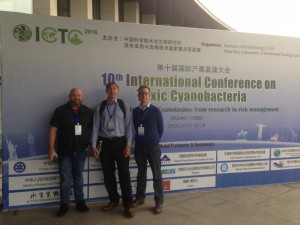
Dave Hartnell, Dan Franklin and Andy Turner at conference venue
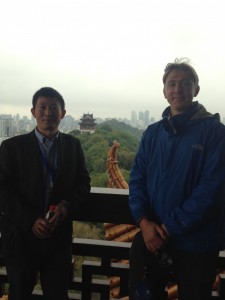
Dan Franklin with colleague Dr Zhou Yang at Yellow Crane Tower
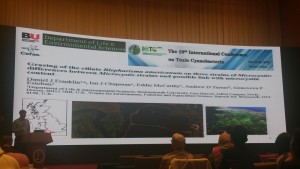
Giving presentation at ICTC 10
Stern review of the REF – what next?
 The Stern review of the REF was published in July 2016. The government have accepted the main recommendations, and we are expecting in November a HEFCE technical consultation on implementation – to affect the next REF exercise (probably in 2021). It is expected that the new arrangements will be settled by the summer of 2017.
So what did Stern recommend – and what is likely to be in the consultation?
- The main thing that Stern might have done, but did not do – following widespread concern in the sector – was move to a metrics-based approach for the REF. Peer review and case studies will remain and there will be an opportunity to celebrate success wherever it is found in the REF – not a metrics based ranking. There may be new metrics, and a new Forum for Responsible Research Metrics has been launched, but the key is that these metrics should be used responsibly and carefully.
- All research active staff should be returned in the REF (and allocated to a unit of assessment).
- Outputs should be submitted at Unit of Assessment level with a set average number per FTE, but with flexibility for some faculty members to submit more and others less than the average. A total cap should be set based upon two outputs on average per FTE with an individual cap (e.g. six) and a minimum per FTE (potentially 0).
There has been some concern expressed about these changes – Maddalaine Ansell (University Alliance) via Wonkhe and James Wilsdon in The Guardian, 29th July 2016. At BU, our strategy is that all academic staff should be active in research as part of Fusion, so we will not be moving towards teaching only contracts. We hope the sector will not do so either – we will consider pressing for all staff to be included and remove any risks around the definition of “research active” to avoid this
- The total number of outputs per UoA should be adjusted so that it does not significantly exceed the 190,000 reviewed in REF2014. This may require the average number of outputs submitted per faculty member to be below two.
- Outputs should not be portable. The review proposes that outputs should be submitted by the HEI where the output was demonstrably generated and that work should be allocated to the HEI where they were based when work accepted for publication. There may be some flexibility around maximum numbers when staff have moved- e.g. maximum three outputs from those who have left.
Concern has been expressed that this will restrict employment options for early career researchers, e.g. Paul Kirby. James Wilsdon again “the broader move to reduce output numbers and decouple them from individuals should reduce pressure on those at the start of their career, or who take time out of research because of childcare, illness or caring responsibilities” Other views: – it might be fairer to early career researchers who will be recruited on potential not previous publications
- Institutions should be given more flexibility to showcase their interdisciplinary and collaborative impacts by submitting institutional level impact case studies
- Impact should be based on research of demonstrable quality. However, case studies could be linked to a research activity and a body of work as well as to a broad range of research outputs
- Guidance on the REF should make it clear that impact case studies should not be narrowly interpreted, need not solely focus on socioeconomic impacts but should also include impact on government policy, public engagement and understanding, cultural life, academic impacts outside the field and impacts on teaching – the report recommends that research leading to impact on curricula and/ or pedagogy should be included. BU welcomes these changes and we look forward to seeing more details of these plans.
So watch this space – once the consultation is launched the Research and Knowledge Exchange team will be working with the policy team to prepare a BU response. You can read more about BU’s policy and public affairs work on our intranet pages.
Increasing Crop Yield through understanding Plant Nutrition – talk from Dr. David Pilbeam
 Bournemouth Natural Science Society would like to invite you to talk on ‘Increasing Crop Yield through understanding Plant Nutrition’.
Dr. Pilbeam is a Visiting Fellow and former Senior Lecturer at the University of Leeds. He has edited books on the subject of plant nutrition and published widely on the subject. He will discuss how new research may lead to changes to farming practice and how we can use crop breeding to respond to climate change.
When: Saturday 19th November at 2.30pm
Where: Bournemouth Natural Science Society
39 Christchurch Road BH1 3NS
For more information please click here
Interested in helping bees and other pollinators thrive in our towns and cities?
The newly launched Pollinator Exchange is your one-stop resource
With pollinator numbers in decline in rural areas, there has been increasing focus on the many ways in which towns and cities can be made more pollinator-friendly. Urban green spaces such as amenity grassland in parks, gardens, verges or roundabouts offer plenty of opportunities for pollinators, provided they are managed correctly.
While much academic research has gone into this field in recent years, this is not always readily available to the people in charge of managing urban green spaces. Local councils, highway agencies and other authorities need clear, evidence-based practical advice to turn our towns and cities into places abuzz with pollinators.
The Pollinator Exchange website, www.pollinatorexchange.org developed by Bournemouth University, fulfils this role. It provides an interactive database of the latest research, practical guidance and projects connected to pollinators in urban areas. All resources come with a brief summary of their main points, allowing those with limited time to follow recent developments and implement key recommendations. Website users can browse the existing catalogue and also add their own resources, thereby contributing to ongoing knowledge exchange on this important topic.
Gill Perkins, Chief Executive at the Bumblebee Conservation Trust, was one of many staff from conservation and land management organisations who generously gave their time to help test and develop the website. She said: ‘Bumblebee Conservation Trust recognises that urban environments are becoming crucially important to reverse the decline in pollinators. The Pollinator Exchange site will facilitate communication and knowledge exchange between groundsmen and contractors, biodiversity officers and everyone who influences decisions on what to grow, making it a vital resource for all to learn best techniques.’
The Pollinator Exchange was funded through the Higher Education Funding Council for England’s knowledge exchange programme: the Higher Education Innovation Funding scheme. (HEIF 5+1 August 2015 – July 2016.)
Please visit www.pollinatorexchange.org for a closer view.
For more information on this project please contact the Project Lead Kathy Hodder.
Impressions of a concussion consensus conference – Berlin
Physiotherapy lecturer Dr Osman Ahmed shares his thoughts regarding his recent conference experience on the Clinical Journal of Sports Medicine blog.
Hello from Sam Porter, Professor of Nursing Sociology and Head of Department of Social Sciences and Social Work
 Having been at BU for three months, I thought I should introduce myself to the research community in the University and take this opportunity to tell you about some of my research interests so that anyone ploughing similar furrows can get in touch with a view to future collaboration.
Dual trained in sociology and nursing (a fact reflected in my neologistic job title), my interests span social sciences and health. Coming from a School of Nursing and Midwifery, a lot of the work I am bringing with me to BU tends towards the clinical end of the spectrum, but I am really excited by the prospect of being able to re-engage a lot more deeply in the social scientific aspects of health and care.
In terms of substantive topics, my main focus is on palliative care (for example, I have been doing a lot of work around support for patients and loved ones dealing with cancer cachexia or wasting). I also do work on supportive care for cancer patients and survivors (a current example of the kind of thing I am involved in here is a qualitative study using Habermasian critical theory to examine patients’ experiences of care while taking oral chemotherapy, and how those experiences affect medication concordance).
In addition, I am interested in arts-based therapies (I recently led a randomised controlled trial of the effectiveness of music therapy for young people with behavioural and emotional problems). The subject population of this trial is indicative of the eclecticism of my interests, which include maternal and child care. Another example of this interest is the work I’m doing with colleagues in Brazil and the UK seeking social media solutions to Brazilian women’s health problems in the first year after giving birth.
Bringing together arts-based therapy and palliative care, I am currently involved in a feasibility study looking at whether music therapy is effective in reducing anxiety in hospice patients who are reaching the end of their lives (or more precisely, looking at whether a full RCT would be effective in evaluating whether music therapy is effective).
As a person trained initially in qualitative research who drifted into the dark realms of trialling, I am aware of the strengths and weaknesses of these differing approaches. I am also deeply interested in how they can be used in combination. I do a lot of methodological work grounded in critical realism, which aims to develop and encourage novel approaches to evaluation research that are capable of robust measurement of outcomes, comprehensive analysis of processes, and critical evaluation of human consequences.
I think that’s probably enough exposure of my chronically dilettantist approach to knowledge acquisition, so I’ll end by saying that if any of this interests you, it would be great to have a conversation.
Best wishes, Sam
2017 BU PhD Studentship Competition!!!
Call for submission of up to 48 funded Postgraduate Research Projects now OPEN
The Graduate School is delighted to announce the launch of the 2017 BU PhD Studentship Competition, with up to 48 funded projects available.
At this stage, Academic Staff are invited to submit proposals for studentship projects which, if successful, will be advertised to recruit PhD candidates for a September 2017 start.
Full details can be found on the Graduate School Staff Intranet where the following information can be found:
- BU PhD Studentship Competition 2017 Policy
- Studentship Proposal Form
- Matched Funded BU PhD Studentships Flyer
Submission Deadline:
Applications should be submitted on the Studentship Proposal Form to the Graduate School via email to phdstudentshipcompetition@bournemouth.ac.uk no later than 9am on Monday 9 January 2017.
The Graduate School will manage the recruitment process along the following timetable:
| Date | Action |
| 1 November 2016 | Launch PhD Studentships Internal Competition – development of proposals |
| 9 January 2017 | Closing date for submission of proposals |
| 23 January – 10 Feb 2017 | Panel meetings |
| Before 28 Feb 2017 | Feedback to supervisors and preparation of adverts |
| March – June 2017 | Launch PhD Studentships External Competition – recruitment of candidates |
| September 2017 | Successful Candidates start |
My Voice, My Story: hearing students’ stories
Date: Monday 7 November
Time: 10am-1pm
Location: F105, Fusion, Talbot Campus
What does it mean to be a student in the 21st century? As part of ESRC’s Festival of Social Science BU researchers Dr Vanessa Heaslip, Dr Clive Hunt, Dr Maggie Hutchings and Dr Alex Wardrop will be leading a workshop to present the real-life stories of non-traditional students. The students’ stories will immerse the aud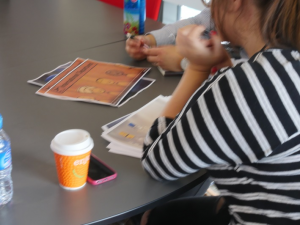 ience through a mix of multi-media methods made up of images, films and talks.
Bournemouth University is leading a pioneering collaborative programme of research exploring ways to make higher education more accessible and more equitable than it sometimes is. This research contributes to new, more participatory, ways of doing, thinking and learning about widening participation which is a core tenet to BU’s Fair Access Research project.
Over the past few weeks BU researchers have been working with a diverse group of non-traditional students from across the university, as they take images that tell their stories of university life. This enables the students to become the researchers of their own lives, using the photovoice methodology to share their stories.
During the research process BU researchers asked students to tell their stories to each other as a gift to help uncover insights into their experiences by talking through the images and hearing their stories retold by another. Some themes that have been emerging through the stories included the concept of homeliness, both in its history and recreation as a student.
 Unsurprisingly, the students identified that the images shared by the final year students appeared more positive compared with the anxieties of first year students.
The workshop will allow you to listen to the non-traditional students’ voices, learn from the students’ stories, gain insights into different research methods and work together to develop practical responses to what we see and hear.
You will gain insights into the power of arts-based social participatory research methods for eliciting deep stories and re-represented for social action. Having engaged with storytelling, participants will discuss ways in which the students’ lived experiences could shape policy changes and interventions to better enable students to feel like they belong.
For more information about this project or BU’s innovative Fair Access Research, please email the Principal Investigators Dr Vanessa Heaslip and Dr Clive Hunt.
The 14th annual Festival of Social Science takes place from 5-12 November 2016 with more
than 250 free events nationwide. Run by the Economic and Social Research Council, the Festival provides an opportunity for anyone to meet with some of the country’s leading social scientists and discover, discuss and debate the role that research plays in everyday life. With a whole range of creative and engaging events there’s something for everyone including businesses, charities, schools and government agencies. A full programme is available at www.esrc.ac.uk/festival You can also join the discussion on Twitter using #esrcfestival.
To hear more about ESRC Festival of Social Science at Bournemouth University, then please get in touch.
AHRC Town Meeting on Anti-Microbial Resistance in the Indoor and Built Environment
 AHRC Cross-Disciplinary Networking and Information Event (Town Meeting) on Anti-Microbial Resistance in the Indoor and Built Environment
| Event date | Event time | Event location |
|---|---|---|
| 30/11/2016 | 10:00 am – 3:30 pm | Amba Hotel, Bryanston St, London |
The event will provide an opportunity to discuss the potential innovative contribution of the arts and humanities to cross-disciplinary collaborative research on AMR. (See the pre-call announcement).
The meeting will start at 10.30am (registration from 10.00am) and finish around 3.30pm, and participants will be able to:
- hear background on the Research Councils AMR initiative and the AHRC-led call on AMR in the Indoor and Built Environment
- network and explore possible research partnerships and collaborations to support potential future applications under the call
- speak to Research Council staff about possible applications.
Who is the event for?
The event is open to academic researchers, both from the arts and humanities and other relevant research fields, who are interested in cross-disciplinary research relating to AMR in the built environment and to potential partners from outside academia who might be interested in the opportunity to initiate possible collaborations that might lead to research bids. Arts and Humanities researchers with related interests and expertise but who may not have previously engaged directly with AMR are welcome to attend to learn more about potential opportunities in this area.
The event provides a chance to:
- find out about the cross-Council AMR initiative and the AHRC-led call for pump-priming grants on AMR in the Indoor and Built Environment due to be launched in November 2016
- discuss with experts the challenges and opportunities of interdisciplinary working and co-delivery with end-users in this field
- put questions about the funding call direct to funders
- network with potential collaborators from other discipline areas or as end-users of research.
How to Register
If you are interested in attending the event please contact AMR@ahrc.ac.uk confirming your interest and providing a brief summary of no more than 300 words, outlining your current role/ organisational affiliation and relevant research / professional expertise as well as briefly stating your potential interest in the AMR in the Built/ Indoor Environment funding call.
Please Note: For those invited to attend the event this summary information will be shared among other participants to support the networking aspects of the event. Your application therefore needs to include a statement confirming that you are happy for this information to be shared with other participants if invited to attend the event.
The closing date for expressing your interest in attending the event is 20 November 2016.
For more information regarding the event please contact Samuel Lambshead 01793 416000 or email s.lambshead@ahrc.ac.uk
If you are interested in attending the town meeting then please let the RKEO Funding Development Team know as we would be interested in receiving a summary of the meeting.
European Research Council Autumn 2016 Newsletter
Professor Jean-Pierre Bourguignon, President of the European Research Council, writes in the latest edition of the European Research Council Newsletter that:
It is the ERC’s mission to fund bottom-up “high-risk/high-gain” research, with scientific quality as sole criterion, albeit with no certainty of to what the exploration will lead. This latest study and the history of science confirm that this is the way forward. Only by letting the most ambitious researchers pursue blue sky projects can Europe remain at the scientific forefront and open the way to new solutions to global problems.
Find out more about how researchers have benefited from ERC funding, projects currently underway and what is important to the ERC, in this newsletter. This includes their calls, the majority of which have deadlines in 2017:
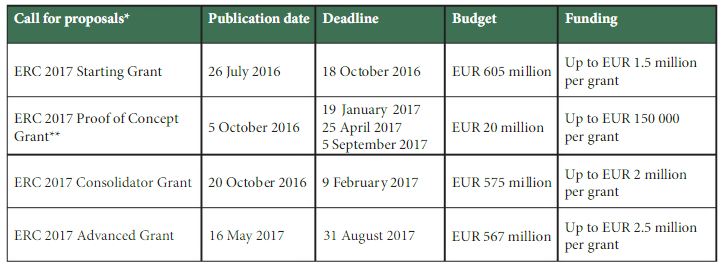
If you are considering applying to ERC funding, please see the calls on the Participant Portal Guide to ERC calls. If this funder is important to you, consider signing up to receive their updates via the ERC website.
Please contact Emily Cieciura, RKEO’s Research Facilitator: EU & International, if you plan to submit to this scheme or any other EU / international funding calls.
Research Professional – all you need to know
Every BU academic has a Research Professional account which delivers weekly emails detailing funding opportunities in their broad subject area. To really make the most of your Research Professional account, you should tailor it further by establishing additional alerts based on your specific area of expertise. The Funding Development Team Officers can assist you with this, if required.
Research Professional have created several guides to help introduce users to ResearchProfessional. These can be downloaded here.
Quick Start Guide: Explains to users their first steps with the website, from creating an account to searching for content and setting up email alerts, all in the space of a single page.
User Guide: More detailed information covering all the key aspects of using ResearchProfessional.
Administrator Guide: A detailed description of the administrator functionality.
In addition to the above, there are a set of 2-3 minute videos online, designed to take a user through all the key features of ResearchProfessional. To access the videos, please use the following link: http://www.youtube.com/researchprofessional
Research Professional are running a series of online training broadcasts aimed at introducing users to the basics of creating and configuring their accounts on ResearchProfessional. They are holding monthly sessions, covering everything you need to get started with ResearchProfessional. The broadcast sessions will run for no more than 60 minutes, with the opportunity to ask questions via text chat. Each session will cover:
-
Self registration and logging in
-
Building searches
-
Setting personalised alerts
-
Saving and bookmarking items
-
Subscribing to news alerts
-
Configuring your personal profile
Each session will run between 10.00am and 11.00am (UK) on the fourth Tuesday of each month. You can register here for your preferred date:
These are free and comprehensive training sessions and so this is a good opportunity to get to grips with how Research Professional can work for you.
Researching Talbot Campus Biodiversity
Ever wondered what wildlife we have on campus? Volunteer students and staff from the Dept. of Life & Environmental Science Green team are initiating a series of Student Environment Research Team (SERT) projects to find out and you can join in. We will help monitor the successful use wildlife is making of the habitats, nesting boxes and wild food resources that are being created on campus. The wildlife- friendly work is being spearheaded by the Estates Team, led by Dr Neil Smith and supported by the Biodiversity Action Plan Group.
There is a chance to get involved in a bit of campus habitat creation yourself this week if you like – join us this Friday at noon to help plant flower bulbs around the Fusion building. The bulbs have been chosen for both their wildlife and aesthetic value. Estates have bought the bulb and the planting design has been developed by a SERT of six students for Ecology & Wildlife Conservation BSc mentored by Damian Evans and Anita Diaz. See which bulbs here – bulbs-for-fusion-building-planting
Join us if you can and if you’d like to get involved with campus biodiversity creation and monitoring in some other way please contact Damian Evans devans@bournemouth.ac.uk
CQR lunchtime seminars “In Conversation …” continue with “Phenomenology” this Wednesday!
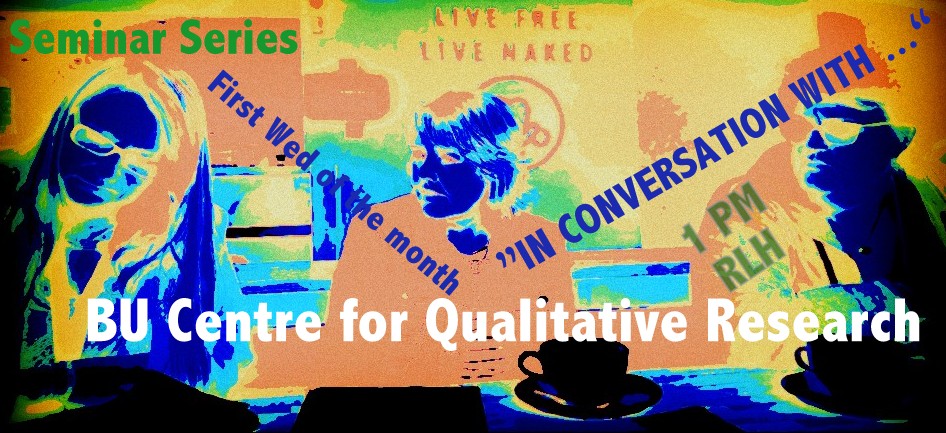
Breaking News! In spite of the recent flooding in Royal London House, the CQR Wed Seminar will go ahead as planned in Room 201. The lifts, however, will be out-of-order.
Following on from the two very successful (and jam packed!) earlier seminars, the Centre for Qualitative Research “In Conversation …” series continues with
“Phenomenology”
presented by
Jane Fry and Vanessa Heaslip
Wed., 2 Nov., Royal London House 201 at 1 pm.
Mark your diaries now and join us for an intriguing conversation!
Because CQR is keen to make information available to students and staff about qualitative METHODS, the seminars are arranged somewhat differently than the typical lunchtime seminar.
We are asking TWO (or more) presenters to agree to present each research method as a CONVERSATION…first, between each other, and then with the audience. We are also asking that no PowerPoint be used in order that it is truly a conversation and NOT a lecture. The conversations will be about a particular research method and its pros and cons, NOT research projects or outcomes.
Many of us then move next door to RLH to Naked Cafe to continue the conversations and network. Faculty and Students invited to attend!
See you Wednesday at Royal London House 201 at 1 pm. Students and Staff are Welcome!!
BU staff can login below:
Other services







Recent posts
BU research Funding opportunities EU
- Applications are now open for 2026 ESRC Postdoctoral Fellowships
 3C Online Social: Thursday 26 March 1–2pm – Research Culture, Community & Can you Guess Who?
 Four BU students at national midwifery conference
 INRC book roundtable/presentation by Drs Jonathan Cole and Catherine Talbot, Wednesday 22/04/2026, 13:00h, P426
 BU M.Res. student’s evidence to UK Parliamentary Women & Equalities Committee
- New Accessibility/disability and Tourism Paper just published, focusing on humanising travel experiences Devis-Rozental C, Buhalis D, Bello BO, Darcy S (2026;), “Reframing accessible tourism through the humanising framework”. International Journal of Contemporary Hospitality Management, https://doi.org/10.1108/IJCHM-05-2025-0632
 ECR Funding Open Call: Research Culture & Community Grant – Apply now
- FLF UKRI round 11- internal launch and timelines
 ECR Funding Open Call: Research Culture & Community Grant – Application Deadline Friday 12 December
- ECR Funding Open Call: Research Culture & Community Grant – Apply Now
 MSCA Postdoctoral Fellowships 2025 Call
 ERC Advanced Grant 2025 Webinar
- MSCA Postdoctoral Fellowships 2025 Call
- ERC Advanced Grant 2025 Webinar
- European Migration Research and Impact – Invitation to a Roundtable Discussion
- MSCA Postdoctoral Fellowships 2025
 Update on UKRO services
 European research project exploring use of ‘virtual twins’ to better manage metabolic associated fatty liver disease
 Research Information Network
- Physical Sciences Case studies: information use and discovery
- Information handling in collaborative research: an exploration of five case studies
- Information literacy monitoring and evaluation
- Data centres: their use, value and impact
- Heading for the open road: costs and benefits of transitions in scholarly communications