This seemed like a good moment to explain what the Lifelong Learning Entitlement is really about and what it means for universities (spoiler: a lot of administrative work and not much else, in the short term), and this update also includes some horizon scanning by UKRI, some data on staff numbers and applications and a bit more on financial sustainability, as hard to get away from in stories about the sector this month. And there is more besides.
Politics and Parliament
Lots of time spent this week on the Rwanda bill, with work for local MP Michael Tomlinson in his new role as Illegal Immigration Minister. The two deputy chairs of the Conservative Party resigned their roles yesterday along with a PPS but the Rwanda bill was passed unamended and has gone to the Lords where there will be more challenges.
Meanwhile it isn’t a manifesto but there is a campaign brochure from the Labour Party. It says “we will be able to seize the opportunities of advances in AI, digital, life sciences and technology as drivers of economic growth”. It presents again the 5 missions we discussed in issue 1 of this update. On education: this is the closest to a reference to HE: there simply aren’t enough high-quality pathways onto apprenticeships, and technical education. So we will have to keep waiting for the detail.
And if you missed it, constituency boundaries change for this election. There were originally going to be major changes locally but those were dropped in the last round of reviews, so not much is changing here. However, there might be implications elsewhere: there is a BBC article here. One point to note is that Chris Skidmore stood down on environmental issues and there is a by-election planned in February: but his constituency is one of those disappearing.
Ongoing legislation
Research and knowledge exchange
Business and innovation
UKRI have published a position statement on their “commitment to improve the research and innovation environment for businesses seeking to scale up, through enhancing the support that we offer alongside private capital to help them invest, innovate and grow”.
As well as confirming some of the things they already do they will be:
- launching a new digital guide to help businesses, along with investors and researchers, to make the most of UKRI products and services to commercialise research
- launching new £20 million proof-of-concept funding in 2024 to support researchers to spin out scientific discoveries into exciting new products and services
- ensuring that UKRI’s core offer of training to new doctoral research students improves awareness and experience of commercialisation and entrepreneurship, building on existing opportunities that allow students to work with businesses
- creating a joined-up funding pathway over 2024, working with the British Business Bank and UK Export Finance, to enhance access to finance for scaling businesses
The Science Minister, Michelle Donelan, gave a speech about “scaleups” on 16th January. It has unicorns, silver bullets, powder kegs and goldmines. There is a lot in in it apart from those theme park elements, but this bit caught my eye:
- Regulate to innovate is not just some slogan that I happen to use – I think it is a commitment I make to businesses across the country.
- And that is why I am backing the Regulatory Horizons Council report, published today, and committing to reviewing the recommendations to become unapologetically ambitious in our regulatory approach.
- And that is also why this year, I will develop a regulatory support service specifically designed to help science and tech companies to navigate rules and regulations. Because we know that regulation isn’t just about dry ink on the statute books. I believe the behaviour of our regulators and regulatory simplicity is absolutely key.
What is the Regulatory Horizons Council? The Regulatory Horizons Council (RHC) is an independent expert committee that identifies the implications of technological innovation, and provides government with impartial, expert advice on the regulatory reform required to support its rapid and safe introduction. Find the membership etc at the link.
Here is the report and its recommendations:
- Recommendation 1: DSIT, working with the Department for Business and Trade (DBT) .. should ensure that regulators are empowered with the tools and resources to better support innovative startups and scaleups.
- Recommendation 2: DSIT should work with relevant partners to embed a greater understanding of regulation, and earlier engagement with regulatory issues, within the early-stage business community.
- Recommendation 3: Government and regulators should continue to build the knowledge base on pro-innovation regulation, and particularly the impacts on start-ups and scaleups.
Emerging technologies horizon scan
In December, UKRI published an insights report on Innovate UK’s 50 emerging technologies that could be part of our everyday lives in 2040 and beyond.
Although there are 50, the report is only 39 pages: the list is in the contents page (and it does briefly explain what they all are). The world has been very focussed on the risks of new technology, AI in particular, in recent months, but this is a very hopeful list, focusing on the problems that can be solved rather than disruption and destruction. The report does note the ethical challenges (in the context of AI in particular) and sets our five questions to consider:
- As technology is more embedded in our bodies, will humans turn into something new and different? What makes us human will be increasingly questioned.
- Should AI be allowed to make decisions on our behalf? All aspects of business and society will be transformed through AI and computing.
- If humans can expect a century of good health, what does this mean for employment, pensions or housing? The quality and length of our lives will be greater than ever before.
- Will a shift towards cleaner, affordable energy change the way we live and work? A transformed energy system could help new industries to thrive.
- What will a vast expansion of our understanding of the world mean for the UK economy? The UK’s ability to draw on its research and business strengths will help us solve big problems and seize opportunities.
Quantum missions
In the context of the above, the government announced 5 “quantum missions” in November: there are likely to be more funding rounds for research and projects in these areas.
- By 2035, there will be accessible, UK-based quantum computers capable of running 1 trillion operations and supporting applications that provide benefits well in excess of classical supercomputers across key sectors of the economy.
- By 2035, the UK will have deployed the world’s most advanced quantum network at scale, pioneering the future quantum internet.
- By 2030, every NHS Trust will benefit from quantum sensing-enabled solutions, helping those with chronic illness live healthier, longer lives through early diagnosis and treatment.
- By 2030, quantum navigation systems, including clocks, will be deployed on aircraft, providing next-generation accuracy for resilience that is independent of satellite signals.
- By 2030, mobile, networked quantum sensors will have unlocked new situational awareness capabilities, exploited across critical infrastructure in the transport, telecoms, energy, and defence sectors.
And the other Horizon (Europe)
You can’t have missed it, but the UK is now an associate member of Horizon Europe from the start of 2024. You can read more on the UKRI website here. The Horizon Europe work programmes are listed here.
Small but beautiful
Research England have also announced the results of the second round of the “expanding excellence in England” fund. Research England is investing £156 million to support 18 universities across England to expand their small, but outstanding research units. The list of projects funded in round two (and round one from 2019) is here.
Regulation
These policy updates so far this year have included a lot of regulatory content, focussing on the OfS, but did you know that many other regulators may have an interest in aspects of education at universities, and this makes for a challenging and potentially burdensome situation.
Research Professional reports on an event sponsored by the Higher Education Policy Institute and AdvanceHE, which Keith attended this week, at which the VC of London South Bank University raised this issue:
- Phoenix pointed out that if a level 4 or 5 course is taught as part of a degree, then it is regulated by the Office for Students, but if it is a standalone qualification such as a higher national certificate and taught in a college, it is overseen by Ofsted.
- Similarly, if higher technical qualifications are taught in higher education, they are quality-assured by the OfS in universities but by Ofsted or Ofqual in further education, while level 4 apprenticeships are overseen by Ofsted regardless of where they are offered.
Of course it is even more complicated than that, as apprenticeship funding is overseen by the ESFA (the Education and Skills Funding Agency, part of the Department for Education), making them an important regulator for HE too. If you haven’t heard of the ESFA, then here is what they do: it isn’t obvious from this that it includes degree apprentices delivered at universities; but it does.
As an executive agency of the Department for Education, and on behalf of the Secretary of State for Education, ESFA is responsible for administering funding to deliver education and skills, from early years through to adulthood.
ESFA funds education and skills providers, including:
- maintained schools and early years institutions, through local authorities
- academy trusts
- special schools
- colleges
- independent training providers (ITPs)
- high needs institutions
ESFA is responsible for:
- £67 billion of funding for the education and training sector, ensuring timely and accurate allocations and payment to education and training providers
- providing assurance to Parliament that public funds are spent properly, achieving value for money for the taxpayer and delivers the policies and priorities set out by the Secretary of State
- provides, where necessary, financial support for providers
Outstanding OfS consultations
Just a reminder of the ones that are ongoing or we are expecting outcomes on from the OfS:
- Consultation on a new free speech complaints scheme: open until 10th March: BU is considering a response
- Consultation on the approach to regulating students’ unions on free speech matters: open until 17th March
- Consultation on the inclusion of higher technical qualifications in student outcome measures: closed November 2023
- Consultation on a new approach to regulating harassment and sexual harassment-this one has been closed since May 23 so there should be an outcome soon
And two Department for Education ones:
Apprenticeships
In the last couple of updates I have mentioned the government focus on apprenticeships, which is being supported by funding provided by the OfS to support the development of new L6 apprenticeships. On 17th January the outcome of the latest funding competition was announced, with £12 million being allocated. The list is here (BU is on it).
Applications and admissions
UCAS have published the end of cycle 2023 data.
Sector:
- Overall applicants fell in 2023, the peak was 2022
- 18 year olds had grown (slowly in some years) since 2014 when this data starts until 2023 when the number fell back
- More females than males applied in every age group
As well as the more general picture there is also data for nursing, which shows tor UK applicants there is a fall in application numbers for most age groups since 2021 but applications for 18 year olds and over 35s remain higher than they were in 2019, and the over 35s are now the biggest group, as they were in 2020 (and almost were in 2021). The proportion of male applicants over 35 is also higher than the other groups.
Midwifery applications have also fallen since 2021 but remain higher than 2019 for 18 years olds and the over 35s, 18 year olds being by far the largest group with the over 35s just squeaking in at second. The gender data is interesting: tiny numbers of male applicants.
Wonhke have an article and analysis: there are a little over a thousand more English domiciled applicants who have accepted a place at a Russell Group provider this year than last. Everyone else (excluding alternative providers) has lost accepted applicants over 2022, but (as UCAS is always keen to remind us) the “last regular year” comparison to 2019 looks a bit rosier. There are loads of charts and even a map.
Student experience, wellbeing and finances
Cost of living: This year’s updates have covered this ongoing issue; the Russell Group published a briefing this week on the impact of inflation on the maintenance loan and what their members are doing to help. The briefing also points out: The shortfall is compounded by the freeze on the parental earnings threshold used to calculate maintenance loans in England. Students with a household income of less than £25,000 are eligible for the maximum loan, but this figure has been frozen in cash terms since 2008. It is estimated that had this threshold increased with earnings, it would now sit at £35,000, making many more students eligible for the maximum support.
Lifelong loan entitlement
This has been a long running story and we have reported for several years on the various legislative changes and consultations but it all still seems a bit remote and confusing: the new funding system will be in place for entrants to HE from September 2025.
This is about two things, really:
- putting funding arrangements for university degrees and other post 18 higher level courses on an equal footing; and
- the “lifelong” bit: enabling flexible and modular learning including to support returning or mature learners
The real change is in the mechanics of funding for universities. In preparation for modules and to support the “LLE personal accounts” the funding basis is switching to a system based on credits, not academic years.
Last week I talked about the OfS funded short course trial that had a microscopic take up. I wonder if the public accounts committee will be interested in the cost/benefit of that £2m investment?
There’s a blog here that the OfS wrote in October 2024 on the changes for HE that the LLE will bring:
Over time, we think this will lead to some or all of the following changes:
- Universities and colleges will offer standalone modules from existing courses
- Students will be able to build a full qualification by completing different modules, across different courses, from different universities or colleges
- Students could end up studying at several universities or colleges at the same time, or across multiple departments in a single higher education provider
- Students will be able to study modules that will give them the skills or knowledge they need to progress their career without the intention of building or completing a full qualification.
If there is a growth in LLE funded modular study, we also think there might be a shift to:
- Universities and colleges changing existing …courses to an LLE fundable modular format
- …An increase in modular study overall, not only LLE fundable modules
- A decrease in the number of employers paying for continuing professional development (CPD) related courses as individuals will receive funding for standalone modules; [and] an increase in employers encouraging employees to take up CPD related modules as they will not need to fund them.
But if you are still puzzled about what it is all really about, and what it means in practice for universities, the Department for Education have published a guide in the form of a policy paper this week. sorry this is a bit wordy!
| The summary: so far not very revolutionary.
From the 2025 to 2026 academic year, the LLE loan will be available for:
· full courses at level 4 to 6, such as a degree or technical qualifications
· modules of high-value technical courses at level 4 to 5
Under the LLE, eligible learners will be able to access:
· a tuition fees loan, with new learners able to access up to the full entitlement of £37,000, equal to 4 years of study in today’s fees
· a maintenance loan to cover living costs
Targeted maintenance grants will also be available for some groups such as learners with disabilities, or for support with childcare.
An additional entitlement may be available in certain cases – for example, for some priority subjects or longer courses such as medicine.
Learners will be able to see their loan balance through their own LLE personal account. This will help them make choices about the courses and learning pathways available. |
| So the devil, as always, must be in the detail. What is covered, see below, again, fairly straightforward, except the bit about modules.
But that isn’t coming straight away “The government will take a phased approach to provide modular funding. We expect to expand modular funding to more courses from the 2027 to 2028 academic year.”
Eligibility:
· The LLE will be available to new and returning learners.
· For returning learners, the amount they can borrow will be reduced depending on the funding they have previously received to support study.
· LLE tuition loans will be available for people up to the age of 60. Learners who are over 60 may still qualify for maintenance support, though not a tuition fee loan.
· Eligibility criteria for the LLE will track existing higher education (HE) student finance nationality and residency rules.
Courses: the LLE will be available for:
· full years of study at higher technical and degree levels (levels 4 to 6)
· modules of technical courses of clear value to employers
From the 2025 to 2026 academic year, the LLE will fund:
· full years of study on courses currently funded by HE student finance including:
o traditional degrees
o postgraduate certificates in education (PGCE)
o integrated master’s degrees (a 4-year programme that awards a master’s degree on top of a bachelor’s degree)
o the foundation year available before some degree courses start
· all HTQs, including both full courses and modules of those courses
· qualifications currently funded by advanced learner loans where there is clear learner demand and employer endorsement
· modules of some technical qualifications at levels 4 and 5 currently funded through advanced learner loans with a clear line of sight to an occupational map and evidence of employer demand |
| So what does this mean for students? The main change is that tuition fee and maintenance loans will be available for a wider range of courses.
The entitlement
New learners (those who have not yet received government support to undertake higher-level learning) will be able to access a full entitlement equal to 4 years of full-time tuition. This is currently equal to £37,000 across 4 years, based on today’s maximum fee limit of £9,250 per year.
This means a student could use their £37,000 to pay for more than 480 credits of learning, depending on the per-credit cost of the course. For example, if a student can borrow £37,000 and they use £7,000 for a 120-credit course, they would have £30,000 of the LLE left for other courses, regardless of the size or duration of the original programme.
Returning learners …who have not used it all will have access to a residual entitlement. For example, a typical graduate who completed a 3-year degree worth £27,750 in today’s fees will have a £9,250 residual entitlement.
An additional entitlement above the core 4-year entitlement will be available for some priority subjects and longer courses such as medicine.
Maintenance loans
Maintenance loans are designed to help learners with living costs while they study. There is a maximum claim amount based on a student’s course, location and personal circumstances.
Under the LLE, the maintenance loan for living costs and targeted support grants, such as the Disabled Students’ Allowance and the Childcare Grant, will be made available for all designated courses and modules that require in-person attendance. Maintenance support will be subject to personal criteria such as income. This will broadly remain the same as the current criteria.
Repayments
The latest repayment arrangements apply as for students who started university this year. |
| And what does it mean for universities?
There will be a maximum financial amount per credit and a maximum number of credits that can be charged for in each course year, which will be set by the government.
We will treat certain course types under the LLE as ‘non-credit-bearing’. This means that different rules will apply. Non-credit-bearing courses include courses such as medicine and PGCEs, and courses where the provider has not assigned a qualifying credit value.
To support the LLE, the government will introduce a standardised transcript template to ensure a learner’s assessed achievements are always captured under the new modular, credit-based system.
There will be a new process for new providers and new qualifications. This is properly new stuff and the subject of a lot of the ongoing work listed below, but probably not a lot of interest to readers of this update! |
| There is a separate paper on how tuition fees will work, from November 2023. This bit is confusing and implementing it will be tricky: lots of new reporting and forms likely to achieve this!
In the LLE system, we’ll set fee limits per credit. Credits are a measurement used by colleges and universities to identify how much learning is in a period of study. One credit generally equals 10 hours of learning by the student. This includes all tuition, assessment and any self-guided study in the student’s own time.
The credit-based system means that providers will only be able to charge for as much learning as they offer. A course containing 60 credits will have half the fee limit of a course containing 120 credits at the same provider.
The LLE system will have different fee limit rates. The limit-per-credit will depend on the type of study. There will be different limits for work placement, study abroad, and foundation years in certain subjects. Each of these limits may be lower if the provider does not have:
· a Teaching Excellence Framework (TEF) award
· an approved access and participation plan (APP).
There will no longer be different limits for part-time study. Instead, each course or module will have a fee limit based on the number of credits it contains. This is subject to a course year maximum and a course maximum. This means that if a course contains 360 credits, its overall fee limit will be the same regardless of how many years it takes to complete.
Some courses will be non-credit-bearing. For these courses, we’ll allocate a default number of credits. For example, we’ll allocate a PGCE course 120 default credits. This is because currently providers do not always allocate the same number of credits to these courses, but the amount of content is always very similar.
Under the LLE system, we’ll calculate fee limits according to the number of credits in a course year, multiplied by a limit-per-credit. For example, if a year of a course contained 120 credits, and its limit-per-credit was £50, its fee limit would be £6,000.
The LLE system will no longer have different fee limits for accelerated study. Instead, the overall fee limit for an accelerated degree will be the same as the overall fee limit for the same degree (full-time or part-time).
There will be a cap on the number of credits for which providers can charge in each type of course. This ensures that credits are not added on to courses simply to increase tuition fees. Providers may offer additional credits beyond the maximum, but are not allowed to charge for them.
If a student repeats part of their course, the repeat study is not counted towards the course cap. For example, if a student on a 360-credit degree fails a 30-credit module and repeats it, the provider can charge them for 390 credits overall.
And those modules?
There are no restrictions on the number of chargeable credits in a module. However, a module must have the same number of credits as it does when it is offered as part of the full course.
Modules offered separately from full courses must contain at least 30 credits. This can include multiple smaller modules bundled together. |
| So what is next?
In spring 2024, we will:
· launch a technical consultation on the wider expansion of modular funding
· lay secondary legislation covering the fee limits for the LLE in parliament
· communicate the details on the benefits of the third registration category
In summer 2024, we will: publish further information about the qualification gateway
In autumn 2024, we will: lay the secondary legislation that will set out the rest of the LLE funding system in parliament
In spring 2025, we will: launch the LLE personal account, where users can track their loan entitlement and apply for designated courses and modules
In autumn 2025, we will: launch the qualification gateway, an approval process that allows qualifications to access LLE funding (as noted above, not directly relevant to us) |
Who are the staff at UK universities?
HESA published a bulletin about UK HE staff statistics as at 1st December 2022, on 16th January 2023.
- Research Professional article here.
- Wonkhe article here
The data shows an increase in the number of academic staff and non-academic staff employed in the sector since the previous year and a small decrease in the number of a-typical academic staff employed.
- In 2022/23, 103,005 or 43% of academic staff were employed on contracts described as having a teaching and research function. The total for 2021/22 was 100,170 or 43%.
- A further 36% of academic staff were on teaching only contracts. This percentage has steadily increased year-on-year since 2015/16, when it was 26%.
- Among academic staff, 71,420, or 30% were employed on fixed-term contracts in 2022/23. Of full-time academic staff, 22% were employed on fixed-term contracts in 2022/23. In contrast, 43% of part-time academic staff were employed on fixed-term contracts, marking an eight percentage point decrease from 2021/22.
- Of academic staff with known ethnicity, 22% were from ethnic minority backgrounds in 2022/23. This has increased from 16% in 2017/18.
- Of the 22,345 professors with known ethnicity, 2,865 or 13% were from ethnic minority backgrounds. The majority of professors from ethnic minority backgrounds were Asian.
- From 2021/22 to 2022/23 there was an increase of 40 Black professors.
- The number of staff known to have a disability increased by 1,100 compared to 2021/22
Financial sustainability: Scotland
Last week’s update mentioned student number caps, which may soon be applied in specific cases (by provider, by subject) based on quality reviews by the OfS. The government recently ruled out reintroducing more widespread caps in England after a consultation. There have caps in Scotland, though, and they are about to be reduced. Wonkhe reported this week on remarks in the Scottish Parliament:
- Scottish finance secretary Shona Robison confirmed that at least 1,200 funded university places for Scottish-domiciled students will be cut following the Scottish government’s 2024–25 budget. Her remarks were made a scrutiny session with the Scottish finance committee – Robison told MSPs that the funding for additional places, instituted due to increased demand during the pandemic, was no longer sustainable.
The Scottish caps on home students have had a direct impact on the finances of Scottish institutions and they have turned increasingly to the international market to make up the income as, like in the rest of the UK, the real value of domestic tuition fees falls. The financial challenges for Scottish universities are described in this recent report from the Scottish Funding Council (4th Jan 24).
You will recall that there is a reason for these caps: the Scottish government funds tuition fees directly in Scotland for Scottish students, there is no tuition fee loan. The actual amount received was £7,610 for each Scottish student this academic year year (see a report from the Institute for Fiscal Studies from December 2023), significantly less than the £9,250 capped fee in England.
Institutional failure
Last week I talked about the OfS licence conditions in place to protect students in the context of a university closing down, perhaps as a result of financial issues.
Wonkhe have several blogs this week.
There is one from two members of Public First on what would happen if a large university ran out of money:
- The DfE (rightly) puts in place lots of warning measures for schools in difficulty, and if a school or group of schools start to find themselves in real trouble, a lot of things kick into place. They can mandate that schools have cost cutters come in; they can prescribe significant changes to operating models; and they can both demand that the school or school group takes an advance from the state, whilst placing (pretty onerous) conditions that are attached to repaying that advance. And given that financial trouble often goes hand in hand with performance trouble, the government has pretty carte blanche to change leadership and management when a poor performance judgement is made….
- Universities are, of course, not big schools. And it is their fiercely guarded autonomy – as safeguarded in HERA – which means we don’t have a clear set of state interventions. When the Westminster government made its various moves to extend a more market based HE system in England in the early 2010s, it was explicitly envisaged that some providers could exit the market – and that government wouldn’t step in. This was not a bug, but instead a positive virtue of the system…
- There is no power in today’s legislation for the government to give “extraordinary support” to a particular institution. In a major failure scenario, they could theoretically want to support (or even force) a merger or acquisition. They could also want to support specific institutions financially to keep them open at least for an interim period. But both would likely require new legislation, potentially at speed, and all of this tells against a story of autonomy
- …. This issue all relies on some very big P political questions. Which institutions might be allowed to fail – and which won’t? What does increased government intervention mean for institutional autonomy, an idea already much eroded in political and policy circles? What does it mean for the status of universities, and could they be reclassified as FE colleges as public sector bodies if the state gains more control over funding or governance? And how much is the sector as a whole willing to trade to save a small, but potentially significant number of institutions?
There is one is from two members of the Office of the Independent Adjudicator for Higher Education (OIA) talking about what will really happen if a provider fails.
They point out the regime that applies to FE, for which there is no equivalent for universities:
- the Technical and Further Education Act 2017 established an insolvency regime that applies to further education and sixth form colleges in England and Wales. This introduced a special education administration regime, which protects learner provision for existing students at insolvent colleges with the overarching duty to the learner
They conclude:
- We have talked before about insurance schemes or a “pot of money” to help students in these situations. We often hear that many providers would not be willing to pay into a system as they do not think such a situation really impacts them.
- But the impact on the wider sector, students and the reputation of HE must be worth further serious discussion, and we are increasingly finding that there is an understanding that this situation needs to be addressed. …..
- Whatever the answer, students should not be the collateral damage. A provider closure can leave students significantly disadvantaged, with their experience of and faith in higher education ruined. The potential impact on some students’ mental health cannot be underestimated. The financial impact, in a system where students are at the end of a long list of unsecured creditors, could create significant hardship and may make it unsustainable for a student to complete their studies.
- We cannot just wait for a large-scale disorderly exit to happen before we engage in a serious discussion.
 Our article ‘Understanding health education, health promotion & public health’ [1] is getting read according to ResearchGate. This conceptual/ theoretical paper was published open access in late 2021 in the Journal of Health Promotion and it reached 4,500 reads yesterday. Whilst the web side of the journal suggests today that the PDF of the paper has been downloaded 8,511 times.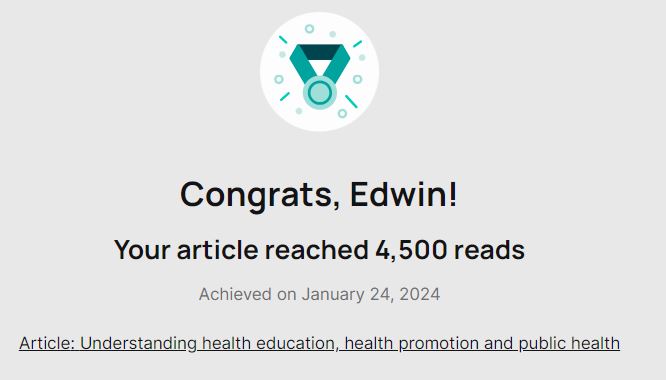


 The British Academy is running a project on the SHAPE of research careers, specifically looking at the identity, activity, and mobility of SHAPE postdoctoral researchers, from early career to mid- and late career. We would like to invite anyone who identifies as an early-career social sciences, humanities, or arts researcher to participate in the final workshop, which will be taking place on 1 February 10am to 1pm on Zoom. As a participant in our online workshops, you would also be invited to attend the March conference, with an opportunity to help develop policy options to better support researchers and research, and to network with SHAPE researchers from across UK higher education and other sectors.


 A workshop presented by







 The BU









 BU Annual Research Conference: Poster Exhibition Call for Applications
 Vitae Three Minute Thesis (3MT®) Competition: Applications Now Open
 3C Online Social: Thursday 26 March 1–2pm – Research Culture, Community & Can you Guess Who?
 Four BU students at national midwifery conference
 INRC book roundtable/presentation by Drs Jonathan Cole and Catherine Talbot, Wednesday 22/04/2026, 13:00h, P426
 ECR Funding Open Call: Research Culture & Community Grant – Apply now
 ECR Funding Open Call: Research Culture & Community Grant – Application Deadline Friday 12 December
 MSCA Postdoctoral Fellowships 2025 Call
 ERC Advanced Grant 2025 Webinar
 Update on UKRO services
 European research project exploring use of ‘virtual twins’ to better manage metabolic associated fatty liver disease