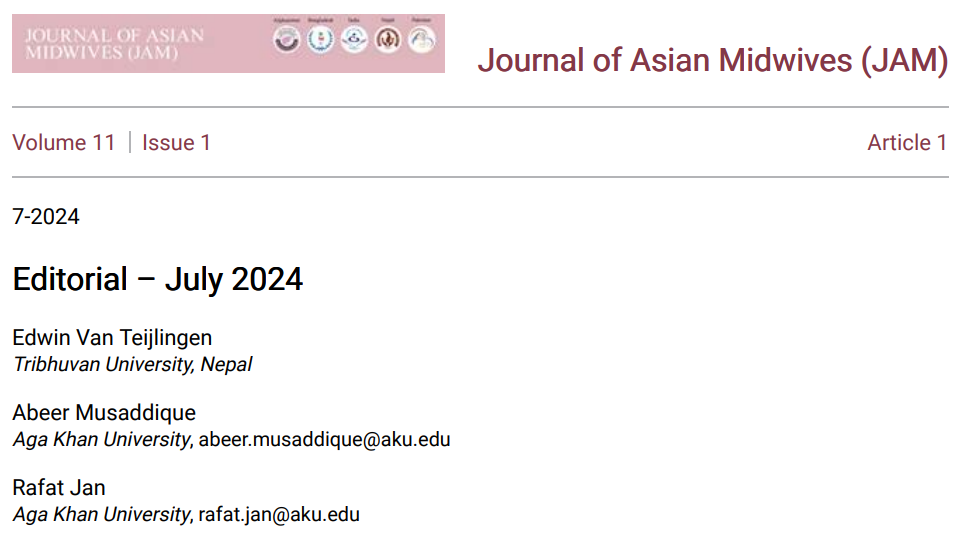
 The latest issue of the Journal of Asian Midwives was published last week. In the accompanying editorial we focused on the environment and sustainability in midwifery and maternity care.
Climate disasters appear to be on the rise worldwide, owing mostly to global warming, but also to urbanization and other human factors. Some Asian countries are among the world’s most climate-vulnerable, such as Nepal ranking 139th out of 182 in terms of exposure, sensitivity, and ability to adapt to the negative effects of climate change. Nepal, well-known for its mountains, the Himalayans, and especially, Mount Everest, is grappling with not solely earthquakes, but also floods, landslides, wildfires, and droughts. In the past decades we have also seen major natural disasters in many other South Asian countries, such as cyclones in Bangladesh, earthquakes and flooding in Pakistan, tsunami and drought in India, and so on.
Marginalized populations, suffer already from poverty, food insecurity, and discrimination, and agriculture-based livelihoods, are especially susceptible to environmental effects. These calamities frequently adversely impact low-income populations. We must not forget that when a disaster strikes, regardless of climate change, the impacted areas will require emergency rescue teams, temporary shelters, food and medication, and other necessities, as well as infrastructure support to keep non-emergency services functional. Remember that even after an earthquake, flood, or volcano eruption, there will still be a mother going into labour!
The Journal of Asian Midwives is Open Access and hence freely available to everybody with internet access in Asia (and elsewhere in the world).
Prof. Edwin van Teijlingen
Joint editor Journal of Asian Midwives
Reference:
- van Teijlingen, E., Musaddique, A, & Jan, R. (2024) Editorial – July 2024. Journal of Asian Midwives, 11(1): 1–2.
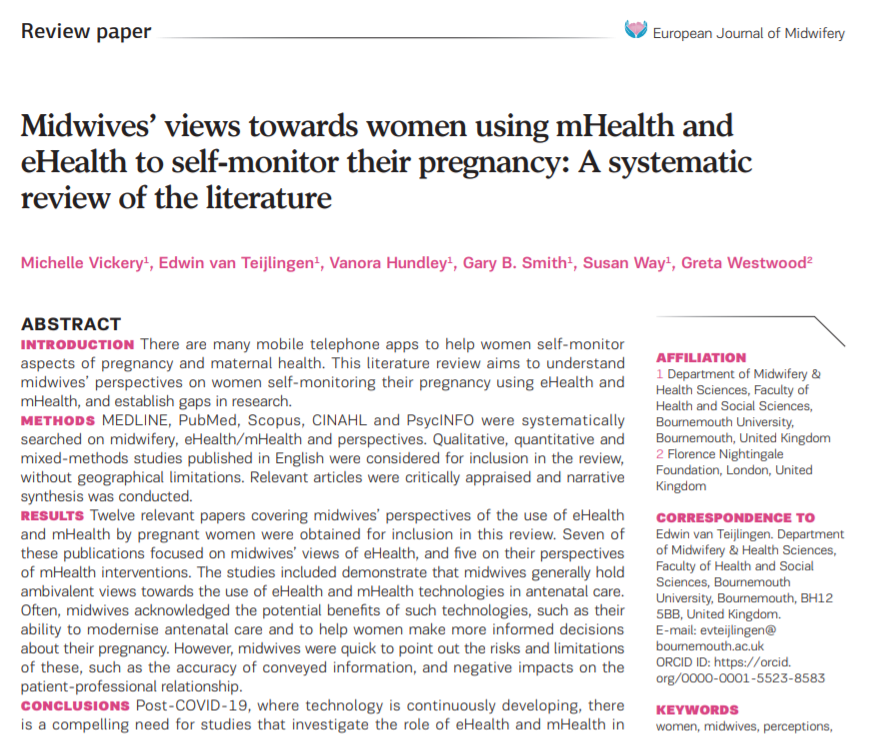





















 Verbal autopsy paper published two days ago
 ESRC Studentships for 2027 Entry: Opportunity Now Open
 SONAMONI contributions to Safety Conference 2026 in South Africa
 Three CMWH presentations at Berlin conference
 Horizon Europe Cluster 3 (Civil Security for Society) 2026 Calls Now Open
 MSCA Doctoral Networks 2026 Call Information Webinar
 ESRC Festival of Social Science 2026: Application Deadline Extended to Thursday 25 June 2026
 Reminder: Register for the ESRC Festival of Social Science 2026 Information Session
 ECR Funding Open Call: Research Culture & Community Grant – Apply now
 ERC Advanced Grant 2025 Webinar
 Update on UKRO services
 European research project exploring use of ‘virtual twins’ to better manage metabolic associated fatty liver disease