Category / Health, Wellbeing & Society

Fourth INRC Symposium: From Clinical Applications to Neuro-Inspired Computation

We cordially invite you to the 4th Symposium of the BU Interdisciplinary Neuroscience Research Centre: From Clinical Applications to Neuro-Inspired Computation on Friday, the 16th of January 2026, 9:30-15:00 at the Lees Lecture Theatre (Talbot Campus, Poole House -outside).

This symposium encompasses a journey from clinical case studies to new, emerging experimental and computational methodologies that underpin future translational applications. It is an opportunity for informal discussions on grant proposals and to explore shared interests with our external guests from the NHS and collaborating EU universities.

The schedule is as follows:

9:30 Coffee

9:50 Opening and Welcome Address

10:00-10.50 Dr Michalis Doumas (Queen’s University Belfast): Sensory integration for postural control in healthy ageing and in people living with Parkinson’s.

10:50 Coffee break

11:00-11:50 Session I. Ageing and Neurodegenerative Disorders

Dr Ioanna Markostamou: Naming spatial relations in typical and atypical ageing: At the crossroads of language and perception.

Dr Catherine Talbot: Dementia in the digital age: exploring the promise and pitfalls of social technologies.

11:50-12.50 Lunch break (no lunch provided, but Talbot Campus facilities available)

12.50-13.40 Dr Andre Rupp (Online Talk): Auditory pitch perception and clinical applications.

13:40 Coffee break

14:00-14.50 Session II: Neuro-inspired computation

Dr Anna Metzger: Understanding haptic perception of objects’ shape and material via DNN modelling.

Dr Hongchuan Yu: Waa3D: an open-source platform to benchmark performance of algorithms for automated neuro tracing in light microscopy datasets.

Concluding Remarks + Invitation to everybody to become a member of the INRC network

If you have any queries, please do not hesitate to contact Ellen Seiss, eseiss@bournemouth.ac.uk or Emili Balaguer-Ballester, eb-ballester@bournemouth.ac.uk.

Thank you very much; we are looking forward to seeing you there.

Kind regards,

Ellen and Emili, on behalf of all of us.

On Christmas Day in the Morning…

On Christmas Day (25 December 2025) the Journal of Mixed Methods Studies published Dr. Orlanda Harvey’s latest paper ‘Using A Range Of Recruitment Strategies To Recruit Those Who Use Anabolic Androgenic Steroids[1]. The Journal of Mixed Methods Studies is an Open Access journal, hence this paper is freely available to anybody with internet access.

Dr. Harvey is a Senior Lecturer in Social Work in the Faculty of Health, Environment & Medical Sciences. This is the latest in a series of publications based on Orlanda’s Ph.D. work at Bournemouth University.  She has published a steady stream of papers over the past six years [2-7].

Congratulations!

Prof. Edwin van Teijlingen

References:

  1. Harvey, O., van Teijlingen, E., Parrish, M. (2025). Using A Range Of Recruitment Strategies To Recruit Those Who Use Anabolic Androgenic Steroids. Journal of Mixed Methods Studies, 11: 43–60. https://doi.org/10.59455/jomes.42
  2. Harvey, O., van Teijlingen, E., Parrish, M. (2024) Using a range of communication tools to interview a hard-to-reach population, Sociological Research Online 29(1): 221–232 https://journals.sagepub.com/doi/pdf/10.1177/13607804221142212

  3. Harvey, O., Keen, S., Parrish, M., van Teijlingen, E. (2019) Support for people who use Anabolic Androgenic Steroids: A Systematic Literature Review into what they want and what they accessBMC Public Health 19: 1024
  4. Harvey, O., Parrish, M., van Teijlingen, E., Trenoweth, S. (2020) Support for non-prescribed Anabolic Androgenic Steroids users: A qualitative exploration of their needs Drugs: Education, Prevention & Policy 27:5, 377-386. doi 10.1080/09687637.2019.1705763
  5.  Harvey, O., Parrish, M., van Teijlingen, E, Trenoweth, S. (2022) Libido as a reason to use non-prescribed Anabolic Androgenic Steroids, Drugs: Education, Prevention & Policy 29(3):276-288.
  6. Harvey, O., van Teijlingen, E., Parrish, M. (2022) Mixed-methods research on androgen abuse – a review, Current Opinion in Endocrinology & Diabetes 29(6):586-593.
  7. Harvey, O., van Teijlingen, E. (2022) The case for ‘anabolics’ coaches: selflessness versus self-interest? Performance Enhancement & Health 10(3) August, 100230

New Nepal scoping review on maternal & neonatal health

Today, Discover Public Health, published our latest academic paper on maternity and neonatal care in Nepal [1].  Our latest paper ‘A scoping review of interventions to improve maternal and neonatal care in Nepal‘ is lead by Dr. Sharada Prasad Wasti at the University of Greenwich and co-authored by Bournemouth University’s Prof. Edwin van Teijlingen.

For this scoping review we found 418 studies, and twenty were included, which used various interventions that aimed to improve maternal and neonatal health. Five overarching interventions were identified: (1) community-based maternal health literacy; (2) health facility strengthening, including health staff training, (3) mobilisation of female community health volunteers (FCHV) for birth preparedness and identifying danger signs; (4) mobile health messaging, and (5) involving husbands in improving the uptake of maternal and neonatal care. Most interventions were a mixture of activities with a combination of interventions rather than a single intervention.

The authors note that no single intervention is sufficient on its own; indeed, a combination of approaches is needed to improve the uptake of maternal and neonatal care services.

This scientific paper in Discover Public Health is open access and, therefore, freely available worldwide to anybody with internet access.  Interestingly, the journal has added an AI generated summary, despite the fact that we as authors had provided a perfectly useful abstract.


Reference:

  1. Wasti, S.P., van Teijlingen, E., Adhikari, N. Morgan, J. (2025) A scoping review of interventions to improve maternal and neonatal care in Nepal. Discover Public Health 22, 855 . https://doi.org/10.1186/s12982-025-01241-x

Writing policy briefs

This week saw the publication of ‘Bridging Research and Policy: Practical Tips for Writing Policy Briefs‘ co-authored by Bournemouth University’s (BU) Dr. Pramod Regmi and Prof. Edwin van Teijlingen as well as former BU staff Dr. Nirmal Aryal.  An effective policy brief bridges the gap between research findings and policymaking, ensuring that evidence is presented succinctly and in a way that is accessible and usable for policymakers and relevant stakeholders. It is an important step in what is called knowledge mobilisation. However, many researchers find it hard to communicate the findings of their studies to relevant policymakers, whilst policymakers note that the evidence they need is not easily accessible and is often not presented in an accessible format. Producing policy briefs is one of the approaches which academics can use to get their research noticed by policymakers.

This practical paper outlines some of the trials and tribulations of producing policy briefs, based on real-world research. It offers several recommendations to help improve the writing and dissemination of policy briefs.  The paper is published in an Open Access journal hence freely available to anybody across the globe with internet access.


References:

  1. van Teijlingen, E., Balen, J., Regmi, P., Rushton, S., Simkhada, P., Aryal, N. (2025). Bridging Research and Policy: Practical Tips for Writing Policy Briefs. Journal of Health Promotion13(1),:89–96. https://doi.org/10.3126/jhp.v13i1.87170


Up2U: New BU academic publication

Congratulations to the interdisciplinary BU team on the publication of the paper ‘Up2U: designing and validating a new evidence-based programme for perpetrators of domestic abuse who want to change’ in Frontiers in Psychology [1].   The new paper is part of the series ‘The Dynamics of Emotion Regulation and Aggressiveness in Gender-Based Violence Contexts’, and it appeared in an Open Access journal and is therefore easily accessible.

Domestic abuse is a pervasive issue rooted in patterns of power and control, contributing to a significant number of high-harm offenses both in the UK and internationally. While programmes have been aiming to disrupt abusive cycles through the understanding and recognition of harm, there is widespread disagreement on what effective interventions should look like. This paper addresses this gap.

The authors of this paper include both psychologists and social workers, as well as a student co-author.  The lead author, Terri Cole, is a Principal Academic in Forensic Psychology.


Congratulations!

Prof. Edwin van Teijlingen


Reference:

  1. Cole, T., Oliver, L., Harvey, O., Healy, J., Sperryn, A., Barbin, A. (2025) Up2U: designing and validating a new evidence-based programme for perpetrators of domestic abuse who want to change, Frontiers in Psychology, Volume 16 – 28 Nov.2025 | https://doi.org/10.3389/fpsyg.2025.1676490

New BU midwifery paper

Congratulations to HEMS colleagues on their recently published paper in MIDIRS Midwifery Digest. This new qualitative publication focuses on the ‘Barriers to the uptake of healthy eating messages by Black African immigrant pregnant women living in the UK: midwives’ perspectives’ [1].  The paper grew out of Aniebiet Ekong’s PhD research on this topic which was supervised by Drs. Pramod Regmi, Juliet Wood, and Jaqui Hewitt-Taylor.


Reference:

  1. Ekong A, Regmi P, Wood J, Hewitt-Taylor J. Barriers to the uptake of healthy eating messages by Black African immigrant
    pregnant women living in the UK: midwives’ perspectives M
    IDIRS Midwifery Digest, 35(4):  372–383.

From Clinical Applications to Neuro-Inspired Computation

We cordially invite you to the 4th Symposium of the BU Interdisciplinary Neuroscience Research Centre: From Clinical Applications to Neuro-Inspired Computation on Friday, the 16th of January 2026, 9:30-15:00 at the Lees Lecture Theatre (Talbot Campus, Poole House -outside).

The symposium consists of a journey from clinical case studies to new, emerging experimental and computational methodologies underpinning future translational applications. It is an opportunity for informal discussions on grant proposals and to explore shared interests with our external guests from the NHS and collaborating EU universities. The provisional schedule is:

9:30. Coffee.

9:50. Welcome Address and Keynote talk: Dr Mihalis Doumas, Queen’s University Belfast.

10.45-11:00. Coffee Break and Networking.

11:00-11:50. Session I. Clinical Neuroscience.

11.50 -12.50. Lunch and Grants Discussion.

12.50-13:45. Keynote talk: Dr Andre Rupp, University of Heidelberg.

13:45-14:00 Coffee Break and Networking.

14:00-14:50. Session II. Neuro-Inspired Computation.

14:50-15:00. Concluding Remarks and Invitation to become a member of the INRC network.

If you have any queries, please do not hesitate to contact Ellen Seiss, eseiss@bournemouth.ac.uk or Emili Balaguer-Ballester, eb-ballester@bournemouth.ac.uk.

Thank you very much, and we are looking forward to seeing you there.

Kind regards,

Ellen and Emili, on behalf of all of us.

BU PhD student attending HIV conference on scholarship

Congratulations to Tom Weeks, PhD student in the Faculty of Health, Environment & Medical Sciences at Bournemouth University, who has been awarded a scholarship from Gilead Sciences to attend the 2025 British HIV Association (BHIVA) Conference. His PhD research focuses on HIV stigma in the UK.  Tom is supervised by Dr. Pramod Regmi (Principal Academic in International Health) and Prof. Edwin van Teijlingen. The BHIVA conference features key sessions including:

  • What’s happening in HIV in 2025: New guidelines, new data, and new plans
  • Towards zero HIV transmission by 2030: Where are we now and where do we go next?

 Tom is eager to engage with the latest developments in HIV care and contribute to the ongoing dialogue around stigma reduction and equitable access to treatment.

Well done!

Prof. Edwin van Teijlingen & Dr. Pramod Regmi


Further CMWH contributions to 2026 ICM congress

Congratulations are due to BU’s Midwifery Lecturer Laura Stedman whose abstract ‘The impact of neonatal intensive care admission at term following gestational diabetes mellitus: A neglected area’ has been accepted for presentation at the 2026 ICM (International Confederation of Midwives) in Lisbon, Portugal.  Also congratulations to BU’s Lead Midwife for Education, Dr. Juliet Wood.  She been accepted to present a workshop at the ICM Congress under the heading ‘Supporting student midwife confidence to facilitate physiologic birth: A workshop for clinical and academic faculty‘.  The latter workshop is a proper international collaboration as the team also includes colleagues from Northern Ireland, the USA, Poland and Australia.

The ICM works with midwives and midwives’ associations globally to ensure that women and gender diverse people have access to a midwife’s care before, during and after childbirth. We advocate for midwives to practise the full scope of our profession, providing education, sexual and reproductive health services and newborn care.

Congratulations to both!

Prof. Edwin van Teijlingen

Centre for Midwifery & Women’s Health

Early labour research accepted for ICM 2026 congress

The ICM, the International Confederation of Midwives, holds its congress every three years, and the next one will be in Portugal in summer 2026.  Dr. Dominique Mylod had her abstract accepted with the title ‘Supporting women in early labour: An interdisciplinary, digital approach’, whilst Prof. Vanora Hundley’s ‘Can we identify women who will need additional support in the early (latent) phase of labour?’ abstract was also acceptedBoth Dr. Mylod and Prof. Hundley are based in the Centre for Midwifery & Women’s Health (CMWH) in the Faculty of Health, Environment & Medical Science.

Congratulations!

Prof. Edwin van Teijlingen

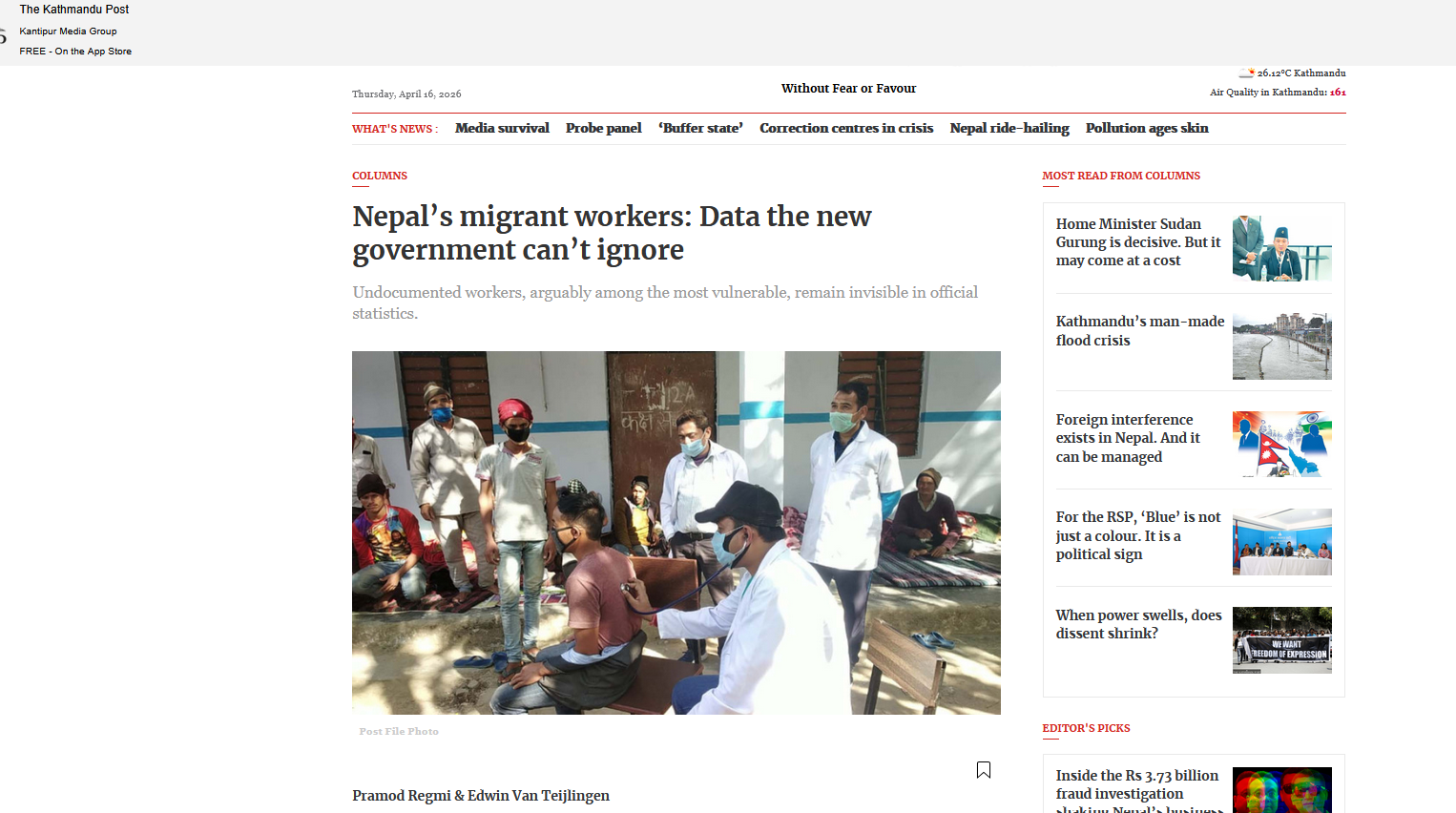
New PhD publication on Nepal’s migrant workers

Congratulations to BU postgraduate student Yagya Adhikari, who has just been informed by the editor of the Journal of Immigrant & Minority Health that his paper “Parental migration for work and psychosocial problems among left-behind adolescents in Nepal” [1] has been accepted for publication.  Yagya’s PhD is based in the Faculty of Health, Environment & Medical Science.  He is supervised by Dr. Pramod Regmi and Prof. Edwin van Teijlingen with support from Mr. Sudip Khanal, Lecturer in Biostatistics, at Manmohan Memorial Institute of Health Sciences (MMIHS) in Kathmandu.  This is the second paper from Yagya’s PhD the first one was published at the start of his PhD studies [2].  Both papers are published in Open Access journals and therefor will be freely available to read by anyone in the world with internet access.


References:

  1. Adhikari, Y.R., van Teijlingen, E., Regmi, P.R., Khanal, S., Parental migration for work and psychosocial problems among left-behind adolescents in Nepal, Journal of Immigrant & Minority Health (forthcoming)
  2. Adhikari, Y.R., Regmi, P.R., Devkota, B., van Teijlingen, E.R. (2022) Forgotten health and social care needs of left-behind families of Nepali migrant workers. Journal of Health Promotion, 10(1):1–4. https://doi.org/10.3126/jhp.v10i1.50976