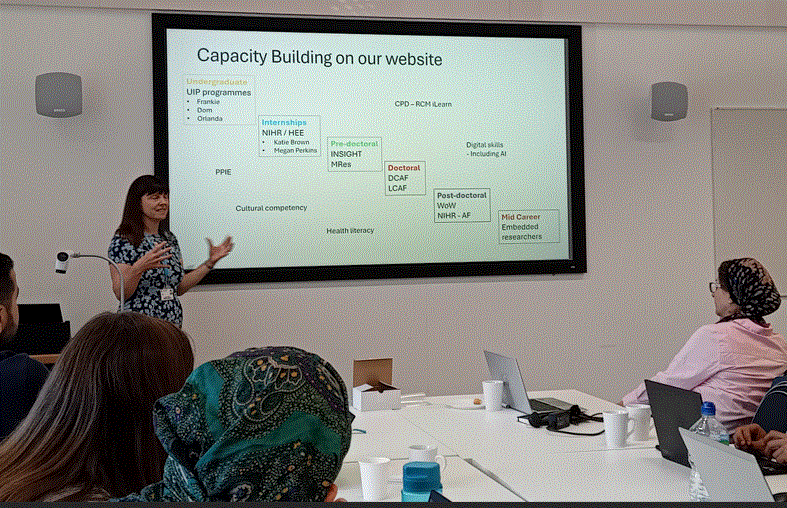
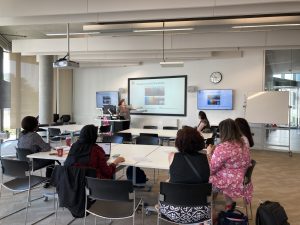
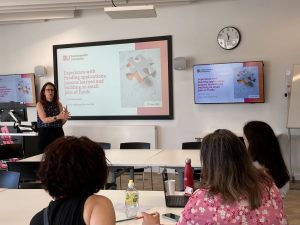
On 19th May 2025 at the Wessex Women and Girls Event at the Southampton Science Park, BU’s Centre for Midwifery and Women’s Health showcased its research and innovation in women’s health.
Professor Vanora Hundley and Dr. Dominique Mylod presented their ongoing development of an Early Labour app as a case study for the Maternity and Infant Health Equity Research Collaboration with Sheffield Hallam University. Professor Carol Clark’s presentation focussed on pelvic floor health and the cost of urinary and faecal incontinence to women’s health and the planet. Dr. Chloe Casey honoured her mother-in-law’s memory with her PechaKucha presentation on using creative methodologies to engage women in recovery from alcohol.
In addition, Dr. Malika Felton and MRes students Susara Blunden and Maryam Malekian displayed posters summarising their research into the impact of exercise on women’s physiology and health, improving diagnositic and treatment pathways for women with endometriosis and exploring the impact of professional knowledge and skills on breastfeeding support respectively.
The event provided a valuable platform for BU researchers to connect with regional partners, contribute to the growing Wessex Women and Girls research network, and play a key role in shaping future initiatives aimed at closing gaps in women’s health. The CMWH’s invovement reinforces BU’s role as a leading voice in this important area of health innovation.
Tagged / BU research
Inaugural research meeting for British Academy grant
Today we had the introductory meeting of our recently funded ‘British Academy Project on Evidence-Informed Policymaking in Nepal’, the project is coordinated by the University of Huddersfield by Prof. Padam Simkhada, who is also Visiting Professor in Bournemouth University’s (BU) Faculty of Health & Social Sciences. The co-investigator at BU is Dr. Pramod Regmi (Principal Academic in International Health), with other co-applicants based at the Keele University, Canterbury Christ Church University, the University of Sheffield, the University of Chester, the Nepal Health Research Council (NHRC), Kathmandu University and the research-based charity Green Tara Nepal.
This one year grant is officially starting next month (1st June). The plans for this project were laid some time ago, and expressed in our 2022 paper ‘Nepal urgently needs a National Evidence Synthesis Centre‘ [1]. Our funded project will focus on the activities of: (1) formative research; (b) capacity building including evidence synthesis; (c) the establishment of a National Evidence Synthesis Centre; and (d) the evaluation of sustainability planning. The British Academy see this award also as providing a developmental opportunity, enabling award holders to build connections within the cohort and critically beyond that as well.
Prof. Edwin van Teijlingen
Centre for Midwifery & Women’s Health
Reference:
- Simkhada, P., Dhimal, M., van Teijlingen, E., Gyanwali, P. (2022) Nepal Urgently Needs a National Evidence Synthesis Centre, Journal of Nepal Health Research Council, 20 (3): i-ii.
Reminder – Submit Your Application for the 2025 ESRC Festival: Deadline Friday 23 May
Up to £1,000 per event available to engage the public with your research in a national prestigious festival

About the Festival of Social Science
The 23rd annual ESRC Festival of Social Science (FoSS) takes place Saturday 18 October – Saturday 8 November 2025, with the theme of ‘Our Working Lives’.
The festival is an annual UK-wide celebration of research and knowledge about people and society, organised and funded by the Economic and Social Research Council (ESRC). It provides a platform for researchers from UK universities to engage the public in a wide range of topics, from health and wellbeing to crime, equality, education, and identity, through engaging events such as exhibitions, lectures, panel debates, performances, and workshops.
The festival is free to attend, with most events open to everyone, though some may target specific groups. It offers researchers a unique opportunity to take their work beyond the university, connect with diverse audiences, and present their research in creative and accessible ways. Funding of up to £1,000 per event is available.
What are the festival aims?
- Encourage, support & create opportunities for social science researchers to engage with the public and young people
- Promote & increase awareness of the social sciences and ESRC-funded research, & the contribution social science makes to the UK
- Enable the public to engage with social science research
- Engage with teachers and young people and raise their awareness of the social sciences
Training to run a great event
The national FoSS team is coordinating public engagement training with Engagement Trainer and Consultant Jamie Gallagher in June (repeated in September). Attendance at these sessions is mandatory for all event leads to attend and further details will be shared upon successful application.
Applications will be assessed on 5 key areas
- Motivation for taking part – Show you have thought carefully about why you are applying e.g. to pilot an idea, reach a new audience, or develop public engagement skills, and what you hope to gain.
- Target audience identified – Events must be aimed at a non-academic audience. Clearly define who your audience is (e.g. a specific public group, community, or professional sector). If you are proposing an event for professionals, businesses, policymakers, or third sector organisations, please note that ESRC rules only permit up to 20% of our events to be targeted at these groups. As we often receive many proposals in this category, selecting one of these audiences may reduce your chances of taking part.
- Audience motivation – Show why your chosen audience would be interested in your activity, and how and when they might engage.
- Content & format – Demonstrate initial ideas for what the activity will involve, why the format suits the goal (e.g. in-person, online), and considerations for timing and location.
- Appropriate costing – Budget should be realistic, clear, and fit the scale and type of activity.
How to apply
We are particularly keen to receive applications from PGRs and early to mid-career researchers and encourage groups/teams to apply. If you have a supervisor, they will need to endorse your application by emailing publicengagement@bournemouth.ac.uk.
If you are considering applying, we strongly encourage you to get in touch with us directly as early as possible.
Apply to take part by completing the online application form.
Deadline for applications: 5pm FRIDAY 23 MAY 2025
You can view the slides from the Information Session here. If you weren’t able to attend, or if you would like to revisit what was covered, you can also watch the session here.
Please read before applying
Before submitting your application, please make sure you meet both the ESRC eligibility criteria and our key requirements. This is essential for your proposal to be considered. Applications that reference academic or undergraduate audiences, or propose campus-based venues, will not be eligible. This opportunity is focused on public engagement beyond academic settings.
Festival Event Leader Pack this practical guide supports researchers in planning and delivering events for the festival. It covers the festival’s aims, event criteria, useful planning tips, audience engagement, and evaluation. It also details the funding, training, and promotional support available from the ESRC, making it a key resource for aligning events with the festival’s goals.
Contact us
Please contact the Public Engagement Team to discuss your application publicengagement@bournemouth.ac.uk
PhD supervision is good for you
Some people in academia (and many outside it) don’t appreciate the importance of PhD supervision . An academic supervising PhD students is not merely for the educational purposes, or in other words, for the benefits of the postgraduate student. The value of postgraduate supervision lies in pushing the boundaries of knowledge, about testing new ideas, new approaches or even new methods.
Interestingly, enough it means that PhD supervision for an academic is also about developing their own ideas, expanding one’s CV, and developing one’s career. Whilst for the university it is also for the wider benefit of research for the wider society. The latter means that PhD students help improve the REF (Research Excellence Framework) scores for a university, through metrics such as number and proportion of PhD completions, but also through papers based on PhD research co-authored with staff. It always amazes me how some outsider regard PhD supervision as simply more of the same, i.e. not that different from supervising an undergraduate student.
Looking at my ow CV, some of my best papers have been co-written with PhD students, including my most cited paper on SCOPUS [1]. Moreover, as the graph of my h-index [checked SCOPUS for May 19th 2025] shows four of my top eight highest cited papers were co-authored with postgraduate students [1-4]. Papers that would not have been written without the postgraduate student conducting knowledge-advancing research! 
Not surprisingly, three of the four former PhD students who co-authored these highly-cited papers are now in academic positions across the UK (the fourth one has retired). These four highlighted papers are not just looking good on my CV, they are also highly ranked within their respective journals. The first paper [1] is the 28th most cited paper in the Journal of Advanced Nursing, an impressive 28th position out of 12,762 articles ever published by this international journal. Similarly, the paper ‘Women’s autonomy in decision-making for health care: Demographic study in Nepal’ [2] is the 10th most cited paper in Reproductive Health, whilst ‘ To tell or not to tell: Barriers and facilitators in family communication about genetic risk’ [3] is the 20th most article in Clinical Genetics. Last, but not least, ‘Risk, Theory, Social & Medical Models: critical analysis of the concept of risk in maternity care’ [4] is the 17th most cited article (out of 3,910) in the international journal Midwifery.
Prof. Edwin van Teijlingen
Centre for Midwifery & Women’s Health
References:
- Simkhada, B., van Teijlingen E., Porter, M., Simkhada, P. (2008) Factors affecting the utilisation of antenatal care in developing countries: a systematic review of the literature, Journal of Advanced Nursing 61(3): 244-260.
- Acharya, D.R., Bell, J., Simkhada, P., van Teijlingen, E, Regmi, P.R. (2010) Women’s autonomy in decision-making for health care: Demographic study in Nepal. Reproductive Health 9(15) reproductive-health-journal.com/content/pdf/1742-4755-7-15.pdf
- Forrest, K., Simpson, S., Wilson, B.J., van Teijlingen E, McKee L, Haites, N., Matthews E. (2003) To tell or not to tell: Barriers and facilitators in family communication about genetic risk,Clinical Genetics, 64: 317-26.
- MacKenzie Bryers H., van Teijlingen, E. (2010) Risk, Theory, Social & Medical Models: critical analysis of the concept of risk in maternity care, Midwifery 26(5): 488-496.
Upcoming 3C Event – Culture, Community & Canapés
The Doctoral College 3C event is approaching! All PGRs and Supervisors are invited.
Following feedback we received at the PGR Engagement Champions meetings, we will be hosting this 3C event at the later time of 16:00-17:30.
For this 3C event, we have swapped out the usual cake for something a little fancier — canapés! Join us and enjoy delicious bites and mingle with colleagues in an informal setting.
Whether you are new to the university or a seasoned researcher, this is the perfect opportunity to:
✨ Catch up with peers
🤝 Meet new faces
🧠 Share ideas and experiences
🥂 Enjoy some tasty food and drinks!
Join us Tuesday 20 May 16:00-17:30 on the fifth floor in the Student Centre, Talbot Campus.
Register here
Let’s foster collaboration, support and networking!
Keep an eye on the Doctoral College Brightspace to stay up to date on all future 3C events.
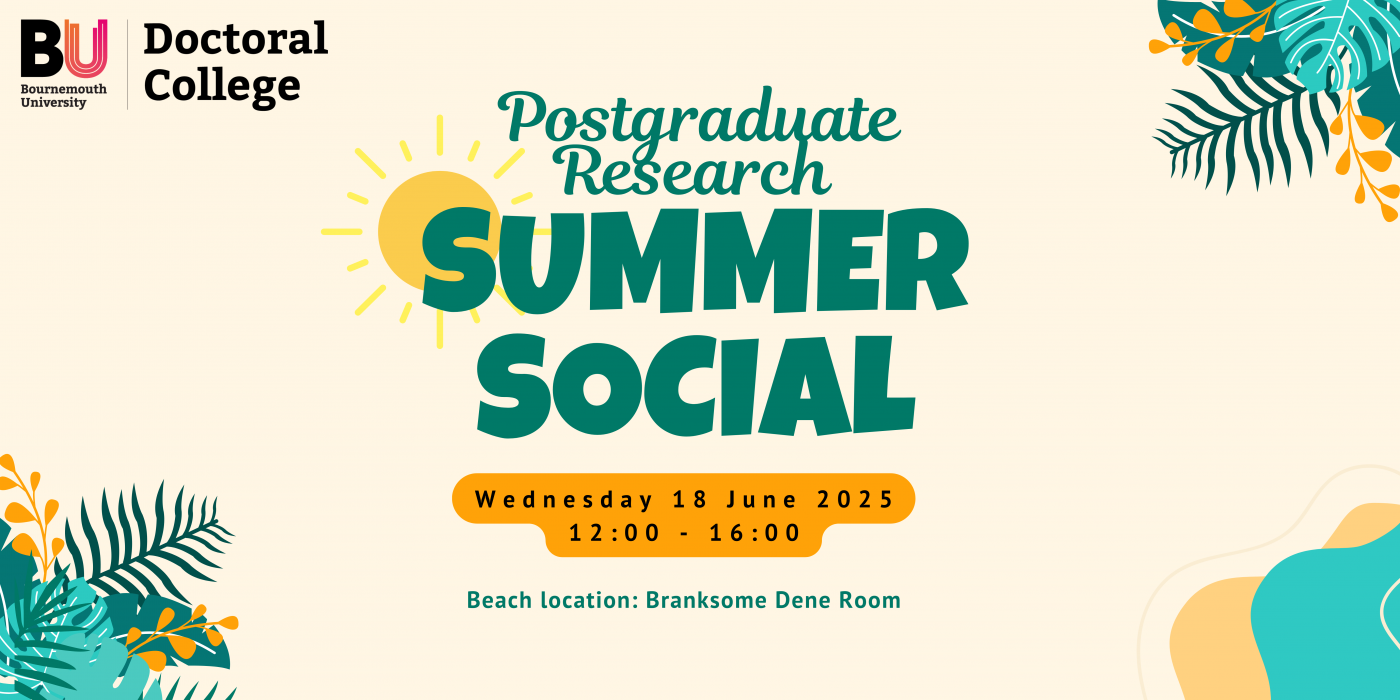
Postgraduate Research Summer Social – tickets on sale

Tickets are now on sale for the Doctoral College Summer Social for the Postgraduate Research community at the delightful Branksome Dene Room. Situated in a stunning location that overlooks the beach, with amazing views of the sea to Old Harry Rocks.
We’ve booked this unique location for the exclusive use of PGRs and Supervisors for the afternoon to unwind and catch up with your fellow researchers and academics.
The Doctoral College PGR events at Branksome Dene Room are always a hit so we hope you can join us!
We are pleased to offer a Greek style lunch menu including a pita with your choice of filling (chicken souvlaki, vegetarian or vegan) served with chips, a salad bar, teas, coffees and soft drinks! You are also welcome to bring your own refreshments to enjoy.
Booking and event details can be found here.
Ticket: £5
Please note there are limited spaces available, so please book as soon as possible if you would like to attend.
If you have any questions, please do get in touch: pgrskillsdevelopment@bournemouth.ac.uk
LinkedIn: Doctoral College – Bournemouth University
X: @BUDocCollege | #BUDoctoralCollege

May’s Research Café – Showcasing tomorrow’s researchers
Postgraduate researchers took the spotlight at BU’s latest Research Café

We had a packed house at the BGB Café for a fascinating evening engaging conversation.
Three passionate postgraduate researchers from Bournemouth University took the stage to share their work. Each speaker gave a short talk on their research, sparking plenty of interest and questions from the audience. We covered everything from what drives our travel choices, to how nostalgia shapes our experience of video games, to the links between alcohol and eating habits in women.
Anna Preece Thesis: Disordered eating behaviours as a barrier to recovery in women with alcohol dependence | Rehabilitation and Sports Sciences (HSS)
Anna presented research on the behavioural links between food and alcohol, exploring how drinking habits and eating behaviours are connected in women. The talk highlighted the implications of these connections for mental health and well-being and discussed ways to improve support for individuals facing these challenges.

Jordan King presenting at Research Café
Jordan King Thesis: Exploring Nostalgic Experiences in Video Games | Psychology (FST)
Jordan explored the emotional power of video games, examining how they evoke memories from the past and create a sense of nostalgia. The talk focused on how digital play connects us to both personal and cultural memories, highlighting the deep emotional impact of gaming.

Wookjun Lee talking at Research Café
Wookjun Lee Thesis: Tourists’ use of public transportation in urban destinations: An experiential perspective | Marketing, Strategy and Innovation (BUBS)
Wookjun examined the factors influencing tourists’ travel choices, focusing on the role of public transport and how to encourage more eco-friendly travel habits. The talk highlighted strategies for promoting greener, more sustainable options for tourists.
It was a great chance to explore topics that affect our everyday lives and get a glimpse into the real-world impact of research happening at BU.
Attendees shared “It was a lovely event. A great time to learn and bond with other researchers” “It was inspiring to see the next generation of researchers sharing their work”
“I found it really interesting to hear directly from postgraduate researchers about the work happening at BU. The range of topics and the enthusiasm behind them made it a really engaging event”

Anna Preece speaking at Research Café
As one of the evening’s speakers, Anna Preece reflected on the experience
“I wanted the opportunity to share my research and hear people’s thoughts and questions about the project. It’s so important in research to hear different perspectives, especially those outside of academia, as they can challenge our thinking, or bring in new ideas… When you’re deep in the research, it’s easy to get lost in the data, so being reminded of the real-world context was invaluable… I hope attendees found the evening thought provoking and enjoyable and it helped them start to recognise the overlap between food and alcohol behaviours and consider what that might look like for themselves or someone they care about.”
Enrica Conrotto, Doctoral College Programme Manager at Bournemouth University, attended the evening and said
“a fantastic event showcasing the work of our Doctoral College PGRs. Congratulations to Anna Preece, Jordan King and Wookjun Lee for their engaging presentations, and a big thank you to the Public Engagement Team for organising the evening. An inspiring evening filled with engaging discussion”
Next up in our Research Café series
Tuesday 1 July, 6:30-8pm at BGB Café
More details coming soon
Contact
If you have any questions about this event or the Research Café series, please contact the Public Engagement with Research Team at publicengagement@bournemouth.ac.uk
RKEDF: Principal Investigation – Post Award for RKE
Are you a Principal Investigator or planning to be one?
This is for researchers who are or plan to be a Principal Investigator for an externally funded research or knowledge exchange project and is taking place on Talbot Campus, 13:00-14:30 on Weds, 4th June 2025.
Topics covered include:
• What is post award?
• Roles and responsibilities
• Systems
• Key policies
• Starting your awarded project
• Making changes to your project and reporting
• Hints and tips
By the end of the session, attendees will have a strong foundation of what to expect when being responsible for their awarded projects.
Book your place HERE.
For any queries regarding this workshop, please contact RKE Development Framework
NIHR Global Health Research Academy 2025
The 2025 NIHR Global Health Research Academy Member event will take place on Tuesday 13th and Wednesday 14th May. The NIHR recognizes that career progression is a common challenge for early-career researchers. This year the event’s theme is ‘Empowering Early-Career Researchers: Navigating Careers in Global Health’. This two-day online event aims to equip participants from across the globe with the skills and knowledge to navigate and build a career in global health research.
Bournemouth University staff and students participating in the NIHR Research and Innovation for Global Health Transformation Call 4: Drowning Prevention for newly mobile infants under 2 years in Bangladesh programme have been invited. This NIHR-funded project is called Sonamoni and BU’s student Md. Shafkat Hossain, whose PhD assessed the work in Bangladesh, is one the participants, as is our colleague from Bangladesh Notan Dutta. In the afternoon BU’s Edwin van Teijlingen who will be chairing a session on ‘Funding & Grant Writing’.
Sonamoni is being coordinated by Bournemouth University in collaboration with the Centre for Injury Prevention and Research (CIPRB) in Bangladesh as well as the University of the West of England, Bristol, the University of Southampton, Design Without Borders (DWB) in Uganda, and the Royal National Lifeboat Institution (RNLI). This project, with Prof. Dr. Aminur Rahman (at CIPRB) as Bangladesh lead, includes the above mentioned BU-based PhD project. The interdisciplinary team at Bournemouth University covers three faculties through: Dr. Mavis Bengtsson, Dr. Kyungjoo Cha, Dr. Mehdi Chowdhury, Dr. Yong Hun Lim, Mr. John Powell, and Prof. Edwin van Teijlingen.
Targeted workshops for REF 2029 impact case study teams
Limited places available – sign up now for May and June!

Photo by John Schnobrich on Unsplash
DATES & TIMES
Friday 30th May, 9.30am-1pm, F306, Fusion Building, Talbot Campus
Developing Policy Engagement for Impact BOOK HERE
Wednesday 11th June, 9.30am-1pm, online via Zoom
Developing Policy Engagement for Impact (same content) BOOK HERE
Thursday 26th June, 9.30am-12.30pm, FG04, Fusion Building, Talbot Campus
Getting your REF Impact Case Study off the Ground BOOK HERE
KEY DETAILS
Developing Policy Engagement for Impact
Facilitated by BU’s policy consultant Carys Davis, this provides expert advice on navigating the policy landscape to ensure your research reaches and informs decision makers. Topics covered:
- The purpose of influencing, the role of evidence and what it means for you
- Writing elevator pitches and key messages
- Principles of communicating with policy and decision makers
- Effective policy writing
- Understanding the policymaking landscape.
Getting your REF Impact Case Study off the Ground
Research impact consultant Bella Reichard delivers this workshop, which she describes as “part training, part retreat” to help provide clarity in developing a polished impact case study for REF 2029. This includes:
- Creating a narrative arc
- Guidance writing your own summary of impact
- Devising an action plan
- Focus on evaluation and evidence of impact.
Who are these workshops for?
- All sessions are aimed primarily at researchers considering, or in the process of, preparing an impact case study for submission to REF 2029.
- They are not limited to a single person per potential case study – it can be useful for teams and/or relevant impact champions to attend together.
- If you are not sure if they are suitable for you, please contact your UOA impact champion.
Take part in the 2025 ESRC Festival of Social Science: Application Deadline Extended to Friday 23 May 2025
Up to £1,000 per event available to engage the public with your research in a national prestigious festival

The 23rd annual ESRC Festival of Social Science (FoSS) takes place Saturday 18 October – Saturday 8 November 2025, with the theme of ‘Our Working Lives’.
About the Festival of Social Science
The festival is an annual UK-wide celebration of research and knowledge about people and society, organised and funded by the Economic and Social Research Council (ESRC). It provides a platform for researchers from UK universities to engage the public in a wide range of topics, from health and wellbeing to crime, equality, education, and identity, through engaging events such as exhibitions, lectures, panel debates, performances, and workshops.
The festival is free to attend, with most events open to everyone, though some may target specific groups. It offers researchers a unique opportunity to take their work beyond the university, connect with diverse audiences, and present their research in creative and accessible ways. Funding of up to £1,000 per event is available.
What are the festival aims?
- Encourage, support & create opportunities for social science researchers to engage with the public and young people
- Promote & increase awareness of the social sciences and ESRC-funded research, & the contribution social science makes to the UK
- Enable the public to engage with social science research
- Engage with teachers and young people and raise their awareness of the social sciences
Training to run a great event
The national FoSS team is coordinating public engagement training with Engagement Trainer and Consultant Jamie Gallagher in June (repeated in September). Attendance at these sessions is mandatory for all event leads to attend and further details will be shared upon successful application.
Applications will be assessed on these 5 key areas
Motivation for taking part – Show you have thought carefully about why you are applying e.g. to pilot an idea, reach a new audience, or develop public engagement skills, and what you hope to gain.
Target audience identified – Events must be aimed at a non-academic audience. Clearly define who your audience is (e.g. a specific public group, community, or professional sector). If you are proposing an event for professionals, businesses, policymakers, or third sector organisations, please note that ESRC rules only permit up to 20% of our events to be targeted at these groups. As we often receive many proposals in this category, selecting one of these audiences may reduce your chances of taking part.
Audience motivation – Show why your chosen audience would be interested in your activity, and how and when they might engage.
Content & format – Demonstrate initial ideas for what the activity will involve, why the format suits the goal (e.g. in-person, online), and considerations for timing and location.
Appropriate costing – Budget should be realistic, clear, and fit the scale and type of activity.
How to apply
We are particularly keen to receive applications from PGRs and early to mid-career researchers and encourage groups/teams to apply. If you have a supervisor, they will need to endorse your application by emailing publicengagement@bournemouth.ac.uk.
If you are considering applying, we strongly encourage you to get in touch with us directly as early as possible.
Apply to take part by completing the online application form.
Deadline for applications EXTENDED to: 5pm FRIDAY 23 May 2025
You can view the slides from the Information Session here. If you weren’t able to attend, or if you would like to revisit what was covered, you can also watch the session here.
Please read before applying
Before submitting your application, please make sure you meet both the ESRC eligibility criteria and our key requirements. This is essential for your proposal to be considered. Applications that reference academic or undergraduate audiences, or propose campus-based venues, will not be eligible. This opportunity is focused on public engagement beyond academic settings.
Festival Event Leader Pack this practical guide supports researchers in planning and delivering events for the festival. It covers the festival’s aims, event criteria, useful planning tips, audience engagement, and evaluation. It also details the funding, training, and promotional support available from the ESRC, making it a key resource for aligning events with the festival’s goals.
Contact us
Please contact the Public Engagement Team to discuss your application publicengagement@bournemouth.ac.uk
Take part in the 2025 ESRC Festival of Social Science – Deadline for applications: Thursday 15 May 2025
Up to £1,000 per event available to engage the public with your research in a national prestigious festival

The 23rd annual ESRC Festival of Social Science (FoSS) takes place Saturday 18 October – Saturday 8 November 2025, with the theme of ‘Our Working Lives’.
About the Festival of Social Science
The festival is an annual UK-wide celebration of research and knowledge about people and society, organised and funded by the Economic and Social Research Council (ESRC). It provides a platform for researchers from UK universities to engage the public in a wide range of topics, from health and wellbeing to crime, equality, education, and identity, through engaging events such as exhibitions, lectures, panel debates, performances, and workshops.
The festival is free to attend, with most events open to everyone, though some may target specific groups. It offers researchers a unique opportunity to take their work beyond the university, connect with diverse audiences, and present their research in creative and accessible ways. Funding of up to £1,000 per event is available.
What are the festival aims?
- Encourage, support & create opportunities for social science researchers to engage with the public and young people
- Promote & increase awareness of the social sciences and ESRC-funded research, & the contribution social science makes to the UK
- Enable the public to engage with social science research
- Engage with teachers and young people and raise their awareness of the social sciences
Training to run a great event
The national FoSS team is coordinating public engagement training with Engagement Trainer and Consultant Jamie Gallagher in June (repeated in September). Attendance at these sessions is mandatory for all event leads to attend and further details will be shared upon successful application.
To help you develop your application, you can sign up to attend the Introduction to Festival of Social Science 2025 webinar on Thursday 8 May, 12pm via Teams.
Applications will be assessed on these 5 key areas
Motivation for taking part – Show you have thought carefully about why you are applying e.g. to pilot an idea, reach a new audience, or develop public engagement skills, and what you hope to gain.
Target audience identified – Events must be aimed at a non-academic audience. Clearly define who your audience is (e.g. a specific public group, community, or professional sector). If you are proposing an event for professionals, businesses, policymakers, or third sector organisations, please note that ESRC rules only permit up to 20% of our events to be targeted at these groups. As we often receive many proposals in this category, selecting one of these audiences may reduce your chances of taking part.
Audience motivation – Show why your chosen audience would be interested in your activity, and how and when they might engage.
Content & format – Demonstrate initial ideas for what the activity will involve, why the format suits the goal (e.g. in-person, online), and considerations for timing and location.
Appropriate costing – Budget should be realistic, clear, and fit the scale and type of activity.
How to apply
We are particularly keen to receive applications from PGRs and early to mid-career researchers and encourage groups/teams to apply. If you have a supervisor, they will need to endorse your application by emailing publicengagement@bournemouth.ac.uk.
If you are considering applying, we strongly encourage you to get in touch with us directly as early as possible.
Apply to take part by completing the online application form.
Deadline for applications: 11:59pm, Thursday 15 May 2025
You can view the slides from the Information Session here. If you weren’t able to attend, or if you would like to revisit what was covered, you can also watch the session here.
Please read before applying
Before submitting your application, please make sure you meet both the ESRC eligibility criteria and our key requirements. This is essential for your proposal to be considered. Applications that reference academic or undergraduate audiences, or propose campus-based venues, will not be eligible. This opportunity is focused on public engagement beyond academic settings.
Festival Event Leader Pack this practical guide supports researchers in planning and delivering events for the festival. It covers the festival’s aims, event criteria, useful planning tips, audience engagement, and evaluation. It also details the funding, training, and promotional support available from the ESRC, making it a key resource for aligning events with the festival’s goals.
Contact us
Please contact the Public Engagement Team to discuss your application publicengagement@bournemouth.ac.uk
Nepal Family Cohort Study meeting in Bournemouth
Prof. Om Kurmi who leads the Nepal Family Cohort Study (NeFCoS) joined the Bournemouth University (BU) team today for a research planning meeting in Bournemouth today. Dr. Om Kurmi, Associate Professor Research in the Centre for Healthcare and Communities at Coventry University. The BU team comprises Dr. Pramod Regmi (Principal Academic-International Health), Prof. Carol Clark (Professor in Physiotherapy), Prof. Edwin van Teijlingen (Professor of Reproductive Health), Dr. Rebecca Neal (Principal Lecturer in Exercise Physiology) and Dr. Vanora Hundley (Professor of Midwifery). 
The Nepal Family Cohort Study (NeFCoS) is a multidisciplinary cohort study into the prevalence, incidence, and determinants of various diseases from childhood to adulthood in children and their parents [1]. NeFCoS has just started to collect date for the first round of follow-up.
Today’s meeting was organised by Dr. Neal and supported by BU’s QR funds.
- Kurmi, O.P., Chaudhary, N., Delanerolle, G., Bolton, C.E., Pant, P.R., Regmi, P., Gautam, S., Satia, I., Simkhada, P., Kyrou, I., Sigdel, T.K., Hundley, V., Dali, P.R., Lokke, A., Hubert Lam, K.B., Bennett, D., Custovic, A., van Teijlingen, E., Gill, P. Randeva, H., O’Byrne, P.M., and Nepal Family Cohort Collaborators Group, Nepal Family Cohort Study: A Study Protocol, BMJ Open 14:e088896. doi:10.1136/ bmjopen-2024-088896
RKEDF May digest

Book now for RKEDF training in May 2025
Click on the titles to find further details and book your place
Introduction to RED – The Research & Enterprise Database
Wednesday 7th May 13:00-13:45 – online
This session is aimed at all academics to provide an overview of the Research & Enterprise Database. Including how to access the system, the information available to view, budget management via RED, and how to use RED to identify your supporting pre and post award officers.
ECR Ethics – Clinical research governance
Monday 19th May 11:00-12:00 – online
The processes surrounding implementing clinical research in the NHS can often be quite daunting, however there is plenty of guidance and advice on offer to help guide you in this should you require. This session will develop your understanding of the governance requirements when carrying out clinical research and help you explore the first steps in seeking approval.
ECR Ethics: Values, standards and BU process – Q&A
Monday 19th May 12:00-13:00 – online
Ethical implications arising from your research design, methodology, conduct, dissemination, archiving, future use and sharing of data produced should all be considered at the before and throughout your research. Careful reflection and planning in relation to research ethics should not only benefit participants but enhance the quality of your research. This Q&A allows you to discuss your ethical considerations with research ethics panel members to further your insights into this important area of being a researcher.
Developing Policy Engagement for Impact
Friday 30th May – 09:30-13:00 – in person
Are you preparing an impact case study for REF 2029? Do you need expert advice on navigating the policy landscape to ensure your research reaches decision makers? If so, this workshop is perfect for you. Carys Davis, a public affairs and policy consultant from The Other Place Public Affairs Ltd., will lead this workshop. RDS’s Impact Team will be present to offer support and guidance. This workshop is primarily aimed at researchers working on impact case studies for REF 2029, who will be given priority for registration. If you’re unsure whether this is suitable for you, please consult your UOA impact champion
Horizon Europe 2025
The European Commission has announced Horizon Europe 2025 Information Days to help applicants prepare proposals for Horizon Europe 2025 calls. Most events are scheduled to take place in May 2025. Please see further details on the BU Research Blog: BU Research Blog | Horizon Europe info days 2025 | Bournemouth University (the blog post has been recently updated)
Epigeum Research Skills Toolkit
Do you want to refresh your researcher skills? Have a look at the Epigeum Research Skills Toolkit (on demand online modules). Further information on how to access Epigeum courses can be found here.
Links for further RKE information and support are below:
RKE SharePoint page: RKE – Home
RKEDF SharePoint for development opportunities: Research and Knowledge Exchange Development Framework RKEDF – Home
RKEDF Brightspace: Homepage – Research & Knowledge Exchange Development Framework
Please help us in avoiding any waste of resources; make sure you can attend or cancel your booking prior to the session. For any further information, please contact RKEDF@bournemouth.ac.uk
Closing tomorrow: please complete the Postgraduate Research Experience Survey 2025

Free lunch voucher & prize draw for all PGRs – please complete the Postgraduate Research Experience Survey 2025 by midnight Wednesday 30 April!
Check your email to access your link to complete the survey.
Postgraduate research students (PGRs) – did you know you can get a FREE lunch voucher if you complete the Advance HE Postgraduate Research Experience Survey (PRES) 2025. This is worth £3.95 which covers the cost of a meal from the Savour menu but can be used to purchase any items from Chartwells outlets. Please come to the Doctoral College (DLG08, Talbot Campus) to collect your voucher. If you are based in Lansdowne Campus, you can collect your vouchers from Tina Ikin in BG507.
The voucher can be used at the following outlets on Talbot and Lansdowne Campus:

On completion of the survey, you will also be entered into a free prize draw, with the opportunity to win one of four £50 shopping vouchers. As a thank you for your time, we will be making a £1 donation on your behalf to the student mental health charity, Student Mind.
So far 42% of PGRs at BU have taken part in this survey. If you have not already completed it, we would really appreciate if you could find a few minutes to respond and tell us about your experience this year. The survey helps us improve the student experience at BU and compare ourselves with other institutions across the country.
To do this we would like to know what you think works well and what as a university we could do better.
How do I take part?
All PGRs (including the ones at the end of their journey!) have now received an email containing a unique link which will allow you to access and complete the survey. If you can’t find this email, contact PRES@bournemouth.ac.uk and we’ll help you to get access.
What will I be asked?
The survey will take around 15 minutes to complete. Your response is confidential, and any reporting will be entirely anonymous. The survey is your chance to tell us about your experience as a PGR at BU. It will ask you to share your views on supervision, resources, research community, progress and assessment, skills and professional development and wellbeing.
Why should I take part?
Your feedback is important. The Postgraduate Research Experience Survey is the only national survey of PGRs and so is the only way for us to compare how we are doing with other institutions and to make changes that will improve your experience in the future.
More information
If you would like to know more about the survey, please visit: PRES 2025.
If you would like to know more about the surveys at Bournemouth University, please visit: Your feedback | Bournemouth University.
Please click here to see actions that we have taken based on feedback from previous surveys.
We hope you take the opportunity to get involved this year and help us make improvements to your experience.
Best wishes,
The Doctoral College
For any PRES related queries, please email: PRES@bournemouth.ac.uk
Plenary talk by Dr Regmi on Hidden Health Burden of Nepalese Migrants
Last week, BU academic Dr. Pramod Regmi delivered a plenary talk on the struggles faced by Nepalese migrant workers from departure to return at the 22nd Britain-Nepal Academic Council (BNAC) Conference, held on 24–25 April in Liverpool. The session included two other panelists, including Prof. Padam Simkhada from the University of Huddersfield, he is also a BU Visiting Professor.
Dr. Regmi’s talk highlighted the health burden experienced by Nepali migrants throughout their migration journey. Labour migration from Nepal poses significant risks at all stages. Many aspiring migrants lack access to accurate information and support, while those from lower socioeconomic backgrounds face high documentation costs and illegal recruitment fees, affecting their mental health and placing strain on their families. Abroad, migrants often suffer exploitation, unsafe working conditions, overcrowded and unsanitary housing, limited access to healthcare, and high medical expenses. Female migrants face additional risks such as sexual violence, unintended pregnancy, exploitation, and unemployment. Upon return, especially for those who experienced abuse or trafficking, reintegration is hindered by social stigma and a lack of support services. Nepal’s weak economy further limits their ability to utilise skills gained abroad.
This presentation was informed by a long history of BU research into the health and well-being of Nepalese migrant workers, led by Dr. Regmi, Dr. Nirmal Aryal, Dr. Orlanda Harvey, Prof. Edwin van Teijlingen, and current PhD students Yagya Adhikari and Anjana Regmi Paudyal in the Faculty of Health & Social Sciences.
A round table discussion after the session focused on four questions:
- How can we better inform migrants during the pre-migration stage?
- How can we reduce the health vulnerabilities of Nepali labour migrant workers abroad?
- What are the barriers to, and opportunities for, reintegration when migrants return?
- How can we facilitate increased research collaboration in destination countries engaging local academic institutions?
Bournemouth University also contributed to two other presentations related to a project studying the impact of federalisation on Nepal’s health system. This study was funded by the UK Health Systems Research Initiative to examine the consequences of Nepal’s transition from a centralised political system to a federal structure in 2015. These two papers were presented by BU collaborators Prof. Julie Balen (Canterbury Christ Church University) and Ms. Amshu Dhakal (Manmohan Memorial Institute of Health Sciences, Kathmandu, Nepal).
BU’s Dr. Regmi, Prof Edwin van Teijlingen and Dr Nirmal collectively have over 40 publications on Nepalese migrants’ health and well-being issues. Their recent publications on the topic include studies on modern slavery [1], kidney disease [2–4], pre-departure training of aspiring migrant workers in Nepal [5], moral panic and societal fears around migrant workers and COVID-19 [6–7], Nepalese migrant workers in Malaysia [8–9], left-behind families of migrant workers [10], migrant workers and the 2022 FIFA Men’s World Cup [11–12], Nepalese migrants in the UK [13], as well as a comprehensive literature review [14]. They are also a founder members of Health Research Network for Migrant Workers in Asia: www.hearmigrants.org
References:
- Paudyal, A. R., Harvey, O., Teijlingen, E. van, Regmi, P. R., Sharma, C. (2024). Returning Home to Nepal after Modern Slavery: Opportunities for Health Promotion. Journal of Health Promotion, 12(1), 125–132. https://doi.org/10.3126/jhp.v12i1.72713
- Aryal, N., Sedhain, A., Regmi, P.R., KC, R. K., van Teijlingen, E. (2021). Risk of kidney health among returnee Nepali migrant workers: A survey of nephrologists. Asian Journal of Medical Sciences, 12(12), 126–132. https://doi.org/10.3126/ajms.v12i12.39027
- Aryal, N., Regmi, P.R., Sedhain, A., KC, R.K., Martinez Faller, E., Rijal, A., van Teijlingen, E. (2021) Kidney health risk of migrant workers: An issue we can no longer overlook. Health Prospect 20(1):15-7
- Regmi, P., Aryal, N., Bhattarai, S., Sedhain, A., KC, R.K. and van Teijlingen, E. (2024) Exploring lifestyles, work environment and health care experience of Nepalese returnee labour migrants diagnosed with kidney-related problems, PLoS One 19(8): e0309203. https://doi.org/10.1371/journal.pone.0309203
- Regmi, P., Aryal, N., van Teijlingen, E., KC, R.K., Gautam, M. and Maharjan, S. (2024). A Qualitative Insight into Pre-Departure Orientation Training for Aspiring Nepalese Migrant Workers. Tropical Medicine and Infectious Disease, 9 (7).
- Aryal, N., Regmi, P., Adhikari Dhakal, S., Sharma, S. and van Teijlingen, E. (2024). Moral panic, fear, stigma, and discrimination against returnee migrants and Muslim populations in Nepal: analyses of COVID-19 media content. Journal of Media Studies, 38 (2), 71-98.
- Regmi, P., Dhakal Adhikari, S., Aryal, N., Wasti, S.P., van Teijlingen, E. (2022) Fear, Stigma and Othering: The Impact of COVID-19 Rumours on Returnee Migrants and Muslim Populations of Nepal, International Journal of Environmental Research & Public Health 19(15), 8986; https://doi.org/10.3390/ijerph19158986
- Chaudhary, M.N., Lim, V.C., Faller, E.M., Regmi, P., Aryal, N., Zain, S.N.M., Azman, A.S. and Sahimin, N. (2024). Assessing the basic knowledge and awareness of dengue fever prevention among migrant workers in Klang Valley, Malaysia. PLoS ONE, 19 (2).
- Chaudhary, M.N., Lim, V.C., Sahimin, N., Faller, E.M., Regmi, P., Aryal, N. and Azman, A.S. (2023). Assessing the knowledge of, attitudes towards, and practices in, food safety among migrant workers in Klang Valley, Malaysia. Travel Medicine and Infectious Disease, 54.
- Adhikari, Y., Regmi, P., Devkota, B. and van Teijlingen, E. (2023). Forgotten health and social care needs of left-behind families of Nepali migrant workers. Journal of Health Promotion, 10, 1-4.
- Regmi, P., Simkhada, P., Aryal, N., van Teijlingen, E. (2022) Excessive mortalities among migrant workers: the case of the 2022 FIFA World Cup. Europasian Journal of Medical Sciences, 4:31-32. https://doi.org/10.46405/ejms.v4i0.455
- Simkhada, P., van Teijlingen, E. and Regmi, P. (2022). Migrant Workers in Qatar: Not just an important topic during the FIFA World Cup 2022. Health Prospect: Journal of Public Health, 21 (3), 1-2.
- Simkhada, B., Sah, R.K., Mercel-Sanca, A., van Teijlingen, E., Bhurtyal, Y.M. and Regmi, P. (2021). Perceptions and Experiences of Health and Social Care Utilisation of the UK-Nepali Population. Journal of Immigrant and Minority Health, 23 (2), 298-307.
- Mahato, P., Bhusal, S., Regmi, P., van Teijlingen, E. (2024). Health and Wellbeing Among Nepali Migrants: A Scoping Review. Journal of Health Promotion, 12(1): 79–90. https://doi.org/10.3126/jhp.v12i1.72699
Apply now to take part in the 2025 ESRC Festival of Social Science
Up to £1,000 per event available to engage the public with your research in a national prestigious festival

The 23rd annual ESRC Festival of Social Science (FoSS) takes place Saturday 18 October – Saturday 8 November 2025, with the theme of ‘Our Working Lives’.
How to apply
We are particularly keen to receive applications from PGRs and early to mid-career researchers and encourage groups/teams to apply. If you have a supervisor, they will need to endorse your application by emailing publicengagement@bournemouth.ac.uk.
If you are considering applying, we strongly encourage you to get in touch with us directly as early as possible.
Apply to take part by completing the online application form.
Deadline for applications: 11:59pm, Thursday 15 May 2025
You can view the slides from the Information Session here. If you weren’t able to attend, or if you would like to revisit what was covered, you can also watch the session here.
About the Festival of Social Science
The festival is an annual UK-wide celebration of research and knowledge about people and society, organised and funded by the Economic and Social Research Council (ESRC). It provides a platform for researchers from UK universities to engage the public in a wide range of topics, from health and wellbeing to crime, equality, education, and identity, through engaging events such as exhibitions, lectures, panel debates, performances, and workshops.
The festival is free to attend, with most events open to everyone, though some may target specific groups. It offers researchers a unique opportunity to take their work beyond the university, connect with diverse audiences, and present their research in creative and accessible ways. Funding of up to £1,000 per event is available.
Training to run a great event
The national FoSS team is coordinating public engagement training with Engagement Trainer and Consultant Jamie Gallagher in June (repeated in September). Attendance at these sessions is mandatory for all event leads to attend and further details will be shared upon successful application.
To help you develop your application, you can sign up to attend the Introduction to Festival of Social Science 2025 webinar on 8th May, 12pm via Teams.
Please read before applying
Before submitting your application, please make sure you meet both the ESRC eligibility criteria and our key requirements. This is essential for your proposal to be considered. Applications that reference academic or undergraduate audiences, or propose campus-based venues, will not be eligible. This opportunity is focused on public engagement beyond academic settings.
Festival Event Leader Pack this practical guide supports researchers in planning and delivering events for the festival. It covers the festival’s aims, event criteria, useful planning tips, audience engagement, and evaluation. It also details the funding, training, and promotional support available from the ESRC, making it a key resource for aligning events with the festival’s goals.
Contact us
Please contact the Public Engagement Team to discuss your application publicengagement@bournemouth.ac.uk.
RKEDF: Introduction to RED – the Research and Enterprise Database
This online session on Wednesday 7 May 2025, 13:00-13:45, is aimed at all academics to provide an overview of the Research & Enterprise Database.
Including how to access the system, the information available to view, budget management via RED, and how to use RED to identify your supporting pre and post award officers.
Book your place here
For any queries regarding this workshop, please contact RKE Development Framework


Expressions of Interest invited from senior academics to join the BU REF Appeals Panel
ESRC Festival of Social Science 2026: Application Deadline Extended to Thursday 25 June 2026

First publication for two CMWH PhD students
Reminder: Register for the ESRC Festival of Social Science 2026 Information Session

ECR Funding Open Call: Research Culture & Community Grant – Apply now

ECR Funding Open Call: Research Culture & Community Grant – Application Deadline Friday 12 December
MSCA Postdoctoral Fellowships 2025 Call
ERC Advanced Grant 2025 Webinar
Update on UKRO services
European research project exploring use of ‘virtual twins’ to better manage metabolic associated fatty liver disease