Professors Vanora Hundley and Edwin van Teijlingen just completed their ERASMUS Plus exchange with Manmohan Memorial Institute of Health Sciences (MMIHS) in Nepal. This was a very successful collaboration with colleagues in Nepal, despite the various turns of fate that were sent to challenge us. Indeed, the Profs toiled with the idea of giving this BU Research Blog the heading ‘The show must go on’ or ‘One man down….’ or even the far less punchy ‘The irony of doing a workshop by ZOOM in Nepal from a hotel 200 meters across the road’! In the end we decided that excellent collaboration requires resilience and a wee bit of ingenuity.
The trip to Nepal was marred by many little hiccups. It started at Heathrow where the airline insisted that they complete a now obsolete form about COVID-19 for the Government of Nepal, otherwise they would not let us on the flight. Arguing that Edwin had been to Nepal in April, and that no one then had asked for that particular piece of paper was fruitless. A quick online completion solved that first hurdle. The next hurdle was the flight leaving Heathrow over two hours late, which in turn meant missing the connection in Doha. Fortunately, the airline booked our academics on a replacement flight which left only hours after the original onwards flight had been scheduled to leave for Kathmandu. ingenuity. The trip to Nepal was marred by many little hiccups. It started at Heathrow where the airline insisted that they complete a now obsolete form about COVID-19 for the Government of Nepal, otherwise they would not let us on the flight. Arguing that Edwin had been to Nepal in April, and that no one then had asked for that particular piece of paper was fruitless. A quick online completion solved that first hurdle. The next hurdle was the flight leaving Heathrow over two hours late, which in turn meant missing the connection in Doha. Fortunately, the airline booked our academics on a replacement flight which left only hours after the original onwards flight had been scheduled to leave for Kathmandu.
The first five days in Kathmandu went well, apart from the to be expected tummy problems that go with monsoon in all low-income countries in South Asia. The teaching at MMIHS mainly focused on methodological issues. Our scheduled teaching sessions focused on the first-year MSc Nursing students (Vanora) and the first-year MSc Public Health students at MMIHS (Edwin).
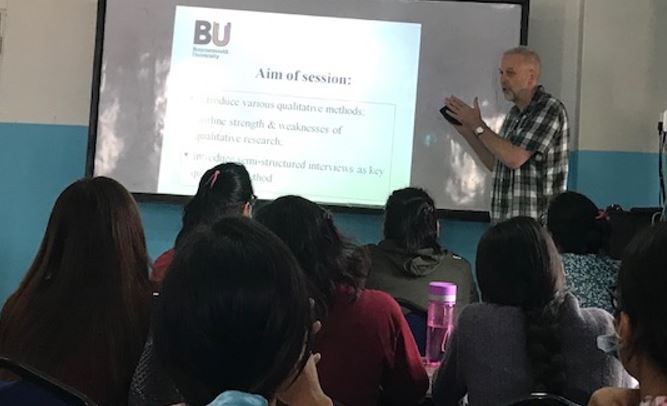 A more informal one-hour tutorial session was organised for the second-year MSc Public Health students who had applied to come to the UK as part of ERASMUS Plus. This question-and-answer-type session was run by both Vanora and Edwin as well as BU PhD student Sulochana Dhakal-Rai. Overall, the teaching was all organised at very short notice, but BU’s professors are flexible and had a broad range of expertise to share.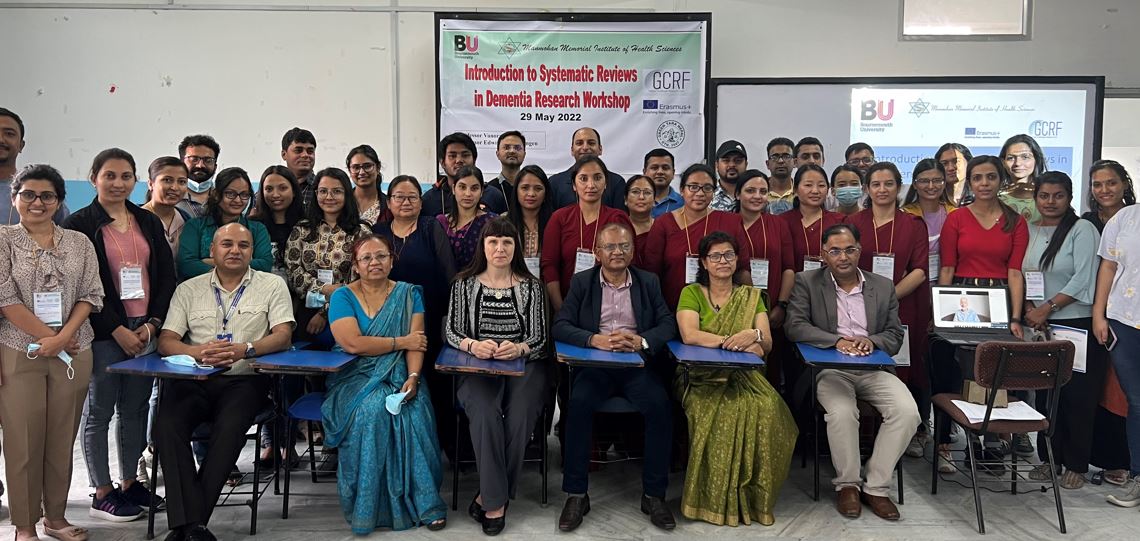
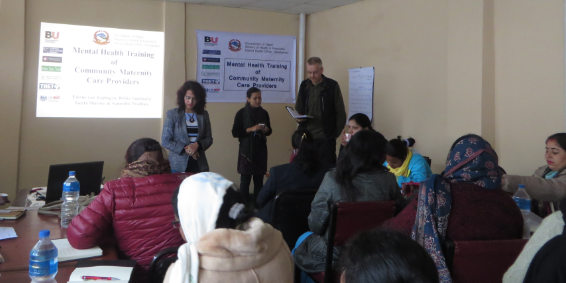
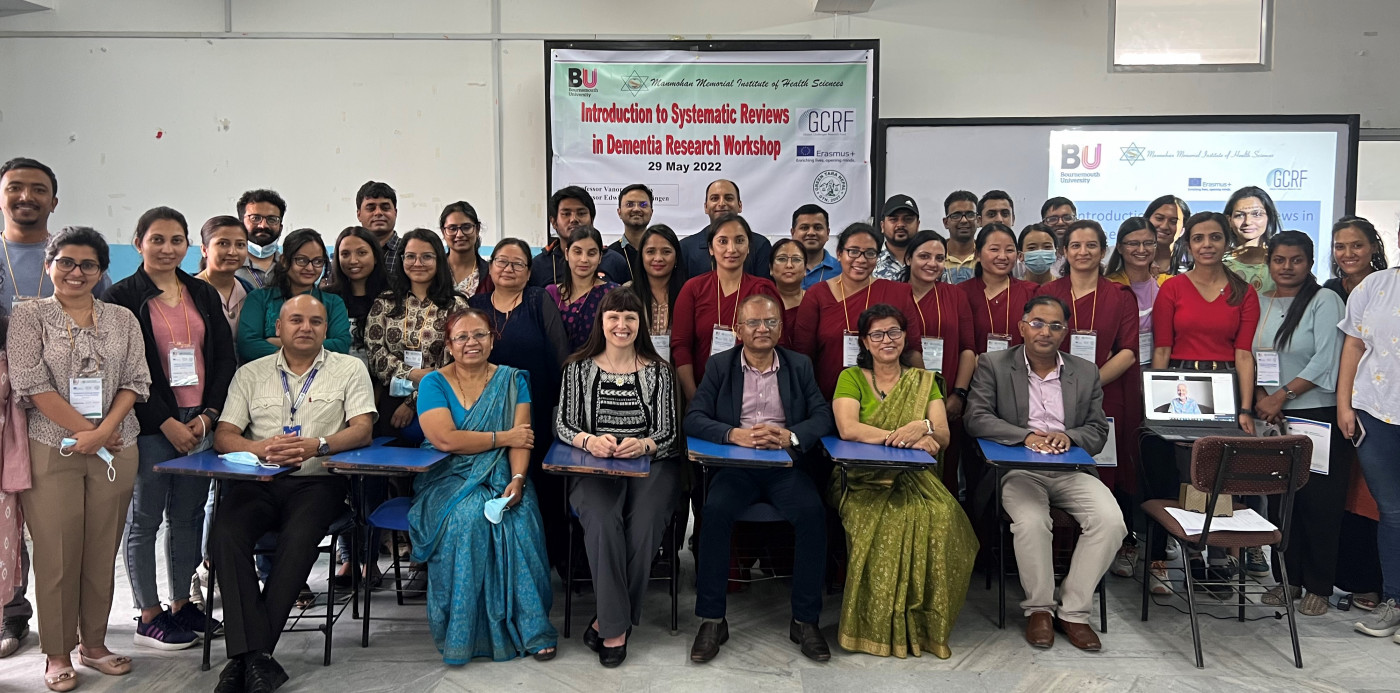
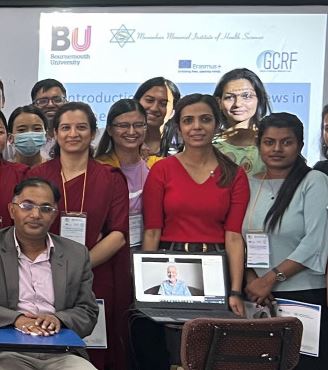
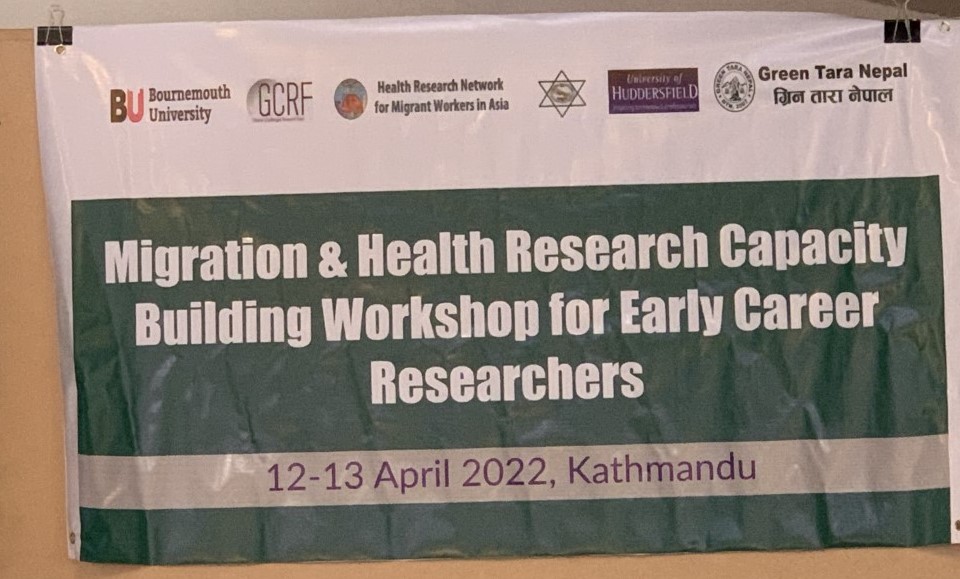
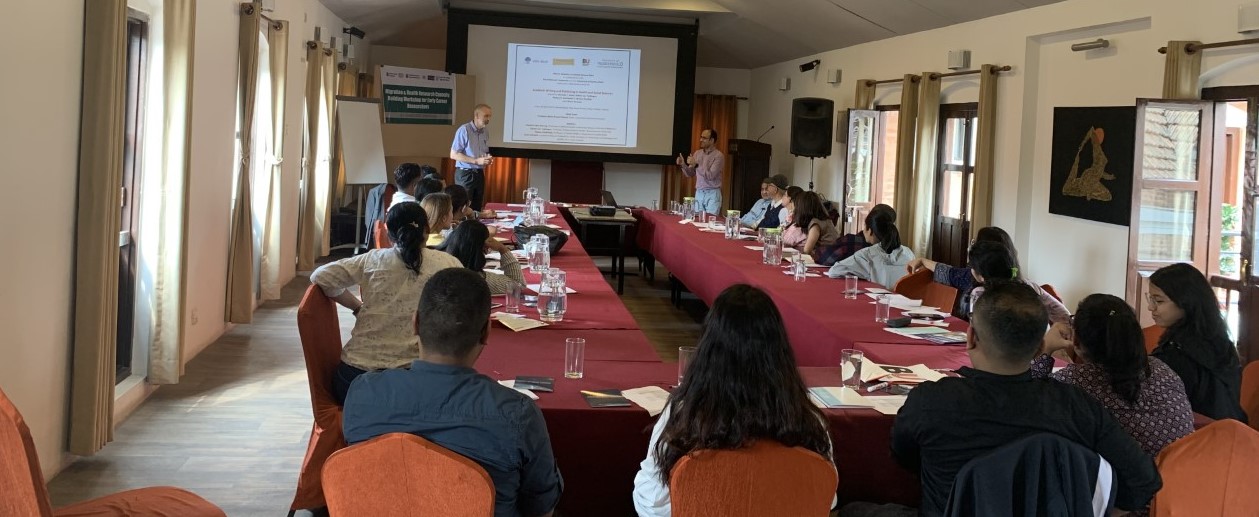
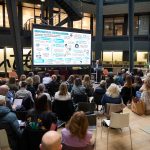
In addition, with extra funding from GCRF (Global Challenges Research Fund), Bournemouth University and MMIHS supported by the local charity Green Tara Nepal planned ran a one-day research workshop in Kathmandu. This GCRF- funded ‘Systematic Review on Dementia Research Workshop’ was very well attended. Although the workshop budgeted for 30 people the attendance register shows that nearly double (n=59) the number of people attended at least part of the workshop. However, running the workshop was not without is problems. Two-days before the workshop Prof. van Teijlingen first had a positive COVID-19 lateral flow test followed by a positive PCR test. This put the burden of running the show very much on Prof. Vanora Hundley with Edwin being called in through Zoom. This is where the potential ‘irony’ title comes in. The irony of doing a workshop by ZOOM in Nepal ….. not from halfway across the globe but from a local hotel 200 meters across the road from MMIHS! The hotel’s internet connection was not as good as most of us have grown used to in Dorset, which added to the difficulty of running the workshop smoothly.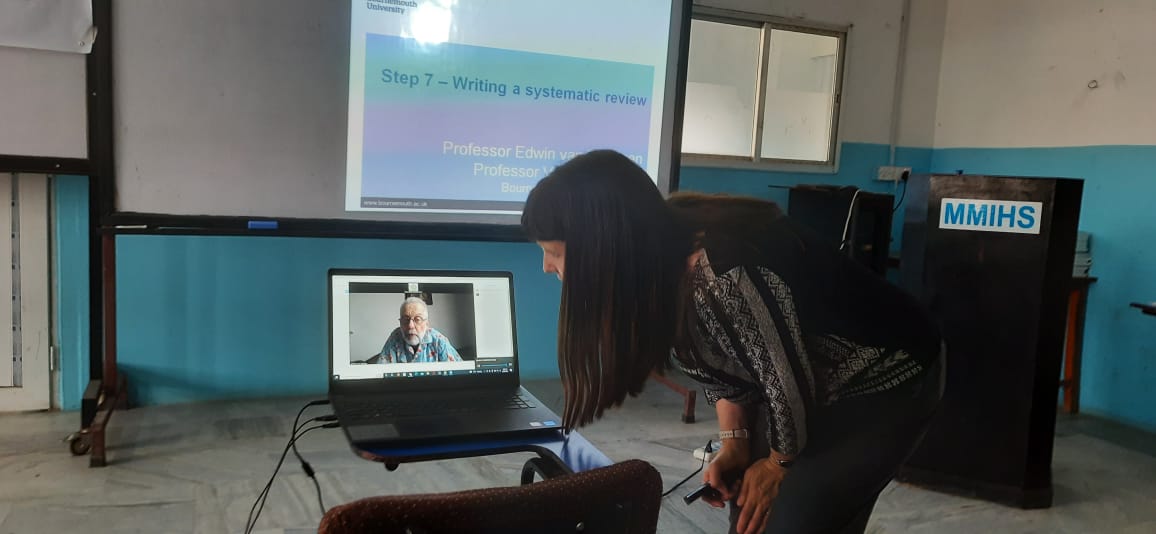
Despite all these challenges, the result was a very successful workshop that will continue to build our collaboration with colleagues in MMIHS and more widely across Nepal.
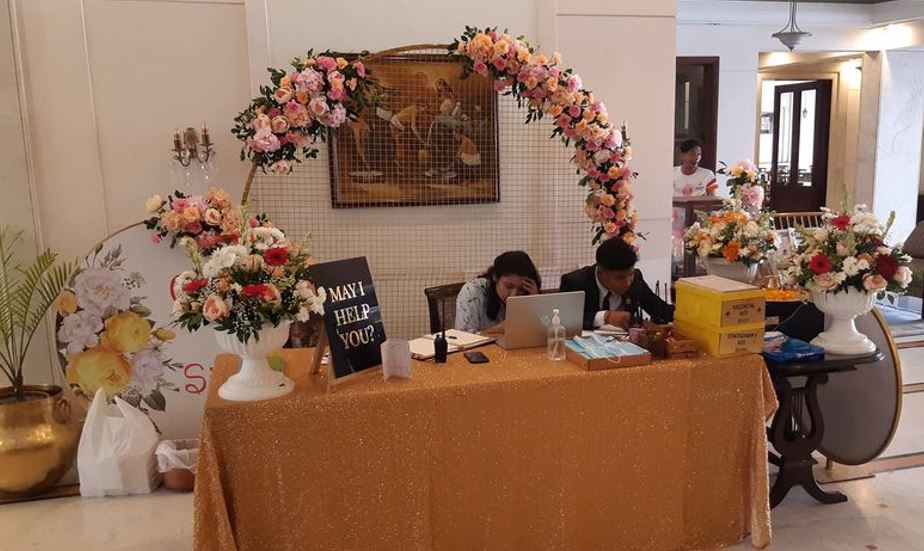
Finally, to end the story of hiccups, MMIHS forgot to inform the hotel that Edwin would be staying four extra nights. On the day he was originally scheduled to leave Nepal he received a phone call from reception asking what time he was checking out. When he said he thought extra nights had been booked for him, there was no reply. A little later he was told he could get another night, but he would have to move to another floor, and it would be for one night only, since all 91 room of the hotel were booked for the weekend for a big Asian wedding party. Luckily MMIHS found him another hotel a bit more outside the city centre for the remaining three nights.
 We are incredibly grateful for the support of colleagues and friends in Nepal and at home in the UK, which helped smooth out some of the more interesting challenges.
Lessons learnt:
· Be ready to change and adapt to the needs of the situation.
· Strong relationships will help you deal with the unexpected.
· Keep positive when things get tough.
In the words of Steve Maraboli “Life doesn’t get easier or more forgiving, we get stronger and more resilient.”























 ECR Opportunities: New Development Programme, Researcher Grants & Upcoming Events
 Help us capture BU’s knowledge exchange activity HE-BCI survey 2025–26
 Verbal autopsy paper published two days ago
 ESRC Studentships for 2027 Entry: Opportunity Now Open
 SONAMONI contributions to Safety Conference 2026 in South Africa
 Horizon Europe Cluster 3 (Civil Security for Society) 2026 Calls Now Open
 MSCA Doctoral Networks 2026 Call Information Webinar
 ESRC Festival of Social Science 2026: Application Deadline Extended to Thursday 25 June 2026
 Reminder: Register for the ESRC Festival of Social Science 2026 Information Session
 ECR Funding Open Call: Research Culture & Community Grant – Apply now
 ERC Advanced Grant 2025 Webinar
 Update on UKRO services
 European research project exploring use of ‘virtual twins’ to better manage metabolic associated fatty liver disease